656 Layered Models: Resources and Visual Gallery
656.1 Learning Objectives
By the end of this chapter, you will be able to:
- Access reference tools: Use subnet calculators, OUI lookups, and protocol analyzers
- Watch supplementary videos: Learn through visual OSI/TCP-IP tutorials
- Explore visual galleries: Study AI-generated diagrams for different learning styles
- Plan next steps: Identify advanced topics building on layered models
656.2 Prerequisites
Required Chapters:
- Layered Models: OSI and TCP/IP Comparison - Model fundamentals
- Layered Models: Knowledge Checks - Self-assessment
Estimated Time: 10 minutes (browsing resources)
How to use this chapter:
- Videos: Watch during focused study time (30-60 min sessions)
- Interactive tools: Bookmark for reference during practical work
- Visual galleries: Review when preparing for exams or refreshing concepts
Learning tip: Different resources suit different learning styles. If you learn better from videos, start there. If you prefer hands-on practice, jump to the interactive tools.
656.3 Cross-Hub Connections
656.4 Video Resources
656.4.1 Additional Video Tutorials
- OSI Model Explained - Comprehensive OSI breakdown
- TCP/IP Model - Practical TCP/IP overview
- IPv6 Fundamentals - IPv6 addressing deep dive
656.5 Interactive Tools
Subnet Calculators:
- Subnet Calculator - Practice IPv4 subnet calculations
- IPv6 Subnet Calculator - IPv6 addressing practice
Address Lookups:
- Wireshark OUI Lookup - Find MAC address manufacturer from OUI prefix
Hands-On Practice Environments:
- Cisco Packet Tracer Labs - Network simulation
- IPv6 Fundamentals Course - Structured IPv6 learning
656.6 Visual Reference Gallery
These AI-generated SVG figures provide alternative visual representations of layered network model concepts. Each figure uses the IEEE color palette for consistency.


656.7 Additional Visual References

Understanding how OSI and TCP/IP models relate helps bridge theoretical networking knowledge with practical protocol implementation.
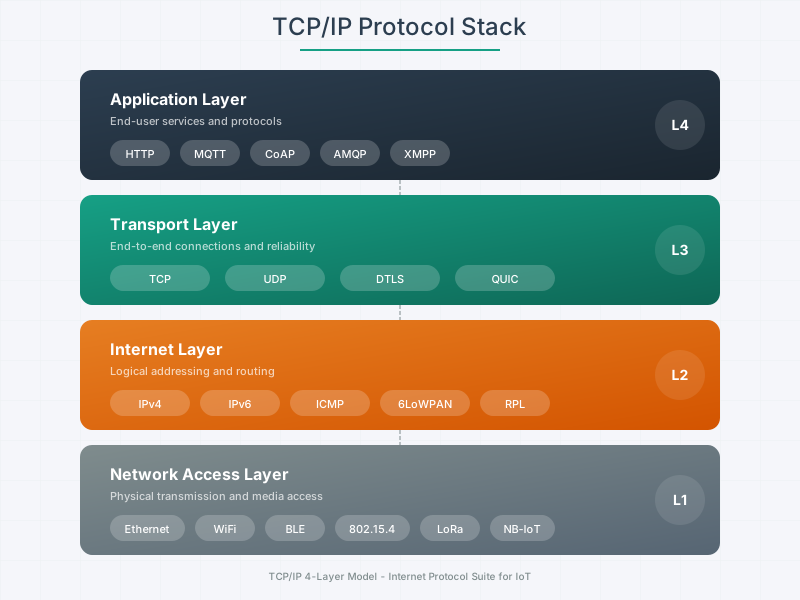
The TCP/IP model provides the practical framework used in real-world networks, organizing protocols into four functional layers.
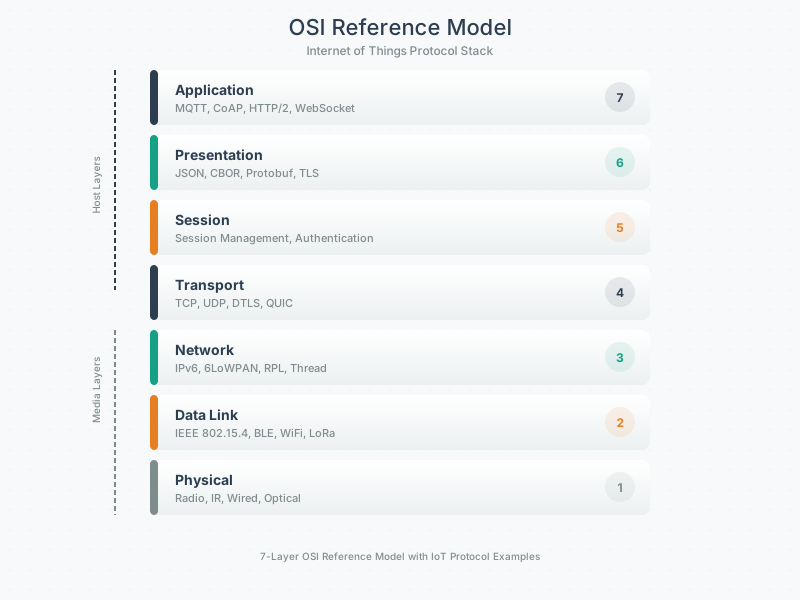
The OSI model applied to IoT highlights unique considerations for constrained devices, particularly at the lower layers where power efficiency and bandwidth limitations matter most.
656.8 Key Takeaways
The complete layered models review has covered:
- Standards and protocols enable global interoperability across diverse systems
- OSI model (7 layers) is theoretical framework; TCP/IP (4 layers) is practical implementation
- Layering enables abstraction, modularity, and independent development
- Encapsulation adds headers at each layer; decapsulation removes them
- IoT reference models address unique IoT challenges (edge processing, scale, resource constraints)
- MAC addresses (48-bit) identify hardware at Layer 2 (local delivery)
- IP addresses (32-bit IPv4, 128-bit IPv6) enable Layer 3 routing
- Subnet masks divide IP addresses into network and host portions
- IPv6 provides abundant addresses for IoT’s billions of devices
- ARP maps IP addresses to MAC addresses for local frame delivery
656.9 What’s Next
Now that you understand how networks are structured in layers and how addressing enables communication, the next chapters explore specific protocols and technologies that implement these models.
Upcoming topics:
- Routing protocols: How routers use routing tables and algorithms to guide datagrams across networks
- Wireless technologies: Wi-Fi, Bluetooth, BLE, and their layering in the OSI model
- LPWAN protocols: LoRaWAN, Sigfox for long-range IoT
- Protocol selection: Matching protocols to IoT use cases (bandwidth, latency, power constraints)
- Network design patterns: Mesh, star, tree topologies at OSI Layer 2 and Layer 3 implications
- Practical implementation: Configuring real IoT devices with IP addresses, gateways, and routes
The encapsulation, addressing, and layering concepts you’ve mastered here apply directly to understanding why different IoT protocols are chosen for different scenarios, and how to design networks that scale from edge sensors to cloud applications.
656.10 Next Steps
Now that you understand layered network models and addressing, you’re ready to learn about:
- Routing Fundamentals - How datagrams find their way across networks
- Wired Communication Protocols - RS-232, I2C, SPI
- Wireless IoT Protocols - Wi-Fi, BLE, LoRaWAN, Zigbee
Continue to: Routing Fundamentals