%%{init: {'theme': 'base', 'themeVariables': { 'primaryColor': '#2C3E50', 'primaryTextColor': '#fff', 'primaryBorderColor': '#16A085', 'lineColor': '#E67E22', 'secondaryColor': '#16A085', 'tertiaryColor': '#E8F6F3'}}}%%
graph LR
    IPv4["IPv4<br/>32-bit addresses<br/>4.3 billion<br/>EXHAUSTED 2011"]

    IPv6["IPv6<br/>128-bit addresses<br/>340 undecillion<br/>UNLIMITED"]

    IPv4 -.->|"Upgrade needed for IoT"| IPv6

    subgraph Benefits["IPv6 Benefits for IoT"]
        B1["48M trillion trillion<br/>addresses per person"]
        B2["Auto-configuration<br/>(SLAAC)"]
        B3["Built-in IPsec<br/>security"]
        B4["No NAT needed<br/>end-to-end"]
    end

    IPv6 --> Benefits

    style IPv4 fill:#E74C3C,stroke:#C0392B,color:#fff
    style IPv6 fill:#2C3E50,stroke:#16A085,color:#fff
    style B1 fill:#16A085,stroke:#2C3E50,color:#fff
    style B2 fill:#16A085,stroke:#2C3E50,color:#fff
    style B3 fill:#16A085,stroke:#2C3E50,color:#fff
    style B4 fill:#16A085,stroke:#2C3E50,color:#fff
668 IoT Protocols Lab: IPv6 and 6LoWPAN
668.1 Learning Objectives
By the end of this chapter, you will be able to:
- Explain IPv6 benefits for IoT: Understand why IPv6 is essential for IoT scalability
- Compare IPv4 and IPv6 addressing: Evaluate address space requirements and transition strategies
- Describe 6LoWPAN compression: Understand how header compression enables IPv6 on constrained networks
- Calculate compression savings: Determine payload efficiency with and without 6LoWPAN
- Apply 6LoWPAN in practice: Recognize how Thread and other protocols use 6LoWPAN
TipFor Beginners: What You’ll Learn
What is this chapter? Deep dive into IPv6 addressing and 6LoWPAN header compression for IoT networks.
Why it matters: - IPv6 provides virtually unlimited addresses for billions of IoT devices - 6LoWPAN makes IPv6 practical on battery-powered sensors with small frames - Understanding these technologies is essential for designing scalable IoT networks
Prerequisites: - Networking Basics for IoT - IoT Protocols Fundamentals
668.2 Network Layer: IPv6 for IoT
668.2.1 Why IPv6?
IPv6 is an upgrade to IPv4, designed to solve address exhaustion and better support modern networks including IoT.
{fig-alt=“IPv4 to IPv6 upgrade comparison showing IPv4’s 4.3 billion exhausted addresses versus IPv6’s 340 undecillion unlimited addresses, with benefits including massive address space, auto-configuration, built-in security, and no NAT requirement”}
%%{init: {'theme': 'base', 'themeVariables': { 'primaryColor': '#2C3E50', 'primaryTextColor': '#fff', 'primaryBorderColor': '#16A085', 'lineColor': '#16A085', 'secondaryColor': '#E67E22', 'tertiaryColor': '#7F8C8D'}}}%%
timeline
    title IPv4 Exhaustion Timeline and IoT Impact
    section IPv4 Era
        1981 : IPv4 defined RFC 791
             : 4.3B addresses seemed infinite
        1993 : CIDR introduced
             : Slowing address consumption
        2003 : NAT becomes widespread
             : Private addresses behind gateways
    section Crisis
        2011 : IANA pool exhausted
             : Last /8 blocks allocated to RIRs
        2012-2015 : Regional exhaustion
             : APNIC, RIPE, ARIN depleted
    section IPv6 Adoption
        2017 : 20% global IPv6 traffic
             : Mobile carriers leading adoption
        2025 : 45%+ global IPv6
             : IoT driving requirement
        Future : IPv6 enables IoT scale
              : 340 undecillion addresses
ImportantIPv6 Key Features for IoT
Massive Address Space: - IPv4: 4.3 billion addresses (2³² = 4,294,967,296) - IPv6: 340 undecillion addresses (2¹²⁸ ≈ 3.4 × 10³⁸) - Implication: Every IoT device can have unique global address - Example: 10 billion devices per person (for 10 billion people) = still only 0.0000000003% of IPv6 space
Built-in Security: - IPsec: Mandatory in IPv6 (optional in IPv4) - Encryption: End-to-end confidentiality - Authentication: Verify sender identity
Auto-Configuration: - SLAAC: Stateless Address Auto-Configuration - No DHCP required: Devices self-assign addresses - Plug-and-play: Reduces setup complexity
Simplified Header: - Fixed 40-byte header (vs variable 20-60 in IPv4) - Fewer fields: Easier processing - Extension headers: Optional features (routing, fragmentation)
No NAT Required: - End-to-end connectivity: Every device globally addressable - Simplified routing: No address translation overhead - Better for peer-to-peer: Direct device-to-device communication
668.2.2 IPv6 Address Format
IPv6 Address: 128 bits (16 bytes), written as 8 groups of 4 hex digits
Example: 2001:0db8:85a3:0000:0000:8a2e:0370:7334

Compressed: 2001:db8:85a3::8a2e:370:7334
(consecutive zeros compressed with ::)
IoT-Relevant IPv6 Address Types:
| Type | Prefix | Scope | Use in IoT |
|---|---|---|---|
| Link-Local | fe80::/10 | Single link | Device-to-device (same network) |
| Unique Local | fc00::/7 | Private | Internal IoT network |
| Global Unicast | 2000::/3 | Internet | Internet-connected sensors |
| Multicast | ff00::/8 | Group | One-to-many (firmware updates) |
Example IoT Deployment:
Smart Home Network:
- Gateway: 2001:db8:1::1 (global, internet-connected)
- Sensor 1: fe80::1234:5678:9abc:def0 (link-local)
- Sensor 2: fd12:3456:789a::1 (unique local)
- All sensors: ff02::1 (multicast, all nodes on link)
668.2.3 IPv6 Header Size Challenge
Problem: IPv6 header is 40 bytes
IEEE 802.15.4 frame:
- Maximum frame: 127 bytes
- MAC header: ~25 bytes
- IPv6 header: 40 bytes
- Payload: 127 - 25 - 40 = 62 bytes
- Overhead: 51% (unacceptable!)Solution: 6LoWPAN (next section)
668.3 Adaptation Layer: 6LoWPAN
6LoWPAN = IPv6 over Low-power Wireless Personal Area Networks
668.3.1 The Problem 6LoWPAN Solves
%%{init: {'theme': 'base', 'themeVariables': { 'primaryColor': '#2C3E50', 'primaryTextColor': '#fff', 'primaryBorderColor': '#16A085', 'lineColor': '#E67E22', 'secondaryColor': '#16A085', 'tertiaryColor': '#E8F6F3', 'clusterBkg': '#E8F6F3', 'clusterBorder': '#16A085', 'fontSize': '12px'}}}%%
graph TB
    Problem["Problem: IPv6 Too Large for 802.15.4"]

    subgraph Before["Without 6LoWPAN"]
        Frame1["802.15.4 Frame: 127 bytes max"]
        MAC1["MAC Header: 25 bytes"]
        IPv6_1["IPv6 Header: 40 bytes"]
        UDP1["UDP Header: 8 bytes"]
        Payload1["Payload: 54 bytes<br/>❌ Only 42% usable"]
    end

    subgraph After["With 6LoWPAN Compression"]
        Frame2["802.15.4 Frame: 127 bytes max"]
        MAC2["MAC Header: 8 bytes<br/>(compressed)"]
        IPv6_2["IPv6 → 6 bytes<br/>(85% reduction!)"]
        UDP2["UDP → 4 bytes<br/>(50% reduction)"]
        Payload2["Payload: 109 bytes<br/>✓ 86% usable"]
    end

    Problem --> Before
    Problem --> After

    Frame1 --> MAC1 --> IPv6_1 --> UDP1 --> Payload1
    Frame2 --> MAC2 --> IPv6_2 --> UDP2 --> Payload2

    style Problem fill:#E74C3C,stroke:#C0392B,color:#fff
    style Payload1 fill:#E67E22,stroke:#2C3E50,color:#fff
    style Payload2 fill:#16A085,stroke:#2C3E50,color:#fff
    style IPv6_2 fill:#2C3E50,stroke:#16A085,color:#fff
{fig-alt=“6LoWPAN compression benefit diagram comparing 802.15.4 frame usage before (40-byte IPv6 header leaves 54-byte payload) and after 6LoWPAN compression (6-byte compressed header leaves 109-byte payload), demonstrating 85% header reduction”}
Note6LoWPAN Key Functions
Header Compression: - IPv6: 40 bytes → 2-8 bytes (83-95% reduction) - UDP: 8 bytes → 4 bytes (50% reduction) - Mechanism: Elide redundant information (link-local prefixes, well-known ports)
Fragmentation: - IPv6 MTU: 1280 bytes minimum - 802.15.4 Frame: 127 bytes maximum - Solution: 6LoWPAN fragments large IPv6 packets across multiple 802.15.4 frames
Neighbor Discovery Optimization: - Standard IPv6: Multicast-heavy, power-hungry - 6LoWPAN: Optimized for low-power, lossy links
Header Dispatch: - Type field: Indicates header type (compressed IPv6, fragmentation, etc.) - Flexible: Supports multiple compression schemes
668.3.2 How 6LoWPAN Compression Works
Example: Temperature sensor sending reading to gateway
Uncompressed (Standard IPv6 + UDP):
IPv6 Header (40 bytes):
- Version, Traffic Class, Flow Label: 4 bytes
- Payload Length: 2 bytes
- Next Header, Hop Limit: 2 bytes
- Source Address: 16 bytes (fe80::0212:4b00:0615:5ea8)
- Destination Address: 16 bytes (fe80::0212:4b00:0615:1234)

UDP Header (8 bytes):
- Source Port: 2 bytes (61616)
- Dest Port: 2 bytes (5683 - CoAP)
- Length, Checksum: 4 bytes

Payload (10 bytes):
- Temperature data: 10 bytes

Total: 40 + 8 + 10 = 58 bytes
Compressed (6LoWPAN):
6LoWPAN Header (6 bytes):
- Dispatch: 1 byte (indicates compression)
- Source/Dest derived from link-layer: 0 bytes (IEEE 802.15.4 addresses used)
- Next Header (UDP): 1 byte
- Hop Limit: 1 byte
- Ports compressed: 1 byte (well-known ports)
- Checksum: 2 bytes

Payload (10 bytes):
- Temperature data: 10 bytes

Total: 6 + 10 = 16 bytesSavings: 58 → 16 bytes (72% reduction!)
668.3.3 6LoWPAN in Practice
Real-World Example: Thread protocol (used by Matter smart home devices)
Thread Device Stack:
%%{init: {'theme': 'base', 'themeVariables': { 'primaryColor': '#2C3E50', 'primaryTextColor': '#fff', 'primaryBorderColor': '#16A085', 'lineColor': '#E67E22', 'secondaryColor': '#16A085', 'tertiaryColor': '#E8F6F3', 'clusterBkg': '#E8F6F3', 'clusterBorder': '#16A085', 'fontSize': '13px'}}}%%
graph TB
    subgraph Thread["Thread Protocol Stack (Matter/HomeKit)"]
        App["Application Layer<br/>CoAP / Matter"]
        Trans["Transport Layer<br/>UDP / DTLS Security"]
        Net["Network Layer<br/>IPv6"]
        Adapt["Adaptation Layer<br/>6LoWPAN Compression"]
        Link["Data Link Layer<br/>IEEE 802.15.4 MAC"]
        Phy["Physical Layer<br/>2.4 GHz Radio"]
    end

    App --> Trans --> Net --> Adapt --> Link --> Phy

    Example["Example: Smart Bulb<br/>IPv6 address: fd11:22::1234<br/>Compressed to 6 bytes by 6LoWPAN<br/>Communicates via CoAP"]

    Example -.-> Thread

    style App fill:#E67E22,stroke:#2C3E50,color:#fff
    style Trans fill:#16A085,stroke:#2C3E50,color:#fff
    style Net fill:#2C3E50,stroke:#16A085,color:#fff
    style Adapt fill:#16A085,stroke:#2C3E50,color:#fff
    style Link fill:#2C3E50,stroke:#16A085,color:#fff
    style Phy fill:#7F8C8D,stroke:#2C3E50,color:#fff
    style Example fill:#E8F6F3,stroke:#16A085,color:#2C3E50
{fig-alt=“Thread protocol stack diagram showing layered architecture from Matter/CoAP application layer through UDP/DTLS transport, IPv6 network, 6LoWPAN adaptation, 802.15.4 data link, to 2.4 GHz physical layer, with smart bulb example showing IPv6 address compression”}
Benefits for Thread: - Native IPv6 (every device has IP address) - Efficient (6LoWPAN compression) - Interoperable (standard IPv6, works with internet)
668.4 Understanding Check: IPv6 for Smart Cities
TipUnderstanding Check: Million-Device Smart City Deployment
Scenario: Your city plans to deploy 1 million IoT devices over the next 5 years: 400,000 LED streetlights, 300,000 parking sensors, 200,000 traffic monitors, and 100,000 environmental sensors. The city’s current IPv4 network uses private addressing with NAT, causing routing complexity and limiting direct device-to-device communication.
Think about: 1. How many /16 IPv4 private networks (65,536 addresses each) would you need to address 1 million devices with NAT? 2. What happens to firmware update efficiency when you eliminate NAT and can multicast directly to device groups using IPv6? 3. Why does SLAAC (Stateless Address Auto-Configuration) reduce deployment complexity compared to managing DHCP for 1 million devices?
Key Insights: IPv6 solves three critical smart city problems:
Address Space: - IPv6 provides 2^96 times more addresses than IPv4 (79 octillion multiplier) - 1 million devices = 0.0000003% of a single /48 IPv6 allocation - Every device gets a globally unique address—no NAT conflicts
Auto-Configuration: - SLAAC lets devices self-assign addresses from router advertisements - No DHCP servers to manage for 1 million devices - Plug-and-play deployment: install sensor → it gets an address → starts reporting
Direct Connectivity: - NAT elimination enables streetlight #45,392 to directly message traffic sensor #18,441 - Firmware updates can multicast to specific device groups (all parking sensors on Block 5) - Simplified security policies: firewall rules use actual device addresses, not translated ports
Verify Your Understanding: - Calculate how many IPv4 /24 subnets you’d need for 1 million devices vs a single IPv6 /48 allocation - Why does eliminating NAT reduce the “state table” burden on network gateways for million-device deployments?
668.5 Visual Reference Gallery
NoteVisual: 6LoWPAN Header Compression
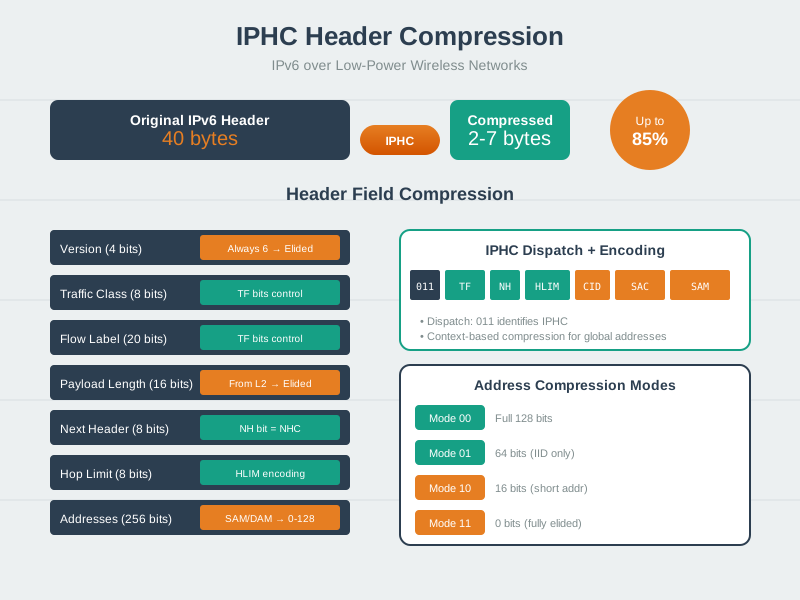
6LoWPAN compression dramatically reduces protocol overhead for constrained 802.15.4 networks, enabling efficient IPv6 communication on battery-powered sensors.
668.6 Summary
This chapter covered the foundational network and adaptation layer technologies for IoT:
- IPv6 provides virtually unlimited addresses (340 undecillion) compared to IPv4’s exhausted 4.3 billion, enabling every IoT device to have a globally unique address
- IPv6 features critical for IoT include SLAAC auto-configuration, built-in IPsec security, and elimination of NAT for true end-to-end connectivity
- 6LoWPAN solves the IPv6/802.15.4 mismatch by compressing 40-byte IPv6 headers to 2-8 bytes, enabling 86% payload efficiency instead of 42%
- Thread protocol demonstrates 6LoWPAN in practice, combining IPv6 addressing with Matter smart home compatibility
- Smart city deployments benefit from IPv6 through simplified addressing, multicast firmware updates, and direct device-to-device communication
668.7 What’s Next
With IPv6 and 6LoWPAN fundamentals understood, explore the application layer protocols built on top:
- IoT Protocols Lab: CoAP vs MQTT: Compare the two dominant IoT application protocols and learn when to use each
- IoT Protocols Lab: Selection Framework: Apply a systematic framework to choose protocols based on power, bandwidth, and latency requirements
- 6LoWPAN Comprehensive Review: Deep dive into 6LoWPAN compression mechanisms and fragmentation