749 DTLS Attack Scenarios and Authentication
749.1 Learning Objectives
By the end of this chapter, you will be able to:
- Analyze Attack Scenarios: Understand amplification DoS, session hijacking, and downgrade attacks against DTLS
- Evaluate Defense Mechanisms: Explain how cookie mechanism, MAC, and finished message verification protect DTLS
- Compare Authentication Methods: Choose between PSK and certificate-based authentication based on deployment needs
- Design Secure Deployments: Apply authentication best practices for small and large-scale IoT systems
Core concept: DTLS defends against UDP-specific attacks (amplification, replay, downgrade) through cookie mechanism, sequence numbers, and handshake verification.
Why it matters: Understanding attacks helps you configure DTLS correctly - a misconfigured DTLS deployment may be worse than no security at all.
Key takeaway: Use PSK for small deployments (< 100 devices) with manual provisioning; use certificates for enterprise scale with automated PKI and revocation.
749.2 Prerequisites
Before diving into this chapter, you should be familiar with:
- DTLS Fundamentals and Architecture: Basic DTLS concepts and properties
- DTLS Handshake Protocols: Understanding of the handshake process
749.3 DTLS Attack Scenarios and Defenses
Understanding attacks against DTLS helps appreciate its security mechanisms:
749.3.1 Attack 1: Amplification DoS
Attack Description:
Attacker sends small ClientHello (50 bytes) with spoofed source IP
Server responds with large Certificate (2000 bytes) to victim
Result: 40x amplification factor
DTLS Defense - HelloVerifyRequest (Cookie Mechanism):
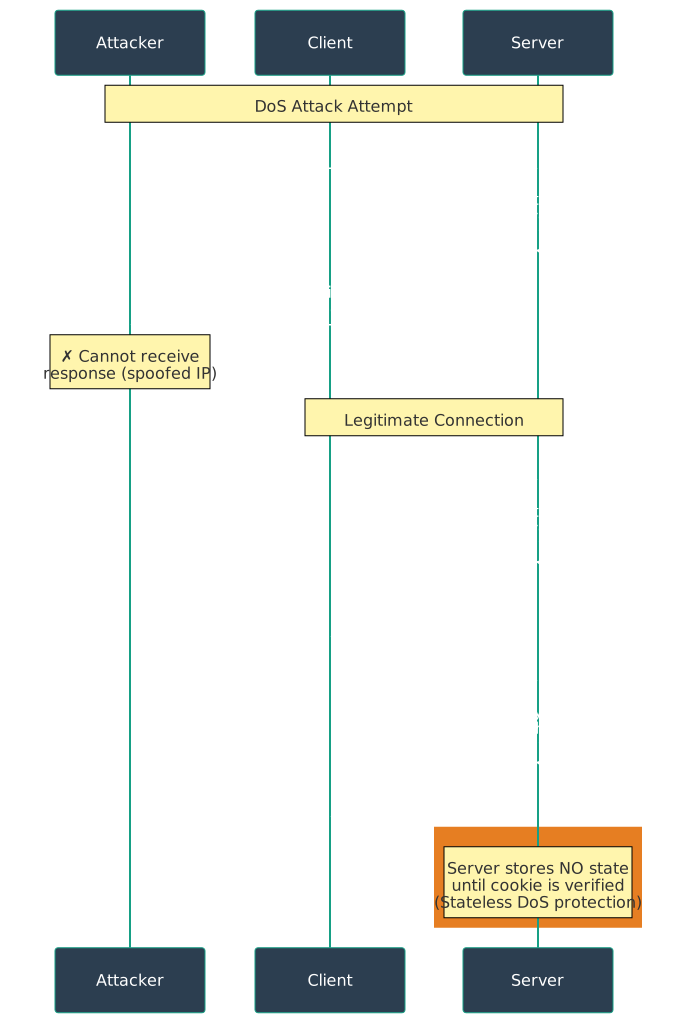
Cookie Implementation:
Cookie = HMAC-SHA256(Client_IP + Client_Port + Server_Secret)

Verification:
1. Client sends ClientHello
2. Server computes cookie, sends HelloVerifyRequest
3. Client echoes cookie in second ClientHello
4. Server recomputes cookie, verifies match
5. Only then sends Certificate (large message)Impact: Reduces amplification factor from 40x to 2x.
749.3.2 Attack 2: Session Hijacking
Attack Description:
Attacker intercepts DTLS handshake, tries to inject own messages
Goal: Establish session with server using victim's credentials
DTLS Defense - Message Authentication Code (MAC):
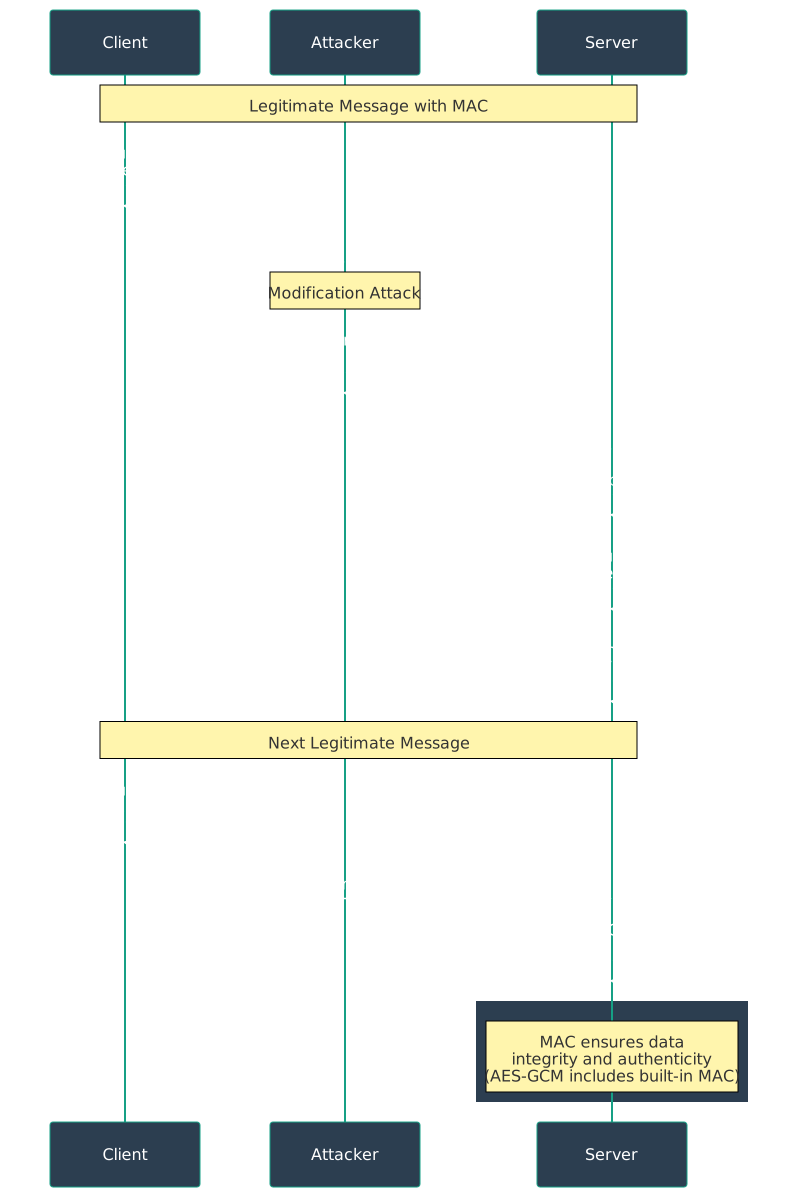
Result: Any tampering detected, packet rejected.
749.3.3 Attack 3: Downgrade Attack
Attack Description:
Attacker intercepts ClientHello, modifies supported cipher list
Removes strong ciphers (AES-256), forces weak cipher (DES)
Goal: Make encryption easier to crack
DTLS Defense - Finished Message Verification:
Handshake process:
1. ClientHello: Lists [AES-256-GCM, AES-128-CCM, 3DES]
2. Attacker modifies: [3DES] (removes strong ciphers)
3. ServerHello: Chooses 3DES (only option)
4. Handshake continues...
5. Finished message: Hash of ALL handshake messages
   - Client: Hash(original ClientHello + ServerHello + ...)
   - Server: Hash(modified ClientHello + ServerHello + ...)
   - Hashes don't match -> Handshake fails
- Connection abortedResult: Any modification to handshake messages detected.
749.4 Authentication Methods: PSK vs Certificates
DTLS supports two main authentication modes:
| Feature | Pre-Shared Key (PSK) | X.509 Certificates |
|---|---|---|
| Setup Complexity | Simple | Complex (PKI needed) |
| Key Distribution | Out-of-band (manual) | Automated (CA) |
| Scalability | Poor (N^2 keys for N devices) | Excellent (each device has 1 cert) |
| Computation | Low (symmetric crypto only) | High (public key crypto) |
| Memory | Low (16-32 bytes key) | High (1-4 KB certificate) |
| Revocation | Manual | Automated (CRL, OCSP) |
| Perfect Forward Secrecy | No (unless ECDHE-PSK) | Yes (with ECDHE) |
| Best For | Small deployments, factory provisioning | Large deployments, enterprise |
749.4.1 PSK Example: Smart Home (10 devices)
Provisioning:
Factory: Generate PSK = 0x1A2B3C4D...
        Write PSK to device EEPROM
        Print PSK on device label (or QR code)

Setup:  User scans QR code
        PSK entered into hub
        Hub stores PSK for each device
Handshake (simplified):
Client->Server: ClientHello, PSK_identity="light-bulb-01"
Server->Client: ServerHello, cipher=AES-128-CCM-PSK
[Both derive keys from PSK]
Client->Server: Finished (encrypted with derived key)
Server->Client: Finished
[Secure channel established]Advantages: - No certificates needed - Fast handshake (no public key ops) - Low memory (fits on tiny MCUs)
Disadvantages: - Manual provisioning - If PSK compromised, all past sessions decryptable (no PFS) - Doesn’t scale to 1000s of devices
749.4.2 Certificate Example: Industrial IoT (1000 sensors)
Provisioning:
Factory: Generate key pair for each device
        Submit CSR to CA
        CA issues certificate
        Store cert + private key in secure element

Deployment: Device presents certificate during handshake
           Server verifies against trusted CA
No manual PSK entry needed!Advantages: - Scales to millions of devices - Certificate revocation (remove compromised devices) - Perfect Forward Secrecy (past sessions safe even if key leaked)
Disadvantages: - Requires PKI infrastructure - Higher memory (certificates) - Slower handshake (public key crypto)
749.5 Knowledge Check
The Misconception: Many developers assume DTLS is simply TLS running on UDP sockets without modification, leading to implementation failures and security vulnerabilities.
The Reality: DTLS required fundamental protocol redesign to handle UDP’s unreliability. Real-world impact:
2020 IoT Camera Incident (quantified): - Vendor: Major smart camera manufacturer - Mistake: Implemented “TLS-like” security over UDP without proper DTLS - Missing: Cookie mechanism, sequence number tracking, handshake retransmission - Result: - DoS vulnerability: 1 attacker -> 40x amplification -> took down 500 cameras - Replay attacks: Captured packets replayed 48 hours later still accepted - Connection failures: 23% handshake failure rate in lossy Wi-Fi (packets lost, no retransmit) - Recall cost: $2.3M for firmware updates + customer service - Reputation damage: 37% customer churn to competitor products
Key DTLS Adaptations Beyond “TLS on UDP”:
- HelloVerifyRequest Cookie (not in TLS):
- Prevents amplification DoS attacks
- Stateless server verification
- Without it: 40x amplification factor
- Explicit Sequence Numbers (13-byte header vs 5-byte TLS):
- In-band sequence tracking (UDP has no stream concept)
- Replay protection without TCP sequence numbers
- Without it: Replay attacks succeed
- Handshake Retransmission (timer-based):
- TLS relies on TCP retransmits
- DTLS implements own timers (exponential backoff)
- Without it: 20-30% connection failures on lossy networks
- Message Fragmentation (handles large certificates):
- TLS uses TCP segmentation
- DTLS fragments at record layer
- Without it: Handshakes fail when Certificate > MTU
Correct Understanding: DTLS is TLS’s security model redesigned for datagram transport, requiring cookie exchange, explicit sequencing, retransmission logic, and fragmentation handling.
749.6 Summary
Attack Defenses: - Amplification DoS: Cookie mechanism reduces factor from 40x to 2x - Session Hijacking: MAC ensures integrity and authenticity - Downgrade Attack: Finished message verifies entire handshake transcript
Authentication Choice: - PSK: Simple, fast, low memory - use for < 100 devices - Certificates: Scalable, revocable, PFS - use for enterprise deployments
Key Considerations: - PSK requires manual provisioning but uses 70% less memory - Certificates provide automated PKI but require more resources - ECDHE-PSK adds forward secrecy to PSK mode
749.7 What’s Next?
Continue to DTLS Performance and Implementation to learn performance benchmarks, session resumption optimization, Connection ID for mobility, and best practices for production deployments.