%%{init: {'theme': 'base', 'themeVariables': {'primaryColor': '#E8F4F8', 'primaryTextColor': '#2C3E50', 'primaryBorderColor': '#16A085', 'lineColor': '#16A085', 'secondaryColor': '#FEF5E7', 'tertiaryColor': '#FDEBD0'}}}%%
flowchart TD
    A[Complete Quiz or Lab] --> B[Identify Knowledge Gap]
    B --> C[Bookmark Topic]
    C --> D[Study Fundamentals Chapter]
    D --> E[Watch Related Video]
    E --> F[Try Related Simulation]
    F --> G[Take Practice Quiz]
    G --> H{Score ≥ 80%?}
    H -->|No| D
    H -->|Yes| I[Mark as Mastered]
    I --> J[Gap Closed!]

    style A fill:#E8F4F8,stroke:#16A085,stroke-width:2px
    style B fill:#FADBD8,stroke:#E74C3C,stroke-width:2px
    style C fill:#FEF5E7,stroke:#E67E22,stroke-width:2px
    style D fill:#E8F4F8,stroke:#16A085,stroke-width:2px
    style E fill:#E8F4F8,stroke:#16A085,stroke-width:2px
    style F fill:#E8F4F8,stroke:#16A085,stroke-width:2px
    style G fill:#FEF5E7,stroke:#E67E22,stroke-width:2px
    style H fill:#FADBD8,stroke:#E74C3C,stroke-width:2px
    style I fill:#D5F4E6,stroke:#27AE60,stroke-width:2px
    style J fill:#D5F4E6,stroke:#27AE60,stroke-width:3px
27 Gap Closure Process
27.1 Learning Objectives
By the end of this chapter, you will be able to:
- Apply the gap closure workflow to systematically address knowledge weaknesses
- Budget study time effectively using the timeline framework (90-115 minutes per gap)
- Understand skill development milestones and target appropriate proficiency levels
- Execute a recovery plan when quiz scores fall below expectations
27.2 Gap Closure Process
TipMVU: Skill Development Milestones
Core Concept: IoT competency develops through four stages - awareness (recognize terms), understanding (explain concepts), application (build working systems), and mastery (debug complex failures and mentor others). Why It Matters: Self-assessment at wrong stages wastes time - studying advanced topics at awareness level causes frustration; staying at understanding level when ready for application delays practical skills. Key Takeaway: Target 70% quiz score before advancing topics; aim for “application” level (can build a working prototype) within 4-6 weeks per major domain; mastery requires 6+ months of project experience.
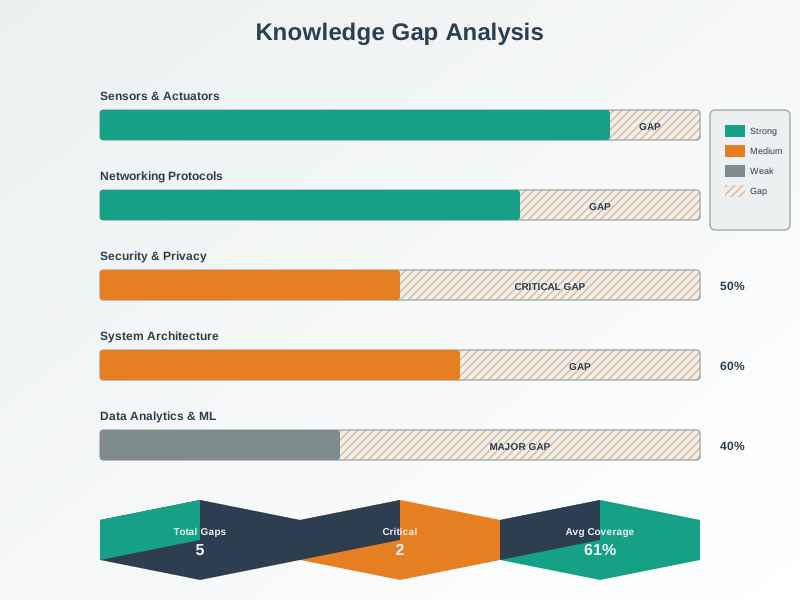
Understanding how to systematically address knowledge gaps is essential for effective learning:
27.3 Study Timeline Framework
Effective gap closure requires structured time allocation. The following timeline shows how to budget a focused study session:
%%{init: {'theme': 'base', 'themeVariables': {'primaryColor': '#2C3E50', 'primaryTextColor': '#fff', 'primaryBorderColor': '#16A085', 'lineColor': '#16A085', 'secondaryColor': '#E67E22', 'tertiaryColor': '#7F8C8D'}}}%%
gantt
    title Knowledge Gap Closure Timeline
    dateFormat X
    axisFormat %M min

    section Assessment
    Take Quiz & Identify Gaps    :done, a1, 0, 15

    section Diagnosis
    Categorize by Topic          :active, d1, 15, 25

    section Study
    Read Fundamentals            :s1, 25, 45
    Watch Related Video          :s2, 45, 60
    Take Notes                   :s3, 60, 75

    section Practice
    Try Simulation               :p1, 75, 90
    Work Examples                :p2, 90, 100

    section Validation
    Retake Quiz (Target 80%)     :crit, v1, 100, 115
27.4 Study Strategy Tradeoffs
Choosing the right study approach depends on your goals and available time:
WarningTradeoff: Single Deep Gap Closure vs Multi-Topic Surface Review
Option A (Single Deep): Focus 90-120 minutes on one knowledge gap until achieving 80%+ mastery. Example: Master MQTT QoS levels completely (read chapter, watch 2 videos, run simulator, retake quiz). Outcome: Permanent understanding with strong recall. Option B (Multi-Topic Surface): Spend 20-30 minutes each on 4-5 topics to raise awareness across broader coverage. Example: Quick review of MQTT, CoAP, BLE, Zigbee, and LoRaWAN basics. Outcome: Improved vocabulary and recognition, but shallow application skills. Decision Factors: Choose single deep when preparing for project implementation or technical interviews requiring problem-solving. Choose multi-topic surface when preparing for multiple-choice exams, broadening awareness before specialization, or triaging which topics need deep investment.
WarningTradeoff: Self-Paced Gap Closure vs Structured Study Groups
Option A (Self-Paced): Work through gaps individually using hub resources. Flexible scheduling - study anytime. Progress at your natural speed (some topics faster, some slower). Best metrics: 70-85% knowledge retention after 30 days. Option B (Study Groups): Form 3-5 person groups meeting 2x weekly to discuss gaps and quiz each other. Fixed schedule but social accountability. Explaining concepts to peers deepens understanding. Best metrics: 80-95% retention after 30 days, but requires 25% more calendar time. Decision Factors: Choose self-paced if you have irregular schedules, prefer independent learning, or are significantly ahead/behind classmates. Choose study groups if you struggle with motivation, benefit from discussion-based learning, or have complex topics where multiple perspectives help.
27.5 Case Study: Closing a Knowledge Gap in 2 Hours
TipCase Study: Closing a Knowledge Gap in 2 Hours
Student Profile: Sarah, studying for IoT networking exam
Gap Discovered: Scored 4/10 on MQTT quiz, particularly struggled with QoS levels
Action Taken (120 minutes total):
- [30 min] Read fundamentals - MQTT QoS Section
- Focused on QoS 0/1/2 comparison table
- Drew packet flow diagrams for each level
- [20 min] Watch video - YouTube tutorial on MQTT QoS in smart home scenarios
- Saw real-world examples of when to use each level
- [40 min] Hands-on practice - Simulated MQTT broker setup
- Published messages at QoS 0, 1, 2
- Observed delivery guarantees with network interruptions
- [15 min] Retake quiz - Scored 9/10
- Understood trade-offs between reliability and bandwidth
- [15 min] Apply to project - Configured smart thermostat MQTT settings
- Used QoS 1 for temperature updates (balance of reliability/efficiency)
Result: Gap closed in one focused study session. Now confident explaining QoS levels to peers.
Key Lesson: Structured approach (read → watch → practice → test) is faster than random studying.
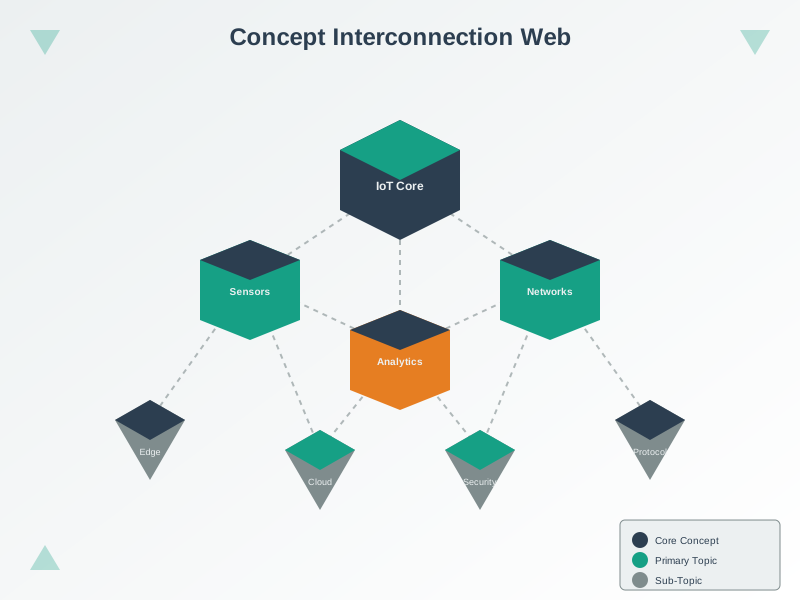
27.6 Cross-Hub Learning Integration
NoteCross-Hub Connections: Integrated Learning
Knowledge gaps don’t exist in isolation. Use all four learning hubs together for maximum effectiveness:
Diagnosis → Quizzes Hub - Take quizzes to discover what you don’t know - Quiz results reveal specific knowledge gaps - Example: “Failed MQTT quiz questions 3, 5, 7 about QoS levels”
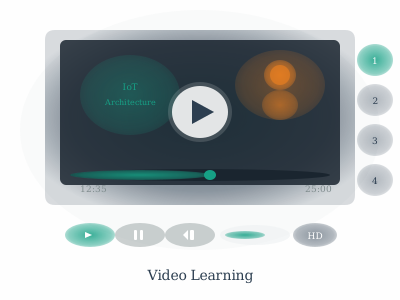
Quick Review → Videos Hub - Watch 5-15 minute videos for rapid refreshers - Visual explanations for complex concepts - Example: “Watch MQTT QoS video for protocol state diagrams”
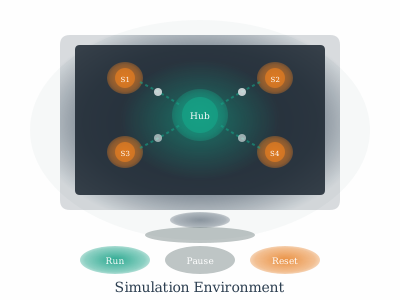
Hands-On Practice → Simulations Hub - Interactive tools reinforce learning - Simulate scenarios you struggled with in quizzes - Example: “Use MQTT simulator to experiment with QoS settings”
Deep Dive → Knowledge Gaps Hub (you are here) - Systematic gap closure with study plans - Track progress across multiple domains - Example: “Follow 2-hour study plan to master MQTT QoS”
Workflow Example: 1. Quiz reveals gap in Routing Protocols (3/10 score) 2. Knowledge Gaps Hub provides structured study plan 3. Videos Hub offers RPL DODAG formation tutorial 4. Simulations Hub lets you build a DODAG network 5. Retake quiz to validate understanding (8/10 score)
27.7 Low Quiz Score Recovery Plan
ImportantLearning Scenario: Low Quiz Score Recovery Plan
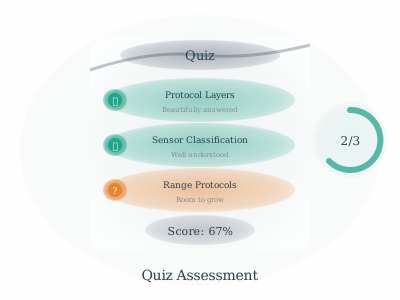
Scenario: You scored 3/10 on the Routing Protocols quiz. Here’s your 90-minute recovery plan:
[0-15 min] Identify specific gaps - Review quiz results: which 7 questions did you miss? - Common weak spots: RPL DODAG construction, Trickle timer, distance-vector vs link-state - Bookmark these three topics
[15-45 min] Focused reading (30 min) - Read Routing Fundamentals - Focus on: - DODAG structure and parent selection (10 min) - Trickle timer algorithm (10 min) - Routing metrics comparison table (10 min) - Take notes on each concept in your own words
[45-65 min] Visual learning (20 min) - Watch “RPL Routing for IoT” video (12 min) from Videos Hub - Review the DODAG formation Mermaid diagram - Draw your own example DODAG on paper
[65-80 min] Hands-on practice (15 min) - Use Network Topology Visualizer from Simulations Hub - Build a sample WSN and observe routing paths - Experiment with different topologies
[80-90 min] Validate understanding (10 min) - Retake the routing quiz - Target: 7/10 or higher (70%+) - If below 7/10: spend another 30 minutes on weakest topic
Expected Outcome: 3/10 → 7-8/10 improvement in 90 minutes of focused study.
Key Success Factors: - Specific time blocks (not “study routing”) - Multiple learning modes (read, watch, practice, test) - Concrete targets (70%+ on retest) - Focused on the 7 missed topics, not reviewing what you already know
27.8 Summary
The gap closure process provides a structured approach to learning:
- Workflow: Complete quiz → Identify gaps → Study → Practice → Validate → Close
- Timeline: Budget 90-115 minutes per knowledge gap for effective closure
- Integration: Use all four learning hubs together (Quizzes, Videos, Simulations, Knowledge Gaps)
- Recovery: Follow the specific recovery plan structure for low quiz scores
- Validation: Always retake quizzes to confirm understanding (target 80%+)
27.9 What’s Next
- Explore the Knowledge Categories to identify your specific weak areas
- Use the Progress Tracking tools to monitor your improvement
- Return to the Knowledge Gaps Hub for the complete overview