%%{init: {'theme': 'base', 'themeVariables': {'primaryColor': '#2C3E50', 'primaryTextColor': '#fff', 'primaryBorderColor': '#16A085', 'lineColor': '#16A085', 'secondaryColor': '#E67E22', 'tertiaryColor': '#7F8C8D'}}}%%
graph TB
    subgraph SPEED["Data Rate Priority"]
        direction TB
        S1["Wi-Fi: 11-1000 Mbps"]
        S2["LTE: 10-100 Mbps"]
        S3["BLE: 1-2 Mbps"]
    end

    subgraph BALANCED["Balanced Approach"]
        direction TB
        B1["Zigbee: 250 kbps"]
        B2["Thread: 250 kbps"]
        B3["NB-IoT: 200 kbps"]
    end

    subgraph EFFICIENCY["Range/Power Priority"]
        direction TB
        E1["LoRaWAN: 0.3-50 kbps"]
        E2["Sigfox: 100 bps"]
        E3["LTE-M: 1 Mbps"]
    end

    LABEL1["HIGH SPEED<br/>Short Range<br/>High Power"]
    LABEL2["MODERATE<br/>Medium Range<br/>Medium Power"]
    LABEL3["LOW SPEED<br/>Long Range<br/>Low Power"]

    LABEL1 --> SPEED
    LABEL2 --> BALANCED
    LABEL3 --> EFFICIENCY

    style SPEED fill:#E67E22,stroke:#2C3E50,stroke-width:2px,color:#fff
    style BALANCED fill:#16A085,stroke:#2C3E50,stroke-width:2px,color:#fff
    style EFFICIENCY fill:#2C3E50,stroke:#16A085,stroke-width:2px,color:#fff
    style LABEL1 fill:#E67E22,stroke:#2C3E50,stroke-width:1px,color:#fff
    style LABEL2 fill:#16A085,stroke:#2C3E50,stroke-width:1px,color:#fff
    style LABEL3 fill:#2C3E50,stroke:#16A085,stroke-width:1px,color:#fff
    style S1 fill:#fff,stroke:#E67E22,stroke-width:1px,color:#2C3E50
    style S2 fill:#fff,stroke:#E67E22,stroke-width:1px,color:#2C3E50
    style S3 fill:#fff,stroke:#E67E22,stroke-width:1px,color:#2C3E50
    style B1 fill:#fff,stroke:#16A085,stroke-width:1px,color:#2C3E50
    style B2 fill:#fff,stroke:#16A085,stroke-width:1px,color:#2C3E50
    style B3 fill:#fff,stroke:#16A085,stroke-width:1px,color:#2C3E50
    style E1 fill:#fff,stroke:#2C3E50,stroke-width:1px,color:#2C3E50
    style E2 fill:#fff,stroke:#2C3E50,stroke-width:1px,color:#2C3E50
    style E3 fill:#fff,stroke:#2C3E50,stroke-width:1px,color:#2C3E50
81 Protocol Selection: The Challenge
81.1 Learning Objectives
By the end of this chapter, you will be able to:
- Understand the Complexity: Recognize why IoT protocol selection is inherently difficult
- Evaluate Trade-offs: Understand the fundamental relationships between range, power, bandwidth, and latency
- Navigate Dimensions: Consider all key factors that influence protocol choice
- Appreciate History: Understand how wireless protocol evolution shaped today’s IoT landscape
NoteRelated Chapters
This Chapter Series: - Protocol Selection Framework - Overview and index - Systematic Selection - Step-by-step framework - Anti-Patterns and Tradeoffs - Common mistakes - Selection Scenarios - Real-world examples
Fundamentals: - Sensor to Network Pipeline - Data flow understanding - Data Formats for IoT - Payload considerations
Networking Overview: - IoT Protocols Overview - Protocol landscape - Networking Fundamentals - Network basics
81.2 Prerequisites
Before diving into this chapter, you should be familiar with:
- IoT Protocols Overview: General understanding of available IoT communication protocols
- Sensor to Network Pipeline: How data flows from sensors to networks
- Networking Basics for IoT: Fundamental networking concepts
TipFor Beginners: Why Protocol Selection Matters
Choosing the wrong communication protocol is like trying to send a package using the wrong delivery service:
- Need it overnight? Don’t use standard mail (low latency → don’t use LoRa)
- Sending overseas? Can’t use local courier (long range → don’t use Bluetooth)
- Heavy package? Don’t use drone delivery (large data → don’t use NB-IoT)
- Tight budget? Don’t use express shipping (cost-sensitive → evaluate carefully)
Common Mistakes: - Using Wi-Fi for battery-powered outdoor sensors (too power-hungry) - Using Bluetooth for a city-wide sensor network (too short range) - Using LoRa for streaming video (too slow)
This chapter gives you a systematic way to avoid these mistakes by matching your requirements to protocol capabilities.
WarningCommon Misconception Alert
Myth 1: “The newest protocol is always the best choice” - Reality: Mature protocols have better ecosystems, more support, proven reliability - Example: Zigbee (15+ years old) still dominates smart home because of device availability
Myth 2: “One protocol can handle all IoT needs” - Reality: Different applications need different protocols (sensor vs video vs tracking) - Example: Smart building uses Wi-Fi (cameras), Zigbee (lights), LoRa (outdoor sensors)
Myth 3: “Higher bandwidth is always better” - Reality: More bandwidth = more power consumption, often unnecessary - Example: Soil sensor sending 20 bytes/hour doesn’t need 100 Mbps Wi-Fi
Myth 4: “Free protocols have no cost” - Reality: Infrastructure, maintenance, and integration all cost money - Example: LoRa gateway costs $500, needs installation, power, maintenance
Myth 5: “Coverage maps guarantee connectivity” - Reality: Buildings, terrain, and indoor deployments affect real-world coverage - Example: NB-IoT may show coverage but fail in basement locations
TipMVU: IoT Connectivity Classes
Core Concept: All IoT devices fall into one of three connectivity classes based on their fundamental constraints: Short-Range (<100m, BLE/Zigbee), Mid-Range (100m-1km, Wi-Fi), or Long-Range (>1km, LoRaWAN/Cellular).
Why It Matters: Choosing the wrong connectivity class is the single most expensive mistake in IoT deployments - it often requires complete hardware redesign. A battery-powered agricultural sensor cannot use Wi-Fi (drains battery in days). A video camera cannot use LoRa (bandwidth too low). Getting this decision right at the start saves months of rework and thousands of dollars per device.
Key Takeaway: Use the “1-10-100” rule: if your device needs >1 Mbps data rate, use Wi-Fi/Cellular; if you need >10 year battery life, use LPWAN; if you have >100 devices in a small area, use mesh networking (Zigbee/Thread). When constraints conflict, power budget always wins - you can work around bandwidth limits but not dead batteries.
81.3 Why Selection is Difficult
IoT protocol selection involves navigating multiple dimensions simultaneously:
Protocol Selection Dimensions:
| Dimension | Key Considerations |
|---|---|
| Range | Indoor vs outdoor, meters vs kilometers |
| Power | Mains vs battery, sleep modes, duty cycle |
| Bandwidth | Data rate requirements, message size |
| Latency | Real-time vs delayed, seconds vs milliseconds |
| Cost | Per-device, infrastructure, operational |
| Security | Encryption, authentication, data sensitivity |
| Scalability | Current vs future device count |
| Interoperability | Ecosystem compatibility, standards |
81.4 The Fundamental Trade-offs
No protocol excels at everything. Understanding trade-offs is essential.
Historical Context: Wireless Technology Evolution
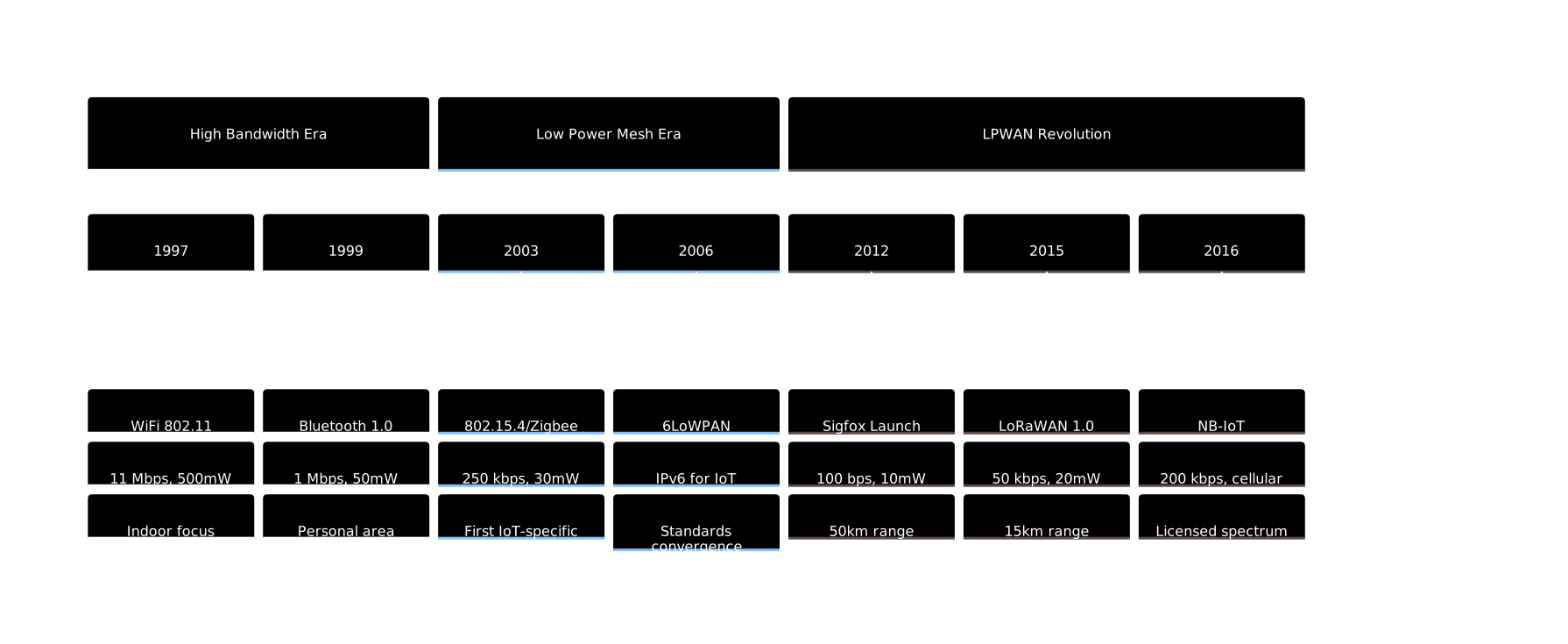
Understanding how wireless protocols evolved helps contextualize today’s IoT landscape. Figure fig-wireless-evolution shows the progression from basic wireless communication to modern IoT protocols, illustrating how range, power, and data rate requirements drove protocol development over time.
Alternative View:
%%{init: {'theme': 'base', 'themeVariables': {'primaryColor': '#2C3E50', 'primaryTextColor': '#fff', 'primaryBorderColor': '#16A085', 'lineColor': '#16A085', 'secondaryColor': '#E67E22', 'tertiaryColor': '#7F8C8D'}}}%%
flowchart TD
    START([What does your<br/>IoT project need?]) --> Q1{Primary<br/>Constraint?}

    Q1 -->|"High Bandwidth<br/>(Video, Audio)"| HB["HIGH BANDWIDTH ERA<br/>Protocols"]
    Q1 -->|"Long Battery Life<br/>(Years)"| LP["LOW POWER ERA<br/>Protocols"]
    Q1 -->|"Maximum Range<br/>(Kilometers)"| LR["LPWAN ERA<br/>Protocols"]

    HB --> HB1["Wi-Fi 802.11<br/>✓ 1-1000 Mbps<br/>✗ 500mW power"]
    HB --> HB2["LTE/5G<br/>✓ 10-1000 Mbps<br/>✗ High cost"]

    LP --> LP1["Zigbee/Thread<br/>✓ Multi-year battery<br/>✗ 100m range max"]
    LP --> LP2["BLE<br/>✓ Coin cell OK<br/>✗ 50m range"]

    LR --> LR1["LoRaWAN<br/>✓ 15km + 10yr battery<br/>✗ 50 kbps max"]
    LR --> LR2["NB-IoT<br/>✓ 10km + carrier support<br/>✗ Subscription cost"]
    LR --> LR3["Sigfox<br/>✓ 50km + tiny power<br/>✗ 100 bps only"]

    style START fill:#2C3E50,stroke:#16A085,stroke-width:3px,color:#fff
    style Q1 fill:#16A085,stroke:#2C3E50,stroke-width:2px,color:#fff
    style HB fill:#E67E22,stroke:#2C3E50,stroke-width:2px,color:#fff
    style LP fill:#16A085,stroke:#2C3E50,stroke-width:2px,color:#fff
    style LR fill:#2C3E50,stroke:#16A085,stroke-width:2px,color:#fff
    style HB1 fill:#fff,stroke:#E67E22,stroke-width:1px,color:#2C3E50
    style HB2 fill:#fff,stroke:#E67E22,stroke-width:1px,color:#2C3E50
    style LP1 fill:#fff,stroke:#16A085,stroke-width:1px,color:#2C3E50
    style LP2 fill:#fff,stroke:#16A085,stroke-width:1px,color:#2C3E50
    style LR1 fill:#fff,stroke:#2C3E50,stroke-width:1px,color:#2C3E50
    style LR2 fill:#fff,stroke:#2C3E50,stroke-width:1px,color:#2C3E50
    style LR3 fill:#fff,stroke:#2C3E50,stroke-width:1px,color:#2C3E50
Key insights from this evolution:
- Early Wi-Fi (1997): Prioritized high bandwidth (11 Mbps) at cost of high power (500mW+) and short range (50m)
- Bluetooth (1999): Optimized for personal area networks (10m) with moderate power (10-50mW) and medium data rates (1-3 Mbps)
- Zigbee/802.15.4 (2003): First protocol explicitly designed for IoT—low power (30mW), mesh networking, but still short-range (100m)
- LPWAN era (2010s): Breakthrough in long-range + low-power combination (LoRa: 10km + 20mW) by accepting very low data rates (0.3-50 kbps)
This historical progression reveals the fundamental physics constraint: you cannot simultaneously maximize range, minimize power, and maximize bandwidth. Every protocol makes deliberate trade-offs based on its target application.

%%{init: {'theme': 'base', 'themeVariables': {'primaryColor': '#2C3E50', 'primaryTextColor': '#fff', 'primaryBorderColor': '#16A085', 'lineColor': '#16A085', 'secondaryColor': '#E67E22', 'tertiaryColor': '#7F8C8D'}}}%%
graph TB
    subgraph HOME["Smart Home"]
        H1["Range: 30m indoor"]
        H2["Power: Plugged in OK"]
        H3["Data: Moderate"]
        H4["Best: Wi-Fi, Zigbee"]
    end

    subgraph FARM["Smart Agriculture"]
        F1["Range: 5+ km outdoor"]
        F2["Power: 5-year battery"]
        F3["Data: Tiny (20 bytes)"]
        F4["Best: LoRaWAN"]
    end

    subgraph WEARABLE["Fitness Tracker"]
        W1["Range: 10m to phone"]
        W2["Power: Coin cell"]
        W3["Data: Bursts"]
        W4["Best: BLE"]
    end

    subgraph FLEET["Vehicle Tracking"]
        V1["Range: Everywhere"]
        V2["Power: Vehicle battery"]
        V3["Data: Real-time GPS"]
        V4["Best: LTE-M, NB-IoT"]
    end

    style H1 fill:#16A085,stroke:#2C3E50,stroke-width:1px,color:#fff
    style H2 fill:#16A085,stroke:#2C3E50,stroke-width:1px,color:#fff
    style H3 fill:#16A085,stroke:#2C3E50,stroke-width:1px,color:#fff
    style H4 fill:#E67E22,stroke:#2C3E50,stroke-width:2px,color:#fff
    style F1 fill:#2C3E50,stroke:#16A085,stroke-width:1px,color:#fff
    style F2 fill:#2C3E50,stroke:#16A085,stroke-width:1px,color:#fff
    style F3 fill:#2C3E50,stroke:#16A085,stroke-width:1px,color:#fff
    style F4 fill:#E67E22,stroke:#2C3E50,stroke-width:2px,color:#fff
    style W1 fill:#16A085,stroke:#2C3E50,stroke-width:1px,color:#fff
    style W2 fill:#16A085,stroke:#2C3E50,stroke-width:1px,color:#fff
    style W3 fill:#16A085,stroke:#2C3E50,stroke-width:1px,color:#fff
    style W4 fill:#E67E22,stroke:#2C3E50,stroke-width:2px,color:#fff
    style V1 fill:#2C3E50,stroke:#16A085,stroke-width:1px,color:#fff
    style V2 fill:#2C3E50,stroke:#16A085,stroke-width:1px,color:#fff
    style V3 fill:#2C3E50,stroke:#16A085,stroke-width:1px,color:#fff
    style V4 fill:#E67E22,stroke:#2C3E50,stroke-width:2px,color:#fff
Classic Trade-offs:
- Range ↔︎ Power: Longer range requires more transmit power
- Wi-Fi: 50-100m range, 100-500mW power
- LoRaWAN: 2-15km range, 20-50mW power (achieves this through slow data rates)
- Bandwidth ↔︎ Power: Higher data rates consume more energy
- LTE: 10 Mbps, drains battery in hours
- NB-IoT: 200 kbps, battery lasts years
- Range ↔︎ Bandwidth: Physics limits how much data you can send far
- Short range (Wi-Fi): 100 Mbps at 50m
- Long range (LoRa): 5 kbps at 10km
TipMinimum Viable Understanding: Protocol Layering
Core Concept: IoT protocols are organized into layers (physical, link, network, transport, application) where each layer handles one responsibility - the physical layer modulates radio signals, the link layer manages channel access, the network layer routes packets, and the application layer formats data - and these layers can be mixed and matched independently.
Why It Matters: Understanding layers prevents costly integration mistakes. When someone says “we use MQTT,” they have only specified the application layer - you still need to decide on transport (TCP or QUIC), network (IPv4 or IPv6), link (Wi-Fi, Ethernet, or cellular), and physical medium. A LoRaWAN deployment uses LoRa PHY, LoRaWAN link/network, and can run MQTT, CoAP, or custom protocols at the application layer. Confusing layers leads to questions like “should we use MQTT or Wi-Fi?” - which compares incompatible layers.
Key Takeaway: When evaluating IoT protocols, identify which layer each technology addresses: Wi-Fi/BLE/LoRa are physical+link layers, IPv6/6LoWPAN are network layers, TCP/UDP are transport layers, and MQTT/CoAP/HTTP are application layers. A complete IoT stack requires choices at each layer. The OSI model has 7 layers, but IoT typically uses a simplified 5-layer model: PHY, MAC, Network, Transport, Application.
81.5 Summary
Key Takeaways:
- Multiple Dimensions: Protocol selection involves range, power, bandwidth, latency, cost, security, scalability, and interoperability simultaneously
- Fundamental Trade-offs: You cannot maximize range, minimize power, AND maximize bandwidth - physics doesn’t allow it
- Historical Context: Understanding protocol evolution (Wi-Fi → BLE → Zigbee → LPWAN) explains today’s options
- Connectivity Classes: Short-range (<100m), Mid-range (100m-1km), Long-range (>1km) - get this right first
- Layer Awareness: Know which OSI layer each protocol addresses to avoid comparing incompatible technologies
81.6 What’s Next
In the next chapter, Systematic Selection Framework, you’ll learn a step-by-step methodology for eliminating protocols that don’t fit your requirements and comparing the remaining candidates systematically.