1608  Context-Aware Energy Management

1608.1 Context-Aware Energy Management

This section provides a stable anchor for cross-references to context-aware energy management across the book.

Context-aware energy management enables IoT devices to dynamically adapt their operation based on real-time understanding of user behavior, environmental conditions, and system state. Rather than using static power budgets, context-aware systems optimize for each specific situation, achieving energy savings of 60-80% while maintaining user experience.

1608.2 Chapter Overview

This topic has been organized into four focused chapters for easier learning:

1608.2.1 1. Duty Cycling Fundamentals

Learn the foundation of low-power IoT design through duty cycling - the practice of periodically waking devices for sensing and returning to sleep mode.

Key Topics: - Duty cycle calculation and average power - Interactive duty cycle calculator - Deep sleep vs light sleep modes - Fixed vs event-driven wake-up strategies - Common misconceptions about duty cycling

1608.2.2 2. ACE System and Shared Context Sensing

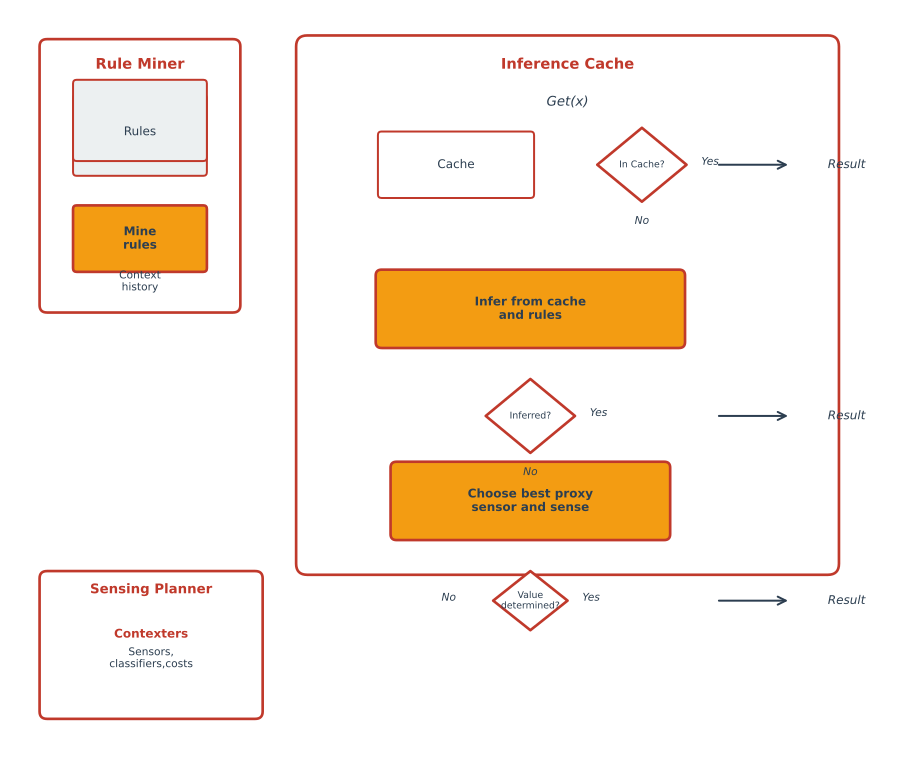
Explore the ACE (Adaptive Context-aware Energy-saving) system that achieves 60-80% energy savings through intelligent caching, cross-app context sharing, and association rule mining.

Key Topics: - Shared context sensing across applications - Cross-app context correlations - Association rule mining (support and confidence) - ACE system architecture (Inference Cache, Rule Miner, Sensing Planner) - Worked examples: Smart building sensors and solar harvesting

1608.2.3 3. Code Offloading and Heterogeneous Computing

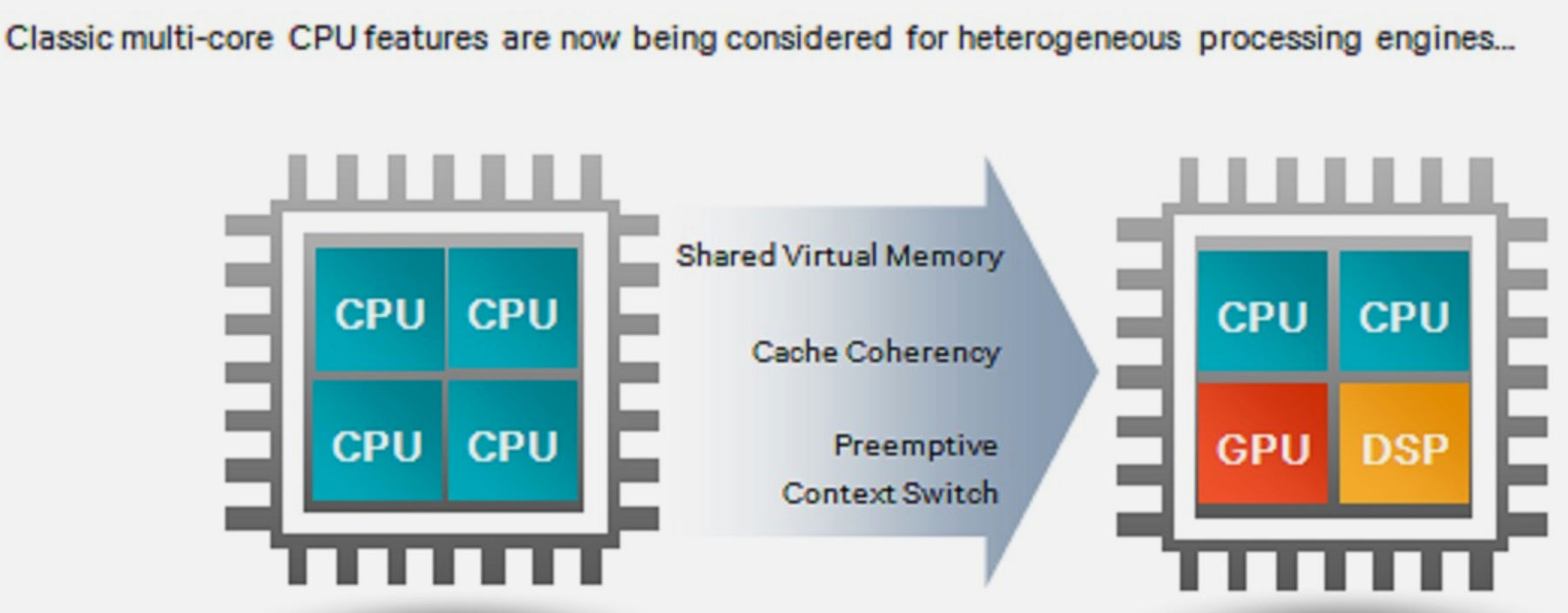
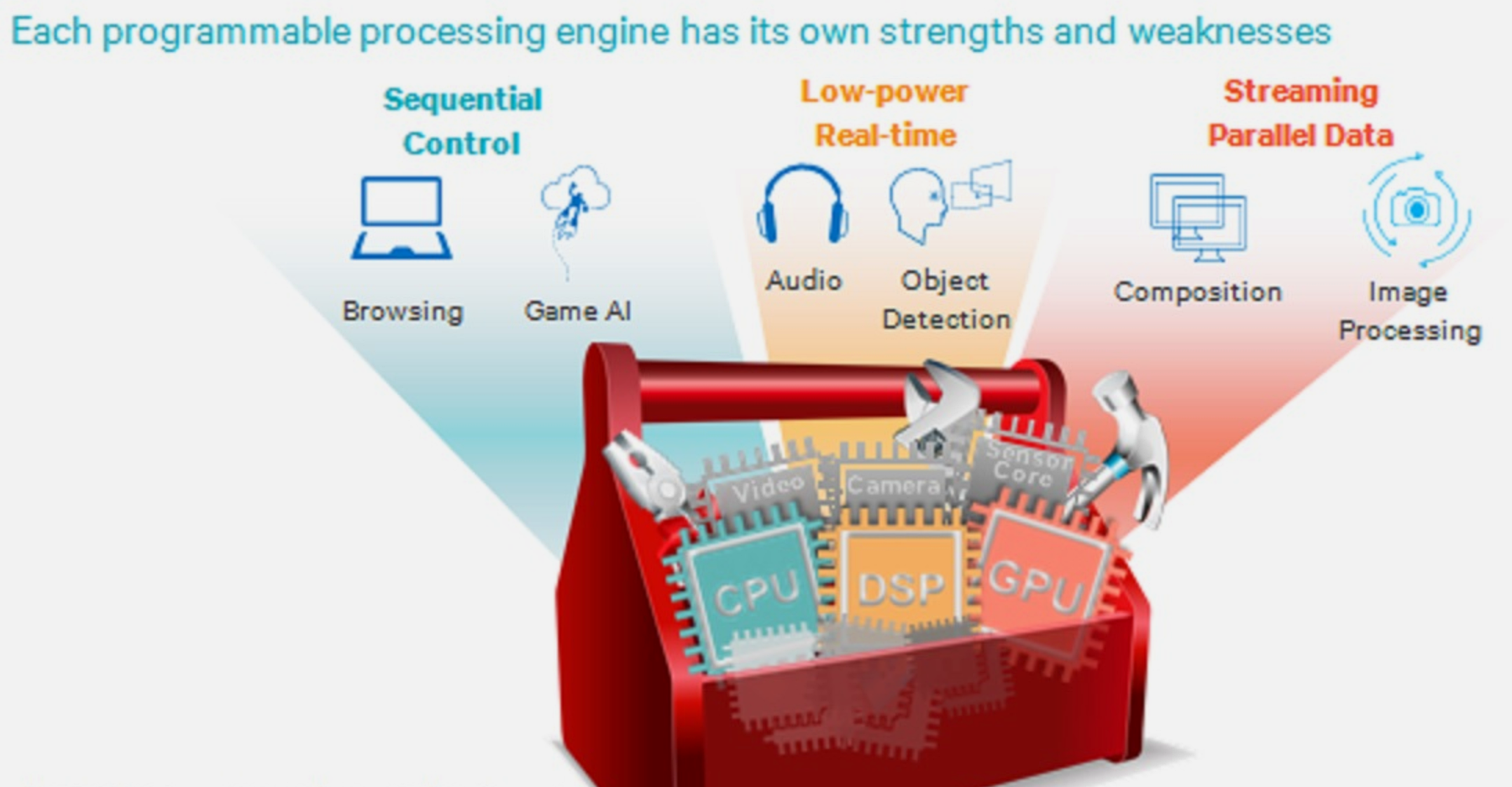
Understand when to process locally versus offload to cloud, and how to leverage heterogeneous processors (CPU, GPU, DSP, NPU) for energy-efficient execution.

Key Topics: - Energy-preserving sensing plans - MAUI offloading framework - Wi-Fi vs cellular offloading trade-offs - Heterogeneous core scheduling - Code offloading worksheets

1608.2.4 4. Energy Optimization Worksheets and Assessment

Apply your knowledge through comprehensive worksheets, quizzes, and practical exercises covering all aspects of context-aware energy management.

Key Topics: - Context-aware battery life calculations - Mixed usage analysis - ACE system energy savings calculations - Comprehensive assessment questions - Key concepts reference

1608.3 Learning Path

For the best learning experience, work through these chapters in order:

%%{init: {'theme': 'base', 'themeVariables': { 'primaryColor': '#2C3E50', 'primaryTextColor': '#fff', 'primaryBorderColor': '#16A085', 'lineColor': '#16A085', 'secondaryColor': '#E67E22', 'tertiaryColor': '#fff'}}}%%
flowchart LR
    A[1. Duty Cycling<br/>Fundamentals] --> B[2. ACE System<br/>& Shared Context]
    B --> C[3. Code Offloading<br/>& Heterogeneous]
    C --> D[4. Optimization<br/>& Assessment]

    style A fill:#16A085,stroke:#2C3E50,color:#fff
    style B fill:#27AE60,stroke:#2C3E50,color:#fff
    style C fill:#E67E22,stroke:#2C3E50,color:#fff
    style D fill:#2C3E50,stroke:#16A085,color:#fff

1608.4 Quick Reference: Key Figures

The following figures are distributed across the chapters:
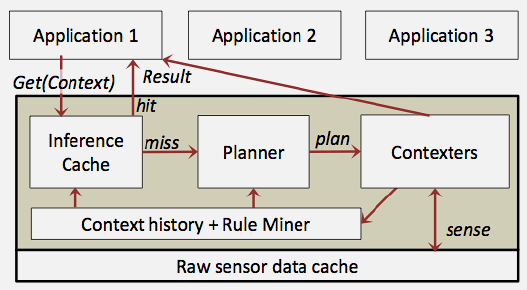
Architecture diagram showing ACE system components including inference cache, rule miner, sensing planner, and contexters working together to minimize energy consumption through context inference
Figure 1608.1: Context: ACESystem
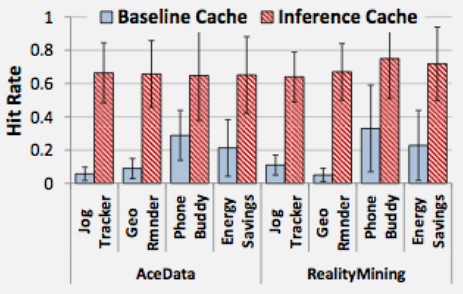
Bar chart comparing cache hit rates and energy savings percentages across different context-aware caching strategies showing 60-80% energy reduction
Figure 1608.2: Context: CachingPerformance
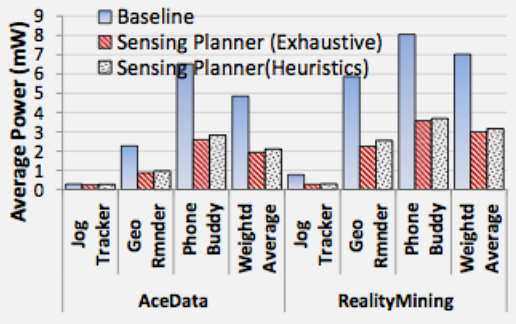
Graph plotting energy consumption in millijoules over time comparing direct sensing versus ACE system showing significant reduction through caching and inference
Figure 1608.3: Context: EnergyConsumed
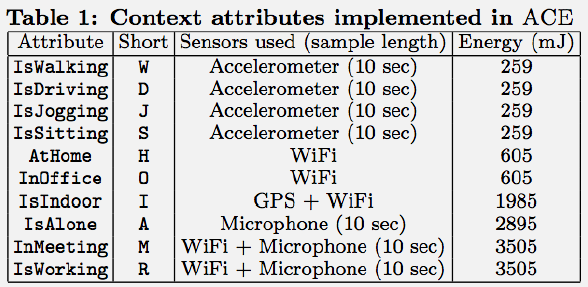
Table listing context attributes with their sensing energy costs ranging from low-cost accelerometer at 10mW to high-cost GPS at 100mW
Figure 1608.4: Context: EnergyOfContextAttributes
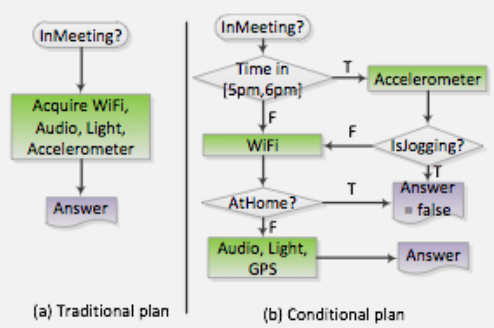
Flow diagram illustrating energy-preserving sensing plan decision tree showing when to use cached values, proxy attributes, or direct sensing
Figure 1608.5: Context: EnergyPreservingSensingPlan
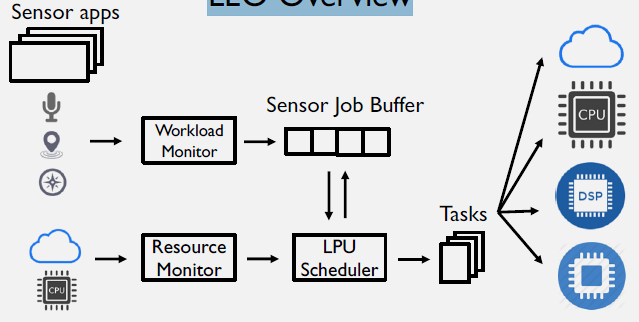
System overview diagram of LEO context-aware framework showing local and remote components for energy-efficient mobile app context management
Figure 1608.6: Context: LEOOverview
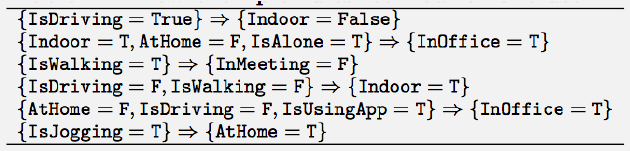
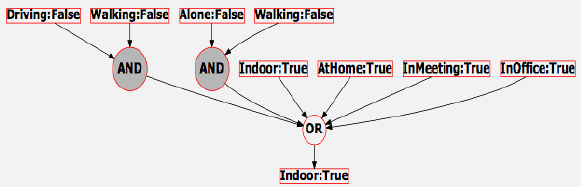
Table displaying learned association rules between context attributes with support and confidence percentages such as Driving equals true implies AtHome equals false
Figure 1608.7: Context: LearnedRulesbyRuleMiner
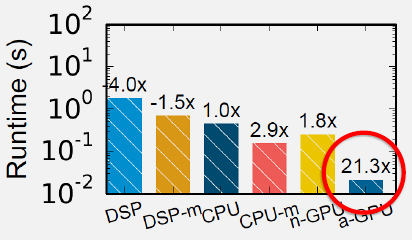
Performance comparison chart showing local GPU computation speedup versus cloud offloading for mobile keyword spotting achieving 21x faster processing
Figure 1608.8: Context: LocalComputation1
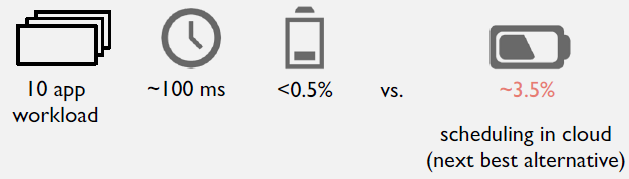
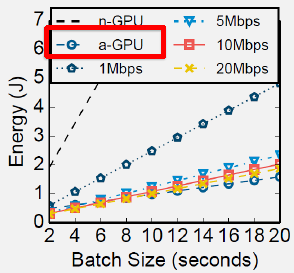
Energy efficiency graph comparing local heterogeneous cores versus cloud processing showing GPU batching reduces energy consumption below cloud transmission overhead
Figure 1608.9: Context: LocalComputation2
Timeline visualization demonstrating low-overhead context inference using cached attributes versus expensive direct sensing operations
Figure 1608.10: Context: LowOverhead
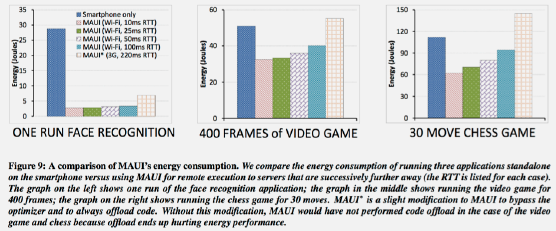
Decision tree diagram for MAUI offloading framework showing energy cost calculation comparing local execution versus remote cloud execution with network transmission costs
Figure 1608.11: Context: MAUIOffloading
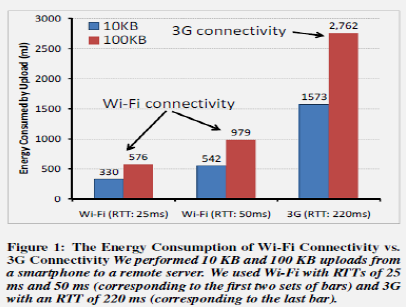
Bar chart comparing energy costs of different wireless technologies Wi-Fi versus 3G versus LTE showing Wi-Fi lowest at 100mJ and LTE highest at 1000mJ per transmission
Figure 1608.12: Context: NetworkingCosts
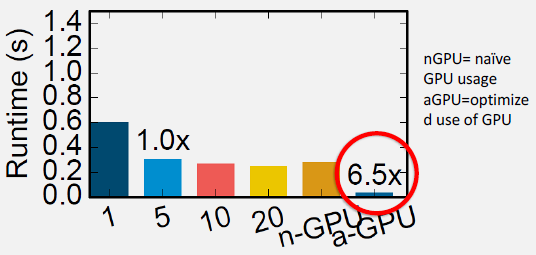
Performance metrics table showing GPU-optimized keyword spotting achieves 6x speedup over cloud and 21x over sequential CPU processing
Figure 1608.13: Context: OptimizedGPUEfficient1
Energy consumption comparison demonstrating GPU batching with optimized implementation uses less energy than cloud offloading for audio processing tasks
Figure 1608.14: Context: OptimizedGPUEfficient2
Latency analysis showing GPU parallel processing reduces keyword spotting latency from 500ms sequential to 25ms with batched GPU execution
Figure 1608.15: Context: OptimizedGPUEfficient3
Diagram illustrating rule miner simplification process showing how complex context history is distilled into simple if-then association rules
Figure 1608.16: Context: RuleMinerSimplification
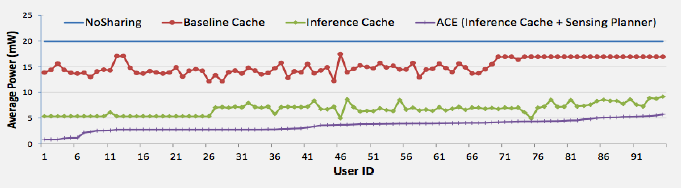
Bar graph showing user battery life extension from days to weeks achieved through context-aware energy management with ACE system implementation
Figure 1608.17: Context: UserSavings
Complete workflow flowchart showing ACE system operation from app context request through cache lookup, rule inference, sensing plan execution, and cache update
Figure 1608.18: Context: Workflow

1608.6 What’s Next

Start with Duty Cycling Fundamentals to learn the foundation of low-power IoT design, or jump to any specific chapter based on your learning needs.