Design A/B partitioning schemes for reliable firmware updates with automatic rollback
Compare update mechanisms (A/B, single partition, delta updates) and choose appropriate strategies
Implement secure update channels using PKI, code signing, and secure boot chains
Evaluate update delivery mechanisms (polling, push, CDN, peer-to-peer) for different deployment scenarios
Apply anti-rollback protection to prevent firmware downgrade attacks
Design OTA systems for bandwidth-constrained cellular IoT deployments
1586.2 Introduction
Over-the-air (OTA) updates are the lifeblood of modern IoT deployments. They enable security patches, bug fixes, and feature additions without physical access to devices. However, OTA updates also represent one of the highest-risk operations in IoT systems - a failed update can brick devices, compromise security, or disrupt critical operations.
This chapter explores the architecture of reliable, secure OTA update systems, from the low-level partitioning schemes that enable rollback to the high-level delivery mechanisms that scale to millions of devices.
1586.3 Continuous Delivery Pipeline
1586.3.1 Pipeline Stages
A comprehensive IoT CD pipeline includes multiple gates:
Stage 1: Build - Cross-compile for all hardware targets - Generate debug and release builds - Create build reproducibility checksums
Stage 2: Unit Tests - Run on host machine or in simulator - Mock hardware interfaces (GPIO, I2C, SPI) - Validate business logic independent of hardware
Stage 4: Hardware-in-the-Loop Tests - Flash firmware to real hardware - Automated test rigs exercise sensors/actuators - Protocol conformance testing - Power consumption validation
Stage 5: Staging Fleet - Deploy to internal test devices - Soak testing (24-48 hours continuous operation) - Integration with real cloud services - Performance monitoring
Stage 6: Canary Deployment - Deploy to 1-5% of production fleet - Monitor key metrics (crash rate, connectivity, battery) - Automatic rollback triggers
Show code
{const container =document.getElementById('kc-deploy-3');if (container &&typeof InlineKnowledgeCheck !=='undefined') { container.innerHTML=''; container.appendChild(InlineKnowledgeCheck.create({question:"Your smart agriculture startup has deployed 5,000 soil moisture sensors across remote farms. After a firmware update, you notice 3% of devices have stopped reporting data. Your remote monitoring dashboard shows these devices last checked in 6 hours ago. What should be your first diagnostic step?",options: [ {text:"Immediately rollback all devices to the previous firmware version",correct:false,feedback:"Rolling back all devices is premature. The 97% of devices still working would be disrupted. First, you need to understand whether the issue is firmware-related or environmental (network outage, power issues). Targeted investigation before fleet-wide action."}, {text:"Check if the offline devices share common attributes (hardware revision, region, sensor type) and correlate with telemetry data from before they went silent",correct:true,feedback:"Correct! Identifying patterns in offline devices (same hardware revision? same geographic region? same network provider?) helps isolate the root cause. Reviewing their last telemetry before going silent (battery level, signal strength, error logs) provides crucial diagnostic data before taking action."}, {text:"Send technicians to physically inspect all 150 offline devices immediately",correct:false,feedback:"Sending technicians to 150 devices across remote farms is expensive and slow. First, analyze available data remotely to understand if this is a software issue (fixable via OTA), network issue, or hardware failure. Physical inspection should be a last resort after remote diagnostics."}, {text:"Assume the devices are defective and order replacements",correct:false,feedback:"Assuming hardware failure without investigation wastes resources. A 3% failure rate after an update strongly suggests a software or compatibility issue, not mass hardware failure. Investigation through remote monitoring data should precede any replacement decisions."} ],difficulty:"medium",topic:"remote monitoring" })); }}
Flowchart depicting staged firmware deployment strategy with risk mitigation: Developer Commit flows through CI Build Pipeline to All Tests Pass decision (No blocks deployment, Yes continues), Generate Signed Firmware, Upload to Artifact Storage, Deploy to Staging Fleet, then Staging Metrics OK 24-hour soak test decision (No blocks deployment, Yes continues to canary rollout). Canary progression shows 1% Production with 6-hour monitoring (high crash rate triggers Auto Rollback, good metrics expand to 5%), then 5% with 12-hour monitoring (issues trigger rollback, good expands to 25%), then 25% with 24-hour monitoring (issues trigger rollback, good reaches Full Rollout 100%), followed by 7-day continuous monitoring. Auto Rollback feeds to Investigate and Fix. Progressive deployment reduces blast radius while monitoring gates enable early detection and automated rollback before fleet-wide impact.
Figure 1586.1: Staged rollout strategy with canary deployments showing progressive expansion from 1% to 100% of production fleet with monitoring gates and automatic rollback triggers at each stage.
1586.3.2 Build Artifacts
Proper artifact management is critical for traceability and debugging:
Manifests: - Firmware version (semantic versioning) - Git commit hash for exact source traceability - Build timestamp and build machine ID - Dependencies (library versions, RTOS version) - Supported hardware variants - Required bootloader version
Signatures: - Cryptographic hash (SHA-256) of firmware image - Digital signature (RSA, ECDSA) for authenticity - Certificate chain for verification - Anti-rollback counter (prevents downgrade attacks)
Flowchart diagram
Figure 1586.2: Firmware versioning strategy showing semantic versioning (MAJOR.MINOR.PATCH), version timeline progression, git branch strategy for releases, and anti-rollback protection to prevent downgrade attacks.
1586.3.3 OTA and CI/CD Visualizations
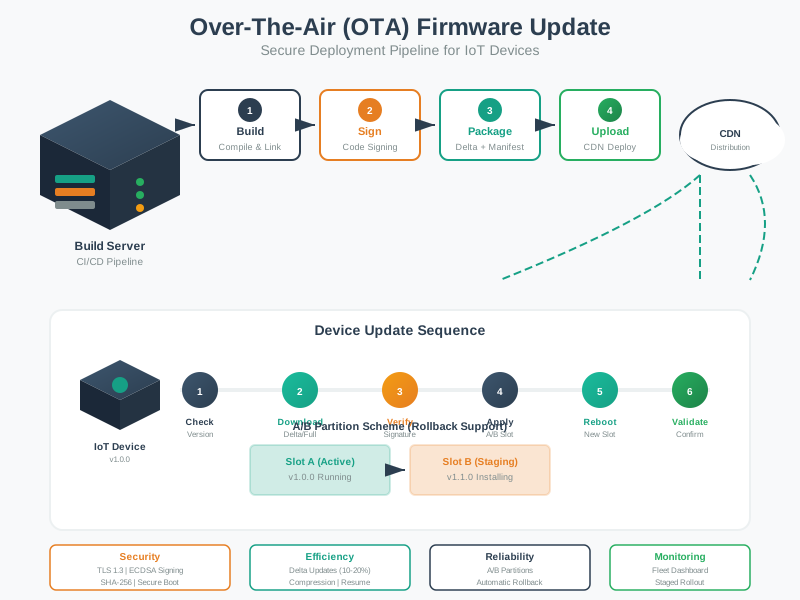
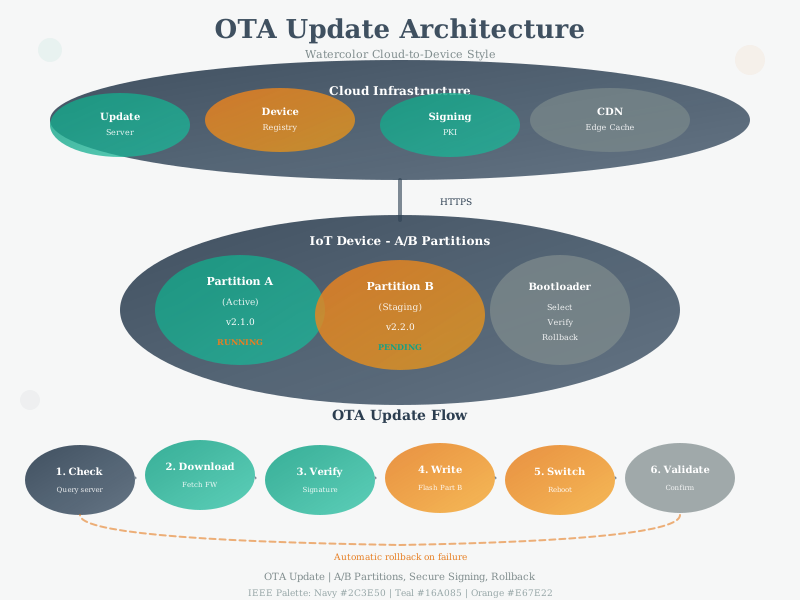
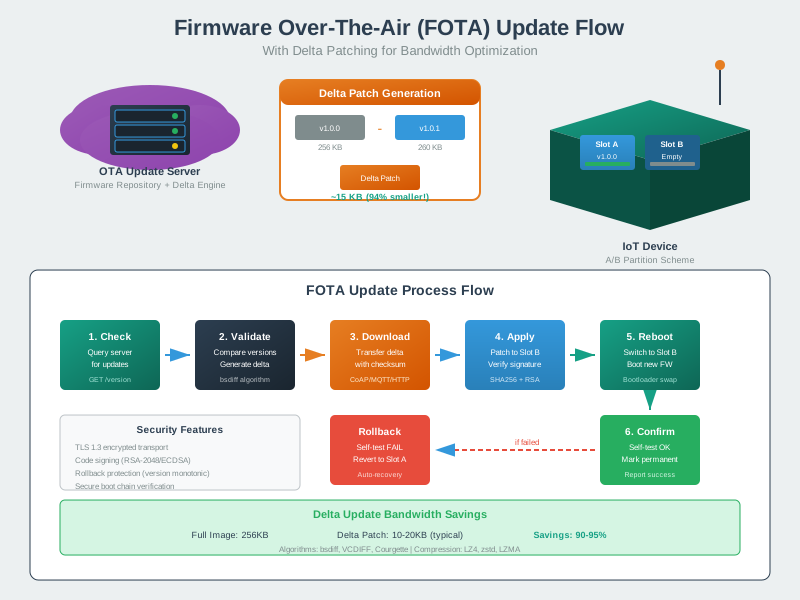
The following AI-generated visualizations illustrate key concepts in OTA update systems and CI/CD pipelines for IoT devices.
OTA Firmware Update Architecture
Figure 1586.3: Over-the-air firmware updates require careful architecture to ensure reliability and security. This visualization shows the end-to-end OTA system including cloud-based fleet management, secure TLS download channels, signature verification, and the A/B partition switching mechanism that enables atomic updates with rollback capability.
OTA Update System Architecture
Figure 1586.4: A production OTA system spans from developer workstation to deployed devices. This visualization traces the complete update pipeline: code commit triggers CI build, binary is signed with HSM-protected keys, distributed via CDN, and devices poll for updates with staged rollout percentages protecting against fleet-wide failures.
OTA Update Process Flow
Figure 1586.5: The OTA update process must handle interruptions gracefully. This visualization shows the fault-tolerant update sequence including resumable downloads, cryptographic verification before flashing, atomic partition swap, boot counter for automatic rollback, and status reporting to cloud.
Firmware Update Flow
Figure 1586.6: Robust firmware updates require multiple decision points. This visualization presents the complete decision flow including battery level checks (prevent mid-update power loss), network stability verification, cryptographic integrity checks, installation with progress tracking, and watchdog-protected boot testing.
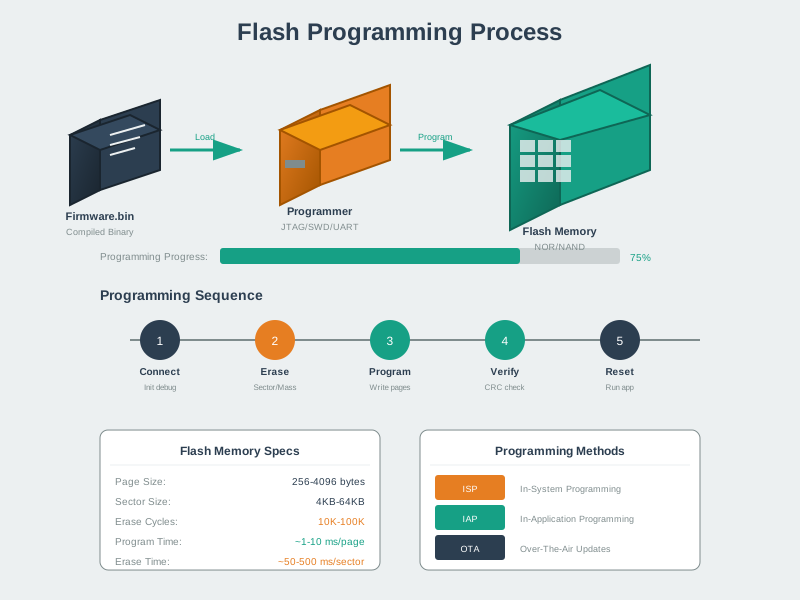
Flash Memory Programming
Figure 1586.7: Understanding flash memory characteristics is essential for reliable OTA updates. This visualization explains the erase-before-write constraint, page/sector alignment requirements, wear leveling to extend device lifespan, and why large sectors increase update time and failure risk.
Power Management for OTA Updates
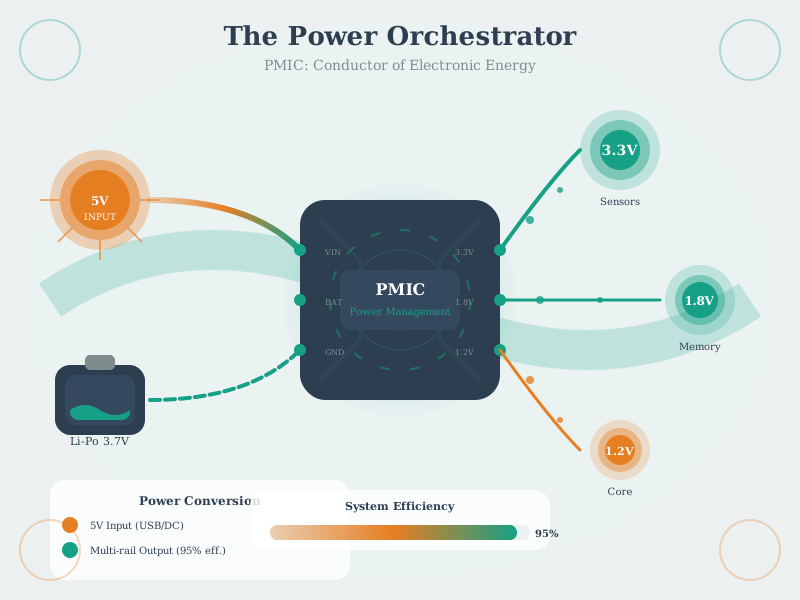
Figure 1586.8: Power management is critical during OTA updates. This visualization shows how PMIC circuits provide battery voltage monitoring, brownout detection, and power-good signals that firmware uses to prevent initiating updates when battery is low or power is unstable.
1586.4 OTA Update Architecture
1586.4.1 Update Mechanisms
A/B Partitioning (Dual Bank): - Two firmware partitions: Active and Inactive - Update downloads to Inactive partition - Atomic switch on successful verification - Automatic rollback if new firmware fails to boot - Advantage: Safe rollback, fast recovery - Disadvantage: Requires 2x storage (expensive on embedded)
Single Partition + Recovery: - One main partition, small recovery partition - Update overwrites main partition - If update fails, boots to recovery for re-download - Advantage: Smaller storage footprint - Disadvantage: Requires network access for recovery
Delta Updates: - Only transmit differences between versions - Reduces bandwidth (critical for cellular/LoRaWAN) - Patches applied in-place or to staging area - Advantage: Minimal data transfer - Disadvantage: Complex implementation, risky patching
Show code
{const container =document.getElementById('kc-deploy-4');if (container &&typeof InlineKnowledgeCheck !=='undefined') { container.innerHTML=''; container.appendChild(InlineKnowledgeCheck.create({question:"A wind turbine manufacturer wants to implement predictive maintenance for their 2,000 deployed turbines. Each turbine has sensors monitoring vibration, temperature, and power output. Which approach best enables predictive maintenance while minimizing false alarms?",options: [ {text:"Set fixed threshold alerts (e.g., vibration > 5mm/s triggers maintenance)",correct:false,feedback:"Fixed thresholds generate many false positives because normal operating ranges vary by turbine age, weather conditions, and load. A turbine in high wind legitimately has higher vibration than one in calm conditions. This approach leads to alert fatigue and missed actual failures."}, {text:"Only perform maintenance on a fixed schedule regardless of sensor data",correct:false,feedback:"Scheduled maintenance ignores valuable sensor data. Some turbines may need attention before the scheduled date (risking failure), while others may be over-maintained (wasting resources). This approach wastes the investment in sensors entirely."}, {text:"Train ML models on historical sensor data to detect anomalies relative to each turbine's baseline, with correlation across multiple sensor types",correct:true,feedback:"Correct! Predictive maintenance works best with anomaly detection relative to each device's learned baseline. Correlating multiple sensors (high vibration + elevated temperature + power drop = bearing failure pattern) reduces false positives. Historical data trains models to distinguish normal variation from failure precursors."}, {text:"Wait for complete failure before dispatching maintenance crews",correct:false,feedback:"Reactive maintenance for wind turbines is extremely costly. Turbine failures can cause cascading damage, and remote locations mean extended downtime. A single turbine failure can cost $200,000+ in repairs plus lost energy production. Predictive maintenance ROI is substantial for high-value assets."} ],difficulty:"hard",topic:"predictive maintenance" })); }}
Flowchart illustrating A/B partition firmware update mechanism for safe over-the-air updates: Starting with Boot Partition A Active running v1.2.0 and Partition B Inactive with old v1.1.0, system downloads new firmware v1.3.0 to inactive Partition B. Verify Signature and Checksum decision validates cryptographic integrity (Invalid path discards update, Valid continues), then Switch Boot to B makes new firmware active. Boot Success decision checks if new firmware starts correctly (Yes path establishes B Active v1.3.0 with A Inactive v1.2.0 as backup, No path triggers Rollback to A returning to original active partition). This dual-partition approach enables atomic firmware updates with automatic recovery if new firmware fails, preventing device bricking while maintaining rollback capability to last known-good version.
Figure 1586.9: A/B partition update scheme showing dual firmware partitions with atomic switching and automatic rollback on boot failure, ensuring safe firmware updates with minimal brick risk.
1586.4.2 Update Security
Security is paramount - a compromised update mechanism can brick entire fleets:
Code Signing with PKI: - Firmware signed with manufacturer’s private key - Device verifies signature with embedded public key - Prevents installation of unauthorized firmware - Certificate rotation strategy for key compromise
Secure Boot Chain: 1. Hardware root of trust (immutable ROM bootloader) 2. ROM verifies bootloader signature 3. Bootloader verifies application signature 4. Each stage validates next stage before execution
Encrypted Transmission: - TLS 1.2+ for download channels - Firmware can be encrypted or plaintext (signature provides authenticity) - Encrypted firmware prevents reverse engineering during transit
Anti-Rollback Protection: - Monotonic counter stored in secure storage - Each firmware has version number - Device refuses to install firmware with lower version - Prevents attacker downgrading to vulnerable version
1586.4.3 Update Delivery
Direct Polling: - Device periodically checks update server - Simple implementation - Disadvantage: Thundering herd problem (10M devices polling simultaneously) - Solution: Randomized polling intervals, exponential backoff
Push Notifications: - Server sends notification to device via MQTT, CoAP Observe, etc. - Device then pulls firmware image - Efficient, immediate propagation - Disadvantage: Requires persistent connection or reachable device
CDN-Based Distribution: - Firmware hosted on Content Delivery Network - Devices download from geographically nearby edge servers - Scales to millions of devices - Examples: AWS CloudFront, Azure CDN, Cloudflare
Peer-to-Peer Updates: - Devices share firmware with nearby devices - Efficient for mesh networks (BLE mesh, Zigbee) - Reduces server bandwidth - Challenge: Ensuring security in P2P distribution
Flowchart diagram
Figure 1586.10: Four OTA update delivery mechanisms with trade-offs: Direct Polling (simple but thundering herd), Push Notification (immediate but requires connection), CDN Distribution (scalable), and Peer-to-Peer (bandwidth efficient but security complex).
1586.5 Summary
OTA update architecture is one of the most critical aspects of IoT system design. Key takeaways from this chapter:
Continuous delivery pipelines for IoT include multiple stages: build, unit tests, static analysis, HIL tests, staging, canary, and production rollout
Build artifacts must include firmware images, manifests with version traceability, and cryptographic signatures
A/B partitioning provides the safest update mechanism with automatic rollback, at the cost of 2x storage
Delta updates reduce bandwidth for cellular IoT but increase complexity and failure risk
Secure boot chains establish trust from hardware root through bootloader to application
Code signing with PKI prevents installation of unauthorized firmware
Anti-rollback protection prevents attackers from downgrading to vulnerable firmware versions
Update delivery mechanisms range from simple polling to CDN distribution to peer-to-peer, each with trade-offs
In the next chapter, Rollback and Staged Rollout Strategies, we explore how to safely deploy updates to large device fleets using canary deployments, feature flags, and ring-based rollouts. You’ll learn how to design automatic rollback mechanisms and calculate optimal staged rollout timelines for your deployments.