Evaluate OTA platforms (AWS IoT, Azure IoT Hub, Mender, Balena, Memfault) for different deployment scenarios
Organize device fleets using groups, tags, and device twins for targeted updates
Apply lessons from real-world case studies (Tesla, John Deere) to your deployments
1585.2 Introduction
Once firmware is deployed to devices in the field, visibility into device health becomes critical. Unlike web applications where server logs are easily accessible, IoT devices are distributed, resource-constrained, and often deployed in environments with limited connectivity. Effective monitoring enables proactive issue detection, faster debugging, and data-driven decisions about future updates.
This chapter explores the tools and techniques for monitoring deployed IoT fleets and the platforms that enable CI/CD and OTA updates at scale.
1585.3 Monitoring and Telemetry
1585.3.1 Device Health Metrics
Show code
{const container =document.getElementById('kc-deploy-8');if (container &&typeof InlineKnowledgeCheck !=='undefined') { container.innerHTML=''; container.appendChild(InlineKnowledgeCheck.create({question:"You're designing a remote monitoring system for 50,000 industrial sensors deployed in factories. Each sensor can report 20 metrics every minute. Your cloud infrastructure costs scale with data ingestion volume. What monitoring strategy balances visibility with cost?",options: [ {text:"Collect all 20 metrics every minute from all 50,000 sensors",correct:false,feedback:"This generates 1 billion data points per minute (50,000 x 20 x 1), which is extremely expensive to ingest, store, and query. Most metrics don't change frequently enough to justify minute-level sampling. This approach wastes 90%+ of infrastructure budget on redundant data."}, {text:"Implement tiered sampling: critical metrics every minute, operational metrics every 15 minutes, diagnostic metrics on-demand or during anomalies",correct:true,feedback:"Correct! Tiered sampling matches collection frequency to metric importance. Temperature trending toward dangerous levels needs minute-level resolution; firmware version needs only daily checks. Edge logic can increase sampling frequency when anomalies are detected, providing detail when needed while reducing baseline costs."}, {text:"Only collect metrics when devices report errors",correct:false,feedback:"Error-only reporting misses gradual degradation patterns essential for predictive maintenance. By the time an error triggers, the failure may have already occurred. Proactive monitoring requires baseline metrics to detect trends toward failure before they happen."}, {text:"Have factory workers manually inspect sensors weekly and enter data",correct:false,feedback:"Manual data collection defeats the purpose of IoT sensors - automation and real-time visibility. Weekly human inspection cannot catch rapid changes, is error-prone, and doesn't scale to 50,000 sensors. The sensors exist specifically to eliminate manual data collection."} ],difficulty:"easy",topic:"remote monitoring" })); }}
Comprehensive observability is essential for proactive issue detection:
Operational Metrics: - Uptime: Time since last reboot - CPU Usage: Average and peak utilization - Memory Usage: Heap fragmentation, available RAM - Battery Level: Voltage, estimated time remaining - Temperature: MCU junction temperature - Network Stats: RSSI, SNR, packet loss, latency
Application Metrics: - Sensor Reading Rate: Samples per hour - Actuator Commands: Successful vs failed operations - Message Queue Depth: Backlog of unsent data - Cloud Sync Status: Last successful sync timestamp
Update Metrics: - Update Success Rate: % of devices successfully updated - Update Duration: Time from download start to commit - Rollback Events: Frequency and reasons - Version Distribution: Histogram of firmware versions in fleet
1585.3.2 Crash Reporting
Show code
{const container =document.getElementById('kc-deploy-9');if (container &&typeof InlineKnowledgeCheck !=='undefined') { container.innerHTML=''; container.appendChild(InlineKnowledgeCheck.create({question:"Your fleet of 10,000 environmental sensors has been running firmware v2.1 for 3 months. Telemetry shows memory usage has been gradually increasing by 0.5% per day on all devices. At current rates, devices will run out of memory in 60 days. What does this pattern most likely indicate?",options: [ {text:"Hardware defect in the memory chips requiring device replacement",correct:false,feedback:"Gradual, consistent memory growth across ALL devices is not a hardware failure pattern. Hardware memory failures are typically sudden and affect random devices, not the entire fleet simultaneously. This pattern points to software, not hardware."}, {text:"A memory leak in the firmware that accumulates over time",correct:true,feedback:"Correct! Gradual, linear memory growth across all devices running the same firmware is the classic signature of a memory leak. Code is allocating memory without freeing it, causing slow but inexorable growth. This requires a firmware fix - typically identifying the leaking allocation using heap analysis tools or code review."}, {text:"Normal behavior that doesn't require attention",correct:false,feedback:"Memory exhaustion in 60 days is not 'normal' - it will cause device crashes and potential fleet-wide failures. Embedded devices should have stable memory usage over time. A consistent upward trend indicates a bug that must be addressed before devices start failing."}, {text:"Sensors collecting too much environmental data",correct:false,feedback:"Data collection doesn't typically cause memory growth unless there's a queue or buffer that isn't being cleared - which would itself be a memory leak or design bug. Normal data flow processes and transmits data, not accumulates it. The pattern indicates a firmware bug."} ],difficulty:"easy",topic:"predictive maintenance" })); }}
When devices fail, engineers need actionable data:
Crash Dump Contents: - Stack trace (call stack at time of crash) - Register dump (CPU register state) - Exception type (hard fault, memory fault, bus fault) - Firmware version and build ID - Uptime before crash - Recent log messages (ring buffer)
Symbolication: - Raw crash dumps contain memory addresses - Symbolication translates addresses to function names and line numbers - Requires debug symbols from build artifacts - Services: Memfault, Sentry, custom solutions
Automated Analysis: - Group similar crashes together (same root cause) - Identify crash trends (increasing after update) - Correlate with firmware versions - Prioritize fixes by impact (# of affected devices)
1585.3.3 Version Distribution Dashboard
Visual monitoring of fleet update progress:
Key Visualizations: - Pie Chart: Distribution of firmware versions - Timeline Graph: Update adoption curve over time - Heatmap: Geographic distribution of versions - Table: Top 10 versions with device counts
Alerts: - Slow adoption (< 50% after 2 weeks) - Version fragmentation (> 5 active versions) - Rollback storm (> 10% devices reverting)
1585.4 Tools and Platforms
1585.4.1 CI/CD Tools
Flowchart diagram
Figure 1585.1: Complete DevOps toolchain for embedded IoT systems showing the flow from planning through code, build, test, and deploy stages with specific tools at each phase.
OTA + monitoring, crash reporting, metrics, symbolication
Embedded/RTOS devices
Arduino IoT Cloud
SaaS
OTA for Arduino, ESP32, ESP8266
Maker/prototyping projects
PlatformIO Remote
SaaS
OTA for PlatformIO projects, firmware library
Multi-platform embedded
Show code
{const container =document.getElementById('kc-deploy-10');if (container &&typeof InlineKnowledgeCheck !=='undefined') { container.innerHTML=''; container.appendChild(InlineKnowledgeCheck.create({question:"A startup is building a fleet of 500 Linux-based edge gateways for industrial monitoring. They need OTA updates with automatic rollback capability. Budget is limited but the team has strong Linux experience. Which OTA platform best fits their needs?",options: [ {text:"AWS IoT Device Management - enterprise-grade with full AWS integration",correct:false,feedback:"AWS IoT Device Management is powerful but designed for AWS-centric architectures. It's more expensive than needed for 500 devices, and the startup would pay for features they don't use (Jobs API, Fleet Indexing at scale). It also doesn't provide A/B rootfs updates out of the box."}, {text:"Mender.io - open source core with A/B rootfs updates for Linux devices",correct:true,feedback:"Correct! Mender is specifically designed for Linux-based IoT devices, provides A/B rootfs updates with automatic rollback built-in, and has an open-source core that a budget-conscious startup can self-host. The enterprise tier is available if they scale. Yocto integration means clean builds, and the team's Linux experience aligns well."}, {text:"Arduino IoT Cloud - easy to use with simple OTA",correct:false,feedback:"Arduino IoT Cloud targets Arduino and ESP32/ESP8266 microcontrollers, not Linux-based edge gateways. It lacks the A/B partitioning and rootfs update capabilities needed for robust Linux device updates. It's designed for maker projects, not industrial deployments."}, {text:"Build a custom OTA solution from scratch",correct:false,feedback:"Building custom OTA with rollback capability is months of engineering work and creates ongoing maintenance burden. For 500 devices, proven platforms like Mender provide tested, secure solutions at a fraction of the cost of custom development. The startup should focus their engineering on their core product, not OTA infrastructure."} ],difficulty:"medium",topic:"OTA firmware updates" })); }}
AWS IoT Device Management: - Jobs: Deploy updates to device groups based on attributes - Secure Tunneling: Remote access to devices behind firewalls - Fleet Indexing: Query fleet based on device state - Integration: Works with AWS Lambda, S3, CloudWatch
Azure IoT Hub: - Device Twins: JSON documents storing device state - Automatic Device Management: Scheduled updates based on twin properties - IoT Edge: Deploy containers to edge devices - Monitoring: Azure Monitor integration
Mender.io: - Open Source Core: Free, self-hosted - Enterprise: SaaS with advanced features - Robust Rollback: A/B partitioning built-in - Yocto Integration: Part of embedded Linux build process
Balena: - Container-Based: Deploy Docker containers, not raw firmware - Multi-Container: Update individual services independently - BalenaOS: Custom Linux optimized for containers - Fleet Dashboard: Web-based device management
1585.4.3 Device Management
Show code
{const container =document.getElementById('kc-deploy-11');if (container &&typeof InlineKnowledgeCheck !=='undefined') { container.innerHTML=''; container.appendChild(InlineKnowledgeCheck.create({question:"A utility company deploys 200,000 smart water meters across a metropolitan area. They need to organize devices for targeted updates and regional maintenance. The fleet includes 3 hardware revisions, serves 50 zip codes, and has devices installed over 5 years. What device management structure best supports their operations?",options: [ {text:"Organize all devices in a single flat group for simplicity",correct:false,feedback:"A flat structure with 200,000 devices makes targeted operations impossible. You can't update only hardware revision 2 devices, or only devices in a specific zip code for regional testing. Operational efficiency requires the ability to select device subsets based on multiple criteria."}, {text:"Use hierarchical groups with dynamic assignment based on device attributes (hardware revision, region, installation date)",correct:true,feedback:"Correct! Hierarchical grouping with dynamic assignment allows flexible targeting: 'Update all rev2.1 devices in zip codes 90210-90220 installed before 2024' becomes a queryable operation. Device twin attributes enable this without manual group maintenance. Modern platforms like AWS IoT or Azure IoT Hub support this natively."}, {text:"Create 200,000 individual device records without any grouping",correct:false,feedback:"Individual records without grouping means every operation requires specifying device IDs manually. Updating 10,000 devices would require listing 10,000 IDs. This doesn't scale and eliminates the operational benefits of fleet management."}, {text:"Organize devices only by installation date since that's when they were deployed",correct:false,feedback:"Installation date is one useful attribute, but organizing ONLY by date ignores hardware revision (critical for compatibility) and region (critical for staged rollouts and maintenance scheduling). Effective fleet management requires multiple orthogonal grouping dimensions."} ],difficulty:"easy",topic:"fleet management" })); }}
Fleet Organization: - Grouping: Organize devices by region, customer, hardware version - Tagging: Flexible metadata for targeting updates - Dynamic Groups: Auto-assign based on attributes (e.g., all devices in California)
Targeted Updates: - Update only devices matching criteria - Example: “Update all v2.0 hardware in Europe with firmware v1.5.2” - Reduces risk of incompatible updates
Shadow/Twin State: - Server maintains desired state - Device reports actual state - Reconciliation process brings device to desired state - Enables features like remote configuration
1585.5 Real-World Case Studies
Show code
{const container =document.getElementById('kc-deploy-12');if (container &&typeof InlineKnowledgeCheck !=='undefined') { container.innerHTML=''; container.appendChild(InlineKnowledgeCheck.create({question:"A connected vehicle manufacturer discovers a critical safety bug in their braking assistance system that affects 500,000 vehicles. Traditional recall would cost $150 million and take 6 months. They have OTA update capability but the fix requires changes to safety-critical code. What is the appropriate response?",options: [ {text:"Deploy the OTA fix immediately to all 500,000 vehicles simultaneously to minimize exposure time",correct:false,feedback:"Even critical safety fixes should not bypass staged rollouts. An immediate 100% deployment could introduce new issues (the fix itself might have bugs) and would affect 500,000 vehicles before any validation. Safety-critical updates require even MORE caution, not less."}, {text:"Use staged OTA rollout with accelerated timelines, enhanced monitoring, and regulatory notification while maintaining automatic rollback capability",correct:true,feedback:"Correct! OTA enables faster response than physical recall, but safety-critical updates require: regulatory notification (NHTSA in US), staged rollout with enhanced monitoring, automatic rollback capability, and possibly driver notification. Tesla's approach combines OTA speed with safety rigor - they've avoided costly recalls while maintaining safety compliance."}, {text:"Ignore the bug since OTA updates are optional for customers",correct:false,feedback:"Safety-critical bugs cannot be ignored regardless of delivery mechanism. Manufacturers have legal obligations (product liability, regulatory compliance) to address known safety issues. OTA makes this easier and faster than physical recall, but the obligation to fix remains unchanged."}, {text:"Disable the braking assistance feature entirely while developing a fix",correct:false,feedback:"Disabling a safety feature (braking assistance) may create more risk than the bug itself. The bug might affect edge cases, while disabling the feature affects all driving. The appropriate response is a carefully validated fix deployed via staged OTA, not feature removal."} ],difficulty:"hard",topic:"OTA firmware updates" })); }}
1585.5.1 Tesla OTA Updates
Scale: - Over 4 million vehicles worldwide - Updates range from minor UI tweaks to Autopilot improvements - Average update size: 500 MB - 2 GB
Process: 1. Internal testing on employee vehicles (Ring 0) 2. Early Access Program (opt-in beta testers, Ring 1) 3. Staged rollout to general fleet (Ring 2) 4. Updates downloaded over Wi-Fi, installed when parked 5. Installation takes 25-45 minutes, requires vehicle restart
Benefits: - 2020: Avoided recall of 135,000 vehicles (tailgate latch issue fixed via software) - Continuous feature additions (Navigate on Autopilot, Sentry Mode) - Security patches deployed rapidly - Improved battery range through software optimization
Challenges: - Safety-critical system (cannot fail during operation) - Limited rollback options (no driver intervention) - Network bandwidth (LTE data costs) - Regulatory approval for safety-related changes
1585.5.2 John Deere Connected Tractors
Context: - Agricultural equipment with embedded controllers - Seasonal usage patterns (high utilization during planting/harvest) - Remote locations with poor connectivity - Expensive equipment ($300,000+ per tractor)
Update Strategy: 1. Off-Season Updates: Schedule updates during winter months 2. Dealer Assistance: Local dealers can perform USB updates if OTA fails 3. Farmer Scheduling: Dashboard allows farmers to schedule updates during downtime 4. Partial Updates: Update non-critical systems first, engine controller last 5. Redundancy: Critical safety systems have fallback modes
Network Handling: - Updates start over cellular, resume if interrupted - Delta updates minimize data transfer - Priority queue (security patches > features)
Lessons: - User control is critical (farmers don’t want surprise updates during harvest) - Multi-channel delivery (OTA + USB) ensures updateability - Context-aware scheduling (seasonal, time-of-day)
1585.6 Knowledge Check
Test your understanding of OTA risk trade-offs and rollout strategy.
NoteQuiz: Smart Lock Emergency Patch
You manufacture smart locks deployed in 100,000 homes across 50 countries. You’ve discovered a critical security vulnerability that allows lock bypass using a specific Bluetooth command sequence. You need to push a firmware patch urgently.
Question 1: Which OTA design choice most directly reduces the chance of bricking a lock during an update?
Explanation: With A/B firmware, the device keeps a known-good image while trying the new one. If the new image fails to boot or fails a health check, the bootloader can revert automatically.
Question 2: For a large fleet of consumer locks, what rollout strategy best limits blast radius?
Explanation: Canary/rings rollouts expose a small cohort first, then expand as telemetry confirms health. Automatic pause criteria prevent fleet-wide failures.
Question 3: Some locks are offline for months (vacation homes). What strategy best improves eventual patch uptake?
Explanation: Offline devices still matter (they can come back online later, or be attacked locally). Long-lived update availability plus app-assisted delivery increases patch reach.
Question 4: A lock update fails and the device can’t start the new firmware. Which fallback behavior is generally safest?
Explanation: A safe fallback keeps the device functional without introducing new security hazards. You typically want rollback + graceful degradation (local access still works; risky features are disabled) rather than automatically unlocking.
Reference answer (one reasonable plan):
Emergency pipeline: build matrix -> unit + static analysis -> HIL smoke on all hardware variants -> security review -> sign artifacts -> canary -> rings rollout
Recovery: A/B rollback with post-boot health checks; safe mode that disables remote unlock/pairing but preserves mechanical/local access
Offline devices: host patch for months; app-assisted updates; allow skipping versions; show update status in dashboards
The following AI-generated visualizations provide alternative perspectives on CI/CD concepts for IoT development.
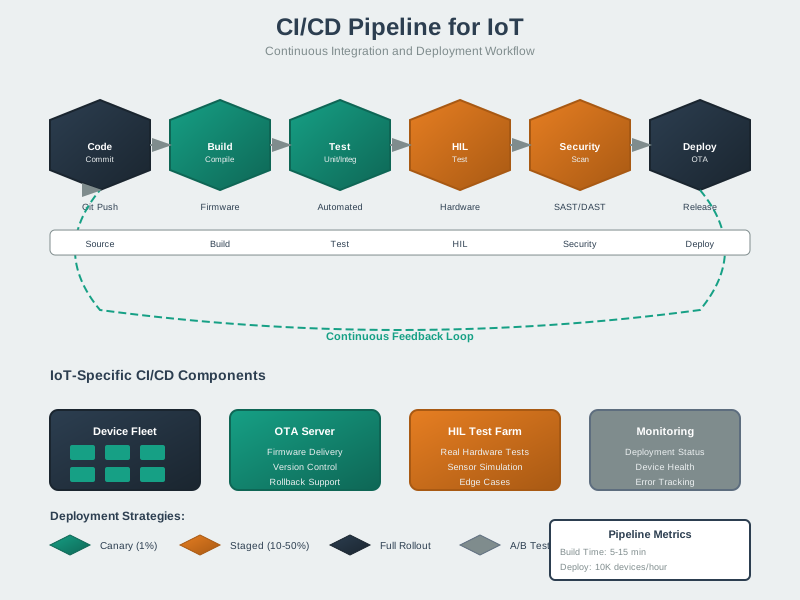
NoteCI/CD Pipeline Architecture
CI/CD Pipeline
A robust CI/CD pipeline automates the entire firmware delivery process from code commit to production deployment, with safety gates at each stage.
NoteDevOps IoT Pipeline
DevOps IoT Pipeline
The DevOps approach brings continuous integration and delivery practices to embedded systems development, enabling faster iteration with maintained quality.
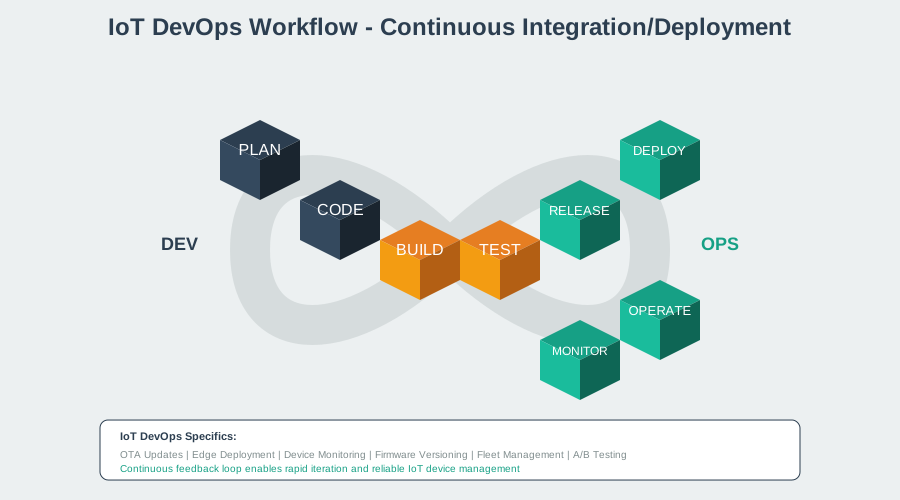
NoteDevOps Workflow for Embedded Systems
DevOps Workflow
Adapting DevOps workflows for embedded systems requires accommodating hardware constraints, cross-compilation, and device fleet management.
1585.8 Summary
Monitoring and tooling are essential for successful IoT CI/CD at scale. Key takeaways from this chapter:
Device health metrics should cover operational (uptime, CPU, memory, battery), application (sensor rates, queue depth), and update metrics (success rate, version distribution)
Crash reporting requires stack traces, symbolication, and automated analysis to group similar crashes and prioritize fixes
Version distribution dashboards enable visual monitoring of fleet update progress with alerts for slow adoption or version fragmentation
CI/CD tools range from Jenkins (customizable) to GitHub Actions (integrated) to Azure DevOps (Microsoft ecosystem)
OTA platforms like AWS IoT, Azure IoT Hub, Mender, and Memfault provide different trade-offs between features, cost, and ecosystem fit
Device management requires hierarchical grouping with dynamic assignment based on hardware revision, region, and other attributes
Real-world case studies from Tesla and John Deere demonstrate the importance of staged rollouts, multi-channel delivery, and user control
CI/CD for IoT requires adapting web development practices to the constraints of embedded systems. The stakes are higher - a bad update can brick critical infrastructure, compromise safety systems, or leave customers locked out of their homes. Implementing comprehensive monitoring, choosing appropriate tools, and learning from industry leaders are essential for responsible IoT product development.
Device Security: Securing devices against compromised firmware
1585.9 What’s Next
In the next chapter, Context-Aware Energy Management, we explore how to optimize power consumption in battery-powered IoT devices through duty cycling, dynamic voltage scaling, and context-aware operation - critical for devices that may need to operate for years on a single battery and receive OTA updates without draining power reserves.