%%{init: {'theme': 'base', 'themeVariables': {'primaryColor': '#2C3E50', 'primaryTextColor': '#fff', 'primaryBorderColor': '#16A085', 'lineColor': '#16A085', 'secondaryColor': '#E67E22', 'tertiaryColor': '#7F8C8D'}}}%%

sequenceDiagram
    participant S as IoT Sensor
    participant P as Kafka Producer
    participant B as Kafka Broker
    participant KS as Kafka Streams
    participant C1 as Time-Series DB
    participant C2 as Alert Service

    Note over S,C2: Message Lifecycle: 2-10ms end-to-end

    S->>P: Temperature: 85°C
    Note right of S: 0ms

    P->>B: Produce to raw-sensors
    Note right of P: +1ms (serialize, send)

    B->>B: Replicate to followers
    Note right of B: +2ms (durability)

    B->>KS: Consume from partition
    Note right of B: +1ms (fetch)

    KS->>KS: Parse → Aggregate → Detect
    Note right of KS: +3ms (processing)

    alt Anomaly Detected (Z > 3)
        KS->>C2: Produce to alerts topic
        C2->>C2: Trigger PagerDuty
        Note right of C2: Critical alert!
    else Normal Reading
        KS->>C1: Produce to metrics topic
        C1->>C1: Store in InfluxDB
        Note right of C1: Query from Grafana
    end

    Note over S,C2: Total latency: ~7ms median
1297 Stream Processing Architectures
1297.1 Stream Processing Architectures
1297.1.1 Apache Kafka + Kafka Streams
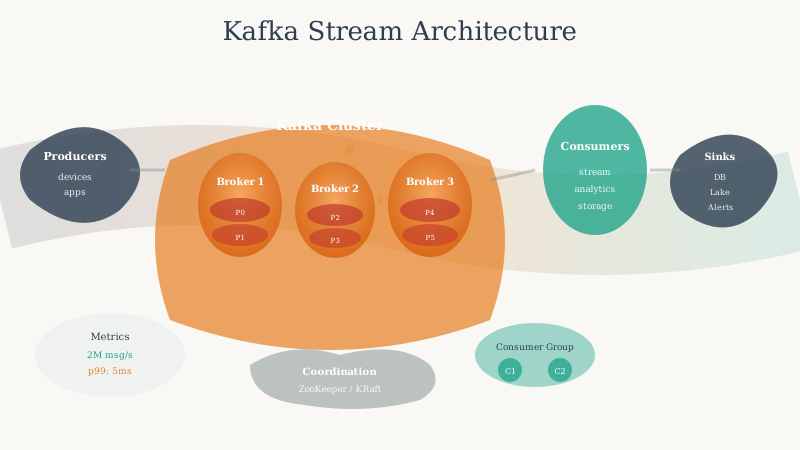
Apache Kafka is a distributed streaming platform that combines message queuing with stream processing capabilities through Kafka Streams.
WarningTradeoff: Push-Based vs Pull-Based Consumer Models for IoT Message Queues
Option A (Push-Based Consumers - RabbitMQ/AMQP style): - Delivery model: Broker pushes messages to consumers immediately upon arrival - Latency: 1-5ms message delivery (minimal delay between publish and consume) - Consumer control: Limited - prefetch count only, broker controls pace - Throughput: 10K-50K msg/sec per consumer (limited by consumer processing speed) - Flow control: Prefetch limits prevent overwhelming slow consumers - Use cases: Real-time alerts, chat systems, command-and-control where immediate delivery is critical - Failure handling: Messages requeued on NACK, broker tracks delivery state
Option B (Pull-Based Consumers - Kafka style): - Delivery model: Consumers fetch batches of messages when ready - Latency: 10-100ms typical (batch accumulation + poll interval) - Consumer control: Full - consumers decide batch size, timing, and offset commits - Throughput: 100K-500K msg/sec per consumer (batch efficiency) - Flow control: Natural backpressure - consumers only pull what they can process - Use cases: Log aggregation, metrics collection, stream processing where throughput matters - Failure handling: Consumer rewinds offset, re-reads from log (no broker state)
Decision Factors: - Choose Push-Based when: Sub-10ms latency required (financial trading, emergency alerts), message ordering per consumer is critical, consumers are always connected and fast, simple request-reply patterns needed - Choose Pull-Based when: Throughput exceeds 50K msg/sec, consumers need replay capability (reprocess historical data), batch processing is acceptable, consumers may be temporarily slow or offline, at-least-once semantics with consumer-controlled commits needed - Hybrid approach: Use push (RabbitMQ) for real-time command channels, pull (Kafka) for telemetry streams - many IoT systems use both patterns for different data types
WarningTradeoff: Key-Based Partitioning vs Round-Robin for Kafka Topics
Option A (Key-Based Partitioning - Same sensor always goes to same partition): - Routing: hash(sensor_id) % partition_count → deterministic partition assignment - Message ordering: Guaranteed per sensor (all readings from sensor X arrive in order) - Load distribution: Uneven if some sensors publish more than others (hot partitions) - Partition locality: Same consumer processes all data for a sensor (enables stateful processing) - Consumer scaling: Adding consumers may not help if load is concentrated in few partitions - Use cases: Sensor aggregations, session windowing, any stateful processing requiring per-key ordering
Option B (Round-Robin Partitioning - Messages distributed evenly across partitions): - Routing: Next message goes to next partition in sequence - Message ordering: None guaranteed (sensor X messages spread across all partitions) - Load distribution: Perfect even distribution regardless of publisher patterns - Partition locality: Each consumer sees random subset of sensors - Consumer scaling: Adding consumers linearly increases throughput - Use cases: Stateless processing (validation, enrichment), independent event handling, maximum throughput scenarios
Decision Factors: - Choose Key-Based when: Processing requires per-sensor state (running averages, anomaly detection), message ordering within a sensor matters (state machines, sequence detection), downstream systems expect sensor affinity (per-device dashboards) - Choose Round-Robin when: Each message is independent (fire-and-forget telemetry), maximum throughput is critical and ordering doesn’t matter, stateless transformations only (JSON parsing, format conversion), want to avoid hot partition problems from uneven sensor traffic - Metrics to monitor: Partition lag variance (key-based often shows 10x+ variance vs round-robin), consumer CPU imbalance across partitions, end-to-end latency p99 per partition
Example calculation: 100 sensors where 10% generate 90% of traffic - Key-based: 10 hot partitions at 90% load each, 90 idle partitions at 1% load - Round-robin: All partitions at uniform 10% load, but lose per-sensor ordering

Strengths: - Durability: All messages persisted to disk with configurable retention - Exactly-once semantics: Guarantees each message is processed exactly once - High throughput: 1+ million messages per second per broker - Horizontal scalability: Add brokers and partitions as needed - Fault tolerance: Automatic failover with replication
Performance Metrics: - Throughput: 1-2 million messages/second per broker - Latency: 2-10 milliseconds (median) - Retention: Days to years of historical data - Partitions: 1000s per cluster
Best For: IoT applications requiring guaranteed delivery, historical replay capability, and integration with multiple downstream systems.
The Kafka architecture excels at decoupling producers from consumers, enabling independent scaling and resilience. This producer-consumer model is fundamental to modern stream processing systems.
WarningTradeoff: Kafka Streams vs Apache Flink for IoT Stream Processing
Option A: Kafka Streams (Library-based) - Deployment model: Embedded library in your Java/Scala application - Infrastructure: No separate cluster - runs in your application containers - Operational cost: $200-800/month (Kafka cluster only, no separate Flink cluster) - State management: RocksDB embedded, state stored in Kafka topics - Throughput: 100K-500K events/sec per instance (scales with app instances) - Latency: 10-100ms typical (depends on commit interval) - Use cases: Stateful transformations, simple aggregations, microservice integration
Option B: Apache Flink (Distributed Framework) - Deployment model: Dedicated cluster with Job Manager and Task Managers - Infrastructure: Separate Flink cluster (3-10+ nodes typical) - Operational cost: $1,000-5,000/month (Kafka + Flink managed clusters) - State management: RocksDB or heap, checkpointed to S3/HDFS - Throughput: 1M-10M events/sec per cluster (horizontal scaling) - Latency: 1-10ms typical (true event-by-event processing) - Use cases: Complex event processing, ML inference, cross-stream joins, very high volume
Decision Factors: - Choose Kafka Streams when: Team already operates Kafka, processing logic fits in Java/Scala, 100K events/sec is sufficient, operational simplicity is critical, tight integration with Kafka ecosystem (Connect, Schema Registry) - Choose Flink when: Event volume exceeds 500K/sec, complex event patterns (CEP) needed, sub-10ms latency required, processing requires Python/SQL, cross-stream joins or sessionization needed - Real-world guidance: Start with Kafka Streams for most IoT projects - it handles 90% of use cases with simpler operations. Migrate to Flink when you hit throughput limits or need CEP capabilities.
1297.1.2 Apache Flink
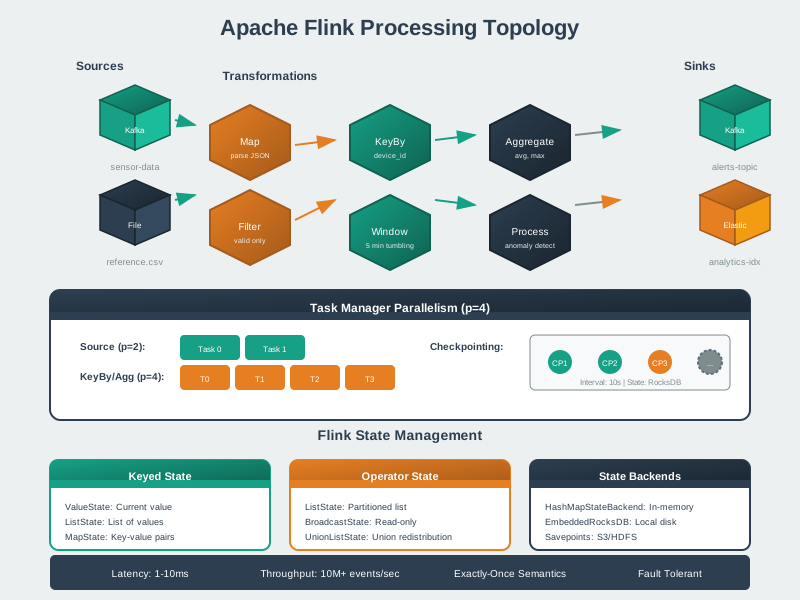
Apache Flink is a distributed stream processing framework designed for true streaming with event-time processing and exactly-once guarantees.

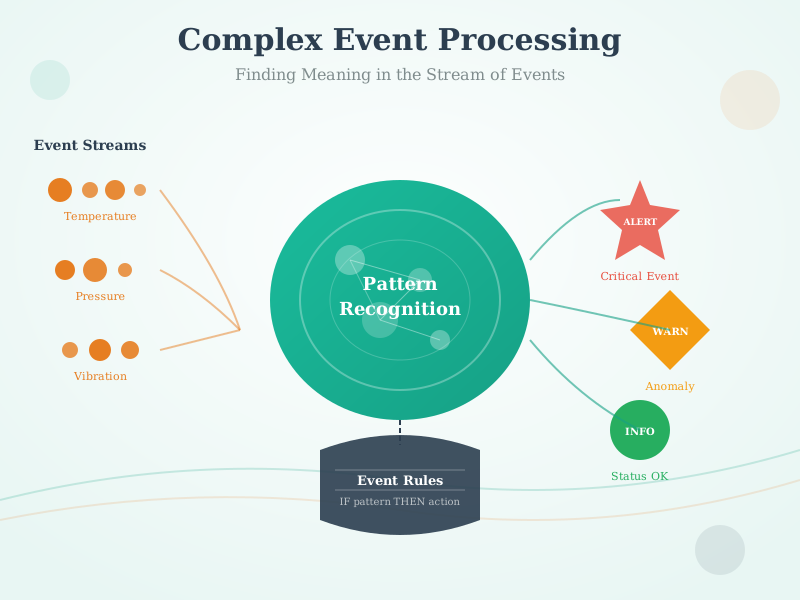
Strengths: - True streaming: Event-by-event processing, not micro-batches - Complex Event Processing (CEP): Built-in pattern matching for sequences - Event-time processing: Native support for watermarks and late data - State management: Fault-tolerant, distributed state with snapshots - Low latency: Single-digit millisecond processing times
Performance Metrics: - Latency: 1-10 milliseconds (p99) - Throughput: Millions of events per second - State size: Can handle gigabytes per task - Recovery time: Seconds to minutes depending on checkpoint size
Best For: Complex event processing, pattern detection, applications requiring very low latency and sophisticated event-time handling.
1297.1.3 Apache Spark Structured Streaming
Spark Structured Streaming extends Spark’s batch processing capabilities to streaming data using a micro-batch approach.

Strengths: - Unified API: Same code for batch and streaming - ML integration: Native integration with MLlib for real-time predictions - SQL support: Query streams with SQL - Ecosystem: Leverage entire Spark ecosystem - Fault tolerance: Checkpoint-based recovery
Performance Metrics: - Latency: 100 milliseconds to seconds (micro-batch interval) - Throughput: Millions of events per second - Batch interval: Typically 500ms to 10 seconds - Scalability: Thousands of nodes
Best For: Applications requiring machine learning on streaming data, teams already using Spark, use cases where 1-second latency is acceptable.
1297.1.4 Architecture Comparison
| Feature | Kafka Streams | Apache Flink | Spark Streaming |
|---|---|---|---|
| Processing Model | Event-by-event | Event-by-event | Micro-batch |
| Latency | 2-10 ms | 1-10 ms | 100 ms - 10 s |
| Throughput | 1M+ msg/sec | Millions/sec | Millions/sec |
| Exactly-Once | Yes | Yes | Yes |
| State Management | RocksDB/InMemory | RocksDB/Memory | HDFS/S3 |
| Event Time | Yes | Advanced | Yes |
| CEP Support | Limited | Built-in | Limited |
| ML Integration | External | External | Native (MLlib) |
| Deployment | Library (no cluster) | Cluster | Cluster |
| Learning Curve | Medium | Steep | Medium |
| Best Use Case | Kafka-centric apps | Complex patterns, low latency | ML + streaming |
WarningTradeoff: Managed Kafka Services vs Self-Hosted Kafka for IoT
Option A (Managed - Confluent Cloud/AWS MSK/Azure Event Hubs): - Setup time: 15-30 minutes (console wizard, no infrastructure provisioning) - Availability SLA: 99.95% (Confluent), 99.9% (MSK), automatic broker replacement - Scaling: Automatic partition rebalancing, 10,000+ partitions supported - Throughput cost at 100MB/sec: ~$2,000-4,000/month (pay per throughput unit) - Ops overhead: Zero broker management, automated patches, built-in monitoring - Features included: Schema Registry, Connect, KSQL (Confluent), CDC connectors - Vendor lock-in: Moderate (Kafka protocol portable, but proprietary extensions)
Option B (Self-Hosted - Apache Kafka on EC2/Kubernetes): - Setup time: 1-3 days (cluster provisioning, ZooKeeper/KRaft, security hardening) - Availability: Manual multi-AZ setup required, failover in 30-120 seconds - Scaling: Manual partition reassignment, rolling restarts for config changes - Throughput cost at 100MB/sec: ~$800-1,500/month (3-5 broker cluster on reserved instances) - Ops overhead: 10-20 hours/month (upgrades, monitoring, incident response, capacity planning) - Features included: Core Kafka only (Schema Registry, Connect require separate setup) - Vendor lock-in: None (full control, portable to any cloud or on-premises)
Decision Factors: - Choose Managed when: Team lacks Kafka expertise (learning curve is steep), time-to-market critical (<4 weeks), need enterprise features (RBAC, audit logs, tiered storage), throughput <500MB/sec (cost-effective range) - Choose Self-Hosted when: Throughput exceeds 500MB/sec (managed costs escalate), regulatory requirements mandate infrastructure control, need custom patches or bleeding-edge features, team has 2+ Kafka-experienced engineers - Break-even analysis: At 50MB/sec, managed wins. At 500MB/sec, self-hosted saves $20K-40K/year. Factor in $150K/year fully-loaded engineer cost for ops time.
WarningTradeoff: Real-Time Dashboards vs Batch Analytics for IoT Monitoring
Option A (Real-Time Dashboards - Sub-second refresh): - Data freshness: 1-10 seconds (live sensor values) - Query latency: 50-200ms (pre-aggregated metrics in Redis/TimescaleDB) - Infrastructure cost: $500-2,000/month (always-on stream processing + hot storage) - Development complexity: High (streaming pipeline, windowed aggregations, push updates) - Use cases: Operations centers, live fleet tracking, real-time alerting, trading floors - Accuracy: Approximate (windowed aggregates may miss late data) - User experience: Animated updates, live charts, immediate feedback
Option B (Batch Analytics - Scheduled refresh): - Data freshness: 1-24 hours (scheduled ETL jobs) - Query latency: 1-30 seconds (ad-hoc queries on data warehouse) - Infrastructure cost: $100-500/month (serverless batch + cold storage) - Development complexity: Lower (SQL transformations, scheduled jobs, standard BI tools) - Use cases: Executive reporting, trend analysis, compliance audits, capacity planning - Accuracy: Exact (complete dataset, no approximations) - User experience: Static reports, PDF exports, email digests
Decision Factors: - Choose Real-Time when: Operators need to react within minutes (factory floor, NOC, dispatch), users expect live feedback (ride-sharing, delivery tracking), anomaly detection must trigger immediate action, competitive advantage depends on speed - Choose Batch when: Insights drive strategic decisions (monthly reviews, budgeting), accuracy matters more than speed (financial reconciliation, compliance), users prefer scheduled reports (email digests, PDF exports), cost efficiency is critical and hourly latency is acceptable - Tiered approach: Real-time dashboards for operations (last 24 hours), batch analytics for history (30+ days) - most mature IoT platforms implement both, serving different user personas and use cases
1297.2 Visual Reference Gallery
NoteStream Processing Architecture
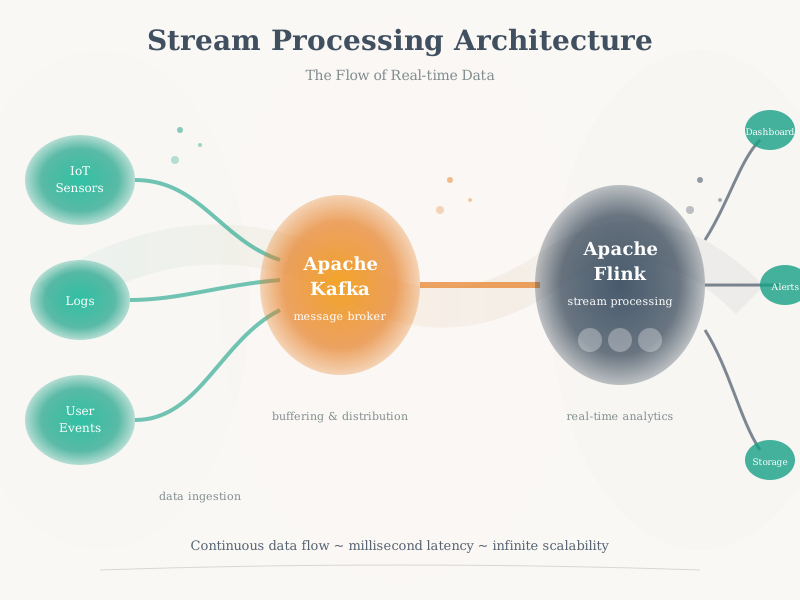
Stream processing architectures handle continuous IoT data flows through ingestion, processing, and output stages. Key components include message brokers for buffering, stream processors for transformations, and sinks for delivering results to dashboards, databases, or alerting systems.
NoteBatch vs Stream Processing Comparison
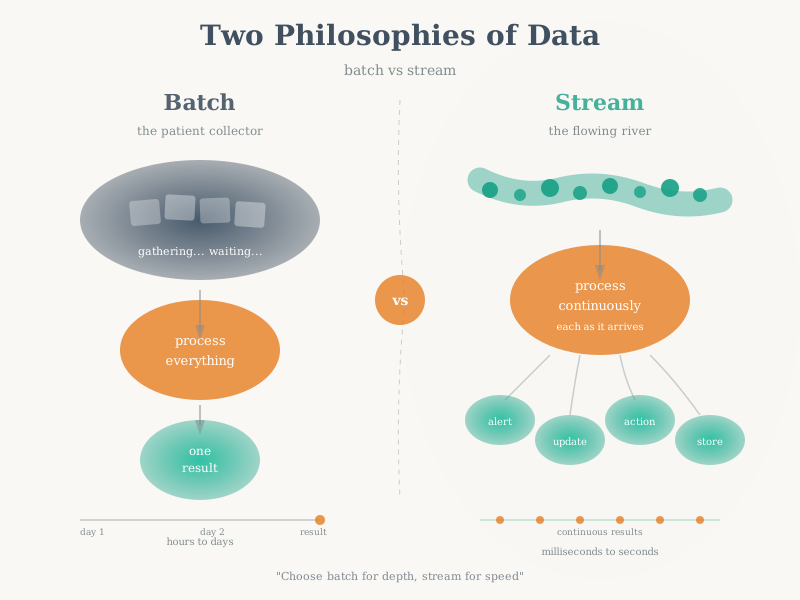
Batch and stream processing serve different IoT needs. Batch excels for comprehensive historical analysis with high throughput, while streaming provides low-latency real-time insights. Modern Lambda and Kappa architectures often combine both approaches.
NoteLambda Architecture Overview
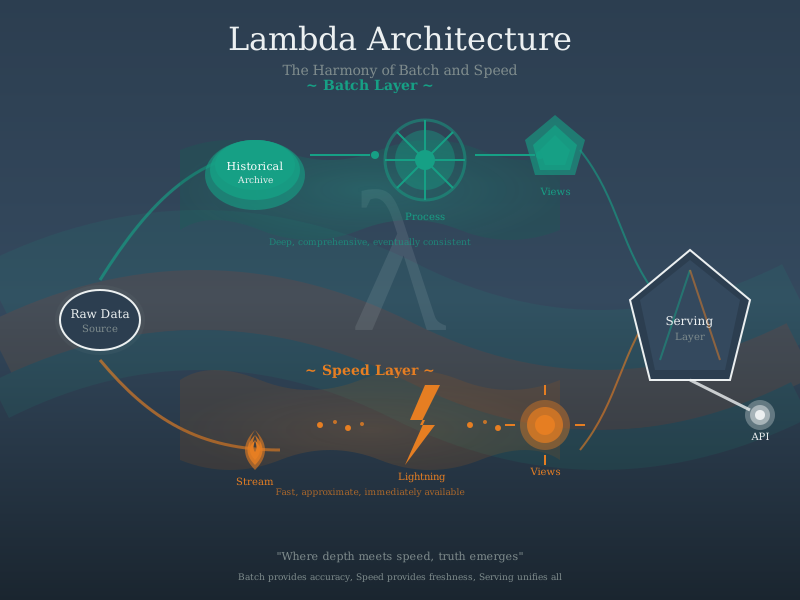
Lambda architecture combines batch and stream processing for IoT analytics. The batch layer provides accuracy through complete recomputation, the speed layer offers low latency for recent data, and the serving layer merges results for unified query access.
1297.3 What’s Next
Continue to Building IoT Streaming Pipelines to learn how to design and implement complete real-time IoT data pipelines with appropriate components and stages.