1312 Interoperability Standards
Learning Objectives
After completing this chapter, you will be able to:
- Implement SenML (Sensor Measurement Lists) for efficient IoT data representation
- Use JSON-LD to add semantic context to IoT data
- Understand the W3C Web of Things framework and Thing Descriptions
- Apply oneM2M standards for horizontal IoT platform integration
- Choose appropriate standards for different interoperability scenarios
1312.1 Prerequisites
Before diving into this chapter, you should be familiar with:
- Interoperability Fundamentals: Understanding the four interoperability levels is essential for knowing why these standards exist and which level each addresses
- Basic JSON: Understanding JSON structure is necessary for working with SenML and JSON-LD
- REST APIs: Familiarity with HTTP methods and resource-oriented design helps understand W3C WoT
1312.2 SenML: Sensor Measurement Lists (RFC 8428)
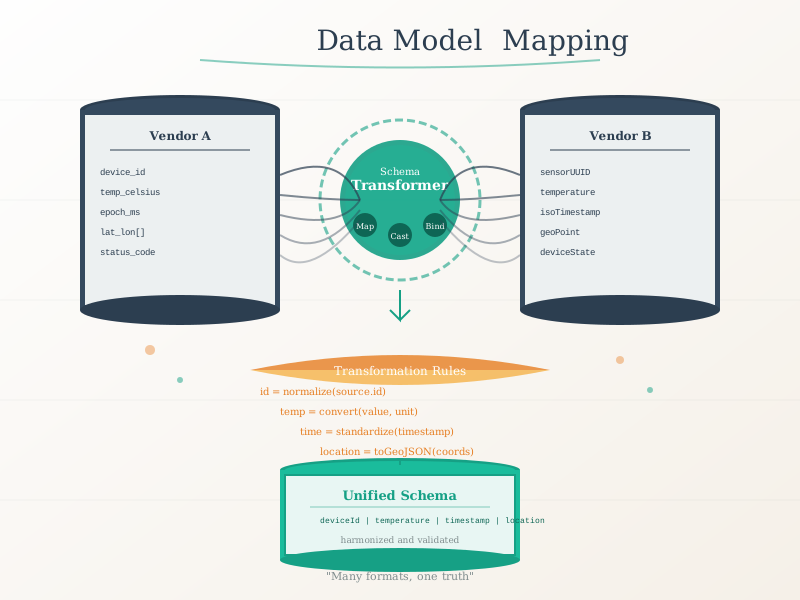
SenML provides a lightweight, standardized format for sensor data that dramatically reduces payload size through base values—critical for constrained networks.
1312.2.1 Why SenML Matters
Traditional JSON sensor payloads repeat metadata for every reading:
// Plain JSON: 240 bytes for 3 readings
[
  {"device": "sensor123", "type": "temperature", "value": 22.5, "unit": "Cel", "timestamp": 1609459200},
  {"device": "sensor123", "type": "temperature", "value": 22.7, "unit": "Cel", "timestamp": 1609459260},
  {"device": "sensor123", "type": "temperature", "value": 22.6, "unit": "Cel", "timestamp": 1609459320}
]
SenML eliminates repetition with base values:
// SenML: 120 bytes for same 3 readings (50% smaller)
[
  {"bn": "urn:dev:ow:10e2073a01080063:", "bt": 1609459200, "bu": "Cel", "n": "temp", "v": 22.5},
  {"n": "temp", "v": 22.7, "t": 60},
  {"n": "temp", "v": 22.6, "t": 120}
]
1312.2.2 SenML Base Values
| Field | Name | Description | Example |
|---|---|---|---|
bn |
Base Name | Prefix for all n values |
"urn:dev:ow:10e2073a01080063:" |
bt |
Base Time | Added to all t values |
1609459200 (Unix epoch) |
bu |
Base Unit | Default unit for all v values |
"Cel" (Celsius) |
bv |
Base Value | Added to all v values |
100 (offset) |
bs |
Base Sum | Added to all s values |
0 |
bver |
Base Version | SenML version | 10 |
1312.2.3 Payload Savings Analysis
For a sensor sending 100 readings with device name, unit, and base timestamp:
| Format | Size | Savings |
|---|---|---|
| Plain JSON | 8,000 bytes | baseline |
| SenML (JSON) | 2,400 bytes | 70% smaller |
| SenML (CBOR) | 1,200 bytes | 85% smaller |
This matters enormously for constrained networks: - LoRaWAN: 51-242 byte payloads - NB-IoT: Charged per byte - Sigfox: 12 byte limit
1312.2.4 SenML Units
SenML defines standard unit symbols (RFC 8428 Section 12.1):
| Unit | Symbol | Description |
|---|---|---|
| Celsius | Cel |
Temperature |
| Percent | % |
Relative humidity, battery |
| Lux | lx |
Illuminance |
| Pascal | Pa |
Pressure |
| Watt | W |
Power |
| Meter | m |
Distance |
| Meters/second | m/s |
Velocity |
Core Concept: SenML (RFC 8428) reduces payload size by 70%+ through base values that eliminate repetitive metadata, while JSON-LD adds semantic context through @context annotations linking terms to shared ontologies.
Why It Matters: Constrained IoT networks (LoRaWAN, NB-IoT) have strict byte limits where every byte counts. SenML’s compression enables more readings per transmission.
Key Takeaway: Use SenML for bandwidth-constrained sensor networks (base values: bn, bt, bu). Use JSON-LD when you need machines to understand data semantics across different vendors.
1312.3 JSON-LD: Linked Data for IoT
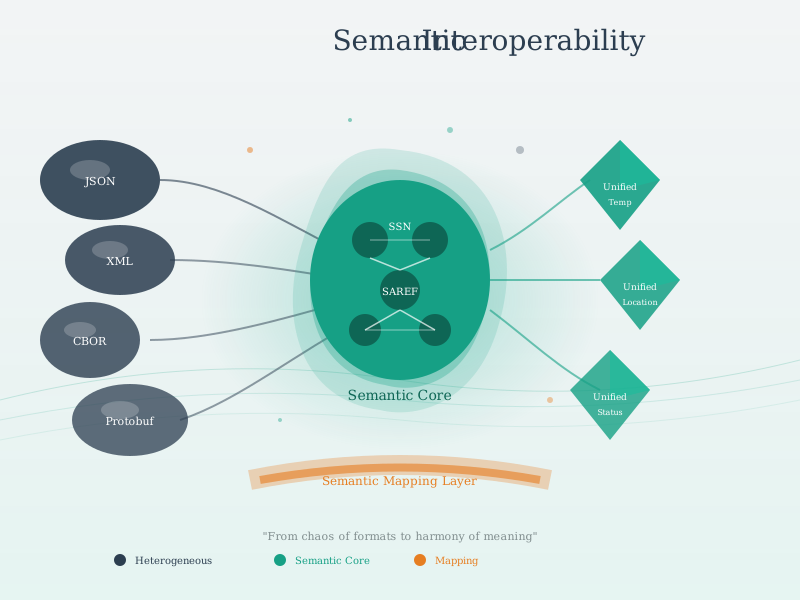
JSON-LD (JSON for Linked Data) adds semantic meaning to JSON by linking terms to shared vocabularies through the @context annotation.
1312.3.1 The Problem JSON-LD Solves
Without shared vocabulary, different vendors use different terms:
// Vendor A
{"temp": 22.5}

// Vendor B
{"temperature": 22.5}

// Vendor C
{"t": 22.5}
Machines cannot know these all mean the same thing. JSON-LD fixes this:
{
  "@context": {
    "sosa": "http://www.w3.org/ns/sosa/",
    "qudt": "http://qudt.org/schema/qudt/",
    "temperature": {
      "@id": "sosa:hasSimpleResult",
      "@type": "qudt:TemperatureValue"
    }
  },
  "@type": "sosa:Observation",
  "sosa:observedProperty": "qudt:Temperature",
  "temperature": 22.5
}
Now any system understanding SOSA/QUDT ontologies knows exactly what “temperature” means.
1312.3.2 Key JSON-LD Concepts
| Keyword | Purpose | Example |
|---|---|---|
@context |
Maps terms to URIs | Links “temperature” to SOSA ontology |
@id |
Unique identifier | "urn:sensor:temp-001" |
@type |
Type classification | "sosa:Observation" |
@value |
Literal value | 22.5 |
@language |
Language tag | "en" |
1312.3.3 Common IoT Ontologies
| Ontology | Purpose | URL |
|---|---|---|
| SOSA/SSN | Sensors and observations | http://www.w3.org/ns/sosa/ |
| QUDT | Units and quantities | http://qudt.org/schema/qudt/ |
| Schema.org | General concepts | https://schema.org/ |
| SAREF | Smart appliances | https://saref.etsi.org/core/ |
1312.4 W3C Web of Things (WoT)
The W3C Web of Things framework provides a standardized way to describe IoT device capabilities through Thing Descriptions (TD)—machine-readable documents that expose what a device can do.
1312.4.1 Thing Description Structure
A Thing Description is a JSON-LD document containing:
{
  "@context": "https://www.w3.org/2022/wot/td/v1.1",
  "id": "urn:dev:wot:com:example:smartlamp:001",
  "title": "Smart Lamp",
  "@type": "Thing",

  "properties": {
    "brightness": {
      "type": "integer",
      "minimum": 0,
      "maximum": 100,
      "forms": [{
        "href": "https://lamp.example.com/brightness",
        "op": ["readproperty", "writeproperty"]
      }]
    }
  },

  "actions": {
    "toggle": {
      "forms": [{
        "href": "https://lamp.example.com/actions/toggle",
        "op": "invokeaction"
      }]
    }
  },

  "events": {
    "overheating": {
      "data": {"type": "number"},
      "forms": [{
        "href": "https://lamp.example.com/events/overheating",
        "subprotocol": "sse"
      }]
    }
  }
}
1312.4.2 WoT Affordances
| Affordance | Description | Interaction Pattern |
|---|---|---|
| Properties | Readable/writable device state | Poll or observe (GET/PUT) |
| Actions | Invocable operations | Trigger and wait (POST) |
| Events | Push notifications | Subscribe and receive |
1312.4.3 Properties vs Events
| Aspect | Properties | Events |
|---|---|---|
| Direction | Client pulls (query on demand) | Device pushes (notification) |
| Initiation | Client decides when to read | Device decides when to emit |
| Use Case | Current temperature, brightness | Motion detected, alarm triggered |
| Protocol | HTTP GET, CoAP GET | WebSocket, MQTT, SSE |
1312.4.4 Protocol Bindings
WoT Thing Descriptions are protocol-agnostic. The forms array specifies how to access each affordance:
"forms": [
  {"href": "http://lamp.local/brightness", "op": "readproperty"},
  {"href": "coap://lamp.local/brightness", "op": "readproperty"},
  {"href": "mqtt://broker/lamp/brightness", "op": "observeproperty"}
]
Applications read the TD, discover available protocols, and choose based on their capabilities.
1312.5 Knowledge Check
1312.6 oneM2M: Horizontal IoT Platform
oneM2M provides a horizontal platform layer that abstracts vertical-specific implementations (smart cities, healthcare, automotive) through a common service layer.
1312.6.1 oneM2M Architecture
┌─────────────────────────────────────────────────────────────┐
│                    Applications (AE)                        │
│         Smart City    Healthcare    Automotive              │
└─────────────────────────────────────────────────────────────┘
                              │
                              ▼
┌─────────────────────────────────────────────────────────────┐
│              Common Services Entity (CSE)                   │
│   Registration │ Discovery │ Data Mgmt │ Subscription       │
│   Security     │ Group Mgmt│ Device Mgmt│ Notification      │
└─────────────────────────────────────────────────────────────┘
                              │
        ┌─────────────────────┼─────────────────────┐
        ▼                     ▼                     ▼
┌───────────────┐     ┌───────────────┐     ┌───────────────┐
│  HTTP Binding │     │  CoAP Binding │     │  MQTT Binding │
└───────────────┘     └───────────────┘     └───────────────┘
1312.6.2 oneM2M Resource Model
| Resource Type | Description | Example |
|---|---|---|
| CSEBase | Root of resource tree | Infrastructure node |
| AE | Application Entity | Smart meter app |
| Container | Data holder | Temperature readings |
| ContentInstance | Individual data point | {"temp": 22.5} |
| Subscription | Event notification | Alert on threshold |
1312.6.3 Why oneM2M for Cross-Domain Integration
| Scenario | Without oneM2M | With oneM2M |
|---|---|---|
| 3 domains, 3 vendors | 9 custom integrations | 3 standard APIs |
| Add new domain | +6 integrations | +1 integration |
| Protocol change | Modify all integrations | Change binding only |
1312.7 Choosing the Right Standard
| Standard | Best For | Level Addressed | Payload Efficiency |
|---|---|---|---|
| SenML | Constrained networks, sensor data | Syntactic | Excellent (70%+ savings) |
| JSON-LD | Semantic linking, vocabulary mapping | Semantic | Moderate (adds (context?) overhead) |
| W3C WoT | Device discovery, capability exposure | Syntactic + Semantic | N/A (metadata, not data) |
| oneM2M | Cross-domain platform, enterprise | All four levels | Varies by binding |
1312.7.1 Decision Tree
Is network constrained (LoRa, NB-IoT)?
├─ YES → Use SenML for data payload
└─ NO → Continue

Do you need machines to understand data meaning?
├─ YES → Add JSON-LD @context
└─ NO → Plain JSON may suffice

Do devices need self-description for discovery?
├─ YES → Implement W3C WoT Thing Descriptions
└─ NO → Static API documentation may suffice

Integrating multiple vendors across domains?
├─ YES → Consider oneM2M platform layer
└─ NO → Point solutions may suffice
1312.8 Summary
- SenML (RFC 8428) provides lightweight sensor data representation with base values (bn, bt, bu) that reduce payload size by 70%+ through eliminating repetitive metadata, critical for constrained networks like LoRaWAN and NB-IoT.
- JSON-LD enables semantic interoperability by linking terms to shared vocabularies through
@contextannotations, allowing heterogeneous systems to understand that different terms reference the same concepts. - W3C Web of Things framework uses Thing Descriptions (JSON-LD documents) to expose device capabilities through properties (readable/writable state), actions (invocable operations), and events (push notifications), with protocol bindings enabling HTTP, CoAP, MQTT access.
- oneM2M provides a horizontal platform layer with common service entity (CSE) that abstracts vertical-specific implementations, enabling cross-domain integration through a unified resource model and multiple protocol bindings.
- Standard selection depends on constraints: SenML for bandwidth-limited networks, JSON-LD for semantic understanding, WoT for device discovery, oneM2M for enterprise cross-domain integration.
1312.9 What’s Next
Now that you understand interoperability standards:
- Integration Patterns: Learn how to implement Protocol Adapters and Gateways using these standards
- Protocol Details: Deep dive into MQTT and CoAP protocols
- Reference Models: Explore IoT Reference Models that incorporate these standards
1312.10 Resources
1312.10.1 Specifications
1312.10.2 Libraries
- RDFLib - Python RDF library
- WoT Scripting API
- Eclipse Leshan - LwM2M implementation