1333 Edge Computing: Topic Review
1333.1 Learning Objectives
By the end of this review, you will be able to:
- Summarize Edge Concepts: Recall key principles of edge computing and the IoT Reference Model levels
- Apply Data Reduction: Calculate bandwidth savings from downsampling, aggregation, and filtering
- Evaluate Power Trade-offs: Assess battery life implications of different sampling and transmission strategies
- Analyze Deployment Scenarios: Interpret real-world edge computing case studies
- Validate Understanding: Test comprehension through video content and supplementary resources
- Connect to Cloud Topics: Understand how edge processing relates to cloud-scale data handling
1333.2 Prerequisites
Required Chapters:
- Edge Fundamentals - Edge computing basics
- Edge Compute Patterns - Processing patterns
- Edge Comprehensive Review - Full review
This Quick Review Covers:
| Topic | Key Points |
|---|---|
| Edge vs Cloud | Latency, bandwidth, privacy |
| Compute Patterns | Filtering, aggregation, ML |
| Architecture | Gateway, fog, cloudlet |
| Use Cases | Latency-sensitive apps |
Interactive Tool:
- Try the Edge Latency Explorer
Estimated Time: 20 minutes
Think of this topic review as a summary map of the edge computing chapters rather than a place to learn everything from scratch.
- If you are new to edge concepts, start with Edge Compute Patterns and Edge Data Acquisition first.
- Once those ideas feel familiar, use this review to:
- Revisit the key definitions (Massive vs Critical IoT).
- Practice quick power/bandwidth calculations.
- Connect the edge story to the upcoming Data in the Cloud chapter.
You can treat this file as a lightweight checkpoint: scan the summary, watch the linked videos, and check whether the formulas and trade-offs still make sense before you move on.
1333.3 Topic Review Chapters
This topic review is organized into three focused chapters. Work through them in order or jump to the section you need:
1333.3.1 1. Architecture Patterns and Decision Frameworks
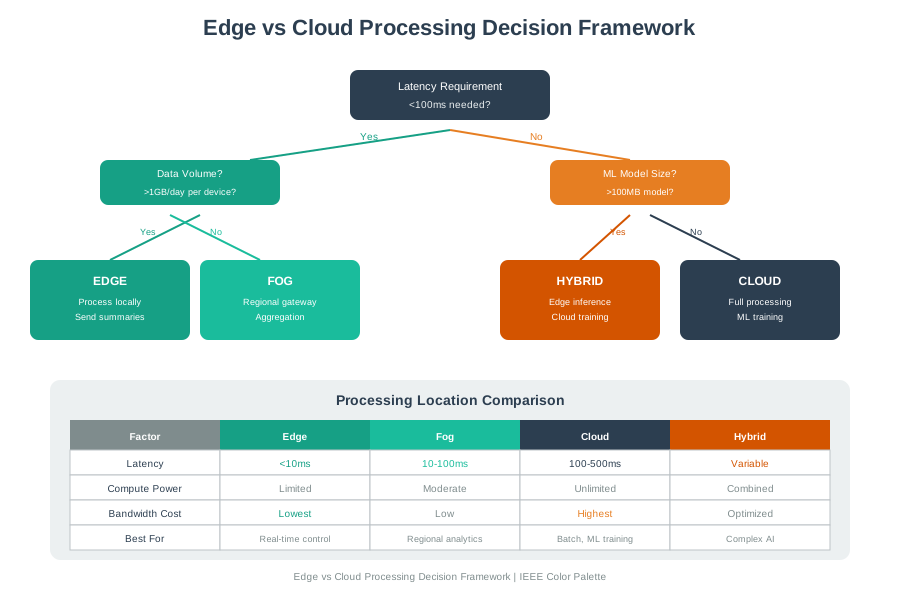
- Edge, fog, and cloud computing tiers
- IoT Reference Model four levels
- Edge Gateway EFR Model (Evaluate-Format-Reduce)
- Decision matrices for architecture selection
- Massive IoT vs Critical IoT comparison
- Workload placement guidelines
1333.3.2 2. Calculations and Power Optimization
- Data volume reduction formulas
- Bandwidth savings calculations
- Battery life estimation with sleep modes
- Latency component analysis
- Total cost of ownership (TCO)
- Practice problems with detailed solutions
1333.3.3 3. Real-World Deployments and Technology Stack
- Agricultural, smart building, and industrial case studies
- Common deployment pitfalls and solutions
- Hardware and software technology stack
- Edge processing techniques (moving average, FFT, rules)
- Security best practices
- KPIs and monitoring dashboards
- Industry standards and open source platforms
- Comprehensive review questions
1333.4 Chapter Summary
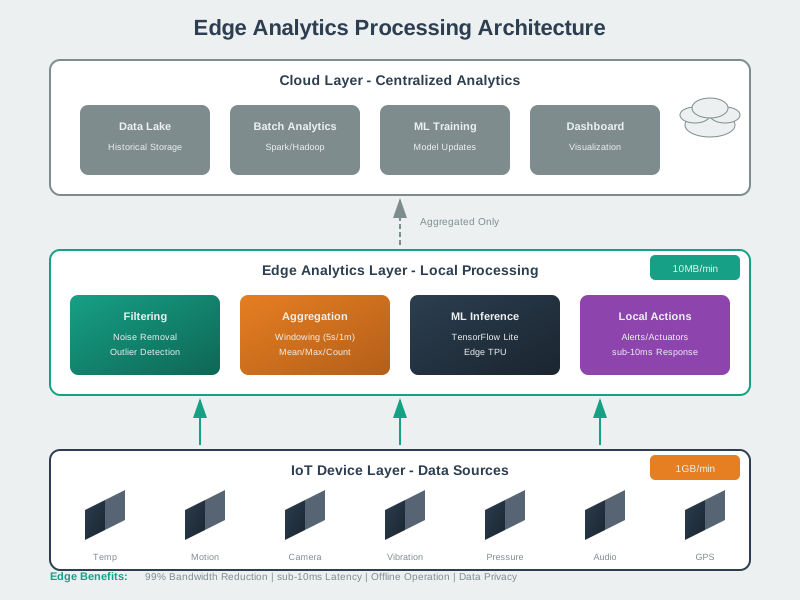
Edge computing processes IoT data close to sources, addressing latency, bandwidth, power, and cost challenges. The IoT Reference Model defines four levels: physical devices (Level 1), connectivity (Level 2), edge computing (Level 3), and data accumulation (Level 4). Levels 1-3 handle data in motion through event-driven processing, while Level 4 converts to data at rest for long-term storage. Edge gateways at Level 3 perform evaluation to filter low-quality data, formatting for standardization, and distillation to reduce volume through aggregation and statistical summarization.
Data volume reduction strategies operate at multiple levels. Sensor-level approaches include reducing sampling rates, event-driven transmission, and using simpler sensors when appropriate. Gateway-level techniques like downsampling, aggregation, filtering, and bundling achieve 100-1000x reduction. The comprehensive edge computing orchestrator demonstrates complete data flow through all four levels with power management, network reliability, quality scoring, and intelligent filtering achieving 3.3x data reduction in practice.
Power optimization critically impacts deployment viability. Deep sleep modes (0.01 mA) versus active (25 mA) and transmit (120 mA) modes dramatically affect battery life. Strategic sampling intervals extend battery life from months to years, with cost analysis showing significant savings from reduced maintenance and battery replacements. The agricultural IoT deployment example illustrates bundling data from multiple sensors at gateways, adding geographic metadata, and forwarding hourly aggregates to cloud, enabling local decision-making while minimizing network costs.
This review connects to multiple learning resources:
- Knowledge Gaps Hub - Common misconceptions about edge vs cloud
- Simulations Hub - Edge Latency Explorer tool
- Videos Hub - Edge-Fog-Cloud architecture videos
- Quizzes Hub - Edge computing self-assessment
These hubs provide interactive tools and additional perspectives to deepen your understanding of edge computing concepts.
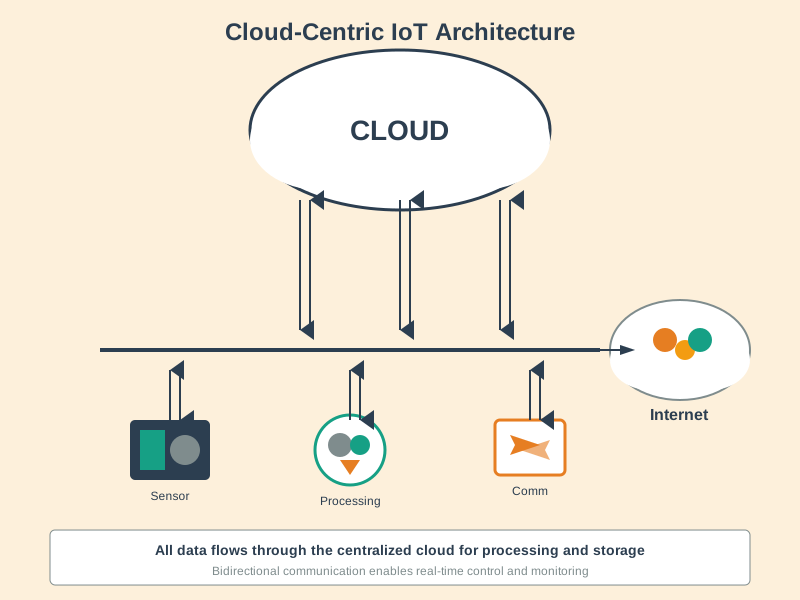
Misconception: Many students believe edge computing is a replacement for cloud infrastructure.
Reality with Quantified Examples:
- AWS IoT Greengrass deployments: 94% use hybrid edge-cloud architectures (only 6% edge-only)
- Microsoft Azure IoT Edge: 87% of production deployments sync edge-processed data to cloud for long-term analytics
- Real-world split: Edge handles ~80% of data volume locally but sends critical 20% to cloud
- Industrial IoT survey (2023): 89% of manufacturers use edge for real-time control but cloud for predictive maintenance models
Why hybrid wins:
- Edge excels at latency-sensitive tasks (<10ms): safety shutdowns, motion control
- Cloud excels at compute-intensive tasks: training ML models on months of data from 100+ sites
- Example: Predictive maintenance - Edge detects anomalies in 5ms, cloud trains improved models using fleet-wide data (requires 1000x more compute than edge gateway has)
Cost reality: Cloud storage costs $0.023/GB/month vs edge storage at $0.50/GB (hardware depreciation). For 10TB historical data, cloud saves $4,770/month.
The optimal architecture is hybrid: edge for real-time decisions, cloud for historical insights and model improvement.
1333.5 Visual Reference Gallery
These AI-generated SVG diagrams provide alternative visual perspectives on the edge computing topics covered in this review.

1333.6 Knowledge Check
Test your understanding of edge, fog, and cloud trade-offs.
Detailed Review Chapters:
- Edge Review: Architecture - Architecture patterns and decision frameworks
- Edge Review: Calculations - Formulas and practice problems
- Edge Review: Deployments - Real-world patterns and technology stack
Study Materials:
- Edge Compute Patterns - Processing patterns
- Edge Data Acquisition - Data collection methods
- Edge Comprehensive Review - Full coverage
Practice:
- Edge Quiz Bank - Test yourself
Architecture:
- Edge Fog Computing - Architecture overview
- Edge Fog Cloud Overview - Continuum placement
Next Topic:
- Data in the Cloud - Cloud-scale data handling
- Data Storage and Databases - Storage models and formats
1333.7 What’s Next
Continue with the detailed review chapters:
- Edge Review: Architecture - Start here for architecture patterns
- Edge Review: Calculations - Formulas and practice problems
- Edge Review: Deployments - Real-world patterns and technology
Or proceed to the next topic: Data in the Cloud - Cloud architectures, scalable storage systems, distributed processing frameworks, and analytics platforms for IoT data at massive scale.