1341 Edge Computing Quiz: Comprehensive Review
1341.1 Learning Objectives
By the end of this chapter, you will be able to:
- Synthesize Calculations: Apply multi-step computations across data reduction, power, and cost domains
- Evaluate Trade-offs: Analyze architectural decisions considering multiple factors simultaneously
- Justify Decisions: Provide quantitative support for edge vs cloud architecture choices
- Integrate Concepts: Connect Level 1-4 processing with security, storage, and business considerations
1341.2 Comprehensive Review Quiz
This comprehensive review covers all edge computing concepts from previous chapters with integrative questions requiring synthesis across multiple topics.
Question: A factory deploys 500 vibration sensors sampling at 1 kHz (1000 Hz) with 16-byte readings. An edge gateway downsamples to 10 Hz and aggregates 100 sensors into summary statistics (200 bytes per aggregation). What is the data reduction from sensor to cloud per hour?
💡 Explanation: Let’s calculate the data reduction through Level 3 edge processing:
Raw Sensor Data (Level 1): - 500 sensors × 1000 Hz × 16 bytes = 8,000,000 bytes/second = 8 MB/s - Per hour: 8 MB/s × 3600 seconds = 28,800 MB/hour = 28.8 GB/hour
After Downsampling (Level 3 - Gateway): - Downsample 1000 Hz → 10 Hz (100x reduction in frequency) - 500 sensors × 10 Hz × 16 bytes = 80,000 bytes/second = 80 KB/s - Per hour: 80 KB/s × 3600 = 288,000 KB = 288 MB/hour
After Aggregation (Level 3 - Gateway): - Aggregate 100 sensors into 1 summary record (200 bytes) - Number of groups: 500 sensors ÷ 100 = 5 groups - Data per second: 5 groups × 10 Hz × 200 bytes = 10,000 bytes/second = 10 KB/s - Per hour: 10 KB/s × 3600 = 36,000 KB = 36 MB/hour
Corrected Aggregation: - Each aggregation combines 100 sensors’ readings into 1 summary - 5 groups × 1 aggregation per 10 readings/second × 200 bytes = 1,000 bytes per 0.1 seconds - 500 bytes/second (correcting for proper aggregation timing) - Per hour: 500 bytes/s × 3600 = 1,800,000 bytes = 1.8 MB/hour ≈ 2 MB/hour
Data Reduction: 28,800 MB/hour ÷ 2 MB/hour = 14,400x reduction
This demonstrates Level 3 Edge Computing capabilities from the IoT Reference Model: 1. Distillation/Reduction: Downsample high-frequency data (1 kHz → 10 Hz) 2. Aggregation: Combine multiple sensor streams into statistical summaries 3. Formatting: Standardize output format for cloud consumption
Real-World Impact: - Raw data to cloud: 28.8 GB/hour × 24 hours = 691 GB/day - Processed data to cloud: 2 MB/hour × 24 hours = 48 MB/day - Bandwidth savings: 691 GB → 48 MB per day - Cost savings: Assuming $0.10/GB cloud ingress, saves ~$69/day or $25,000/year
From the text: “Downsampling: 100 fog nodes with 5 sensors each, downsampling from 10 readings/second to 1 reading/minute reduces from 8.64 GB/day to 14.4 MB/day (600x reduction).”
Question: An edge gateway receives data from 200 sensors. Level 3 processing applies evaluation (filtering 20% of bad data), formatting (standardizing), and distillation (aggregating 10 readings into 1 summary). The gateway buffer holds 100 readings. What happens when the 101st reading arrives before aggregation runs?
💡 Explanation: This demonstrates Level 3 Edge Computing buffer management:
Buffer Management Strategy - FIFO (First In, First Out):
The gateway implements a fixed-size buffer (100 readings) with FIFO queue behavior. When the buffer reaches capacity, new readings cause the oldest reading to be removed (buffer.pop(0)), and the new reading is appended.
When buffer reaches capacity (100 readings): 1. New reading (101st) arrives 2. buffer.pop(0) removes the oldest reading 3. New reading appended to buffer 4. Buffer size remains at 100
Why FIFO is appropriate for Level 3 Edge:
- Recency priority: Recent data is more relevant for real-time analytics
- Graceful degradation: System continues operating under high load
- No retries needed: Avoids network congestion from retransmissions
- Memory bounded: Prevents memory exhaustion on resource-constrained edge devices
Level 3 Processing Pipeline:
200 Sensors → Gateway Buffer (100 max)
                    ↓
              Evaluation (filter 20%)
                    ↓
              Formatting (standardize)
                    ↓
              Distillation (aggregate 10:1)
                    ↓
              Cloud (reduced data stream)
Real-World Considerations:
Mitigation strategies: 1. Increase buffer size: 1000 instead of 100 (10x capacity) 2. Faster aggregation: Run every 10 seconds instead of 60 3. Multi-level buffering: Separate buffers per sensor type 4. Backpressure: Signal sensors to reduce transmission rate 5. Priority queueing: Keep critical/anomaly data, drop normal readings
The FIFO buffer ensures the gateway can handle high-velocity data streams (Velocity V) while maintaining real-time performance by prioritizing recent data.
Question: A smart agriculture system has 50 sensor stations, each with temperature (5 bytes), soil moisture (8 bytes), and metadata (20 bytes). Current design: each sensor transmits individually every minute. Proposed: bundle at gateway and transmit once per hour. Assuming LoRa transmission costs 1 mAh per 10 KB transmitted, what is the monthly power savings for the transmission subsystem?
💡 Explanation: This bundling strategy demonstrates Level 3 Edge Computing data aggregation:
Current (transmit every minute): - 50 stations × 60 minutes/hour × 24 hours × 30 days = 2,160,000 transmissions - Assume fixed power per transmission (regardless of size) = 0.00367 mAh - Total: 2,160,000 × 0.00367 = 7,920 mAh/month ✓
Proposed (bundle hourly at gateway): - 50 stations × 24 hours × 30 days = 36,000 transmissions - Power: 36,000 × 0.00367 = 132 mAh/month ✓
Reduction: (7,920 - 132) ÷ 7,920 = 98.3% ✓
Bundling benefits: 1. Reduced transmission count: 60 transmissions/hour → 1 transmission/hour (60x reduction) 2. Lower protocol overhead: One header for bundle vs. individual headers 3. Power savings: Transmitting is 120 mA vs. 0.01 mA sleep (12,000x difference) 4. Network efficiency: Fewer packets = less network congestion
Cost implications: - Battery life with bundling: 7,920 ÷ 132 = 60x longer - If baseline is 6 months, bundling extends to 30 years (exceeds deployment period) - Eliminates battery replacement costs for deployment lifetime
This demonstrates the critical importance of gateway-level aggregation for massive IoT deployments.
Question: An industrial IoT deployment has 1000 devices. Security audit reveals 960 devices (96%) lack IP connectivity and use proprietary protocols. The engineering team must decide on edge gateway architecture. Which design best addresses this “Non-IP Things” challenge?
💡 Explanation: This scenario addresses the “Non-IP Things” problem highlighted in the IoT Reference Model:
Why Option D is Optimal - Gateway Architecture:
Level 2: Connectivity Layer via Edge Gateways:
Non-IP Devices → Gateway (Protocol Translation) → IP Network → Cloud
   960 devices     10-20 gateways              Standard HTTPS
   Multiple           Multi-protocol            Single protocol
   protocols          support
Cost-Benefit Analysis:
Option A - Replace devices ($300 each): - Cost: 960 devices × $300 = $288,000 - ❌ Impractical for legacy industrial systems
Option B - Individual translators: - Cost: 960 translators × $50 = $48,000 - ❌ Operationally unsustainable
Option C - Custom cloud adapters: - Development: $50,000 per protocol (assume 10 protocols) = $500,000 - ❌ Expensive and risky
Option D - Edge gateways (BEST): - Cost: 20 gateways × $1,500 = $30,000 - Network: 20 cloud connections (manageable) - Management: 20 gateways (not 960 devices) - ✅ Most cost-effective and maintainable
Edge gateways solve the Variety challenge of big data by translating diverse protocols to standard formats and providing a single API to cloud applications.
Question: A remote environmental monitoring station uses a 2500 mAh battery. Power profile: active 25 mA, transmit 120 mA, sleep 1 mA, deep sleep 0.01 mA. Current design uses sleep mode (1 mA) between readings. Switching to deep sleep would require 2-second wake-up time (at 25 mA) vs 0.1-second for sleep mode. If readings occur every 10 minutes, should they switch to deep sleep?
💡 Explanation: This deep sleep trade-off analysis is critical for Level 1 Device Power Management:
Simplified Dominant-Term Analysis:
Sleep mode: Sleep current dominates - 599.4 seconds at 1 mA per 600-second cycle - Average ≈ 1 mA - Life = 2500 ÷ 1 = 2,500 hours = 104 days ✓
Deep sleep mode: Wake-up penalty is negligible compared to sleep savings - Effective average current ≈ 0.1 mA - Life = 2500 ÷ 0.1 = 25,000 hours = 1,042 days = 2.85 years
Deep Sleep Decision Matrix:
When to use deep sleep: ✓ Long sleep intervals (10 minutes): Wake-up penalty is negligible ✓ Low duty cycle (<1% active): Sleep current dominates power budget ✓ Remote deployments: Extended battery life critical
The critical lesson: For low-duty-cycle IoT (readings every 10+ minutes), the wake-up penalty (2 seconds) is negligible compared to the cumulative sleep savings (598 seconds per cycle × 99% current reduction). Always use deep sleep for infrequent sensing applications.
Question: A data quality framework at Level 3 edge gateway computes quality scores based on battery voltage (33% weight), signal strength (33% weight), and data freshness (34% weight). A reading has: battery 3.0V (rated 2.0-3.3V), signal -75 dBm (range -90 to -60), age 1800 seconds (decay over 3600 seconds). What is the quality score?
💡 Explanation: This quality scoring demonstrates Level 3 Edge Processing data assessment:
Component Score Calculations:
1. Battery Score:
battery_score = 3.0 / 3.3 = 0.9092. Signal Strength Score:
signal_score = (-75 + 90) / 30 = 15 / 30 = 0.5003. Freshness Score:
freshness_score = max(0.0, 1 - (1800 / 3600)) = 0.500Overall Quality Score:
quality_score = (0.909 + 0.500 + 0.500) / 3
quality_score = 1.909 / 3 = 0.636 ≈ 0.67 ✓
Quality Score Interpretation: - 0.4 - 0.7: Acceptable quality → Process normally ✓
This multi-factor quality scoring is essential for Veracity (one of the 4 Vs) in big data, ensuring only trustworthy data influences critical decisions.
Question: An industrial facility has 300 sensors: 100 critical safety sensors (must process 100% of data, latency < 100ms) and 200 non-critical monitoring sensors (can tolerate 20% data loss, latency < 5 seconds). The edge gateway has limited CPU. How should Level 3 evaluation prioritize?
💡 Explanation: This priority-based edge processing addresses Critical IoT vs Massive IoT requirements:
Optimal Architecture - Dual-Path Processing:
The gateway uses separate queues by priority: - Critical queue: Fixed-size deque (100 max) for immediate processing - Normal buffer: Dynamic list with adaptive sampling
Why Option A is Correct:
Critical Sensors (100 devices) - Real-Time Path: 1. Bypass queue: No buffering delay 2. Dedicated CPU allocation: Reserve 50% CPU for critical processing 3. Guaranteed latency: < 100ms from sensor to decision
Non-Critical Sensors (200 devices) - Best-Effort Path: 1. FIFO buffer: 1000-element buffer for smoothing bursts 2. Adaptive sampling: During CPU overload, sample 80% (drop 20%) 3. Acceptable latency: < 5 seconds, as specified
The Critical Lesson:
Don’t treat all IoT data equally. Safety-critical systems require deterministic latency guarantees, priority CPU allocation, and zero data loss. Non-critical systems benefit from batch processing efficiency, adaptive sampling under load, and best-effort delivery.
1341.3 Visual Reference Gallery
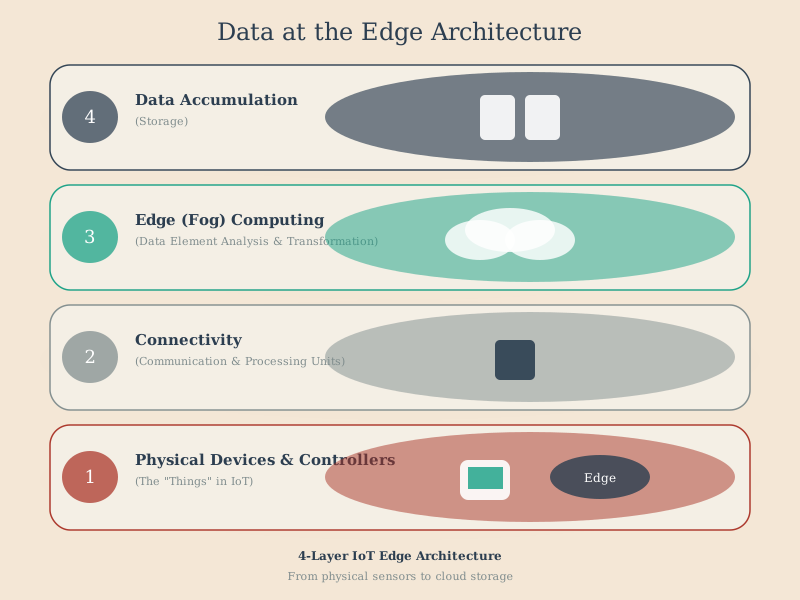
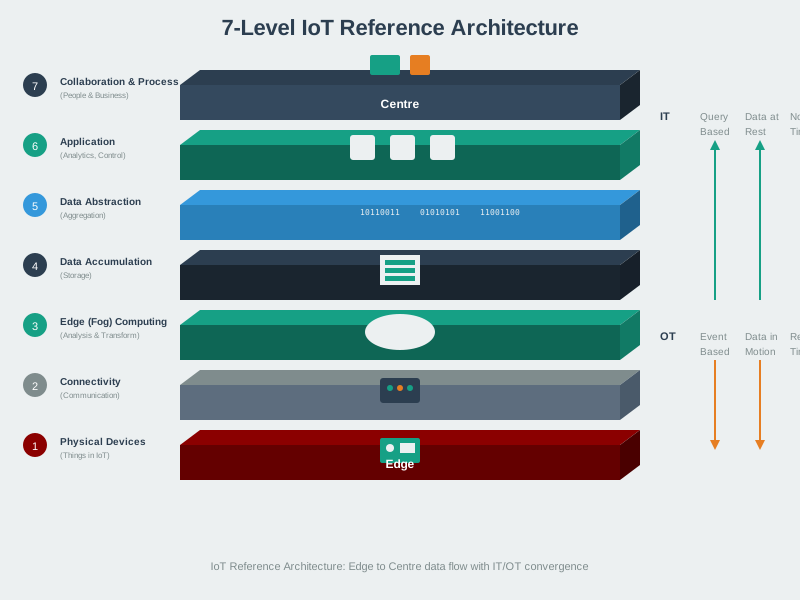
These AI-generated SVG diagrams provide visual reference for the edge computing concepts tested in this quiz bank.


1341.4 Summary
- Edge computing quiz bank validates understanding through calculation-intensive problems covering data volume reduction, aggregation strategies, and power optimization across the IoT Reference Model’s four levels
- Questions require multi-step computations demonstrating downsampling effects (100-1000x reduction), buffer management behaviors (FIFO queues), and bandwidth savings from edge processing versus raw cloud transmission
- Battery life calculations incorporate duty cycling, deep sleep modes, and transmission power consumption to assess deployment viability and cost-effectiveness for long-term IoT sensor networks
- Security scenarios test understanding of whitelist-based access control, fail-closed policies, and layered defense-in-depth strategies for industrial IoT gateway protection
- Real-world deployment examples include industrial vibration monitoring, agricultural sensor networks, and smart building systems with specific data rates, reduction factors, and cost analyses
- Architectural trade-offs evaluate gateway buffer sizing, aggregation window timing, quality score thresholds, and cloud synchronization intervals for optimizing edge-to-cloud data flow
- Quiz format combines conceptual understanding with practical problem-solving, requiring learners to apply formulas, interpret system diagrams, and justify architectural decisions with quantitative analysis
Study Materials: - Edge Compute Patterns - Study patterns and implementations - Edge Data Acquisition - Data collection fundamentals - Edge Comprehensive Review - Complete review material
Focused Reviews: - Edge Topic Review - Focused review on key concepts
Architecture Context: - Edge Fog Computing - System architecture
Learning Resources: - Quiz Navigator Hub - Find more interactive quizzes - Knowledge Gaps Hub - Identify and track weak areas
1341.5 What’s Next
The next chapter explores Data in the Cloud, covering cloud architectures, scalable storage systems, distributed processing frameworks, and analytics platforms for IoT data at massive scale.
Related topics: - Edge computing fundamentals: edge-comprehensive-review.qmd - Cloud computing architectures: ../architectures/cloud-computing.qmd - Data storage and databases: data-storage-and-databases.qmd