1319 Edge Compute Patterns
1319.1 Edge Fundamentals
This section provides a stable anchor for cross-references to edge computing fundamentals across the book.
1319.2 Learning Objectives
By the end of this chapter series, you will be able to:
- Classify IoT Application Types: Distinguish between Massive IoT (scale-focused) and Critical IoT (reliability-focused) patterns
- Design Edge Architectures: Select appropriate compute placement for latency, bandwidth, and privacy requirements
- Implement Edge Processing: Apply data filtering, aggregation, and local inference at the edge
- Optimize Data Flow: Balance processing between edge, fog, and cloud layers for cost and performance
- Handle Intermittent Connectivity: Design resilient systems that function during network outages
- Apply Edge ML Patterns: Deploy machine learning models on resource-constrained edge devices
1319.3 Chapter Overview
Edge computing positions processing power close to data sources for immediate response while maintaining cloud connectivity for centralized analytics. This chapter series covers the complete edge computing landscape:
1319.4 Chapter Series
This topic is covered across four focused chapters:
1319.4.1 1. IoT Reference Model
Understand the seven-level IoT Reference Model that defines where processing occurs:
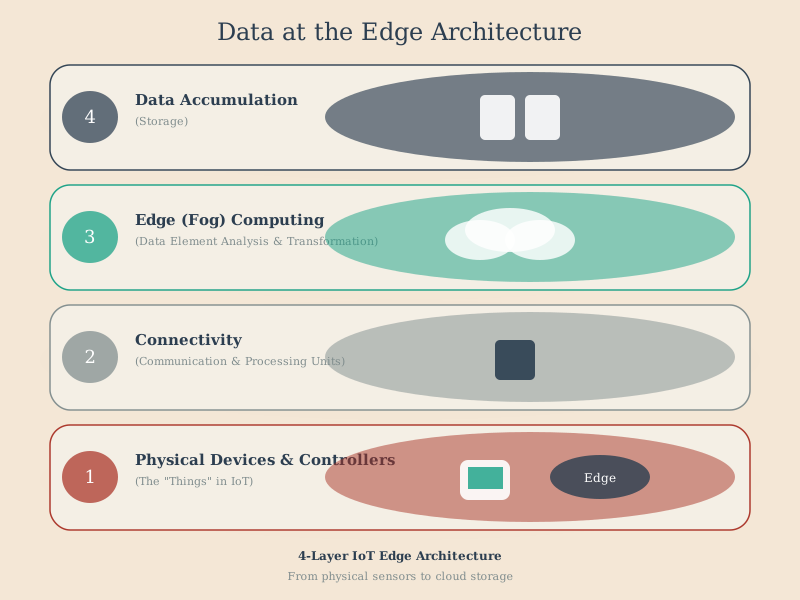
- Levels 1-4 (Operational Technology): Physical devices, connectivity, edge computing, data accumulation
- Levels 5-7 (Information Technology): Data abstraction, applications, collaboration
- Level 3 Functions: Evaluation, formatting, distillation, and assessment at the edge
1319.4.2 2. Edge Processing Patterns
Master the four primary edge processing patterns:
- Filter at Edge: Send only threshold-exceeding events (99%+ data reduction)
- Aggregate at Edge: Compute statistics locally before transmission
- Infer at Edge: Run ML models locally for anomaly detection
- Store and Forward: Buffer data during connectivity outages
Includes trade-off analysis for edge ML vs cloud ML, and batch vs streaming processing.
1319.4.3 3. Cyber-Foraging and Caching
Explore advanced edge computing concepts:
- Cyber-Foraging: Opportunistically offload computation to nearby devices
- What/Where/When Framework: Decision framework for task offloading
- Virtualization vs Mobile Agents: Compare implementation approaches
- Edge Caching Strategies: Multi-tier caching hierarchies for optimal latency
1319.4.4 4. Practical Guide
Apply edge computing with interactive tools and real-world examples:
- Latency Calculator: Compare device, edge, and cloud processing locations
- Worked Examples: Factory monitoring, drone landing, memory optimization
- Common Pitfalls: Avoid typical edge deployment mistakes
- Knowledge Checks: Test your understanding with scenario-based questions
Core Concept: Process data where latency, bandwidth, and reliability requirements are best met - edge for sub-100ms responses, cloud for complex analytics.
Why It Matters: Choosing the wrong processing location leads to either unacceptable latency (cloud for safety systems) or unnecessary hardware costs (edge for batch analytics). A factory safety shutdown requiring 50ms response cannot wait for 300ms cloud round-trip.
Key Takeaway: Start with your latency requirement. If under 100ms is needed, edge processing is mandatory - no amount of cloud optimization can overcome physics (speed of light limits network latency). If latency is flexible (seconds to minutes), leverage cloud for cost-effective ML and storage.
Think of edge computing like a chain of restaurants: local kitchens vs. a central warehouse.
A fast-food chain could prepare all food at one massive central kitchen and ship it everywhere (cloud computing). Or, each restaurant could have its own small kitchen that handles most orders locally (edge computing). The best approach? A mix - local kitchens for speed, central warehouse for bulk supplies.
Two main types of IoT applications:
| Type | Priority | Example | Edge Strategy |
|---|---|---|---|
| Massive IoT | Scale and cost | 10,000 agricultural sensors | Send tiny summaries, minimize data |
| Critical IoT | Speed and reliability | Factory safety system | Process locally, decide instantly |
Key question this chapter answers: “Where should I process my IoT data - at the sensor, at a local gateway, or in the cloud?”
Edge Computing is like having a smart helper right next to you instead of calling someone far away!
Imagine you’re playing a game and need to make a quick decision. Would you rather: - A) Ask your friend sitting next to you (super fast!) - B) Call someone in another country and wait for them to answer (slow!)
Edge computing is like having that helpful friend nearby. Instead of sending all the information far away to the cloud (like calling another country), we process it right where the action is happening!
One day, Sammy the Sensor was monitoring the oven temperature at Max the Microcontroller’s Pizza Palace. The oven got too hot! But thanks to edge computing, Max could make a smart decision right there - without waiting for the faraway cloud. In just 50 milliseconds, the oven started cooling down. The pizza was saved!
1319.5 Prerequisites
Before diving into this chapter series, you should be familiar with:
- Edge, Fog, and Cloud Overview: Understanding the three-tier architecture
- Data Storage and Databases: Knowledge of database types and storage strategies
- Networking Basics: Familiarity with network protocols and connectivity
1319.6 What’s Next
Start with IoT Reference Model to understand the seven-level architecture, then progress through processing patterns, cyber-foraging, and practical applications.
Building on edge computing foundations, explore related topics: - Data in the Cloud examines Levels 5-7 of the IoT Reference Model - Data Storage and Databases covers storage solutions for both edge and cloud - Interoperability addresses integrating heterogeneous edge devices - Machine Learning at the Edge explores TinyML and edge AI frameworks