1342 Edge Computing: Comprehensive Review
1342.1 Edge Computing Comprehensive Review
This comprehensive review consolidates edge computing concepts across architecture, data reduction, gateway design, power optimization, and storage economics. The material has been organized into focused chapters for easier study and reference.
1342.2 Review Chapters
This review is organized into five focused chapters:
| Chapter | Focus Area | Key Topics |
|---|---|---|
| Architecture and Reference Model | Foundational concepts | Seven-level IoT reference model, Edge-Fog-Cloud continuum, processing trade-offs, golden rule of edge computing |
| Data Reduction Calculations | Bandwidth optimization | Downsampling, aggregation, filtering, quality scoring, cost savings calculations |
| Gateway Architecture and Security | Protocol and security | Non-IP Things problem, multi-protocol gateways, fail-closed whitelisting, layered security |
| Power Optimization | Battery life | Deep sleep analysis, duty cycling, priority-based processing, event-driven architectures |
| Storage and Economics | Business justification | Tiered storage, retention policies, ROI analysis, total cost of ownership |
1342.3 Learning Objectives
Across all chapters, you will be able to:
- Calculate Data Reduction: Compute bandwidth savings from edge processing and aggregation techniques
- Design Edge Architectures: Apply multi-level processing strategies for industrial IoT deployments
- Evaluate Processing Trade-offs: Balance latency, bandwidth, and compute requirements at each tier
- Solve Optimization Problems: Apply mathematical models to edge computing resource allocation
- Assess Real-World Scenarios: Analyze factory, smart city, and agricultural edge deployments
- Validate Understanding: Test comprehension through challenging multi-step calculations
1342.4 Prerequisites
Before diving into this comprehensive review, complete these chapters:
Required Reading:
- Edge Compute Patterns - Core edge architectures
- Edge Data Acquisition - Data collection at the edge
- Big Data Overview - Data management context
Recommended Background:
- IoT Reference Models - Architecture foundations
- Networking Fundamentals - Network basics
Time Investment: 2-3 hours for thorough review across all chapters
1342.5 Quick Reference: Key Metrics
| Metric | Typical Value | Chapter |
|---|---|---|
| Data reduction (factory) | 14,400x | Data Reduction |
| Cost savings (bandwidth) | $25,000/year | Data Reduction |
| Gateway vs replacement savings | $258,000 | Gateway Security |
| Battery life improvement | 24x (deep sleep) | Power Optimization |
| ROI (typical deployment) | 129% over 5 years | Storage Economics |
| Payback period | 1.6 years | Storage Economics |
1342.6 Consolidated Summary
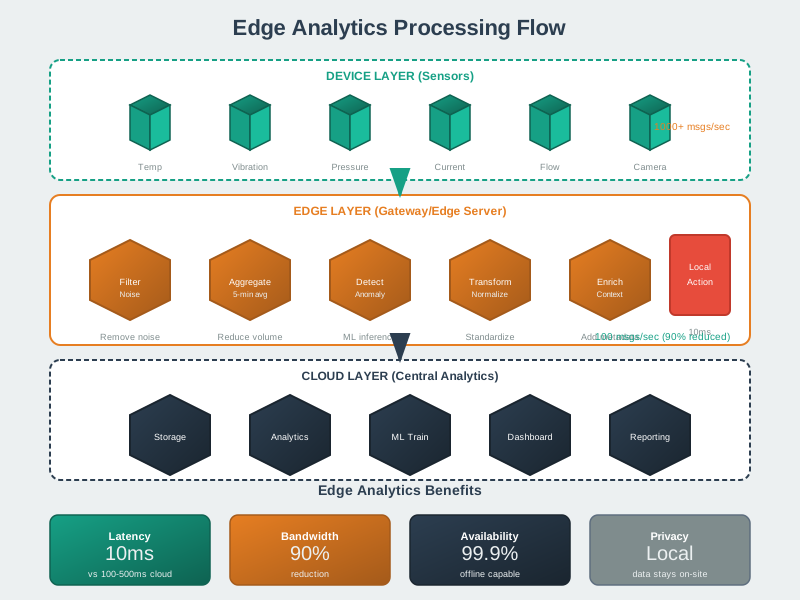
Edge-Fog-Cloud Continuum provides a progressive data processing pipeline where latency increases (under 1ms at edge to 100-500ms at cloud) while bandwidth requirements decrease dramatically through data reduction at each tier.
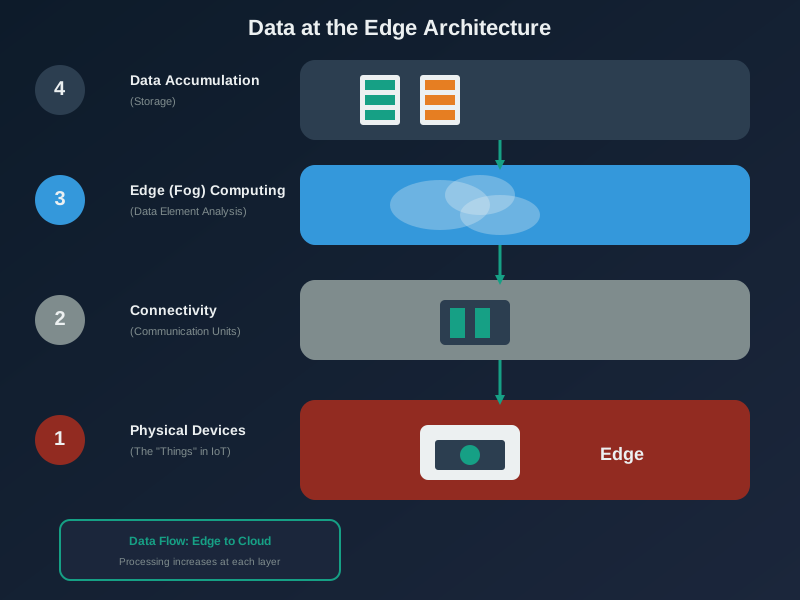
Seven-Level Reference Model guides processing decisions: Levels 1-2 handle physical sensing and connectivity, Level 3 performs edge computing (filtering, aggregation, format standardization), Levels 4-5 provide fog-layer storage and abstraction, and Levels 6-7 enable cloud analytics and enterprise integration.
Data Reduction Calculations demonstrate massive savings. For 500 vibration sensors at 1 kHz sampling, edge processing achieves 14,400x reduction (28.8 GB/hour to 2 MB/hour) through downsampling (100x) and aggregation (144x), saving approximately $25,000/year in cloud ingress costs.
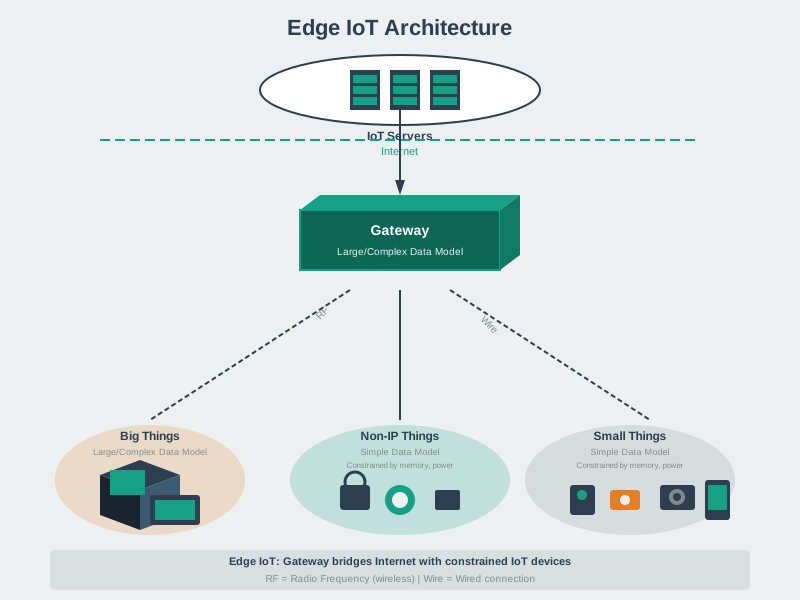
Gateway Architecture solves the “Non-IP Things” challenge where 96% of industrial devices use proprietary protocols. Deploying 10-20 multi-protocol edge gateways instead of replacing devices saves over $250,000 while providing protocol translation, security perimeter, and data aggregation.
Power Optimization through deep sleep extends battery life from 104 days to 6.8 years (24x improvement) for low-duty-cycle applications, saving $375,000 in battery replacement costs over 5 years for 1000-device deployments.
Golden Rule Application states: process data as close to the source as possible, but only as close as necessary. Edge handles latency-critical operations, fog provides regional analytics and ML inference, and cloud enables deep analytics, model training, and global coordination.
1342.8 Visual Reference Gallery
These AI-generated SVG diagrams provide alternative visual perspectives on edge computing concepts covered in this comprehensive review.

1342.9 What’s Next
Begin your review with Edge Review: Architecture and Reference Model to establish foundational concepts, then proceed through the remaining chapters in order.
For targeted practice, use the Edge Quiz Bank after completing each chapter.