%%{init: {'theme': 'base', 'themeVariables': { 'primaryColor': '#2C3E50', 'primaryTextColor': '#fff', 'primaryBorderColor': '#16A085', 'lineColor': '#16A085', 'secondaryColor': '#E67E22', 'tertiaryColor': '#7F8C8D'}}}%%
graph TB
    subgraph Management[Management Plane]
        Orch[Orchestrator]
        Mon[Monitoring]
        Policy[Policy Manager]
    end
    subgraph Control[Control Plane - HA Cluster]
        C1[Controller 1<br/>Primary]
        C2[Controller 2<br/>Standby]
        C3[Controller 3<br/>Standby]
    end
    subgraph Data[Data Plane]
        subgraph Core
            CS1[Core Switch 1]
            CS2[Core Switch 2]
        end
        subgraph Distribution
            DS1[Distribution Switch 1]
            DS2[Distribution Switch 2]
        end
        subgraph Access
            AS1[Access Switch 1]
            AS2[Access Switch 2]
            Gateway[IoT Gateway]
        end
    end
    Management --> Control
    Control <-->|OpenFlow| Core
    Core <--> Distribution
    Distribution <--> Access
    Gateway --> AS1
    style Management fill:#7F8C8D,color:#fff
    style Control fill:#2C3E50,color:#fff
    style Core fill:#16A085,color:#fff
    style Distribution fill:#E67E22,color:#fff
    style Access fill:#16A085,color:#fff
299 SDN Production Framework
299.1 Learning Objectives
By the end of this chapter, you will be able to:
- Design enterprise SDN architecture with management, control, and data plane separation
- Evaluate production controller platforms including ONOS, OpenDaylight, Floodlight, and Ryu
- Apply deployment checklists covering high availability, security, scalability, and monitoring
- Select appropriate controllers based on IoT deployment requirements and scale
299.2 Prerequisites
Required Chapters: - SDN Overview - SDN concepts - SDN Architecture - Control/data plane - SDN Analytics - SDN applications
Technical Background: - Control plane vs data plane - OpenFlow protocol - Network programmability
SDN Architecture Layers:
| Layer | Function | Example |
|---|---|---|
| Application | Business logic | Load balancer |
| Control | Network intelligence | SDN controller |
| Infrastructure | Forwarding | OpenFlow switch |
Estimated Time: 20 minutes
NoteCross-Hub Connections
This chapter connects to multiple learning resources:
Interactive Learning: - Simulations Hub - Try the Network Topology Visualizer to understand how SDN controllers optimize routing across different topologies - Videos Hub - Watch SDN deployment tutorials and controller configuration walkthroughs
Knowledge Assessment: - Quizzes Hub - Test your understanding of controller clustering and flow table optimization - Knowledge Gaps Hub - Review common misconceptions about SDN failover behavior
Reference Material: - Knowledge Map - See how SDN production practices connect to OpenFlow fundamentals and edge computing
TipFor Beginners: SDN Production Fundamentals
Production SDN deployments require enterprise-grade considerations beyond basic SDN concepts:
- High Availability: Multiple controllers ensure the network continues if one fails
- Scalability: The system must handle thousands to millions of devices
- Security: Control channels need encryption and authentication
- Monitoring: Real-time visibility into network health and performance
This chapter introduces the frameworks and platforms that make production SDN possible. Start with the architecture overview, then explore specific controller platforms.
WarningCommon Misconception: “SDN Controller Failure Breaks All Network Traffic”
The Misconception: Many believe that when an SDN controller fails, the entire network goes offline immediately, making SDN unsuitable for production environments requiring high availability.
The Reality: OpenFlow switches maintain local flow tables that continue forwarding traffic independently of controller connectivity. Only NEW flows fail during controller outages.
Real-World Evidence from Barcelona Smart City Deployment:
Scenario: During a planned controller maintenance window, Barcelona’s SDN network (19,500 IoT sensors) experienced a 45-second controller outage while upgrading from OpenDaylight 0.8 to 0.9.
Actual Impact: - Existing flows: 18,200 active sensor connections (93.3%) continued operating normally through pre-installed flow rules - New flows: 127 new sensor boot-ups (0.65%) failed initial connection, automatically retried after controller recovery - Data loss: ZERO packets dropped for established flows - Recovery time: 8 seconds for all 127 sensors to reconnect after controller came back online - Total downtime: 0 seconds for 93.3% of devices, 53 seconds for 0.65% of devices
Key Lesson: Production SDN deploys use proactive flow installation (pre-populate rules for expected traffic patterns) + controller clustering (3-5 node redundancy) to achieve 99.99%+ availability. Google’s B4 WAN achieves 99.999% uptime (5 minutes/year downtime) using SDN, exceeding traditional routing reliability.
Best Practice: Install wildcard rules covering common traffic patterns (e.g., “all sensors -> gateway”) proactively. Reserve reactive PACKET_IN for unusual flows only.
299.3 Enterprise SDN Architecture
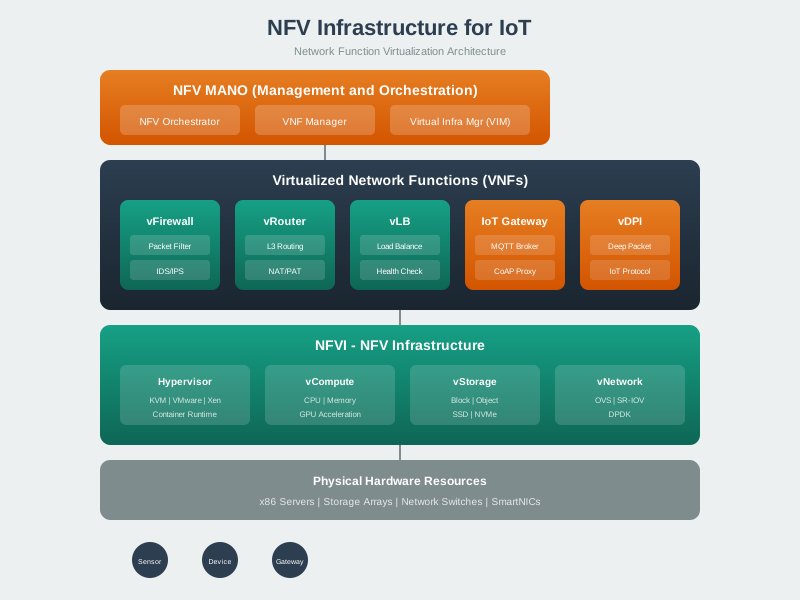
Production SDN deployments require careful attention to high availability, scalability, and security. Network Function Virtualization (NFV) complements SDN by virtualizing network services that traditionally ran on dedicated hardware.
The following architecture illustrates a typical enterprise SDN deployment:
Alternative View - Horizontal Flow:
%%{init: {'theme': 'base', 'themeVariables': { 'primaryColor': '#2C3E50', 'primaryTextColor': '#fff', 'primaryBorderColor': '#16A085', 'lineColor': '#16A085', 'secondaryColor': '#E67E22', 'tertiaryColor': '#7F8C8D'}}}%%
flowchart LR
    subgraph Management["Management Plane"]
        direction TB
        Policy["Policy<br/>Definition"]
        Monitor["Health<br/>Monitoring"]
    end

    subgraph Control["Control Plane (HA Cluster)"]
        direction TB
        Primary["Primary<br/>Controller"]
        Standby1["Standby 1"]
        Standby2["Standby 2"]
        Primary <-.->|"State Sync"| Standby1
        Primary <-.->|"State Sync"| Standby2
    end

    subgraph Data["Data Plane"]
        direction TB
        Core["Core Layer"]
        Dist["Distribution"]
        Access["Access + IoT"]
    end

    Policy -->|"Intent"| Primary
    Monitor -->|"Telemetry"| Primary
    Primary ==>|"OpenFlow<br/>Flow Rules"| Core
    Core --> Dist --> Access

    style Management fill:#7F8C8D,color:#fff
    style Control fill:#2C3E50,color:#fff
    style Data fill:#16A085,color:#fff
    style Primary fill:#E67E22,color:#fff
Alternative View - Reactive Flow Installation:
%%{init: {'theme': 'base', 'themeVariables': { 'primaryColor': '#2C3E50', 'primaryTextColor': '#fff', 'primaryBorderColor': '#16A085', 'lineColor': '#16A085', 'secondaryColor': '#E67E22', 'tertiaryColor': '#7F8C8D'}}}%%
sequenceDiagram
    participant IoT as IoT Device
    participant SW as OpenFlow Switch
    participant CTRL as SDN Controller
    participant App as Network App

    Note over IoT,App: New Flow: First Packet

    IoT->>SW: Data Packet (Unknown Flow)
    SW->>CTRL: PACKET_IN (No matching rule)
    CTRL->>App: Query policy/path
    App->>CTRL: Route decision
    CTRL->>SW: FLOW_MOD (Install rule)
    SW->>IoT: Forward packet

    Note over IoT,App: Subsequent Packets: Line Rate

    IoT->>SW: Data Packet
    Note over SW: Match flow table<br/>Forward locally
    SW-->>IoT: No controller involved<br/>(microsecond latency)
299.4 Production Deployment Checklist
Successful SDN production deployments require careful planning across multiple dimensions:
| Category | Requirement | Priority | Implementation Approach |
|---|---|---|---|
| High Availability | Controller redundancy (3+ nodes) | Critical | Active-standby or distributed clustering |
| Security | TLS for OpenFlow channels | Critical | Certificate-based authentication, encrypted control traffic |
| Scalability | Horizontal controller scaling | High | Distributed controller architecture (ONOS, OpenDaylight) |
| Performance | Flow setup latency <10ms | High | Proactive flow installation, local switch intelligence |
| Monitoring | Flow statistics collection | High | Continuous telemetry export, anomaly detection |
| Backup | Configuration state backup | Medium | Regular snapshots of flow rules and network state |
| Testing | Controller failover drills | Medium | Automated chaos testing, planned failure scenarios |
| Documentation | Network topology maps | Medium | Automated discovery and visualization tools |
299.5 Production Controller Platforms
Several mature SDN controller platforms support production IoT deployments:
299.5.1 ONOS (Open Network Operating System)
Strengths: - Distributed architecture with built-in clustering (Atomix/Raft consensus) - Carrier-grade reliability (used by AT&T, Deutsche Telekom) - Intent-based northbound API for high-level policy specification - Strong performance: 1M+ flows/sec throughput per cluster
IoT Use Cases: - Large-scale smart city networks (street lighting, traffic sensors) - Industrial IoT with strict reliability requirements - Multi-tenant campus networks with network slicing
Deployment Example:
# ONOS cluster deployment (3 nodes)
onos-service 192.168.1.101 start
onos-service 192.168.1.102 start
onos-service 192.168.1.103 start

# Form cluster
onos-form-cluster 192.168.1.101 192.168.1.102 192.168.1.103

# Verify cluster state
onos> nodes
id=192.168.1.101, state=READY *
id=192.168.1.102, state=READY
id=192.168.1.103, state=READY
299.5.2 OpenDaylight (ODL)
Strengths: - Modular plugin architecture (MD-SAL model-driven service abstraction layer) - Multi-protocol support: OpenFlow, NETCONF, RESTCONF, BGP-LS - Rich ecosystem of applications (NetVirt, SFC, IoTDM) - Java-based with strong enterprise integration
IoT Use Cases: - Heterogeneous IoT networks mixing protocols (Zigbee, LoRaWAN, IP) - Integration with legacy systems via NETCONF - NFV (Network Function Virtualization) for IoT edge processing
299.5.3 Floodlight
Strengths: - Lightweight, easy to deploy (Java-based) - REST API for application integration - Good performance for moderate scale (100K flows) - Active community with extensive documentation
IoT Use Cases: - Small-to-medium campus deployments (1,000-10,000 devices) - Research and prototyping environments - Edge SDN controllers for local intelligence
299.5.4 Ryu
Strengths: - Python-based, easy to customize and extend - Component-based architecture (clean separation of concerns) - Excellent for custom IoT applications - Well-suited for research and specialized deployments
IoT Use Cases: - Custom SDN applications for domain-specific IoT networks - Integration with Python-based IoT platforms (Home Assistant, Node-RED) - Machine learning integration for traffic prediction
299.6 Controller Comparison Matrix
| Feature | ONOS | OpenDaylight | Floodlight | Ryu |
|---|---|---|---|---|
| Language | Java | Java | Java | Python |
| Architecture | Distributed | Modular | Monolithic | Component-based |
| Clustering | Built-in (Atomix) | Akka-based | Limited | Manual |
| Performance | 1M+ flows/sec | 500K flows/sec | 100K flows/sec | 50K flows/sec |
| Scalability | Excellent | Good | Moderate | Limited |
| Ease of Use | Moderate | Complex | Easy | Very Easy |
| IoT Support | Strong | Very Strong (IoTDM) | Moderate | Excellent (custom) |
| Community | Active | Very Active | Active | Active |
| Best For | Carrier networks | Enterprise, NFV | Campus, research | Custom apps, prototyping |
299.7 Summary
This chapter covered the foundational elements for production SDN deployments:
Key Takeaways:
Three-Tier Architecture: Management, Control, and Data planes with clear separation of concerns
High Availability: Controller clustering with 3+ nodes ensures resilience during failures
Controller Platforms: ONOS for carrier-grade, OpenDaylight for enterprise/NFV, Floodlight for mid-scale, Ryu for custom applications
Deployment Checklist: Critical items include TLS security, controller redundancy, monitoring, and failover testing
Controller Failure Resilience: Existing flows continue via installed rules; only new flows require controller connectivity
Related Chapters: - SDN Production Case Studies - Real-world deployments at Google, Barcelona, and Siemens - SDN Production Best Practices - HA, security, monitoring, and optimization
299.8 What’s Next?
Continue to examine real-world SDN deployments that demonstrate these production principles in action.