%%{init: {'theme': 'base', 'themeVariables': { 'primaryColor': '#2C3E50', 'primaryTextColor': '#fff', 'primaryBorderColor': '#16A085', 'lineColor': '#16A085', 'secondaryColor': '#E67E22', 'tertiaryColor': '#7F8C8D'}}}%%
graph TB
    subgraph Flat[Flat Architecture]
        F_C[Single Controller]
        F_S1[Switch 1]
        F_S2[Switch 2]
        F_S3[Switch 3]
        F_C --> F_S1
        F_C --> F_S2
        F_C --> F_S3
    end
    subgraph Hierarchical[Hierarchical Architecture]
        H_Root[Root Controller]
        H_C1[Local Controller 1]
        H_C2[Local Controller 2]
        H_S1[Switches]
        H_S2[Switches]
        H_Root --> H_C1
        H_Root --> H_C2
        H_C1 --> H_S1
        H_C2 --> H_S2
    end
    subgraph Distributed[Distributed Architecture]
        D_C1[Controller 1]
        D_C2[Controller 2]
        D_C3[Controller 3]
        D_C1 <--> D_C2
        D_C2 <--> D_C3
        D_C3 <--> D_C1
    end
    style Flat fill:#2C3E50,color:#fff
    style Hierarchical fill:#16A085,color:#fff
    style Distributed fill:#E67E22,color:#fff
292 SDN for IoT: Variants and Challenges
292.1 Learning Objectives
By the end of this chapter, you will be able to:
- Understand TCAM Constraints: Explain flow table memory limitations and their impact on SDN deployments
- Design Rule Placement Strategies: Apply wildcard rules and hierarchical aggregation to optimize TCAM usage
- Address Scalability Challenges: Plan SDN architectures that handle large numbers of IoT devices
- Implement Caching Strategies: Select appropriate rule eviction algorithms (LRU, LFU, timeout-based)
- Evaluate Hybrid Approaches: Combine TCAM with DRAM for handling overflow scenarios
- Optimize Controller Communication: Minimize PACKET_IN messages to improve SDN performance
292.2 Prerequisites
Before diving into this chapter, you should be familiar with:
- SDN Fundamentals and OpenFlow: Understanding the basic SDN architecture, control/data plane separation, and OpenFlow protocol is essential for grasping the challenges and optimization strategies
- SDN Analytics and Implementations: Knowledge of traffic engineering, network slicing, and flow rule programming provides context for understanding TCAM constraints and rule placement strategies
- Wireless Sensor Networks: Familiarity with resource-constrained devices helps understand SD-WSN adaptations and energy-aware routing challenges
- Networking Basics: Understanding routing protocols, network topologies, and packet forwarding provides the foundation for evaluating SDN variants
TipFor Beginners: SDN Challenges and Trade-offs
SDN sounds perfect - centralized control, programmable networks, dynamic optimization. But like any powerful technology, it has real-world constraints. The biggest challenge? Network switches have limited memory for storing forwarding rules, like a restaurant having only 20 recipe cards even though the menu has 1000 dishes. The controller must decide which rules to keep and which to fetch on-demand.
Everyday Analogy: Imagine a library where you can only keep 100 books on shelves (TCAM - fast access), but own 10,000 books total in storage (slower access). When someone requests a book not on the shelf, you must fetch it from storage (slow), decide which shelf book to remove, and place the new book on the shelf. SDN faces the same challenge - switches have limited fast memory (TCAM) for flow rules, so the controller must smartly manage which rules stay cached.
| Term | Simple Explanation |
|---|---|
| TCAM (Fast Memory) | Special expensive memory in switches for instant packet lookup (but very limited) |
| Flow Rule | An instruction telling the switch what to do with specific traffic |
| Rule Caching | Keeping frequently-used rules in fast memory, like browser caching websites |
| Controller Bottleneck | When too many switches ask the controller for help simultaneously, causing delays |
| Network Slicing | Dividing one physical network into multiple virtual networks for different uses |
| Scalability | How well the system handles growth from 100 to 10,000 devices |
Why This Matters for IoT: A smart city with 100,000 IoT sensors can’t store rules for every device in switch memory. The SDN controller must be clever: use wildcard rules (one rule matching many devices), prioritize critical flows (fire alarms over temperature logs), and cache rules intelligently. Understanding these challenges prevents overloading the network controller and ensures your IoT system scales reliably.
NoteRelated Chapters
Deep Dives: - SDN Fundamentals and OpenFlow - OpenFlow basics and flow tables - SDN Controller Basics - Controller architecture and APIs
Protocols: - Wireless Sensor Networks - Resource-constrained devices - Routing Fundamentals - Traditional routing
Architecture: - Software Defined Networking - SDN overview - Edge Computing Patterns - Edge-SDN integration
Comparisons: - M2M Review - M2M vs SDN approaches - Ad-hoc Networks - Distributed vs centralized control
Production: - SDN Production and Analytics - Deployment strategies - Network Design and Simulation - SDN testing
Learning: - Simulations Hub - SDN simulators
292.3 SDN Challenges
292.3.1 Rule Placement Challenge
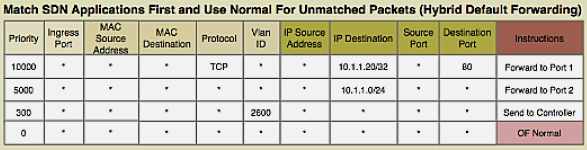
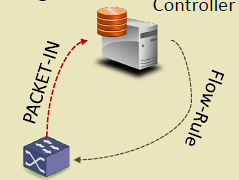
Problem: Switches have limited TCAM (Ternary Content-Addressable Memory) for storing flow rules.
TCAM Characteristics: - Fast lookup (single clock cycle) - Expensive ($15-30 per Mb) - Limited capacity (few thousand entries) - Power-hungry
Challenges: - How to select which flows to cache in TCAM? - When to evict rules (LRU, LFU, timeout-based)? - How to minimize PACKET_IN messages to controller?
Solutions: - Wildcard Rules: Match multiple flows with single rule - Hierarchical Aggregation: Aggregate at network edge - Rule Caching: Intelligent replacement algorithms - Hybrid Approaches: TCAM + DRAM for overflow
292.3.2 Controller Placement Challenge
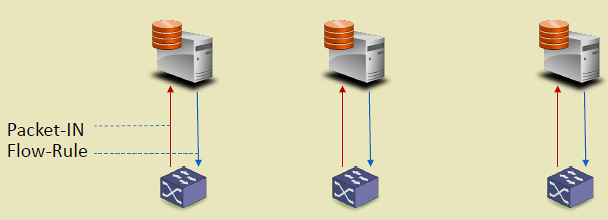
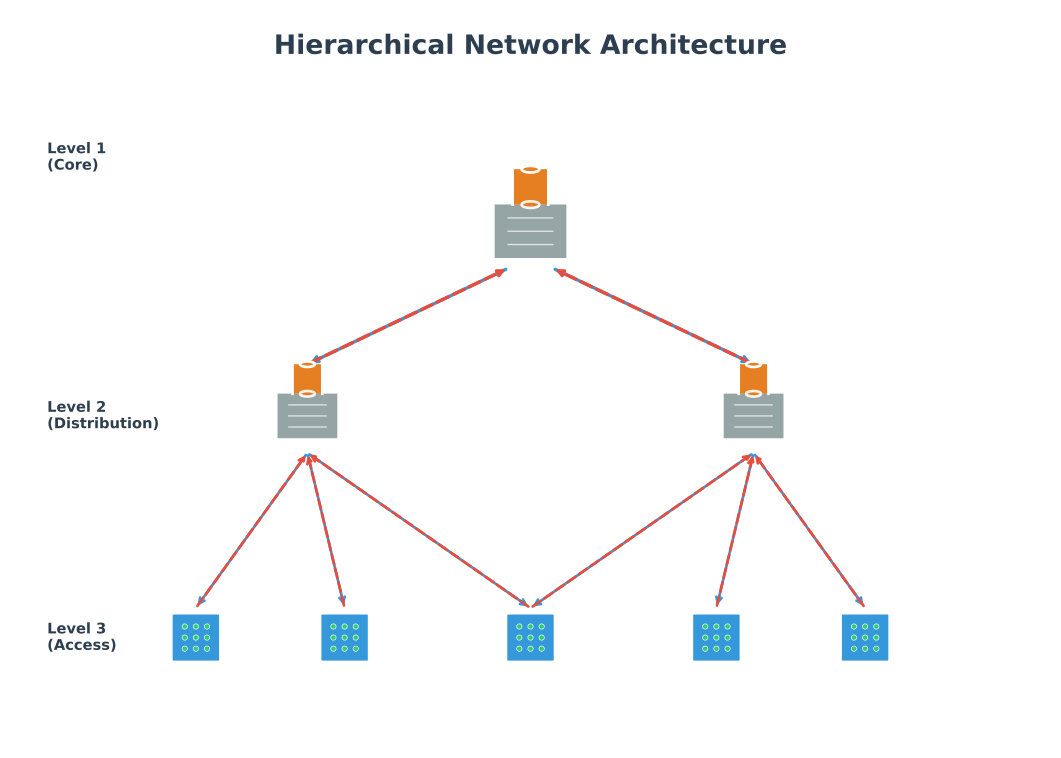
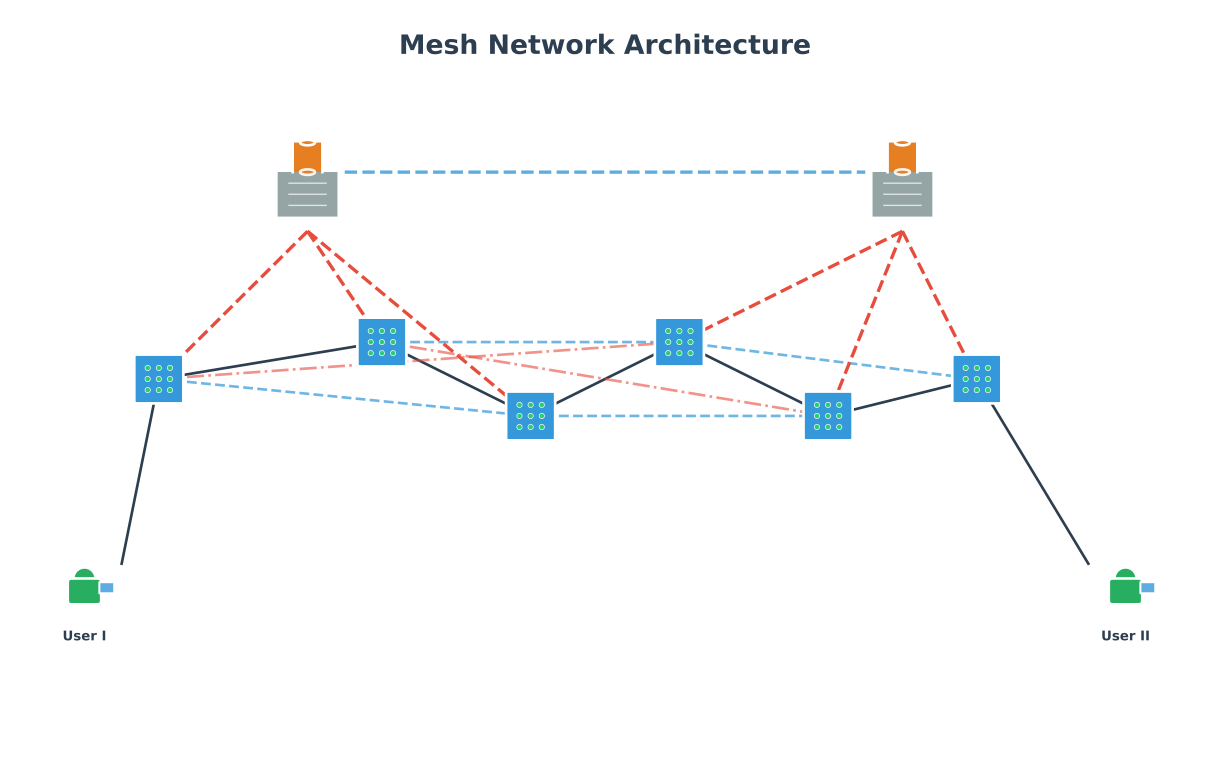
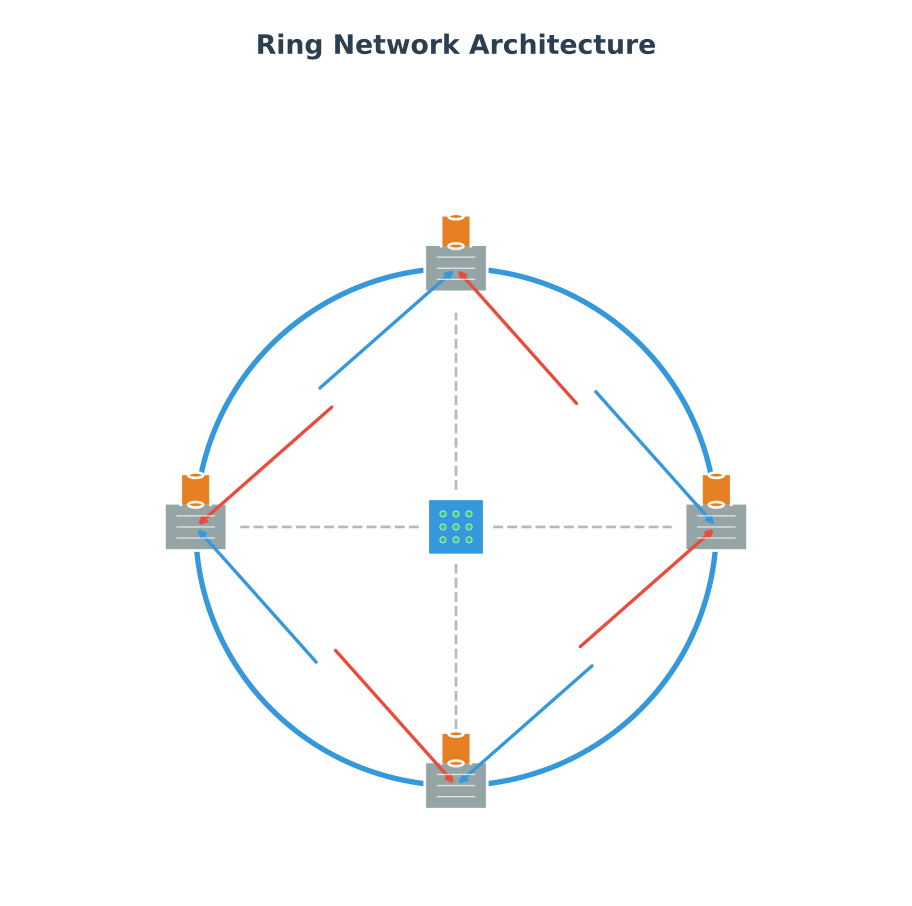
Problem: Where to place controllers for optimal performance?
Considerations: - Latency: Controller-switch delay affects flow setup time - Throughput: Controller capacity (requests/second) - Reliability: Controller failure impacts network - Scalability: Number of switches per controller
Architectures:
Alternative View:
%%{init: {'theme': 'base', 'themeVariables': { 'primaryColor': '#2C3E50', 'primaryTextColor': '#fff', 'primaryBorderColor': '#16A085', 'lineColor': '#16A085', 'secondaryColor': '#E67E22', 'tertiaryColor': '#7F8C8D'}}}%%
flowchart TB
    subgraph Problem["TCAM Capacity Challenge"]
        TCAM["Switch TCAM<br/>2,000 rules max"]
        FLOWS["IoT Traffic<br/>50,000 flows/hour"]
        OVERFLOW["Overflow!<br/>48,000 rules can't fit"]
    end

    subgraph Solution["Intelligent Rule Management"]
        WILD["Wildcard Rules<br/>1 rule = 1000 flows"]
        CACHE["LRU Caching<br/>Hot flows stay"]
        HYBRID["TCAM + DRAM<br/>Overflow to software"]
    end

    subgraph Result["Optimized Operation"]
        FAST["TCAM: Critical flows<br/><1μs lookup"]
        SLOW["DRAM: Bulk flows<br/>~10μs lookup"]
        CTRL["Controller: New flows<br/>~10ms setup"]
    end

    TCAM --> OVERFLOW
    FLOWS --> OVERFLOW
    OVERFLOW -->|"Apply"| WILD
    OVERFLOW -->|"Apply"| CACHE
    OVERFLOW -->|"Apply"| HYBRID
    WILD --> FAST
    CACHE --> FAST
    HYBRID --> SLOW
    SLOW -.-> CTRL

    style Problem fill:#c0392b,color:#fff
    style Solution fill:#16A085,color:#fff
    style Result fill:#2C3E50,color:#fff
    style OVERFLOW fill:#E67E22,color:#fff
%%{init: {'theme': 'base', 'themeVariables': { 'primaryColor': '#2C3E50', 'primaryTextColor': '#fff', 'primaryBorderColor': '#16A085', 'lineColor': '#16A085', 'secondaryColor': '#E67E22', 'tertiaryColor': '#7F8C8D'}}}%%
graph LR
    subgraph Flat["Flat: 1 Controller"]
        F_P["Pros:<br/>Simple, Low cost"]
        F_C["Cons:<br/>Single point of failure<br/>Limited scalability<br/>High latency at edges"]
        F_Use["Use: <100 switches<br/>Small campus"]
    end

    subgraph Hier["Hierarchical: Root + Local"]
        H_P["Pros:<br/>Local decisions fast<br/>Global coordination<br/>Scalable"]
        H_C["Cons:<br/>Complex sync<br/>Root = bottleneck"]
        H_Use["Use: Multi-site<br/>Smart city districts"]
    end

    subgraph Dist["Distributed: Peer Controllers"]
        D_P["Pros:<br/>No single failure<br/>Load balanced<br/>Geo-distributed"]
        D_C["Cons:<br/>Consistency challenges<br/>Complex consensus"]
        D_Use["Use: >1000 switches<br/>Carrier/enterprise"]
    end

    style Flat fill:#2C3E50,color:#fff
    style Hier fill:#16A085,color:#fff
    style Dist fill:#E67E22,color:#fff
Placement Strategies: - K-median: Minimize average latency to switches - K-center: Minimize maximum latency (worst-case) - Failure-aware: Ensure backup controller coverage
292.4 SDN for IoT
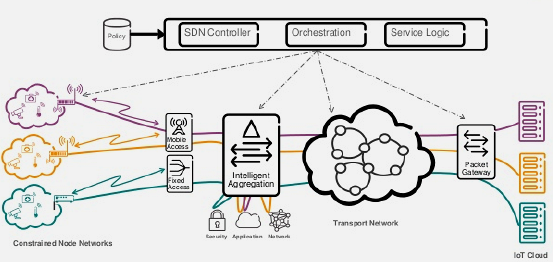
SDN brings significant benefits to IoT networks:
1. Intelligent Routing - Dynamic path computation based on IoT traffic patterns - Energy-aware routing for battery-powered devices - Priority-based forwarding (critical alarms vs routine telemetry)
2. Simplified Management - Centralized view of heterogeneous IoT devices - Programmatic configuration via APIs - Rapid service deployment
3. Network Slicing - Logical network per IoT application - Isolation between applications - Custom QoS per slice
TipUnderstanding Network Slicing
Core Concept: Network slicing creates multiple independent virtual networks on the same physical infrastructure, each with dedicated resources, isolated traffic, and custom policies - like having separate highways for trucks, cars, and emergency vehicles on the same road surface. Why It Matters: IoT deployments serve diverse applications with conflicting requirements - a fire alarm needs guaranteed low latency while a temperature sensor can tolerate delays. Network slicing ensures critical traffic gets dedicated bandwidth and priority without building separate physical networks for each use case. Key Takeaway: When designing network slices, define clear isolation boundaries (VLAN tags, MPLS labels, or VxLAN tunnels), allocate minimum guaranteed bandwidth per slice, and implement slice-aware admission control to prevent one slice from consuming resources allocated to another.
4. Traffic Engineering - Real-time adaptation to congestion - Load balancing across paths - Bandwidth allocation per IoT service
5. Enhanced Security - Centralized access control - Dynamic firewall rules - Anomaly detection via flow monitoring
%%{init: {'theme': 'base', 'themeVariables': { 'primaryColor': '#2C3E50', 'primaryTextColor': '#fff', 'primaryBorderColor': '#16A085', 'lineColor': '#16A085', 'secondaryColor': '#E67E22', 'tertiaryColor': '#7F8C8D'}}}%%
graph TB
    subgraph IoT[IoT Devices]
        Sensors[Sensors]
        Actuators[Actuators]
        Gateways[Gateways]
    end
    subgraph SDN[SDN Control Plane]
        Controller[SDN Controller]
        Router[Intelligent Routing]
        QoS[QoS Manager]
        Security[Security Manager]
    end
    subgraph Apps[Applications]
        SmartCity[Smart City]
        Industrial[Industrial IoT]
        Healthcare[Healthcare]
    end
    IoT --> SDN
    SDN --> Apps
    Controller --> Router
    Controller --> QoS
    Controller --> Security
    style IoT fill:#2C3E50,color:#fff
    style SDN fill:#16A085,color:#fff
    style Apps fill:#E67E22,color:#fff
%%{init: {'theme': 'base', 'themeVariables': { 'primaryColor': '#2C3E50', 'primaryTextColor': '#fff', 'primaryBorderColor': '#16A085', 'lineColor': '#16A085', 'secondaryColor': '#E67E22', 'tertiaryColor': '#7F8C8D'}}}%%
sequenceDiagram
    participant Sensor as IoT Sensor
    participant Switch as OpenFlow Switch
    participant Ctrl as SDN Controller
    participant App as Smart City App

    Note over Sensor,App: Scenario: Fire Alarm Priority Routing

    Sensor->>Switch: Fire alarm packet
    Switch->>Ctrl: PACKET_IN (new flow)
    Ctrl->>Ctrl: Classify: CRITICAL<br/>Compute fastest path<br/>Reserve bandwidth

    Ctrl->>Switch: Install high-priority rule<br/>Output: fast path to cloud

    Note over Switch: Flow table updated:<br/>Fire alarm → Priority 7<br/>Dedicated bandwidth

    Switch->>App: Alarm delivered <50ms
    App->>Ctrl: Acknowledge
    Ctrl->>Ctrl: Log for anomaly detection

    Note over Sensor,App: Regular Telemetry (Different Treatment)

    Sensor->>Switch: Temperature reading
    Note over Switch: Match: telemetry → Priority 1<br/>Best-effort queue
    Switch->>App: Delivered when capacity available
292.5 Software-Defined WSN
Traditional WSNs are resource-constrained and vendor-specific, making dynamic reconfiguration difficult. SD-WSN applies SDN principles to wireless sensor networks.
292.5.1 Sensor OpenFlow
Concept: Adapt OpenFlow for resource-constrained sensor nodes.
Forwarding Modes: - ID-Centric: Route based on source node ID - Value-Centric: Route based on sensed value threshold - Example: Forward only if temperature > 30°C
Benefits: - Dynamic routing logic without firmware updates - Application-specific forwarding policies - Centralized network control
292.5.2 Soft-WSN
Features:
1. Sensor Management - Enable/disable sensors dynamically - Multi-sensor boards: activate subset based on application
2. Delay Management - Adjust sensing frequency in real-time - Balance freshness vs energy consumption
3. Active-Sleep Management - Dynamic duty cycling - Coordinated sleep schedules
4. Topology Management - Node-specific: Change routing at individual nodes - Network-wide: Broadcast policies (forward all, drop all)
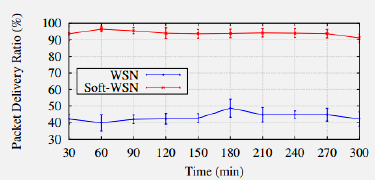
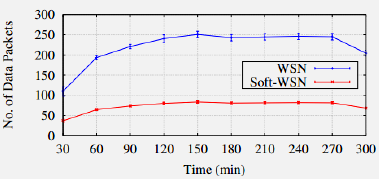
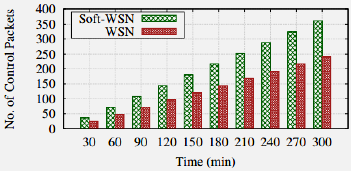
Results: - Packet Delivery Ratio: +15-20% improvement over traditional WSN - Data Replication: -30-40% reduced redundant packets - Control Overhead: +10-15% increased due to PACKET_IN messages - Net Benefit: Overall efficiency gain despite control overhead
292.5.3 SDN-WISE
Architecture:
%%{init: {'theme': 'base', 'themeVariables': { 'primaryColor': '#2C3E50', 'primaryTextColor': '#fff', 'primaryBorderColor': '#16A085', 'lineColor': '#16A085', 'secondaryColor': '#E67E22', 'tertiaryColor': '#7F8C8D'}}}%%
graph TB
    subgraph Controller[SDN-WISE Controller]
        Logic[Network Logic]
        FlowMgr[Flow Manager]
        Topo[Topology Manager]
    end
    subgraph WSN[Sensor Network]
        N1[Sensor Node 1<br/>Flow Table]
        N2[Sensor Node 2<br/>Flow Table]
        N3[Sensor Node 3<br/>Flow Table]
        Sink[Sink Node]
    end
    Controller <-->|SDN-WISE Protocol| Sink
    Sink --> N1
    N1 --> N2
    N2 --> N3
    N3 --> Sink
    style Controller fill:#2C3E50,color:#fff
    style WSN fill:#16A085,color:#fff
    style Sink fill:#E67E22,color:#fff
%%{init: {'theme': 'base', 'themeVariables': { 'primaryColor': '#2C3E50', 'primaryTextColor': '#fff', 'primaryBorderColor': '#16A085', 'lineColor': '#16A085', 'secondaryColor': '#E67E22', 'tertiaryColor': '#7F8C8D'}}}%%
flowchart TD
    subgraph Traditional["Traditional OpenFlow Matching"]
        T_PKT["Packet Header"] --> T_MATCH["Match: IP, Port, VLAN"]
        T_MATCH --> T_ACT["Action: Forward/Drop"]
        T_Note["Cannot inspect payload content"]
    end

    subgraph ValueCentric["SDN-WISE Value-Centric Matching"]
        V_PKT["Sensor Packet"] --> V_HDR["Match Header:<br/>Source Node ID"]
        V_PKT --> V_VAL["Match Payload:<br/>temperature > 30C?"]
        V_HDR --> V_DEC{Decision}
        V_VAL --> V_DEC
        V_DEC -->|"Critical"| V_ALERT["Forward to<br/>Emergency Handler"]
        V_DEC -->|"Normal"| V_AGG["Forward to<br/>Aggregator"]
    end

    subgraph Benefits["WSN Benefits"]
        B1["In-Network Filtering:<br/>Reduce 70% traffic"]
        B2["Content-Based Routing:<br/>Semantic forwarding"]
        B3["Energy Savings:<br/>Don't transmit irrelevant data"]
    end

    T_Note -.->|"SDN-WISE Extends"| V_VAL
    V_ALERT --> B1
    V_AGG --> B2
    B1 --> B3

    style Traditional fill:#7F8C8D,color:#fff
    style ValueCentric fill:#16A085,color:#fff
    style Benefits fill:#E67E22,color:#fff
    style V_ALERT fill:#c0392b,color:#fff
Key Features: - Flow tables adapted for sensor constraints - In-Network Packet Processing (INPP) for local computation - Programmable via any language through API - IEEE 802.15.4 compatible
292.6 SDN for Mobile Networks
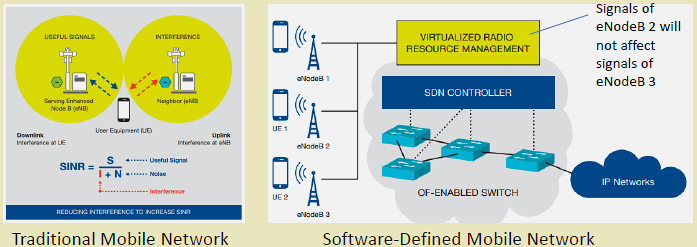
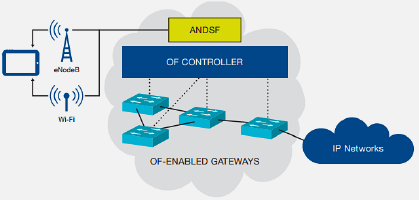
Traditional mobile networks (3G/4G/5G) face challenges: difficult to scale, inflexible, expensive. SDN addresses these:
Benefits:
1. Flow Table Paradigm - Seamless end-to-end communication across Wi-Fi, 3G, 4G, 5G - Unified forwarding model
2. Centralized Control - Base station coordination for interference mitigation - Efficient handoff management
3. Path Management - Route based on service requirements (latency, bandwidth) - Independent of core routing policies
4. Network Virtualization - Network slicing: dedicated slice per service type - Service differentiation: premium vs best-effort
Applications:
Mobile Traffic Offloading: - Intelligently offload from cellular to Wi-Fi - Based on user preferences, QoS requirements, network load - SDN controller coordinates: ANDSF (Access Network Discovery and Selection Function)
292.6.1 Mobility-Aware SDN
292.6.1.1 ODIN
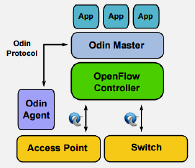
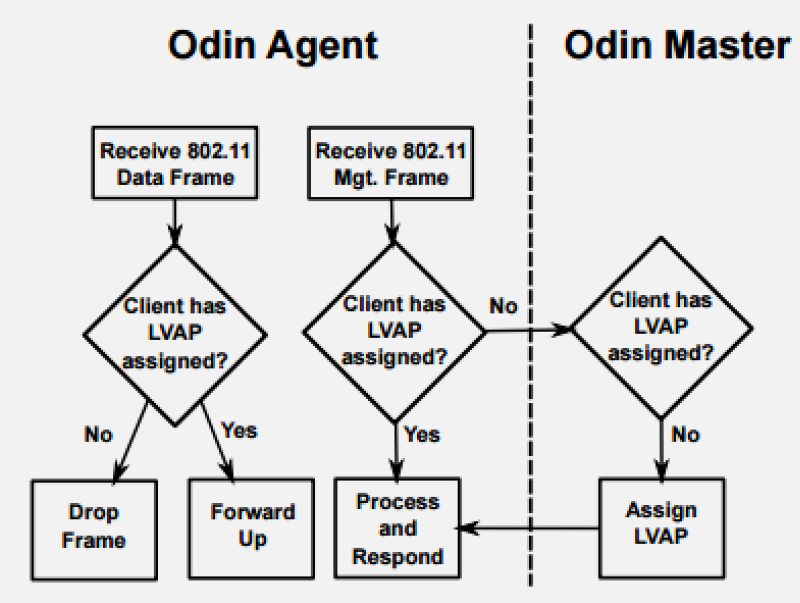
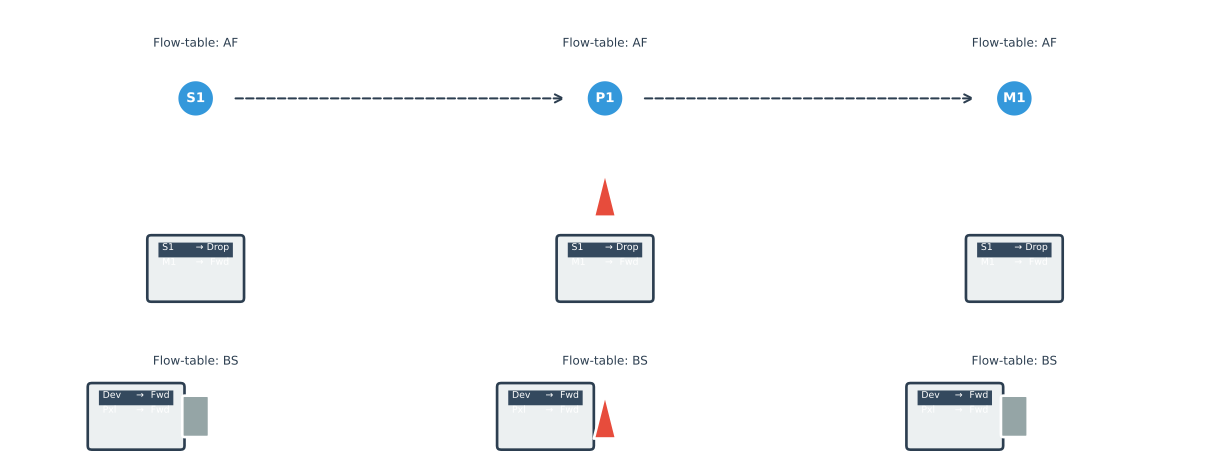
Concept: SDN-based enterprise WLAN with mobility support.
Components: - ODIN Agent: Runs on access points - ODIN Master: Runs on controller
Features: - Light Virtual APs: Multiple virtual APs per physical AP - Client association control - Seamless handoff
292.6.1.2 Ubi-Flow
Focus: Mobility management in SD-IoT.
Features: - Scalable AP control - Fault tolerance - Flow scheduling: - Network partitioning - Load balancing - Network matching
292.6.1.3 Mobi-Flow
Concept: Proactive flow rule placement based on mobility prediction.
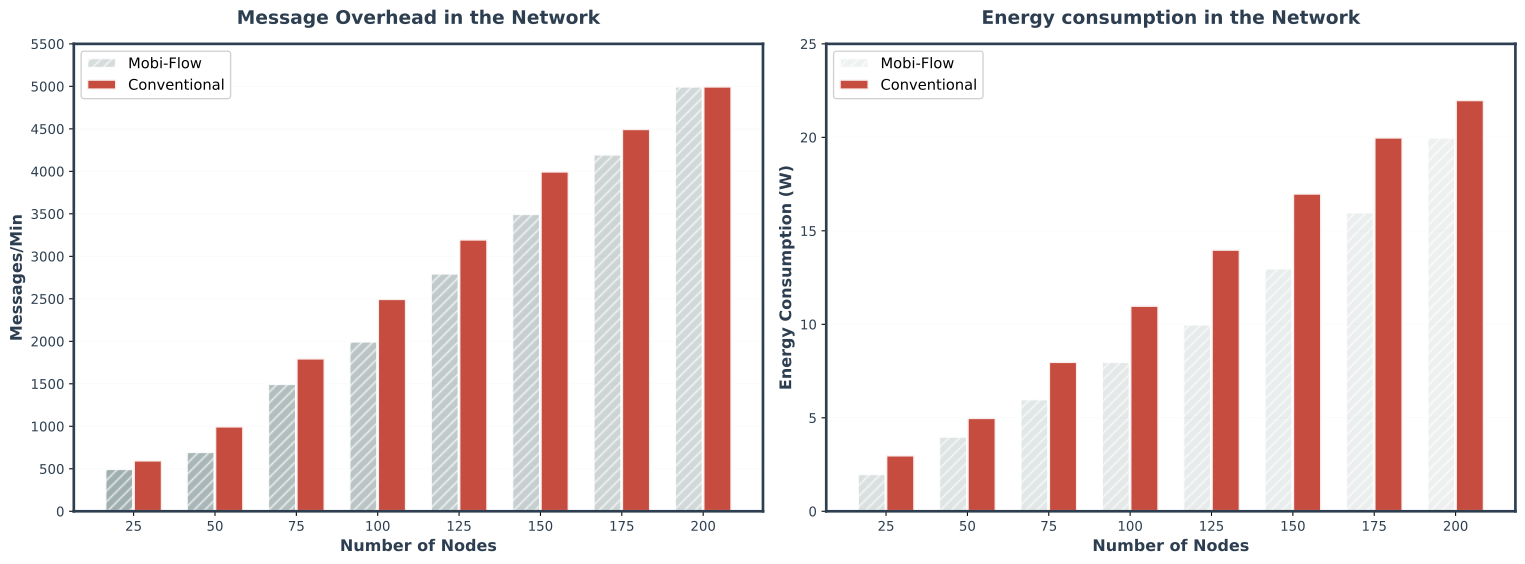
Approach: 1. Predict user location at time t+1 using Order-K Markov predictor 2. Install flow rules at predicted APs before user arrives 3. Minimize PACKET_IN messages and handoff delay
Results: - 30-40% reduction in control message overhead - 20-30% energy savings at mobile devices - Improved QoS (lower latency)
292.7 SDN for Data Centers
Data centers handle diverse traffic patterns:
Mice Flows: - Short-lived (< 10s) - Small size (< 1 MB) - Latency-sensitive - SDN Strategy: Wildcard rules for fast processing
Elephant Flows: - Long-lived (minutes to hours) - Large size (> 100 MB) - Throughput-sensitive - SDN Strategy: Exact-match rules with dedicated paths
Flow Classification: - Monitor initial packets to classify flow type - Install appropriate rules dynamically - Load balancing: distribute elephants across paths
292.8 Knowledge Check
Test your understanding of these architectural concepts.
292.9 Visual Reference Gallery
NoteSDN Architecture Visualizations
These AI-generated figures provide alternative visual representations of SDN concepts covered in this chapter.
292.9.1 SDN Architecture Layers

292.9.2 OpenFlow Protocol

292.9.3 SDN Controller Design

292.10 Summary
This chapter covered SDN challenges and specialized variants for IoT deployments:
- Rule Placement: TCAM memory limitations require intelligent caching strategies using wildcard rules, hierarchical aggregation, and hybrid TCAM/DRAM approaches
- Controller Placement: Optimal controller positioning balances latency, throughput, reliability, and scalability using flat, hierarchical, or distributed architectures
- SDN for IoT Benefits: Centralized control enables intelligent routing, simplified management, network slicing, traffic engineering, and enhanced security for heterogeneous IoT devices
- Software-Defined WSN: Sensor OpenFlow and SDN-WISE adapt SDN principles to resource-constrained sensors with value-centric forwarding and dynamic duty cycling
- Mobile Network Integration: SDN enables seamless handoff management, mobile traffic offloading, and mobility prediction with systems like ODIN, Ubi-Flow, and Mobi-Flow
- Data Center Optimization: SDN handles mice flows (latency-sensitive) and elephant flows (throughput-sensitive) with flow classification and load balancing
NotePhantom Figure Gallery
The following AI-generated figures provide alternative visual representations of concepts covered in this chapter. These “phantom figures” offer different artistic interpretations to help reinforce understanding.
292.10.1 Additional Figures

292.11 What’s Next
The next chapter explores UAV: FANETs and Integration, covering flying ad hoc networks, 3D topology routing, gateway selection algorithms, and UAV-VANET integration for aerial IoT systems.