%%{init: {'theme': 'base', 'themeVariables': { 'primaryColor': '#2C3E50', 'primaryTextColor': '#fff', 'primaryBorderColor': '#16A085', 'lineColor': '#16A085', 'secondaryColor': '#E67E22', 'tertiaryColor': '#7F8C8D', 'fontSize': '11px'}}}%%
graph TB
START{Device Count}
START -->|"<100"| SMALL{Latency<br/>Critical?}
START -->|"100-10K"| MEDIUM{Processing<br/>Complexity?}
START -->|">10K"| LARGE{Global<br/>Distribution?}
SMALL -->|"<100ms"| E1["EDGE ONLY<br/>Direct device-cloud<br/>MQTT/HTTP<br/>Cost: ~$50/mo"]
SMALL -->|">100ms OK"| E2["EDGE + CLOUD<br/>Serverless functions<br/>AWS Lambda/Azure<br/>Cost: ~$100/mo"]
MEDIUM -->|"Simple agg."| F1["EDGE + FOG<br/>Local gateway<br/>SQLite/Redis<br/>Cost: ~$500/mo"]
MEDIUM -->|"ML/Analytics"| F2["EDGE + FOG + CLOUD<br/>Distributed compute<br/>Kubernetes/ML<br/>Cost: ~$2K/mo"]
LARGE -->|"Single region"| C1["FULL STACK<br/>Regional deployment<br/>Auto-scaling<br/>Cost: ~$5K/mo"]
LARGE -->|"Multi-region"| C2["GLOBAL STACK<br/>CDN + Multi-cloud<br/>Geo-replication<br/>Cost: ~$20K/mo"]
style E1 fill:#16A085,stroke:#2C3E50,color:#fff
style E2 fill:#16A085,stroke:#2C3E50,color:#fff
style F1 fill:#E67E22,stroke:#2C3E50,color:#fff
style F2 fill:#E67E22,stroke:#2C3E50,color:#fff
style C1 fill:#2C3E50,stroke:#16A085,color:#fff
style C2 fill:#2C3E50,stroke:#16A085,color:#fff
204 Production Architecture Management Resources
204.1 Overview
This page contains supplementary resources for production architecture management including:
- Extended lab challenges for advanced practice
- Production considerations and best practices
- Comprehensive review quiz
- Chapter summary and related chapters
- Alternative views (decision trees, state machines)
- Visual reference gallery
For the framework overview, see Production Architecture Management.
204.2 Challenge 4: Add Shadow Delta Conflict Resolution
Task: Implement logic to handle conflicts when both cloud and device try to update the same value.
Modification area: In processShadowDelta(), add timestamp comparison:
// Only accept cloud changes if they're newer than local changes
if (shadow.desired.telemetryInterval != config.telemetryIntervalMs) {
  // In production, compare timestamps to resolve conflicts
  // For this exercise, cloud always wins (common pattern)
  logMessageF("SHADOW", "Resolving conflict: Local=%d, Cloud=%d (cloud wins)",
              config.telemetryIntervalMs, shadow.desired.telemetryInterval);
  config.telemetryIntervalMs = shadow.desired.telemetryInterval;
}
Learning Point: Device twin systems must handle eventual consistency and conflict resolution between cloud and device state.
TipChallenge 5: Implement Degraded Mode Operation
Task: When battery falls below 10%, reduce telemetry frequency to conserve power.
Steps: 1. Find the loop() function 2. Before sending telemetry, add:
// Adaptive telemetry in degraded mode
int effectiveInterval = config.telemetryIntervalMs;
if (currentHealth == HEALTH_CRITICAL && simulatedBattery < CRITICAL_BATTERY_THRESHOLD) {
  effectiveInterval = config.telemetryIntervalMs * 3;  // 3x slower
  if (currentTime - lastTelemetryTime >= effectiveInterval) {
    logMessage("POWER", "Using reduced telemetry rate due to low battery");
  }
}
Learning Point: Production devices should implement graceful degradation to extend operation time during adverse conditions.
204.2.1 Expected Outcomes
When running this simulation, you should observe:
- Registration Phase (first 2-3 seconds):
- Device generates unique ID from MAC address
- Simulated cloud handshake completes
- Initial configuration is applied
- Device transitions from UNPROVISIONED to ACTIVE state
- Operational Phase (ongoing):
- Heartbeats every 10 seconds confirming device is alive
- Telemetry every 30 seconds with temperature, humidity, and battery data
- Health checks every 5 seconds evaluating device status
- Shadow syncs every 15 seconds or when state changes
- Dynamic Events (every ~45 seconds):
- Simulated commands arrive (diagnostics, LED blink, sensor read)
- Configuration updates change thresholds and intervals
- Device adapts behavior based on new settings
- State Transitions:
- Watch for ACTIVE to DEGRADED transitions when battery drops
- Observe MAINTENANCE mode entry/exit via commands
- See how health status affects operational decisions
204.2.2 Key Concepts Demonstrated
| Concept | Implementation | Real-World Equivalent |
|---|---|---|
| Device Registration | registerDevice() with ID generation |
AWS IoT Just-In-Time Provisioning, Azure DPS |
| Heartbeat Pattern | sendHeartbeat() at fixed interval |
MQTT keep-alive, CoAP ping |
| Health Monitoring | performHealthCheck() with multiple metrics |
Device health scores in IoT platforms |
| Device Shadow | DeviceShadow struct with reported/desired |
AWS Device Shadow, Azure Device Twin |
| Command Execution | executeCommand() with acknowledgment |
AWS IoT Jobs, Azure Direct Methods |
| Configuration Sync | checkConfigUpdates() with versioning |
OTA configuration, feature flags |
| State Machine | DeviceState enum with transitions |
Device lifecycle management |
NoteProduction Considerations
This simulation demonstrates concepts in a simplified form. Production implementations would include:
- Security: TLS mutual authentication, X.509 certificates, secure boot
- Reliability: Message queuing (QoS 1/2), retry logic, exponential backoff
- Scalability: Efficient binary protocols (CBOR, Protocol Buffers), batched updates
- Resilience: Offline operation, local storage, automatic recovery
- Monitoring: Metrics export (Prometheus), distributed tracing, log aggregation
204.2.3 Example Output
=== Example 1: Complete IoT Architecture Deployment ===

1. Deploying Edge Layer (Sensors)...
  Deployed 2 edge sensors

2. Deploying Fog Layer (Gateway)...
  Deployed fog gateway: fog_gateway_001
  Gateway is marked: True

3. Deploying Cloud Layer (Server)...
  Deployed cloud server: cloud_server_001

4. Establishing Connectivity...
  Established 3 communication links

5. Data Flow Path from Sensor to Cloud:
  Layer 1 (PHYSICAL): temp_sensor_001 (sensor_node)
  Layer 2 (CONNECTIVITY): temp_sensor_001 (sensor_node)
  Layer 3 (EDGE): fog_gateway_001 (gateway)
  Layer 4 (ACCUMULATION): cloud_server_001 (cloud_server)

6. System Statistics:
  System: SmartFactory
  Total devices: 4
  Devices by type:
    - sensor_node: 2
    - gateway: 1
    - cloud_server: 1
  Devices by layer:
    - PHYSICAL: 2
    - EDGE: 1
    - ACCUMULATION: 1
  Total links: 3
  Gateway nodes: 1
NoteRelated Chapters
Deep Dives: - IoT Reference Models - 7-level architecture this framework implements - Edge-Fog-Cloud Computing - Multi-tier deployment strategies - Processes and Systems - System design principles
Device Management: - Wireless Sensor Networks - WSN deployment patterns - M2M Communication - Device-to-device architectures - Sensor Fundamentals - Device provisioning
Protocols: - MQTT Overview - Cloud connectivity protocol - CoAP Overview - Constrained device protocol
Learning: - Knowledge Gaps - Architecture concepts review - Quizzes Hub - Test production deployment knowledge
NoteAlternative View: Production Deployment Decision Tree
This variant presents the production architecture decision process as a flowchart, helping engineers systematically evaluate deployment requirements.
NoteAlternative View: Device Lifecycle State Machine
This variant shows the production device lifecycle as a state machine, emphasizing transitions and trigger conditions.
%%{init: {'theme': 'base', 'themeVariables': { 'primaryColor': '#2C3E50', 'primaryTextColor': '#fff', 'primaryBorderColor': '#16A085', 'lineColor': '#E67E22', 'secondaryColor': '#E67E22', 'tertiaryColor': '#7F8C8D', 'fontSize': '11px'}}}%%
stateDiagram-v2
    [*] --> Unprovisioned: Factory Default

    Unprovisioned --> Provisioning: Registration Initiated

    Provisioning --> Active: Config Complete
    Provisioning --> Unprovisioned: Provisioning Failed

    Active --> Degraded: Health Check Failed
    Active --> Maintenance: Scheduled Update
    Active --> Active: Normal Operation

    Degraded --> Active: Auto-Recovery
    Degraded --> Maintenance: Manual Intervention
    Degraded --> Decommissioned: Unrecoverable

    Maintenance --> Active: Update Complete
    Maintenance --> Degraded: Update Failed

    Active --> Decommissioned: End of Life
    Decommissioned --> [*]: Data Wiped
TipUnderstanding Device Decommissioning
Core Concept: Decommissioning is the controlled, secure process of removing IoT devices from active service, including revoking credentials, wiping sensitive data, and updating fleet inventory to reflect the device’s end-of-life status. Why It Matters: Improperly decommissioned devices create security vulnerabilities (orphaned credentials that could be exploited), compliance violations (GDPR, HIPAA require data deletion), and fleet management confusion (phantom devices distorting health metrics). A device that simply stops reporting is not decommissioned. Proper decommissioning ensures the device cannot rejoin the network with stale credentials, all customer data is cryptographically erased, and support systems no longer generate false alerts for the retired unit. Key Takeaway: Implement a formal decommissioning workflow that revokes device certificates in your PKI, triggers secure data erasure on the device (or confirms physical destruction), removes the device from billing and monitoring systems, and generates an audit trail proving proper disposal for regulatory compliance.
204.4 Visual Reference Gallery
NoteVisual: 7-Level IoT Reference Model
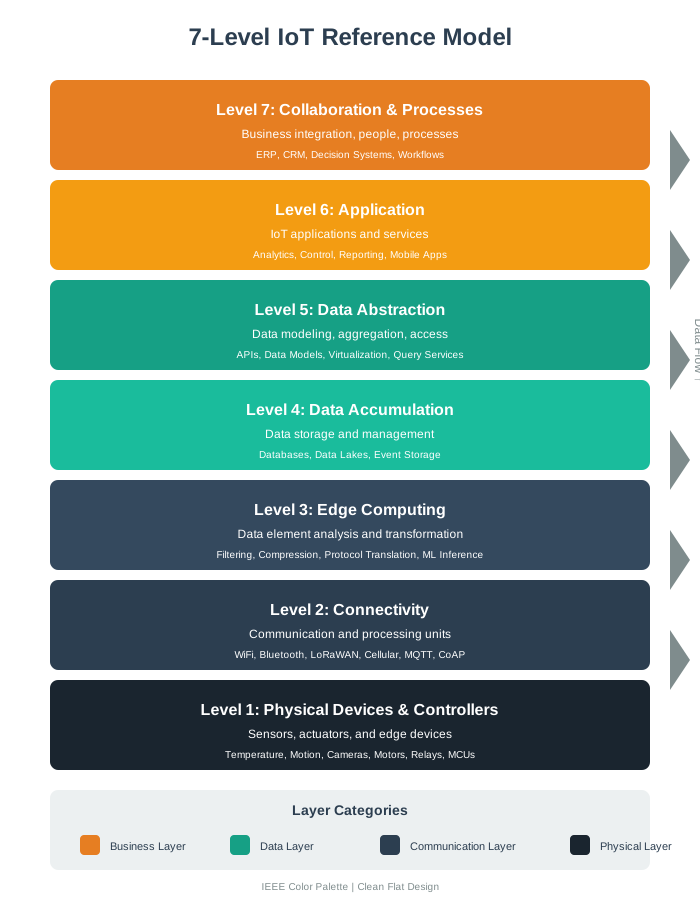
This reference model guides production architecture decisions, showing how data flows through all layers of a complete IoT system.
NoteVisual: Comparison of Deployment Models
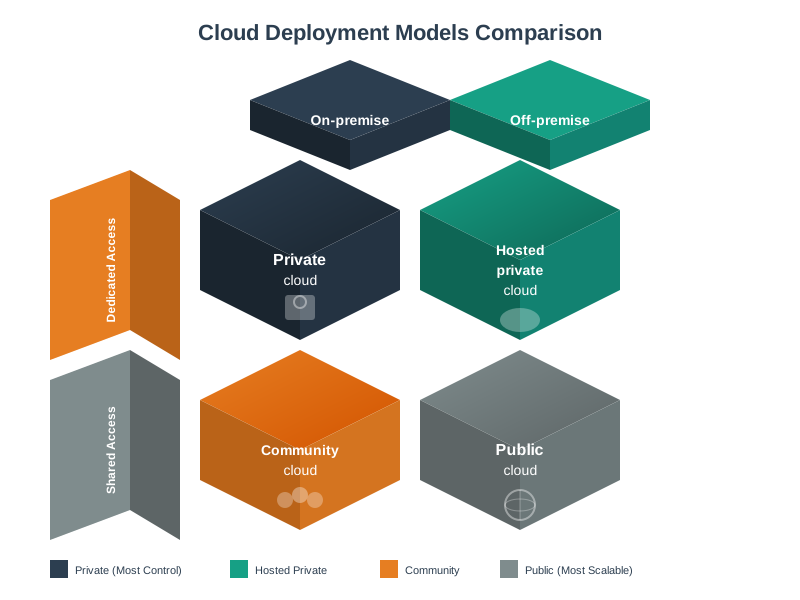
Understanding deployment model trade-offs is critical for production architecture planning and capacity management.
NoteVisual: Continuum Architecture
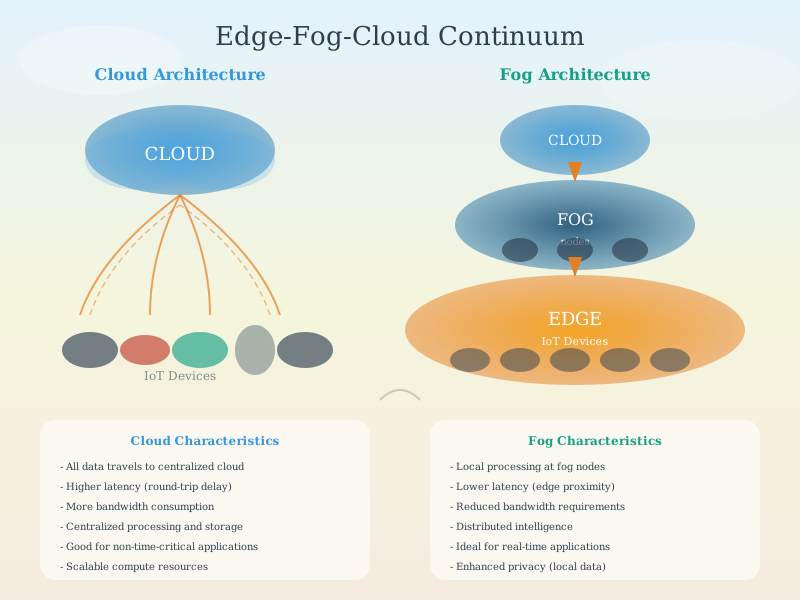
The computing continuum illustrates how production IoT systems distribute processing across multiple tiers for optimal performance and cost.
204.5 Summary
Production Framework integrates multi-layer architecture orchestration (Edge-Fog-Cloud), device lifecycle management, protocol abstraction, power optimization, and multi-tenant system management into a comprehensive IoT deployment solution.
Six-Phase Lifecycle guides production systems through Design (requirements and architecture), Development (prototype and testing), Deployment (provisioning and configuration), Monitoring (health checks and metrics), Optimization (resource tuning), and Scale (capacity planning and multi-tenancy) with feedback loops connecting each phase.
Device Lifecycle Management encompasses provisioning (QR code registration, auto-configuration), continuous health monitoring (battery, connectivity, data quality), automated maintenance scheduling, and graceful decommissioning with secure data handling.
Three-Tier Data Flow demonstrates progressive optimization: Edge tier (100-10K devices) handles raw sensing, Fog tier achieves 80% data reduction through aggregation and local caching, and Cloud tier provides global-scale analytics with 10K+ messages/second ingestion capability.
Production vs Prototype Challenges multiply dramatically at scale. With 10,000 devices, expect 30+ failures per day (not 1 per month), 60,000 messages/minute requiring load balancing, and operational costs shifting from hardware to bandwidth, storage, and 24/7 monitoring.
Cost Estimation at production scale shows approximately $0.21 per device per month covering compute, storage, data transfer, monitoring, and operations, totaling $4,300/month for 10K devices or $31,500/month for 100K devices.
Real-World Deployment lessons from smart building and parking sensor projects demonstrate that edge processing reduces bandwidth costs by 84%, staged OTA rollouts catch bugs before fleet-wide impact, and multi-tenant isolation enables shared infrastructure across customers with separate access controls.
204.6 What’s Next?
Having explored these architectural concepts, we now examine Processes And Systems. The next chapter builds upon these foundations to explore additional architectural patterns and considerations.