229 Control Systems Decision Guidance
229.1 Learning Objectives
By the end of this chapter, you will be able to:
- Select Control Architectures: Choose between open-loop, closed-loop, and hybrid systems
- Configure PID Parameters: Select appropriate P, I, D terms for your application
- Design Distributed Systems: Architect local vs. cloud control for IoT deployments
- Apply Decision Matrices: Use structured frameworks for control system design
- Avoid Common Pitfalls: Recognize when NOT to use PID control
229.2 Prerequisites
Required Chapters: - PID Control Simulation Lab - Hands-on PID experience - Understanding Checks - Real-world scenarios
Estimated Time: 30 minutes
The Problem: Control system design involves many trade-offs—cost vs. performance, speed vs. stability, simplicity vs. capability. Without structured decision-making, engineers often: - Over-engineer simple problems - Under-engineer critical systems - Choose cloud control when local is safer - Add unnecessary complexity
The Solution: Decision matrices and frameworks help you systematically evaluate options and make defensible engineering choices.
How to use this chapter: 1. Start with the decision you need to make 2. Find the relevant decision matrix 3. Map your requirements to the matrix 4. Follow the recommended approach
229.3 Summary of Control Concepts
This section synthesizes the foundational concepts of processes, systems, and feedback control essential for IoT architecture design.
Key Takeaways:
- Process vs System
- Process: Algorithm/steps that transform inputs to outputs
- System: Complete set of interconnected components working together
- IoT devices decompose into hierarchical subsystems
- Feedback Mechanisms
- Feedback enables self-regulation and adaptation
- Can be local (device-level) or distributed (system-level)
- Essential for autonomous IoT operation
- Open-Loop Control
- No feedback from output to input
- Simpler, cheaper, lower power
- Cannot self-correct errors or adapt to disturbances
- Suitable for predictable environments or pure sensing
- Closed-Loop Control
- Continuous feedback enables self-correction
- Maintains desired output despite disturbances
- More complex but provides stability and accuracy
- Recommended for most IoT control applications
- PID Control
- Industry-standard control algorithm
- P (Proportional): Reacts to current error magnitude
- I (Integral): Eliminates steady-state error, handles disturbances
- D (Derivative): Reduces overshoot, provides damping
- PI most commonly used in practice
- Design Trade-offs
- Simple vs. robust
- Fast response vs. stability
- Cost vs. performance
- Local vs. distributed feedback
Understanding these control principles is critical for designing reliable, autonomous IoT systems that can maintain desired behaviors in real-world environments.
229.4 Practical Decision Guidance
When designing IoT control systems, use these decision frameworks:
229.4.1 1. Open-Loop vs. Closed-Loop Decision Matrix
| Use Open-Loop When | Use Closed-Loop When |
|---|---|
| Environment highly predictable | Disturbances expected |
| Accuracy not critical (±20%) | Precision required (±2%) |
| Battery life paramount | Reliability paramount |
| No safety implications | Life-safety critical |
| Cost <$50 per unit | Value >$500 per failure |
Example: Outdoor lighting timer (predictable) vs. aquarium temperature (fish die if wrong).
229.4.2 2. PID Term Selection Guide
| Control Mode | When to Use | Typical Applications |
|---|---|---|
| P-only | Fast response needed, steady-state error acceptable | LED dimming, non-critical positioning |
| PI | Zero steady-state error required, moderate dynamics | HVAC, industrial process control, most IoT |
| PID | High inertia + overshoot intolerable | Ovens, motor control, precision robotics |
| PD | Fast response + damping, manual reset acceptable | Rare—used in velocity control only |
Rule of thumb: Start with PI (Kp=1.0, Ki=0.1). Add D only if overshoot >10%.
229.4.3 3. Distributed Control Architecture Decision
| Requirement | Local Control | Cloud Control | Hybrid |
|---|---|---|---|
| Latency | <100ms | >1s acceptable | <100ms local, analytics in cloud |
| Reliability | Must work offline | Cloud dependency OK | Autonomous + telemetry |
| Cost | $50-500/device | $10-100/device | $100-300/device |
| Use Cases | Industrial safety, medical | Home comfort, monitoring | Smart buildings, agriculture |
Critical insight: For life-safety (fish farms, medical, industrial), always close the loop locally. Use cloud for dashboards/analytics, not primary control.
229.4.4 4. Real-World PID Tuning Quick Start
Step 1: Set Ki=0, Kd=0. Increase Kp until system oscillates. Use Kp = 0.5 × oscillation threshold.
Step 2: Add Ki = 0.1 × Kp. If steady-state error persists, double Ki. If overshoots badly, halve Ki.
Step 3: Only add Kd if overshoot >10%. Start with Kd = 0.1 × Kp. If system becomes sluggish, remove D.
Typical values for temperature control: - Kp: 2-5 (fast water heaters) to 10-20 (slow ovens) - Ki: 0.1-0.5 (eliminates offset in 30-120 seconds) - Kd: 0.5-2.0 (only if overshoot problem, e.g., industrial ovens)
229.4.5 5. When NOT to Use PID
- Event-driven systems: Motion detection, door sensors (use simple thresholds)
- On/off actuators: Can’t modulate relay/solenoid (use hysteresis control instead)
- High noise: Sensor readings vary ±10% (D term amplifies noise—use PI only)
- Very slow processes: 1+ hour response time (use model predictive control instead)
Remember: 80% of IoT control problems solve with simple PI control (Kp=2, Ki=0.1) and local feedback. Don’t over-engineer.
229.5 Python Implementation Reference
229.5.1 PID Controller for IoT Systems
Key Features: 1. Complete PID Implementation: Proportional, Integral, and Derivative terms 2. Anti-Windup: Prevents integral term saturation 3. Derivative Filtering: Reduces high-frequency noise 4. Plant Simulation: First-order system with time delay 5. Performance Metrics: Steady-state error, overshoot, rise time
Example Output:
=== PID Controller Simulation ===

--- P-only (Kp=2) ---
Steady-State Error: 16.67
Overshoot: 0.0%
Final Output: 33.33

--- PI (Kp=2, Ki=0.5) ---
Steady-State Error: 0.42
Overshoot: 12.3%
Final Output: 49.58

--- PID (Kp=2, Ki=0.5, Kd=0.1) ---
Steady-State Error: 0.38
Overshoot: 8.1%
Final Output: 49.62

=== IoT Temperature Control ===

Time(s)  Temp(°C)  Heater(%)
------------------------------
   0.0    18.00      83.4
  10.0    20.15      67.2
  20.0    21.52      42.1
  30.0    21.89      28.3
  60.0    22.01      21.7

Performance:
  Steady-State Error: 0.15°C
  Overshoot: 2.3%
229.6 Production Framework: IoT Control Systems
This section provides a comprehensive, production-ready Python framework for IoT control systems, implementing PID controllers, open-loop and closed-loop architectures, system simulation, and auto-tuning capabilities.
This production framework provides comprehensive IoT control system capabilities including:
- PID Controller: Full PID implementation with anti-windup, output limiting, and configurable modes (P, PI, PD, PID)
- Plant Models: First-order, thermal, and motor dynamics with realistic physics
- System Simulation: Closed-loop and open-loop simulation with disturbance injection
- Auto-Tuning: Ziegler-Nichols and Cohen-Coon tuning methods
- Performance Analysis: 7 metrics including rise time, settling time, overshoot, and integral errors
The framework demonstrates production-ready patterns for IoT control systems with realistic plant models, comprehensive performance analysis, and auto-tuning capabilities.
229.7 Knowledge Check
229.8 Further Reading
Control Theory Fundamentals: - Ogata, K. (2010). Modern Control Engineering. Prentice Hall. - Åström, K. J., & Murray, R. M. (2021). Feedback Systems: An Introduction for Scientists and Engineers. Princeton University Press.
PID Tuning Methods: - Ziegler-Nichols tuning method - Cohen-Coon method - Software auto-tuning algorithms
IoT-Specific Resources: - ESP32 PID library: Arduino PID Library - Industrial IoT control systems - Edge computing for distributed control
Online Simulators: - PID simulator: https://pidtuner.com - Control system design tools in MATLAB/Simulink
229.9 References
Perera, C., et al. (2014). “Context Aware Computing for The Internet of Things: A Survey.” IEEE Communications Surveys & Tutorials.
Franklin, G. F., Powell, J. D., & Emami-Naeini, A. (2019). Feedback Control of Dynamic Systems. Pearson.
Ang, K. H., Chong, G., & Li, Y. (2005). “PID control system analysis, design, and technology.” IEEE Transactions on Control Systems Technology.
IoT Architecture Working Group. (2016). “IoT Reference Architecture.” IoT-A Project Deliverable.
This chapter established the fundamental concepts of processes and systems that underpin IoT device behavior and control mechanisms.
System Fundamentals: We defined systems as collections of interacting components with defined boundaries, inputs, and outputs. Understanding system boundaries helps architects determine what should be monitored, controlled, and optimized within IoT deployments. Every IoT device can be viewed as a system transforming sensor inputs into data outputs or actuator controls.
Feedback and Control: The chapter distinguished between open-loop and closed-loop control systems. Open-loop systems execute predetermined actions without measuring results, while closed-loop systems use feedback to continuously adjust behavior. Most effective IoT systems employ closed-loop control - thermostats maintaining temperature setpoints, industrial controllers regulating processes, and adaptive algorithms optimizing performance based on measured outcomes.
Process Optimization: We explored how processes transform inputs into valuable outputs through series of steps. In IoT contexts, processes include data collection workflows, communication protocols, power management strategies, and decision-making algorithms. Understanding process dynamics helps engineers optimize system responsiveness, energy efficiency, and reliability.
These systems and process concepts provide the analytical framework for understanding how IoT devices behave, respond to stimuli, and maintain desired operational states. This foundation prepares you for examining more complex multi-device network architectures.
229.10 Visual Reference Gallery
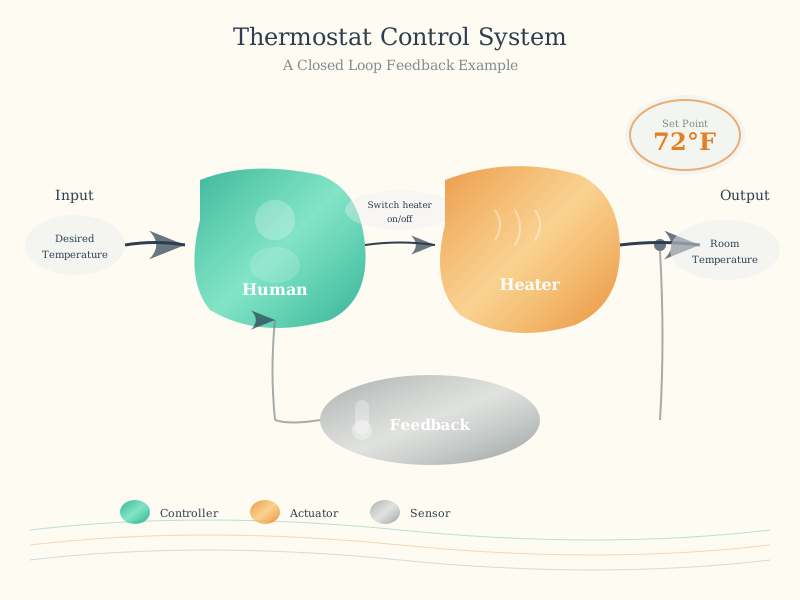
This classic example demonstrates closed-loop control principles applied to an everyday appliance, illustrating how the concepts from the labs apply to real-world IoT devices.
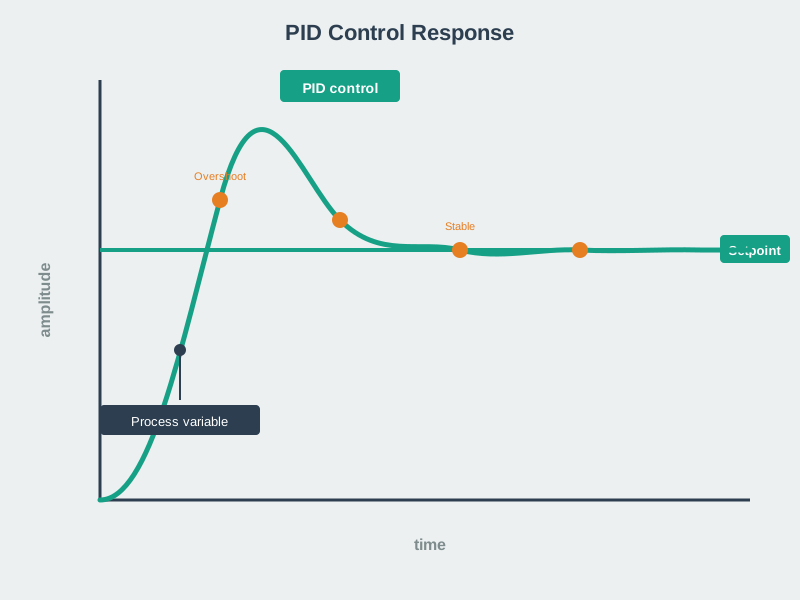
This visualization shows how derivative control anticipates future error based on the rate of change, providing damping to reduce overshoot in PID systems.
This comprehensive view shows a complete PID controller in action within a closed-loop system, tying together all the control concepts from the lab exercises.
Deep Dives: - Processes and Systems - Control theory fundamentals - Sensor Fundamentals - Measurement principles - Actuators - Control action mechanisms
Comparisons: - Edge Compute Patterns - Processing at the edge - Network Design - System simulation
Products: - IoT Use Cases - Industrial control applications - Hardware Prototyping - ESP32 and Arduino
Learning: - Simulations Hub - PID controller simulators - Quizzes Hub - Test your control system knowledge
229.11 What’s Next?
Having explored these architectural concepts, we now examine Multi Hop Ad Hoc Networks. The next chapter builds upon these foundations to explore additional architectural patterns and considerations.