164  Architecture Design Patterns and Case Studies

164.1 Learning Objectives

By the end of this chapter, you will be able to:

  • Identify anti-patterns: Recognize common architectural mistakes and their consequences
  • Apply solutions: Implement fixes for cloud-only, direct-database, and energy depletion anti-patterns
  • Analyze case studies: Extract architectural lessons from Amazon and Shell IoT deployments
  • Use decision frameworks: Apply the architecture selection decision tree to new projects
  • Troubleshoot systematically: Diagnose IoT problems by layer

164.2 Common Architecture Anti-Patterns and Solutions

~15 min | Advanced | P04.C18.U03

Understanding what NOT to do is as important as best practices. Here are frequent mistakes in IoT reference architecture implementation:

164.2.1 Anti-Pattern 1: Cloud-Only Architecture (Skipping Layers 3-5)

Problem:

Sensors (L1) → Wi-Fi (L2) → Cloud (L6-L7)
  • 1000 sensors x 1 reading/second = 1000 msgs/sec to cloud
  • Bandwidth cost: $5,000/month on cellular
  • Latency: 200-500ms round-trip prevents real-time control
  • Reliability: Internet outage = complete system failure

Solution:

Sensors (L1) → Wi-Fi (L2) → Edge Gateway (L3) → Database (L4) →
API (L5) → Apps (L6) → Users (L7)
  • L3 filters 1000 msgs/sec → 50 msgs/sec (20x reduction)
  • L4 stores locally, syncs summaries to cloud
  • L5 abstracts sensor types from applications
  • Result: $5K/month → $200/month, <10ms local response, offline operation

164.2.2 Anti-Pattern 2: Direct Database Access from Applications (No Layer 5)

Problem:

Dashboard queries PostgreSQL directly:
SELECT * FROM sensor_readings WHERE sensor_id = 'zigbee_042'
  • Adding LoRaWAN sensors breaks dashboard (different table schema)
  • Temperature in Celsius (Zigbee) vs Fahrenheit (legacy sensors) = manual conversion
  • No access control granularity (all apps see all data)

Solution (Layer 5 Abstraction):

Dashboard calls: GET /api/sensors/042/temperature?unit=celsius
Layer 5 API:
1. Translates sensor_id to correct backend (Zigbee table, LoRaWAN table)
2. Converts units if needed
3. Enforces access controls
4. Returns: {"sensor": "042", "temperature": 25.5, "unit": "celsius"}
  • Result: Add new sensor types without changing apps, centralized unit conversion

164.2.3 Anti-Pattern 3: Hotspot Energy Depletion (WSN/M2M)

Problem:

100 sensors → 1 gateway (single path)
Sensors near gateway relay 90% of traffic → batteries die in 3 months
Edge sensors still have 95% battery but network is disconnected

Solution:

100 sensors → 3 gateways (distributed load)
Each gateway handles ~33 sensors
Energy consumption balanced across network
  • Result: 3-month lifetime → 2-year lifetime, same battery capacity

164.2.4 Troubleshooting Guide by Layer

Symptom Likely Layer Diagnostic Fix
High cloud costs L3 missing Check msgs/sec to cloud Add edge filtering/aggregation
Slow dashboard L4 improper Query time? Index database, use time-series DB
Can’t add new sensors L5 missing Apps know sensor formats? Add abstraction API
Works when internet up, fails offline L3 weak Local autonomy? Add edge processing rules
Battery dies fast L1-L2 Idle listening? Implement duty cycling
NoteKnowledge Check: Scalability Anti-Patterns

164.3 Industry Case Studies

~20 min | Intermediate | P04.C18.U04

164.3.1 Smart Home IoT Topology and Power Architecture

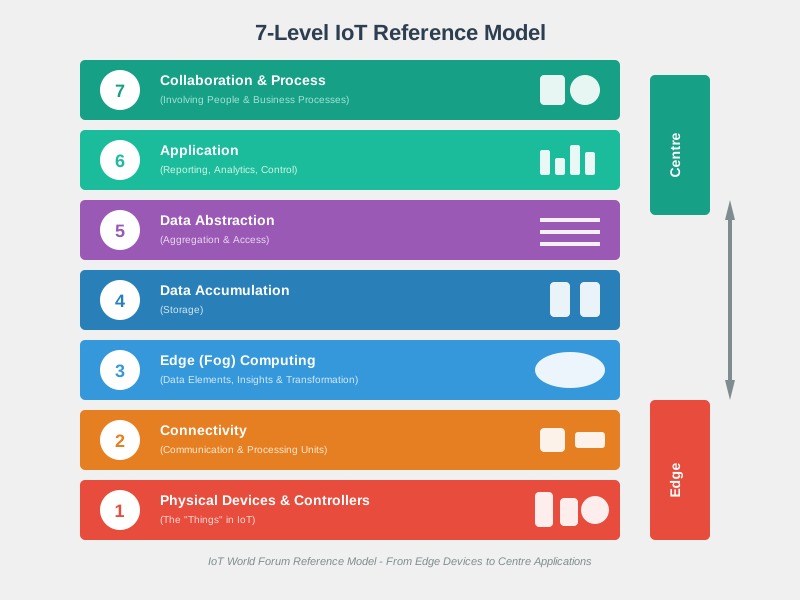
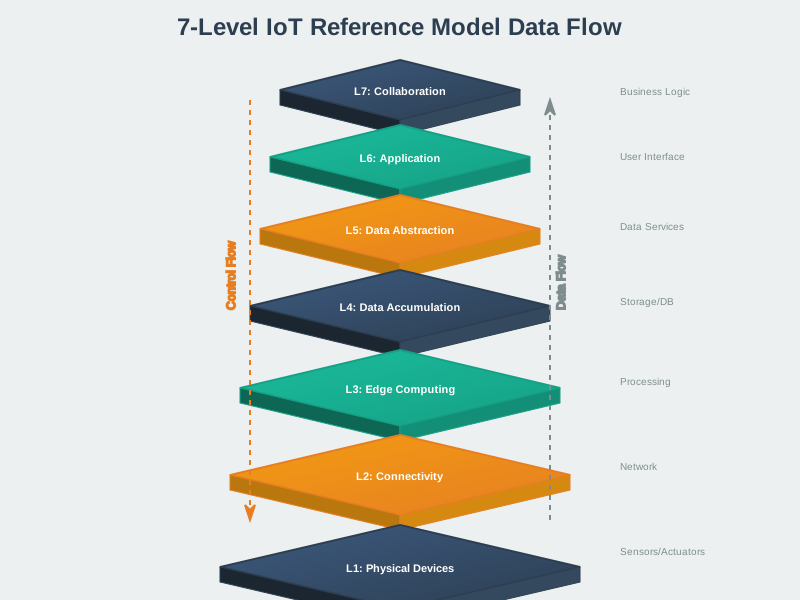
Before diving into enterprise case studies, let’s examine a concrete smart home deployment that illustrates the 7-level reference model in a residential context.

This diagram reveals several key architectural patterns that map to the 7-level reference model:

Level 1 (Physical Devices): - Battery-powered sensors: Motion detectors, door/window sensors (3-5 year battery life) - Mains-powered actuators: Smart lights, thermostats, door locks (continuous power via PoE or AC) - PoE-enabled devices: IP cameras, access control panels (receive both data and power via single Ethernet cable)

Level 2 (Connectivity): - Star topology with central hub: Zigbee coordinator or Z-Wave controller acts as network center - Power-over-Ethernet (PoE): IEEE 802.3af/at injectors provide up to 25.5W per device, eliminating need for separate power wiring - Communication range: Zigbee mesh extends effective range; PoE supports 100m cable runs

Level 3 (Edge Computing): - Gateway performs: Protocol translation (Zigbee to Wi-Fi), rule-based automation (“turn on lights when motion detected after sunset”), local device pairing/management - Offline operation: Critical functions (unlock door, emergency lighting) work without internet

Architectural Benefits:

Design Choice Benefit 7-Level Mapping
PoE Infrastructure Single cable for data + power reduces installation cost by $50-100 per device L1 (Physical) + L2 (Connectivity)
Star Topology Simplified troubleshooting - hub failure is obvious; device failure isolated L2 (Connectivity)
Mixed Power Sources Critical sensors battery-powered (work during outages), convenience devices PoE-powered L1 (Physical Devices)
Local Gateway Sub-10ms automation latency (motion to light), no cloud dependency for basic functions L3 (Edge Computing)

Real-World Example: Retrofit Installation Cost Analysis

For a 3-bedroom home (25 devices total):

Traditional AC Wiring Approach: - Electrician labor: $150/outlet x 15 AC outlets = $2,250 - Materials (outlets, wiring): $500 - Total: $2,750

PoE + Battery Hybrid Approach: - 1x PoE switch (8-port): $120 - 10x PoE devices (lights, locks, thermostats): $0 additional wiring - 15x battery-powered sensors: $0 wiring - Total: $120 (98% cost reduction for wiring infrastructure)

This smart home architecture demonstrates how thoughtful application of the 7-level reference model - particularly optimizing Levels 1-3 (devices, connectivity, edge) - can dramatically reduce deployment costs while improving system reliability through local processing and mixed power architectures.

Industry: E-commerce logistics (fulfillment center operations)

Challenge: Amazon operates 175+ fulfillment centers globally processing 1.6M packages daily. Initial ad-hoc IoT deployments lacked consistency across centers, making it difficult to replicate successful automation strategies and creating integration nightmares when adding new device types.

Solution Architecture (Mapped to 7-Level Model):

Level 1 (Physical Devices): 80,000+ devices per fulfillment center - Kiva robots (autonomous mobile robots transporting shelving units) - Conveyor belt sensors (package tracking, weight verification, barcode scanning) - Robotic arms (package sorting, palletization) - Environmental sensors (temperature, humidity for climate-controlled storage)

Level 2 (Connectivity): Hybrid network architecture - Wi-Fi 6 for high-speed robot coordination (1200 robots per center) - Wired Ethernet for conveyor systems (guaranteed bandwidth, no interference) - Private LTE for outdoor yard operations (trailer loading, parking management)

Level 3 (Edge Computing): Zone-level edge servers (one per 10,000 sq ft) - Robot collision avoidance (10ms local path planning, cannot tolerate cloud latency) - Real-time conveyor jam detection and automatic speed adjustment - Package routing decisions (which conveyor belt for each package destination) - Buffer data during internet outages (edge autonomy ensures operations continue)

Level 4 (Data Accumulation): Three-tier storage - On-premise PostgreSQL: Real-time operational data (package locations, robot status) - 7 days retention - On-premise InfluxDB: Time-series sensor data (conveyor speeds, robot trajectories) - 30 days retention - AWS S3 + Redshift: Historical analytics data for long-term optimization - 7 years retention

Level 5 (Data Abstraction): Unified device API - REST API abstracts 15+ different robot/sensor vendors (Kiva, Dematic, Honeywell, Zebra scanners) - Standard data model: All devices report to /api/devices/{id}/state regardless of vendor - Adding new vendor requires writing adapter (2-3 days) instead of rewriting applications (4-6 weeks)

Level 6 (Application): Warehouse management systems - Real-time package tracking dashboard showing 50,000 active packages in facility - Predictive maintenance app forecasting robot failures 48 hours in advance - Labor management system optimizing human picker assignments based on package locations - Energy optimization app adjusting HVAC based on robot heat generation patterns

Level 7 (Collaboration & Processes): Human-machine coordination - Warehouse managers receive alerts when zones fall behind throughput targets - Maintenance teams coordinate robot servicing based on predictive models - Safety protocols: Humans entering robot zones trigger automatic robot slowdown - Cross-facility learning: Insights from Seattle center deployed to Dallas center overnight

Results: - Consistency: 7-level model provided common vocabulary across 175 centers, enabling rapid replication of successful automation strategies - Throughput: 40% increase in packages processed per hour through edge-layer robot coordination - Integration speed: Adding new device vendor reduced from 6 weeks (rewriting apps) to 3 days (writing Layer 5 adapter) - Reliability: Edge autonomy ensured operations continued during 23 internet outages (avg 45min each) across 175 centers in 2023 - Cost savings: $80M annually through predictive maintenance (Layer 6 apps) reducing unplanned robot downtime by 65%

Lessons Learned: - Layer 3 (Edge) is critical for robot collision avoidance - cloud latency (200-500ms) is unacceptable for safety-critical path planning - Layer 5 (Abstraction) paid for itself within 6 months by accelerating vendor integration (15 different device vendors in typical center) - Clear layer separation enabled different teams to work independently - robotics team owns L1-L3, IT team owns L4-L5, application developers own L6, operations owns L7

Industry: Energy (electrical grid management)

Challenge: Shell operates smart grid infrastructure across 12 European countries with 8 million smart meters. EU regulations mandate interoperability between vendors and countries, but proprietary IoT implementations created integration barriers costing 20M EUR annually in custom adapters.

Solution Architecture (Mapped to IoT-A Reference Model):

Resource Layer: Physical grid assets - 8 million smart meters (multiple vendors: Landis+Gyr, Itron, Sagemcom) - 2,500 grid sensors (voltage, current, power quality monitors) - 800 substations with automated switching equipment - 150,000 distribution transformers with remote monitoring

IoT Service Layer: Standardized device services - DLMS/COSEM protocol for smart meter communication (IEC 62056 standard) - MQTT for sensor telemetry with standardized JSON schemas - RESTful APIs for substation control (IEC 61850 compliant)

Virtual Entity Layer: Digital twins of grid assets (IoT-A’s unique contribution) - Each transformer represented as virtual entity with properties: location, capacity, temperature, load, health_status - Virtual entity aggregates data from multiple physical sensors (oil temperature, bushing current, tap changer position) - Digital twin enables “what-if” simulations: “If transformer T-4521 fails, which transformers will be overloaded?”

Service Organization Layer: Orchestrated grid services - Load balancing service: Monitors all transformers, triggers automatic load shedding if overload detected - Outage detection service: Correlates smart meter connectivity loss patterns to identify grid failures - Renewable integration service: Coordinates solar/wind fluctuations with grid storage and demand response

Application Layer: Utility operations - Grid operations dashboard showing 8M meters, 2,500 sensors in real-time (map-based visualization) - Predictive maintenance app forecasting transformer failures 30 days in advance - Customer billing app integrating smart meter data with CRM and invoicing systems - Regulatory reporting app generating compliance reports for 12 national energy regulators

Business Layer: Strategic grid management - Revenue protection: Detect energy theft through anomaly detection (45M EUR annual recovery) - Capital planning: Use digital twin simulations to optimize grid expansion investments - Renewable integration: Maximize solar/wind usage while maintaining grid stability

Cross-Cutting Security: EU GDPR compliance - Smart meter data anonymization (remove customer PII before analytics) - End-to-end encryption (AES-256) for meter readings - Role-based access control: Field technicians see only assigned assets, executives see aggregated dashboards

Results: - Interoperability: IoT-A model enabled seamless integration across 12 countries with different vendors and regulations - Cost reduction: 18M EUR annual savings by eliminating custom integration code (virtual entity layer provides vendor abstraction) - Digital twin value: Predictive simulations reduced transformer failures by 42% through proactive maintenance - Outage response: Virtual entity layer enabled 30% faster fault localization by correlating multiple sensor readings - Renewable integration: Grid now handles 35% renewable energy (up from 18%) through service organization layer coordination

Lessons Learned: - IoT-A’s virtual entity layer is powerful for physical infrastructure digital twins - transformers, substations represented as software objects - Service organization layer critical for complex orchestration (load balancing requires coordinating meters, sensors, substations simultaneously) - Business layer alignment ensured IoT investments tied to strategic goals (revenue protection, renewable integration) not just technology experiments - Cross-cutting security simplified GDPR compliance - one privacy framework across all layers instead of per-layer security bolt-ons
164.4 Architecture Selection Decision Tree

When designing an IoT system, choosing the right architecture pattern is critical. Use this decision tree to guide your selection:

%%{init: {'theme': 'base', 'themeVariables': {'primaryColor': '#2C3E50', 'primaryTextColor': '#fff', 'primaryBorderColor': '#1A252F', 'lineColor': '#16A085', 'secondaryColor': '#E67E22', 'tertiaryColor': '#ECF0F1', 'fontSize': '14px'}}}%%
flowchart TD
    Start["What's your primary<br/>requirement?"]

    Start --> Latency{"Real-time<br/>response<br/>needed?"}
    Start --> Scale{"Massive scale<br/>(1000+ devices)?"}
    Start --> Remote{"Remote/harsh<br/>environment?"}
    Start --> Simple{"Simple device<br/>control only?"}

    Latency -->|"<100ms"| Edge["EDGE COMPUTING<br/>Process at device"]
    Latency -->|"100ms-1s"| Fog["FOG COMPUTING<br/>Process near devices"]
    Latency -->|">1s OK"| Cloud["CLOUD<br/>Centralized processing"]

    Scale -->|Yes| ScaleQ{"Need local<br/>autonomy?"}
    ScaleQ -->|Yes| WSN["WSN<br/>Wireless Sensor Network"]
    ScaleQ -->|No| Cloud

    Remote -->|Yes| RemoteQ{"Devices need<br/>to communicate<br/>with each other?"}
    RemoteQ -->|Yes| M2M["M2M<br/>Machine-to-Machine"]
    RemoteQ -->|No| LPWAN["LPWAN + Cloud<br/>Long-range to cloud"]

    Simple -->|Yes| Direct["DIRECT<br/>Device-to-App"]

    Edge --> EdgeNote["Use when: Safety-critical,<br/>bandwidth-limited, privacy-sensitive"]
    Fog --> FogNote["Use when: Regional processing,<br/>aggregation, intermittent connectivity"]
    Cloud --> CloudNote["Use when: Big data analytics,<br/>global access, ML/AI training"]
    WSN --> WSNNote["Use when: Environmental monitoring,<br/>distributed sensing, mesh networks"]
    M2M --> M2MNote["Use when: Industrial automation,<br/>vehicle-to-vehicle, autonomous systems"]
    LPWAN --> LPWANNote["Use when: Agriculture, utilities,<br/>asset tracking, low data rate"]
    Direct --> DirectNote["Use when: Consumer devices,<br/>simple control, local only"]

    style Start fill:#2C3E50,stroke:#1A252F
    style Edge fill:#16A085,stroke:#0D6655
    style Fog fill:#27AE60,stroke:#1E8449
    style Cloud fill:#3498DB,stroke:#2471A3
    style WSN fill:#E67E22,stroke:#AF5F1A
    style M2M fill:#9B59B6,stroke:#7D3C98
    style LPWAN fill:#F39C12,stroke:#D68910
    style Direct fill:#7F8C8D,stroke:#5D6D7E

Figure 164.1: IoT Architecture Decision Tree: Selecting the Right Pattern

164.4.1 Quick Architecture Comparison

Architecture Best For Latency Scale Connectivity Complexity
Edge Real-time, privacy <50ms Low-Medium Local High
Fog Regional processing 50-500ms Medium-High Regional Medium-High
Cloud Analytics, storage 100ms-5s Unlimited Always-on Medium
WSN Environmental sensing Varies Very High Mesh High
M2M Direct device comms <100ms Medium Peer-to-peer Medium
Hybrid Most real deployments Varies High Mixed High
TipPractical Advice: Most Systems Are Hybrid

Real-world IoT systems rarely use a single architecture pattern. A smart factory might use:

  • Edge: Safety interlocks (must react in <10ms)
  • Fog: Quality control aggregation (per-line statistics)
  • Cloud: Production analytics, ML model training
  • M2M: Robot-to-robot coordination on the floor

The decision tree helps you identify the dominant pattern, but plan for hybrid architectures as your system matures.

NoteKnowledge Check: Architecture Selection

164.6 Summary

In this chapter, you learned:

  • Three common anti-patterns: Cloud-only (missing L3), direct database access (missing L5), and energy hotspots
  • Amazon case study: Layer 3 edge computing critical for 10ms robot collision avoidance; Layer 5 abstraction enabled 15-vendor integration
  • Shell case study: IoT-A virtual entity layer powers digital twins; service organization enables grid-wide load balancing
  • Architecture decision tree: Select based on latency requirements, scale, connectivity, and environment constraints
  • Hybrid reality: Production systems typically combine multiple patterns

164.7 What’s Next

Continue to Practical Application and Assessment for interview preparation, an interactive quiz, the Architecture Layer Builder game, and a hands-on lab building a multi-layer IoT demo with ESP32.