%%{init: {'theme': 'base', 'themeVariables': {'primaryColor':'#2C3E50','primaryTextColor':'#fff','primaryBorderColor':'#16A085','lineColor':'#16A085','secondaryColor':'#E67E22','tertiaryColor':'#7F8C8D'}}}%%
graph LR
    subgraph sensor["IoT Sensor Node"]
        WuRX["Wake-up RX<br/>1µW always-on"]
        UWB_TX["UWB TX<br/>100µW when active"]
    end

    subgraph gateway["Gateway/Hub"]
        TX["High-Power TX<br/>Sends wake-up signal"]
        RX["Sensitive RX<br/>Receives UWB data"]
    end

    TX -->|"Wake-up<br/>signal"| WuRX
    UWB_TX -->|"Sensor data<br/>burst"| RX

    style WuRX fill:#16A085,stroke:#2C3E50,color:#fff
    style UWB_TX fill:#E67E22,stroke:#2C3E50,color:#fff
    style TX fill:#2C3E50,stroke:#16A085,color:#fff
    style RX fill:#2C3E50,stroke:#16A085,color:#fff
185 IoT System-on-Chip Architecture
185.1 Learning Objectives
By the end of this chapter, you will be able to:
- Understand SoC Architecture: Analyze internal block diagrams of IoT System-on-Chip designs including CPU cores, RF subsystems, DSP accelerators, and power management
- Evaluate Hardware Accelerators: Understand the power savings from dedicated DSP blocks (FFT, CORDIC, MAC) versus software implementations
- Compare Commercial and Research SoCs: Distinguish between general-purpose commercial IoT SoCs and ultra-low-power research designs
- Analyze Die Area Tradeoffs: Understand how silicon area allocation impacts cost, power, and capability
185.2 Prerequisites
Before diving into this chapter, you should be familiar with:
- MCU vs MPU Selection: Understanding the fundamental differences between microcontrollers and microprocessors
- Power Management and Interfaces: Familiarity with power modes, GPIO, and sensor interfacing
185.3 Under the Hood: IoT System-on-Chip (SoC) Architecture
When you buy an ESP32 module or a TI CC2650, you’re getting a complete System-on-Chip (SoC)—a single integrated circuit containing all the components needed for a complete IoT system. Understanding what’s inside these chips helps you make better hardware selections and optimize your designs.
IoT SoC high-level block diagram: This diagram shows the major functional blocks integrated on a single chip—processing core, memory, wireless communication, sensors, and power management—illustrating how modern IoT devices achieve complete system functionality in minimal footprint.
The block diagram above illustrates the architectural organization of a typical IoT SoC. Each major subsystem (processing, communication, sensing, power) is integrated on the same die, enabling compact designs, low power consumption, and cost-effective manufacturing. The following sections explore these subsystems in detail.
TipFor Beginners: What is a System-on-Chip?
Analogy: Think of a SoC like a complete kitchen appliance factory on a single chip:
- Traditional approach (discrete components): Separate factory buildings for different tasks—one for motors, one for electronics, one for packaging—all connected by trucks (wires)
- SoC approach: Everything under one roof—all machines integrated, sharing power and communication efficiently
Why SoCs dominate IoT:
| Discrete Components | System-on-Chip (SoC) |
|---|---|
| Multiple chips needed | Single chip solution |
| More PCB space required | Compact design |
| Higher power (chip-to-chip communication) | Lower power (on-chip buses) |
| Complex assembly | Simple integration |
| $10-50 total cost | $2-10 complete solution |
The key insight: Modern IoT SoCs pack incredible capability into chips smaller than your fingernail—CPU, memory, radio, sensors, and power management all integrated.
185.4 Commercial IoT SoC Examples
Modern IoT modules you can buy today integrate sophisticated SoC designs. The following figure shows the internal architecture of a typical IoT SoC, revealing the complexity hidden within these tiny chips:
IoT SoC internal architecture: This detailed view shows the complex subsystems integrated on a single chip—CPU with cache hierarchy, memory controllers, RF transceiver with baseband processing, sensor interfaces, power management, and clocking—all interconnected via high-speed buses to create a complete wireless sensor platform.
This cross-section reveals the sophisticated architecture required for even “simple” IoT devices. Key observations include the dedicated RF subsystem for wireless communication, specialized DSP blocks for signal processing, and power management circuitry that enables battery operation—all packed into a chip smaller than your fingernail.

Key Architecture Insights:
| Component | Purpose | Power Optimization |
|---|---|---|
| Main ARM M3 | Application processing | Can be powered down during sleep |
| RF ARM M0 | Radio stack processing | Dedicated core, efficient for BLE/Zigbee |
| Sensor Controller | Autonomous sensing | Operates at 24kHz, wakes main CPU only when needed |
| AES Accelerator | Hardware encryption | 100x faster than software, saves power |
| DC-DC Converter | Power regulation | 80%+ efficiency vs 50% for LDO |
185.5 Research-Grade Ultra-Low-Power IoT SoC
To understand what’s possible with advanced IoT chip design, let’s examine a research SoC that achieves 6.45µW total system power—enough to run entirely from harvested RF energy:

185.6 Why These Components? Design Trade-offs
185.6.1 Dedicated DSP Accelerators
Instead of using the main CPU for signal processing (which wastes power), dedicated hardware performs common operations:
| Accelerator | Function | Power Savings |
|---|---|---|
| CORDIC | Sin/cos/atan calculations | 50-100x vs software |
| MAC | Multiply-accumulate for filters | 20x vs software |
| FFT | 16-point spectrum analysis | 100x vs software |
| FIR | 4-channel filtering | 30x vs software |
Example: Computing a 16-point FFT:
- Software on MSP430: ~10,000 cycles x 0.5µA/MHz = 5µA for 1ms
- Hardware FFT: ~50 cycles x 0.1µA = 0.005µA for 10µs (1000x less energy!)
185.6.2 Asymmetric Radio Architecture
Traditional radios use the same circuitry for transmit and receive, but IoT has asymmetric communication patterns:
{fig-alt=“Asymmetric radio architecture diagram showing IoT sensor node with ultra-low-power wake-up receiver (1µW always-on) and UWB transmitter (100µW when active), communicating with gateway that has high-power transmitter for wake-up signals and sensitive receiver for UWB data. Arrows show wake-up signal from gateway to sensor and sensor data burst from sensor to gateway.”}
Why asymmetric?
- Sensor node TX: Simple, power-efficient UWB transmitter (no complex modulation)
- Sensor node RX: Ultra-simple wake-up receiver (just detects presence of signal)
- Gateway does the hard work: Complex receivers and high-power transmitters (wall-powered)
185.6.3 Energy Harvesting with MPPT
The boost converter includes Maximum Power Point Tracking (MPPT)—an algorithm that continuously adjusts load impedance to extract maximum power from solar cells:
| Solar Condition | Without MPPT | With MPPT | Improvement |
|---|---|---|---|
| Full sun | 80µW | 95µW | +19% |
| Partial shade | 20µW | 35µW | +75% |
| Indoor lighting | 2µW | 5µW | +150% |
The MPPT boost converter alone makes the difference between a working device and a dead device under indoor lighting!
185.7 Physical Implementation: Die Photo Analysis
Real IoT SoCs look like this under a microscope (the 6.45µW chip die photo):
Die Dimensions: 3.78mm x 3.57mm = 13.5 mm² total area
185.8 Extreme Miniaturization: Ant-Sized Radio Systems
Modern IoT research has pushed miniaturization to extraordinary limits. The following figure shows digital circuits from an ant-sized radio—a complete wireless sensor platform small enough to fit on the back of an insect:
Ultra-Miniaturized IoT Systems: This die photo captures the digital circuitry of a complete wireless sensor platform measuring just 1.9mm x 1.5mm (2.85 mm²)—smaller than a grain of rice and 4.7x smaller than the 6.45µW research SoC described above. The entire system includes an 8-bit CPU, 64-byte SRAM (for minimal code/data), radio transmitter, sensor interfaces, and energy harvesting circuitry. This represents the absolute limit of IoT miniaturization: when assembled with antenna and solar cell, the complete sensor weighs <10 milligrams—light enough to attach to insects for tracking studies or deploy as dust-sized environmental monitors. The dense digital logic (visible as regular rectangular patterns) contrasts with custom analog/RF blocks (curved/triangular shapes). Power budget: The entire system runs on <50µW harvested from a 2mm² solar cell—enough to sample sensors and transmit 1-byte packets every 10 seconds. This technology enables applications impossible with conventional IoT: tracking individual bees in a hive, monitoring structural vibrations at millimeter scale, or deploying thousands of sensors from aircraft for wildfire detection. The key enabling technologies are ultra-low-power digital design (sub-threshold operation at 0.5V), energy-aware protocols (transmit-only, no receiver), and 3D integration (stacking dies to reduce footprint).
Area Breakdown (approximate from die photo):
| Block | Area (mm²) | Percentage | Notes |
|---|---|---|---|
| Radios | 3.5 | 26% | UWB TX + Wake-up RX |
| Power Management | 2.0 | 15% | Boost converter + MPPT |
| Memory (DMEM) | 2.5 | 19% | 8KB total data memory |
| DSP Accelerators | 2.0 | 15% | FFT, FIR, CORDIC, MAC |
| Analog Front End | 1.5 | 11% | 4-ch AFE + ADC |
| CPU + Control | 1.5 | 11% | MSP430 + LCU |
| I/O Pads | 0.5 | 4% | Bond pads around edge |
Key Observations:
- Radio dominates: Even at this ultra-low power, RF circuits take 26% of die area
- Memory is expensive: 8KB of on-chip SRAM takes 19% of area
- Processing is cheap: The entire MSP430 CPU takes only 11% of area
- Power management matters: 15% dedicated to efficient energy harvesting
WarningDesign Insight: Why On-Chip Memory is Precious
In the research SoC, 8KB of SRAM occupies 2.5mm² (19% of the chip). At typical fab costs of $0.10-0.50 per mm², this memory alone costs $0.25-1.25 per chip!
Practical implications:
- Code must be highly optimized to fit in limited memory
- External flash/RAM adds cost, power, and board space
- This is why ESP32 (520KB RAM) costs $5 while basic ATtiny (512 bytes) costs $0.50
- Memory architecture drives both chip cost and application capability
185.9 Comparing Commercial vs Research SoCs
| Metric | TI CC2650 (Commercial) | Research 6.45µW SoC |
|---|---|---|
| Total Power | ~1mW typical | 6.45µW |
| CPU | ARM Cortex-M3 @ 48MHz | MSP430 @ low MHz |
| Memory | 128KB Flash + 20KB RAM | 8KB total |
| Radio | BLE 4.2 / Zigbee | UWB TX + Wake-up RX |
| ADC | 12-bit 200ksps | 8-bit |
| Energy Harvesting | External | Integrated MPPT |
| Use Case | General-purpose IoT | Battery-free sensors |
| Cost | ~$3 in volume | Research prototype |
The trade-off: Commercial SoCs prioritize flexibility and ease of use; research SoCs push efficiency limits for specialized applications like battery-free sensors.
185.10 Knowledge Check
185.11 Visual Reference Gallery
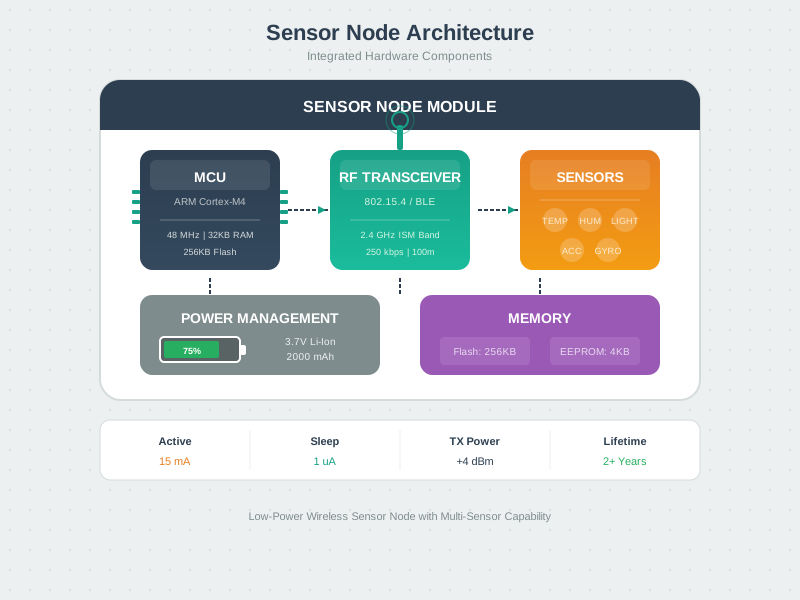
NoteVisual: Sensor Node Hardware Architecture
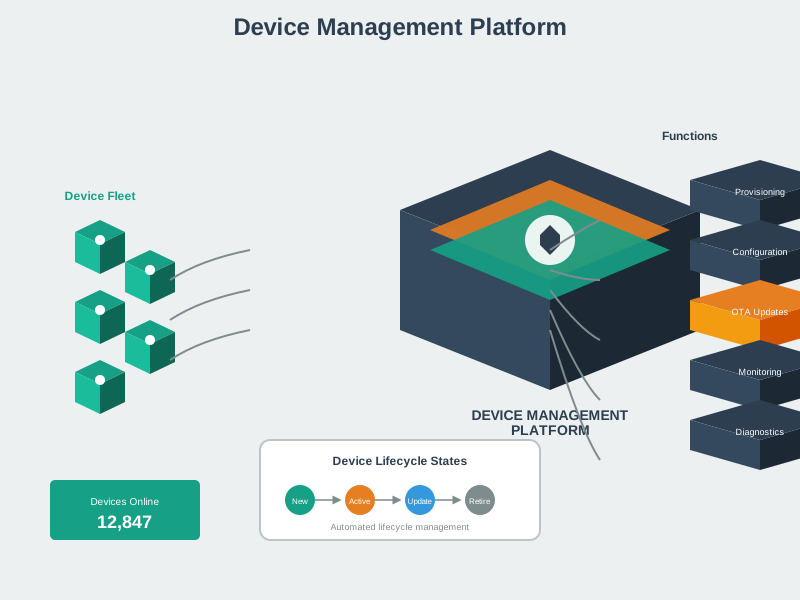
NoteVisual: Device Management Platform
NoteVisual: Intermediary IoT Devices

185.12 Summary
This chapter covered IoT System-on-Chip architecture:
- SoC Integration: Modern IoT SoCs pack CPU, memory, radio, sensors, and power management on a single chip (4mm x 4mm for TI CC2650)
- Commercial vs Research: TI CC2650 draws ~1mW for general-purpose IoT; research SoCs achieve 6.45µW for battery-free sensors
- Hardware Accelerators: Dedicated DSP blocks (FFT, CORDIC, FIR, MAC) provide 20-100x power savings versus software implementations—critical for ultra-low-power sensing applications
- Asymmetric Radios: Research SoCs use simple UWB transmitters (100µW) with ultra-low-power wake-up receivers (1µW), offloading complex RF processing to wall-powered gateways
- Die Area Allocation: Radio (26%), memory (19%), power management (15%), DSP (15%), CPU (11%)—radio and memory dominate cost
- Memory Cost: 8KB SRAM occupies 19% of die area; memory architecture drives both chip cost and application capability
- Energy Harvesting: Integrated MPPT boost converters extract 75-150% more power from solar cells in suboptimal lighting conditions
NoteRelated Chapters
Fundamentals:
- Enablers Fundamentals - Computing power and miniaturization enablers
- Communication and Protocol Bridging - Sensor communication protocols
Platforms:
- Prototyping Hardware - Arduino, ESP32, Raspberry Pi platforms
- Specialized Prototyping Kits - Platform selection guide
Power:
- Energy-Aware Considerations - Power budget calculations
- Enablers Production - Power management frameworks
Architecture:
- Edge-Fog Computing - MCU vs MPU in distributed architectures
- IoT Reference Models - Device layer specifications
Sensing:
- Sensor Fundamentals - ADC resolution requirements
- Sensor Interfacing - GPIO, I2C, SPI connections
Learning:
- Videos Hub - Hardware selection tutorials
NotePhantom Figure Gallery
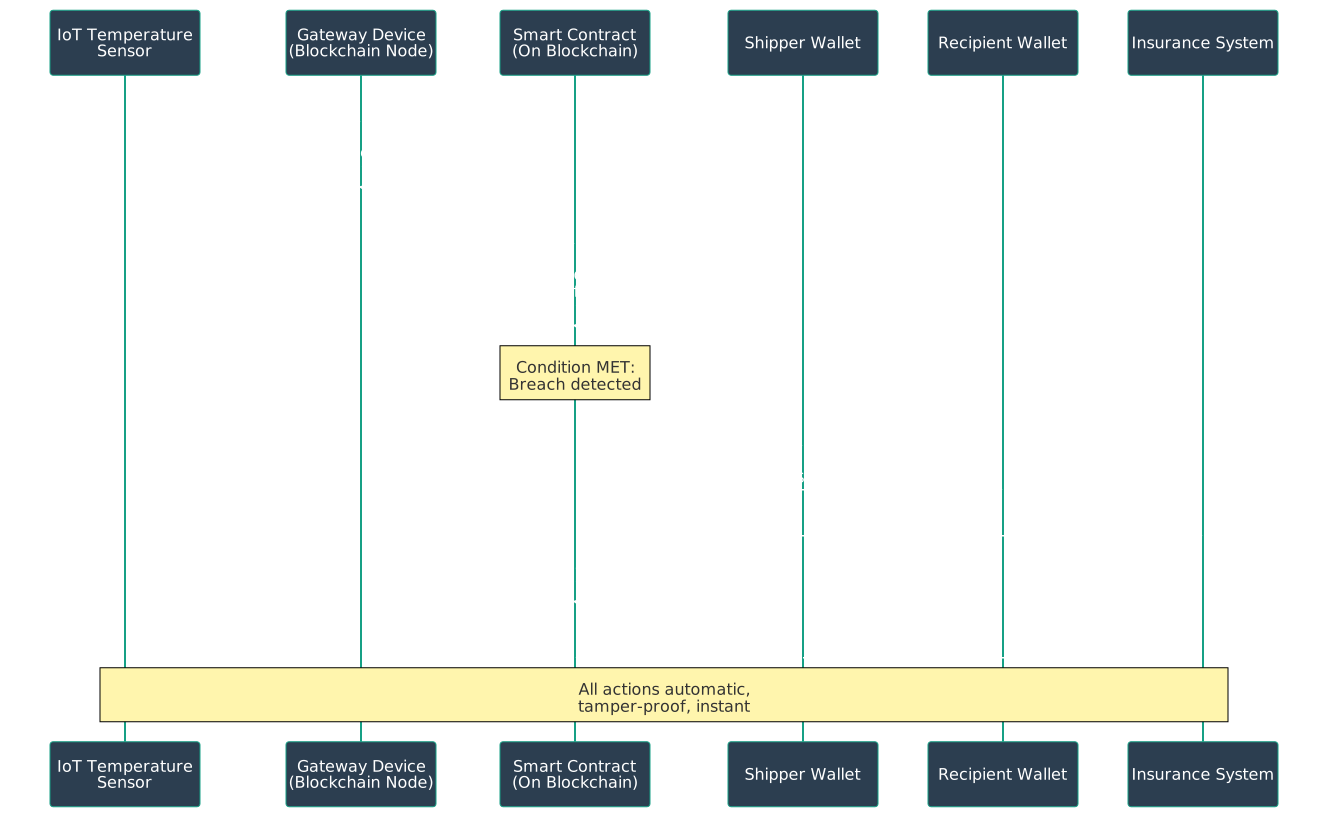
The following AI-generated figures provide alternative visual representations of concepts covered in this chapter. These “phantom figures” offer different artistic interpretations to help reinforce understanding.
185.12.1 Additional Figures


185.13 What’s Next
The next chapter explores Communication and Protocol Bridging, covering protocol translation, data aggregation, and leveraging gateway capabilities for intermediate processing between edge sensors and cloud infrastructure.