%% fig-alt: "Rural connectivity DTN architecture showing three villages with Wi-Fi kiosks uploading queries to mobile bus during daily route, bus traveling to hub station with internet gateway to upload queries and download responses, and bus delivering answers back to villages on return route"
%%{init: {'theme': 'base', 'themeVariables': { 'primaryColor': '#2C3E50', 'primaryTextColor': '#fff', 'primaryBorderColor': '#16A085', 'lineColor': '#16A085', 'secondaryColor': '#E67E22', 'tertiaryColor': '#7F8C8D', 'fontSize': '16px'}}}%%
graph LR
    V1[Village 1<br/>Wi-Fi Kiosk] -.Upload Queries.-> Bus[Mobile Bus<br/>Wi-Fi + Storage]
    V2[Village 2<br/>Wi-Fi Kiosk] -.Upload Queries.-> Bus
    V3[Village 3<br/>Wi-Fi Kiosk] -.Upload Queries.-> Bus

    Bus -->|Daily Route| Hub[Hub Station<br/>Internet Gateway]
    Hub -->|Download Responses| Bus

    Bus -.Deliver Answers.-> V1
    Bus -.Deliver Answers.-> V2
    Bus -.Deliver Answers.-> V3

    style V1 fill:#2C3E50,stroke:#16A085,color:#fff
    style V2 fill:#2C3E50,stroke:#16A085,color:#fff
    style V3 fill:#2C3E50,stroke:#16A085,color:#fff
    style Bus fill:#E67E22,stroke:#16A085,color:#fff
    style Hub fill:#16A085,stroke:#2C3E50,color:#fff
258 DTN Applications
258.1 Learning Objectives
By the end of this chapter, you will be able to:
- Identify DTN Use Cases: Recognize scenarios where DTN provides unique value
- Design Rural Connectivity: Apply DTN for developing region connectivity
- Implement Wildlife Tracking: Use opportunistic forwarding for animal monitoring
- Plan Hybrid Architectures: Combine infrastructure and DTN for robust systems
- Evaluate Deployment Trade-offs: Balance latency tolerance against infrastructure costs
258.2 Prerequisites
Before diving into this chapter, you should be familiar with:
- DTN Fundamentals: Understanding store-carry-forward is essential for application design
- DTN Epidemic Routing: Knowledge of flooding-based routing helps understand when it’s appropriate
- DTN Social Routing: Context-aware routing provides efficient alternatives for many applications
TipFor Beginners: DTN Applications
When to Use DTN:
- Wildlife tracking (animals rarely meet)
- Disaster recovery (infrastructure down)
- Space networks (extreme delays)
- Rural connectivity (intermittent access)
When NOT to Use DTN:
- Video streaming (requires continuous connection)
- Real-time gaming (cannot tolerate delays)
- Emergency alerts (need immediate delivery)
Real Examples: - DakNet (India): Buses carry internet data to villages - 24h latency acceptable for email/queries - ZebraNet (Kenya): GPS collars on zebras exchange data when animals meet - 3-7 day latency acceptable for migration studies
NoteRelated Chapters
DTN Series: - DTN Fundamentals - Store-carry-forward basics - DTN Epidemic Routing - Flooding-based protocols - DTN Social Routing - Context-aware and social-based routing
Applications: - IoT Application Domains - DTN use cases - Wildlife Tracking Examples - Real-world DTN
Architecture: - Wireless Sensor Networks - WSN in sparse deployments - UAV Networks - Aerial DTN applications - Mobile Phones as Gateway - Mobile DTN carriers
Learning: - Simulations Hub - DTN simulators
258.3 Applications of DTN Routing
258.3.1 Remote and Developing Regions
Scenario: Rural Agricultural Extension Service
Operation: - Villages have Wi-Fi kiosks but no internet - Farmers submit queries (crop prices, weather, health questions) - Bus with Wi-Fi node drives daily route - Bus collects queries from villages - At hub, bus uploads queries to internet gateway - Responses downloaded to bus - Bus delivers responses on return route
Real Implementation: DakNet (2003), India - Latency: 24-48 hours (acceptable for non-urgent queries) - Cost: Extremely low (reuses existing bus routes) - Impact: Thousands of rural users connected
258.3.2 Military Tactical Networks
Challenged Environment: - No infrastructure - Jamming and interference - High mobility - Intermittent connectivity - Hostile territory
DTN Solution: - Soldiers carry handheld DTN nodes - Vehicles act as mobile relays - UAVs provide aerial data mules - Opportunistic forwarding when in range - Store-and-forward tolerates disconnections
258.3.3 Sensor Systems
Wildlife Tracking Example:
ZebraNet (2002): - GPS collars on zebras - Collect location/movement data - Store locally for weeks - Transfer opportunistically when zebras encounter each other - Download to base station when animals visit watering hole - Battery budget: ~3 years
DTN Benefits: - No need to track every animal continuously - Data eventually reaches base station - Ultra-low power (mostly storage, rare transmissions)
258.3.4 Hybrid Models
Modern IoT deployments often combine infrastructure and DTN:
Smart City Hybrid:
Why Hybrid? - Infrastructure where available (low latency, high bandwidth) - DTN for coverage gaps (no infrastructure cost) - Mobile nodes bridge gaps - Graceful degradation (DTN fallback if infrastructure fails)
258.3.5 Space Networks
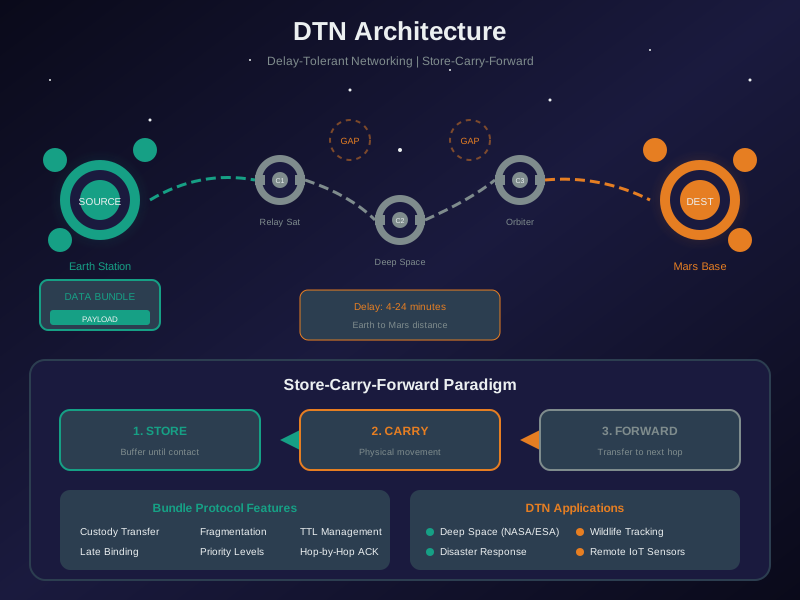
Interplanetary Communication: - Light-speed delays: Mars is 4-24 minutes away - Planetary occlusion: No line-of-sight during planet rotation - Relay satellite handoffs - Bundle Protocol (RFC 5050) standardizes DTN for space
NASA Deep Space Network: - Uses DTN principles for Mars rovers - Store data during blackouts - Forward when Earth visible - Tolerates hours of disconnection
258.3.6 Disaster Recovery
Post-Disaster Scenarios: - Cell towers destroyed - Power grid down - Roads blocked - First responders need communication
DTN for Disaster Response: - Responders carry DTN nodes - Drones provide aerial relay - Survivor phones act as DTN nodes - Messages eventually reach command center - Better than no communication
258.4 Knowledge Check
258.5 Application Selection Guide
Use DTN When:
| Scenario | Latency Tolerance | DTN Suitable? |
|---|---|---|
| Wildlife tracking | Days-weeks | Yes |
| Rural health records | Hours-days | Yes |
| Disaster messaging | Minutes-hours | Yes |
| Environmental monitoring | Hours | Yes |
| Video streaming | Milliseconds | No |
| Real-time control | Milliseconds | No |
| Financial transactions | Seconds | No |
| Voice calls | Milliseconds | No |
Decision Framework:
Is continuous connectivity available?
├── Yes → Use traditional networking
└── No → Can application tolerate delay?
    ├── No → Invest in infrastructure or satellite
    └── Yes → How much delay?
        ├── Minutes → Epidemic routing (high delivery)
        ├── Hours → Context-aware routing (balanced)
        └── Days → Social routing (efficient)
258.6 Visual Reference Gallery
NoteVisual: DTN Store-and-Forward Architecture
NoteVisual: Epidemic Routing Propagation
NotePhantom Figure Gallery
The following AI-generated figures provide alternative visual representations of concepts covered in this chapter. These “phantom figures” offer different artistic interpretations to help reinforce understanding.
258.6.2 Performance Metrics


258.6.3 DTN Localization

258.7 Summary
This chapter covered real-world DTN applications and deployment scenarios:
- Rural Connectivity: DakNet-style systems use buses or vehicles as data mules to connect villages without infrastructure, accepting 24-48 hour latency for email and information queries
- Wildlife Tracking: ZebraNet demonstrates opportunistic data collection from animals using GPS collars that exchange data when animals encounter each other, with 3-7 day acceptable latency
- Military Tactical: Soldiers, vehicles, and UAVs form DTN networks in infrastructure-free hostile environments with jamming and high mobility
- Space Networks: NASA’s Deep Space Network uses DTN principles (Bundle Protocol) to handle light-speed delays and planetary occlusion for Mars communication
- Disaster Recovery: Post-disaster scenarios leverage responder nodes, drones, and survivor phones for communication when infrastructure is destroyed
- Hybrid Architectures: Modern deployments combine infrastructure (low latency) with DTN (coverage gaps and fallback), using mobile collectors to bridge disconnected areas
- Application Selection: DTN is suitable when applications can tolerate minutes-to-days latency; unsuitable for real-time streaming, voice, or financial transactions
258.8 What’s Next
This concludes the DTN series. Continue with Ad Hoc Labs and Quiz for hands-on DTN implementation exercises, or explore Ad Hoc Production and Review for protocol comparisons and production considerations.
258.6.1 Social Routing