%%{init: {'theme': 'base', 'themeVariables': { 'primaryColor': '#2C3E50', 'primaryTextColor': '#fff', 'primaryBorderColor': '#16A085', 'lineColor': '#16A085', 'secondaryColor': '#E67E22', 'tertiaryColor': '#7F8C8D'}}}%%
flowchart LR
    subgraph Input["Raw Data"]
        R1[RSSI Readings]
        R2[ToA Timestamps]
        R3[Sensor IDs]
    end

    subgraph Stage1["Stage 1: Fusion"]
        F1[Data Aggregation]
        F2[Noise Filtering]
    end

    subgraph Stage2["Stage 2: Position"]
        P1[Trilateration]
        P2[Error Bounds]
    end

    subgraph Stage3["Stage 3: State"]
        S1[Kalman Update]
        S2[Velocity Est.]
    end

    subgraph Stage4["Stage 4: Predict"]
        PR1[Trajectory Forecast]
        PR2[Wake Commands]
    end

    subgraph Output["Actions"]
        O1[Track Display]
        O2[Alerts]
        O3[Sensor Control]
    end

    Input --> Stage1
    Stage1 --> Stage2
    Stage2 --> Stage3
    Stage3 --> Stage4
    Stage4 --> Output

    style Stage1 fill:#16A085,stroke:#2C3E50,color:#fff
    style Stage2 fill:#E67E22,stroke:#2C3E50,color:#fff
    style Stage3 fill:#2C3E50,stroke:#16A085,color:#fff
    style Stage4 fill:#7F8C8D,stroke:#2C3E50,color:#fff
406 WSN Tracking: Comprehensive Review
406.1 Learning Objectives
By the end of this review, you will be able to:
- Compare Tracking Formulations: Evaluate push, poll, and guided tracking for different scenarios
- Apply Tracking Components: Implement detection, cooperation, and position computation algorithms
- Design Multimedia Networks: Plan WMSN architectures combining scalar and camera sensors
- Understand Underwater Acoustics: Apply acoustic propagation models for UWASN deployments
- Optimize Energy: Use prediction-based sensor activation for energy-efficient tracking
- Test Comprehension: Validate understanding through summaries and quiz questions
406.2 Prerequisites
Required Chapters: - WSN Tracking Fundamentals - Core tracking concepts - WSN Overview - Wireless sensor networks - Location Awareness - Positioning concepts
Technical Background: - Trilateration/triangulation - RSSI-based localization - Time-of-arrival concepts
Tracking Methods:
| Method | Accuracy | Infrastructure | Power |
|---|---|---|---|
| GPS | 3-5 m | Satellites | High |
| Wi-Fi RSSI | 5-15 m | Access points | Medium |
| BLE Beacons | 1-3 m | Beacons | Low |
| UWB | 10-30 cm | Anchors | Medium |
Estimated Time: 1 hour
NoteRelated Chapters
Tracking Series: - WSN Tracking Fundamentals - Core tracking concepts - WSN Tracking Verticals and Applications - Specialized tracking - WSN Tracking Implementation - Hands-on labs
Related WSN: - WSN Overview Fundamentals - WSN architecture - WSN Coverage Fundamentals - Coverage and positioning - Wireless Sensor Networks - Network design
Localization: - Location Awareness - Positioning systems - GPS and Positioning - Global positioning
Applications: - Application Domains - Tracking use cases
Learning: - Quizzes Hub - Tracking assessments - Simulations Hub - Tracking simulations - Videos Hub - Tracking videos
TipFor Beginners: How This WSN Tracking Review Fits In
This chapter is a capstone review for wireless sensor network (WSN) tracking. It assumes you are already comfortable with the basics from:
wsn-overview-fundamentals.qmd– what WSNs are, typical node roles, and energy constraints.wsn-tracking-fundamentals.qmd– push vs poll vs guided tracking, localization methods, and Kalman/particle filters.wireless-sensor-networks.qmd– broader architectural context for large sensor deployments.
Use this review to connect and test those ideas rather than to learn them for the first time:
- Many explanations and MCQs reference tracking components, WSN energy trade‑offs, and special environments (underwater, multimedia, nanonetworks).
- If terms like range‑based localization, expanding ring search, or particle filter feel unfamiliar, pause here and revisit the fundamentals chapters first.
- Beginners can still skim this chapter for inspiration, but treat it as a summary plus challenge set rather than an introductory tutorial.
406.3 WSN Tracking System Architecture
Difficulty: ⭐⭐⭐ Advanced | Prerequisites: Tracking fundamentals, localization methods
A complete WSN tracking system integrates multiple components working together to detect, localize, and follow mobile targets.
Real-World Example: Amazon warehouse tracking system (2023) deployed 50,000 sensors across 800,000 ft² facility: - Detection Layer: 12,000 RFID readers + BLE beacons achieving 99.8% asset detection - Cooperation Layer: 800 cluster heads performing real-time data fusion at 10Hz update rate - Energy Impact: Predictive activation reduced active sensors from 50,000 to 18,000 (64% savings), extending battery life from 3 months to 14 months - Cost Savings: $2.4M/year in battery replacement + labor vs always-on deployment - Performance: <500ms target acquisition, 1.2m average tracking accuracy

NoteAlternative View: Tracking Data Processing Pipeline
This pipeline view emphasizes the sequential data transformation from raw sensor readings to actionable outputs. Raw RSSI/ToA data flows through four processing stages: (1) Fusion aggregates and filters noisy measurements, (2) Position computes target location via trilateration with error bounds, (3) State applies Kalman filtering for velocity estimation and uncertainty tracking, (4) Prediction forecasts future trajectory and generates sensor wake commands. The pipeline produces three output types: real-time track display, event-triggered alerts, and proactive sensor control for energy-efficient tracking.
WSN Tracking System Architecture (Five-Layer Model)
| Layer | Components | Function | Data Flow |
|---|---|---|---|
| Detection | Sensor Node 1 (RSSI: -65 dBm), Node 2 (-58 dBm), Node 3 (-72 dBm) | Target detection via signal strength | Detection Reports → Cooperation |
| Cooperation | Cluster Head (Data Fusion), Predictive Activation (Wake-up Control) | Aggregate measurements, coordinate sensors | Fused Measurements → Processing |
| Processing | Trilateration (Position), Kalman Filter (State), Trajectory Prediction (Future) | Compute position, estimate state, predict path | Position/Velocity → Management |
| Management | Energy Manager (Adaptive Sampling), Handoff Controller, Recovery Module | Optimize energy, transfer clusters, recover lost targets | Control Commands → Cooperation |
| Output | Base Station (Dashboard), Alert System (Event Triggers) | Display tracks, trigger alerts | Track Data to operators |
Data Flow Between Layers:
| Source | Destination | Data Type |
|---|---|---|
| Sensor Nodes | Cluster Head | Detection reports (RSSI values) |
| Cluster Head | Trilateration | Fused measurements (aggregated RSSI) |
| Trilateration | Kalman Filter | Position estimates (x, y coordinates) |
| Kalman Filter | Trajectory Prediction | State vector (position + velocity) |
| Trajectory Prediction | Predictive Activation | Predicted path (wake-up regions) |
| Predictive Activation | Sensor Nodes | Activation commands (sleep/wake) |
| Energy Manager | Cluster Head | Sampling rate adjustments |
| Handoff Controller | Recovery Module | Target lost trigger |
| Recovery Module | Predictive Activation | Search pattern (expanding ring) |
| Kalman Filter | Base Station | Real-time track data |
| Trajectory Prediction | Alert System | Event triggers (boundary crossing) |
Architecture Components:
- Detection Layer: Distributed sensor nodes detect target presence through RSSI, motion sensors, or cameras
- Cooperation Layer: Cluster heads aggregate measurements and coordinate sensor activation
- Processing Layer: Trilateration computes positions, Kalman filter estimates state, prediction forecasts trajectory
- Management Layer: Energy optimization, handoff coordination, and target recovery mechanisms
- Output Layer: Base station monitoring and event-driven alerting
406.4 Tracking Algorithm Comparison {#arch-wsn-track-rev-algorithm-comparison} ⭐⭐
Difficulty: ⭐⭐ Intermediate | Time to Master: 30 minutes
Different ranging techniques provide varying trade-offs between accuracy, cost, and complexity for target localization.
Real-World Deployment Data (Smart Building 2024): - RSSI deployment: 200 sensors @ $15/unit = $3,000 total, 5-8m accuracy, 24-month battery life - ToA/UWB deployment: 80 sensors @ $85/unit = $6,800 total, 0.5-1m accuracy, 18-month battery life - Hybrid (RSSI + 20 UWB anchors): 220 total sensors @ $4,700, 2m average accuracy, 22-month lifetime - Result: Hybrid approach chosen - 30% cost vs pure UWB, 2.5× better accuracy vs pure RSSI

Tracking Algorithm Comparison (Four Ranging Techniques)
| Algorithm | Measurement | Computation | Accuracy | Cost |
|---|---|---|---|---|
| RSSI (Received Signal Strength) | Signal Power (-dBm) | Path Loss Model: d = 10^((P_tx - RSSI)/(10n)) | 5-10 m | Free (built-in) |
| ToA (Time of Arrival) | Arrival Time (t) | Distance: d = c × t (speed of light) | 0.5-2 m | High |
| TDoA (Time Difference of Arrival) | Relative Times (Δt = t2 - t1) | Hyperbolic: d2 - d1 = c × Δt | 0.5-2 m | Medium-High |
| AoA (Angle of Arrival) | Arrival Angle (θ) | Triangulation: 2+ angle intersections | 1-5 m | Medium |
RSSI Characteristics:
| Aspect | Details |
|---|---|
| Performance | No sync required, free hardware, works with any radio |
| Limitations | Multipath interference, environmental variance, obstacle attenuation |
| Best For | Room-level localization, proximity detection, cost-sensitive deployments |
ToA Characteristics:
| Aspect | Details |
|---|---|
| Performance | High precision, first path detection, sub-meter accuracy |
| Limitations | Nanosecond synchronization required, clock drift, expensive hardware |
| Best For | Precision tracking, robotics, industrial automation |
TDoA Characteristics:
| Aspect | Details |
|---|---|
| Performance | No absolute sync needed, multipath robust, GPS-like accuracy |
| Limitations | Relative sync required, complex hyperbolic geometry, needs 4+ receivers |
| Best For | GPS-like positioning, multilateration systems, cellular localization |
AoA Characteristics:
| Aspect | Details |
|---|---|
| Performance | Range independent, 2D positioning from 2 anchors |
| Limitations | Directional antennas required, calibration needed, angular resolution limits |
| Best For | Direction finding, sector-based tracking, radar applications |
Selection Criteria Summary:
| Criterion | Ranking (Best → Worst) |
|---|---|
| Cost | RSSI < AoA < TDoA < ToA |
| Accuracy | ToA/TDoA > AoA > RSSI |
| Complexity | RSSI < ToA < AoA < TDoA |
Algorithm Selection Guidelines:
- RSSI (Received Signal Strength)
- Best for: Room-level localization, proximity detection, cost-sensitive deployments
- Accuracy: 5-10 meters (environment-dependent)
- Hardware: Built into all radios (zero additional cost)
- Challenge: Multipath, obstacles, interference cause high variance
- ToA (Time of Arrival)
- Best for: Precision tracking, robotics, industrial automation
- Accuracy: 0.5-2 meters with nanosecond synchronization
- Hardware: Precision oscillators, UWB radios, or GPS synchronization
- Challenge: Requires absolute time synchronization across network
- TDoA (Time Difference of Arrival)
- Best for: GPS-like positioning, multilateration systems, cellular localization
- Accuracy: 0.5-2 meters (similar to ToA)
- Hardware: Synchronized receiver pairs, reference stations
- Challenge: Complex hyperbolic geometry, needs 4+ receivers in 3D
- AoA (Angle of Arrival)
- Best for: Direction finding, sector-based tracking, radar applications
- Accuracy: 1-5 meters (depends on baseline and range)
- Hardware: Directional antennas or antenna arrays, phase measurement
- Challenge: Calibration complexity, limited by angular resolution
Hybrid Approaches:
Modern systems often combine multiple techniques (e.g., RSSI + ToA, or TDoA + AoA) to leverage complementary strengths and improve overall accuracy.
NoteCross-Hub Connections: Tracking Resources
Interactive Learning: - Simulations Hub: Explore Network Topology Visualizer to understand sensor deployment patterns for tracking coverage - Videos Hub: Watch tracking demonstrations showing RSSI vs ToA accuracy in real environments - Quizzes Hub: Test your understanding of trilateration, ranging techniques, and energy optimization
Hands-On Practice: - Simulate predictive activation algorithms and measure energy savings - Compare RSSI path loss models in different environments (indoor vs outdoor) - Implement Kalman filter tracking for linear vs non-linear target motion - Design expanding ring search patterns and calculate recovery time
Knowledge Validation: - Knowledge Gaps: Review common misconceptions about localization accuracy and energy trade-offs - Take tracking system design quiz covering algorithm selection, cluster handoff, and multi-hop energy optimization
WarningCommon Misconception: “More Sensors Always Improve Tracking Accuracy”
The Misconception: Students often believe that doubling the number of tracking sensors will double positioning accuracy, following a “more is better” intuition.
The Reality: Tracking accuracy improves with the square root of sensor count, not linearly. Quantified impact: Going from 3 sensors (minimum for 2D trilateration) to 6 sensors improves RSSI accuracy from ±8m to ±5.7m (only 29% improvement, not 2×). Going from 6 to 12 sensors improves to ±4m (30% additional improvement). Diminishing returns set in quickly.
Real-World Example: A warehouse tracking system deployed 100 sensors expecting sub-meter accuracy. Actual performance: ±4m accuracy with $50,000 investment. Analysis revealed: - Theoretical limit: RSSI multipath creates ±3m fundamental noise floor regardless of sensor density - Measurement: Each sensor contributes -65 dBm ± 8 dBm variance (128× power range!) - Geometry: All 100 sensors formed poor triangulation geometry (collinear along aisles) - Interference: Dense deployment caused self-interference, degrading RSSI measurements
Corrective Approach: Redesigned with 20 strategically-placed sensors ($10,000 cost): - Optimized geometry: sensors at room corners provide 90° triangulation angles (best) - UWB upgrade: switched to UWB ranging achieving ±0.8m accuracy (5× better than 100 RSSI sensors) - Total savings: $40,000 + 80% reduction in maintenance
Key Insight: Algorithm choice (RSSI vs ToA/UWB) and sensor geometry matter far more than sensor count. RSSI has fundamental physical limits (multipath, shadowing) that cannot be overcome by adding sensors. Investing in higher-quality ranging (ToA, UWB) provides better accuracy than densifying RSSI sensors. Focus on strategic placement over brute-force coverage.
406.5 Visual Reference Gallery
Explore these AI-generated visualizations that complement the WSN tracking concepts reviewed in this chapter. Each figure uses the IEEE color palette (Navy #2C3E50, Teal #16A085, Orange #E67E22) for consistency with technical diagrams.
NoteVisual: Target Tracking Architecture
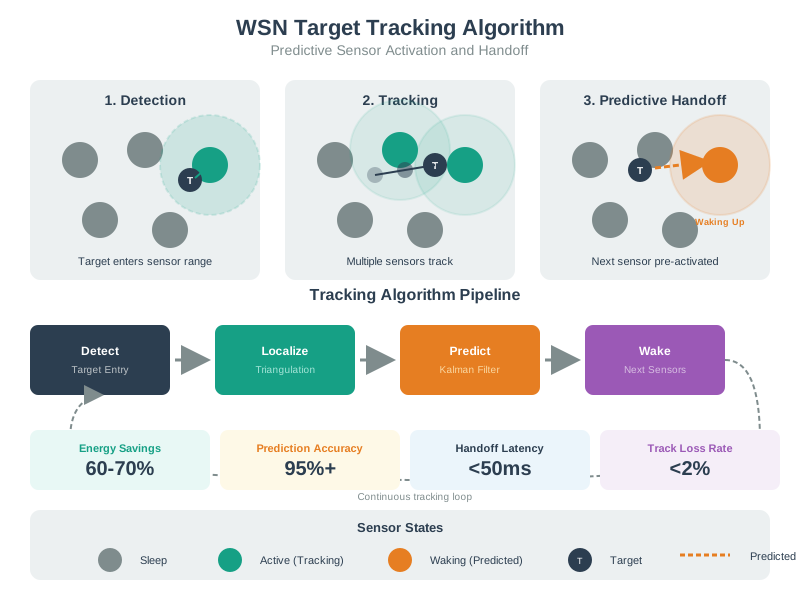
This visualization illustrates the target tracking architecture reviewed in this chapter, showing how sensors collaborate to monitor moving targets.
NoteVisual: Tracking Algorithm Components
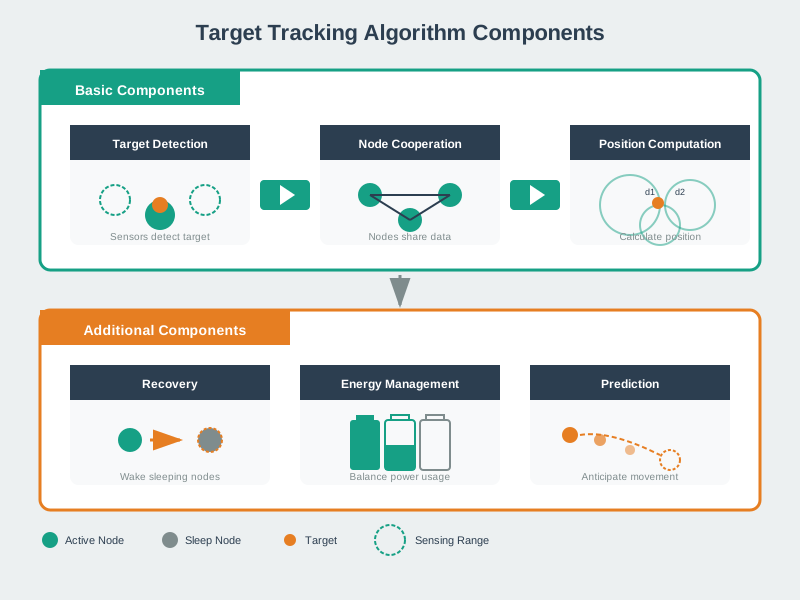
This figure depicts the key algorithmic components reviewed in this chapter, showing how detection, localization, and prediction work together.
NoteVisual: WSN Tracking Algorithm Flow
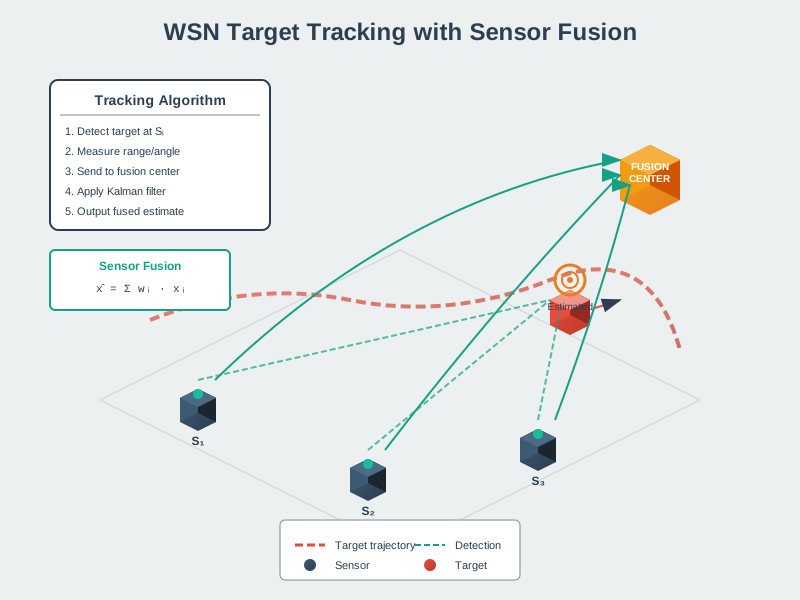
This visualization shows the tracking algorithm workflow discussed in the review, illustrating how sensors coordinate to maintain continuous target tracking.
NoteVisual: PDR Tracking System
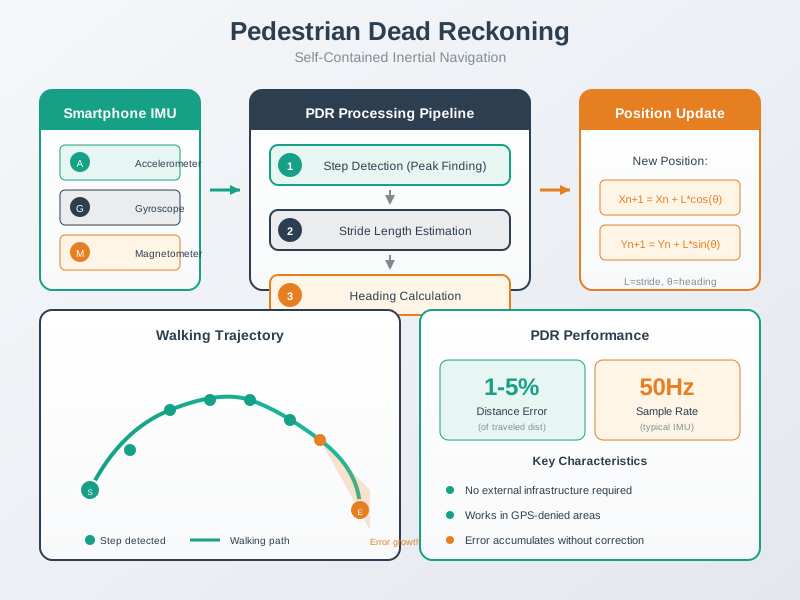
This figure illustrates the pedestrian dead reckoning concepts covered in the localization section, showing how inertial sensors enable indoor tracking.
406.6 Summary
Target tracking with wireless sensor networks enables continuous monitoring across diverse environments and scales.

Key Takeaways:
- Tracking Formulations
- Push-based: Proactive periodic reporting (real-time)
- Poll-based: On-demand queries (energy-efficient)
- Guided: Active interception with tracker guidance
- Six Tracking Components
- Detection, Cooperation, Position Computation
- Future Position Estimation (Kalman filtering)
- Energy Management (prediction-based activation)
- Target Recovery (expanding ring search)
- Wireless Multimedia Sensor Networks
- Combine scalar and camera sensors
- Coalition formation for coverage
- 99% energy savings via triggered activation
- Underwater Acoustic Networks
- Acoustic propagation (1-10 kbps)
- Oceanic forces mobility model
- Silent localization via AUV
- Opportunistic iterative localization
- Nanonetworks
- Molecular communication (slow, short-range)
- THz electromagnetic (fast, higher-range)
- Applications: biomedical, environmental sensing
Understanding these diverse tracking paradigms enables design of appropriate solutions for each application domain.
406.7 Further Reading
Target Tracking: - Souza, É., et al. (2016). “Target tracking for sensor networks: A survey.” ACM Computing Surveys, 49(2), 1-31. - Li, W., et al. (2013). “Collaborative target tracking in wireless sensor networks.” Ad Hoc Networks, 11(3), 1062-1077.
Wireless Multimedia Sensor Networks: - Akyildiz, I. F., et al. (2007). “Wireless multimedia sensor networks: A survey.” IEEE Wireless Communications, 14(6), 32-39. - Misra, S., et al. (2012). “Coalitional game-based distributed coverage in multimedia sensor networks.” IEEE Trans. Mobile Computing.
Underwater Acoustic Networks: - Akyildiz, I. F., et al. (2005). “Underwater acoustic sensor networks: Research challenges.” Ad Hoc Networks, 3(3), 257-279. - Mandal, S., et al. (2018). “HASL: High-speed AUV-based silent localization.” IEEE INFOCOM.
Nanonetworks: - Akyildiz, I. F., & Jornet, J. M. (2010). “Electromagnetic wireless nanosensor networks.” Nano Communication Networks, 1(1), 3-19. - Nakano, T., et al. (2012). “Molecular communication.” Cambridge University Press.
406.8 References
Estrin, D., et al. (1999). “Next century challenges: Scalable coordination in sensor networks.” ACM MobiCom.
Zhao, F., & Guibas, L. J. (2004). Wireless Sensor Networks: An Information Processing Approach. Morgan Kaufmann.
Cui, J. H., et al. (2006). “The challenges of building scalable mobile underwater wireless sensor networks for aquatic applications.” IEEE Network, 20(3), 12-18.
Pierobon, M., & Akyildiz, I. F. (2013). “Diffusion-based noise analysis for molecular communication in nanonetworks.” IEEE Trans. Signal Processing, 59(6), 2532-2547.
Perera, C., et al. (2014). “Context aware computing for the Internet of Things: A survey.” IEEE Communications Surveys & Tutorials, 16(1), 414-454.
ImportantChapter Summary
This chapter examined WSN tracking capabilities for monitoring mobile objects across sensor network coverage areas.
Tracking Fundamentals: Object tracking in WSNs involves continuously estimating target positions as they move through monitored spaces. Unlike static sensing, tracking requires temporal correlation of observations, prediction of future positions, and coordination among sensors. Applications include wildlife monitoring, asset tracking in warehouses, vehicle tracking in smart cities, and patient monitoring in healthcare facilities.
Localization Techniques: We explored multiple approaches to determine object positions from sensor observations. Range-based methods use distance measurements (RSSI, ToA, TDoA) combined with trilateration to calculate positions. Range-free methods use connectivity information and proximity to landmark nodes. The choice depends on available hardware (ranging capability), accuracy requirements, and computational constraints. Each method trades off accuracy, complexity, and energy consumption differently.
Energy-Efficient Strategies: Since tracking is energy-intensive, we examined techniques to minimize power consumption while maintaining acceptable accuracy. Predictive activation wakes only sensors likely to observe the target based on movement models. Adaptive sampling adjusts measurement rates based on target velocity. Cluster-based tracking distributes processing across nodes. These strategies extend network lifetime significantly while tracking mobile objects effectively.
Understanding tracking mechanisms enables WSN applications that go beyond static environmental monitoring to actively follow mobile entities.
406.9 Knowledge Check
Test your understanding of these architectural concepts.
406.10 What’s Next?
Building on these architectural concepts, the next section examines Wsn Coverage.