%% fig-alt: "Diagram showing IoT architecture components and their relationships with data flow and processing hierarchy."
%%{init: {'theme': 'base', 'themeVariables': { 'primaryColor': '#2C3E50', 'primaryTextColor': '#fff', 'primaryBorderColor': '#16A085', 'lineColor': '#16A085', 'secondaryColor': '#E67E22', 'tertiaryColor': '#7F8C8D'}}}%%

graph LR
    Node1[Node A<br/>Message M] -.->|No direct<br/>path| Node2[Node B]

    Node1 -->|Store| Buffer1[Local<br/>Buffer]
    Buffer1 -->|Carry| Mobile[Mobile<br/>Node]
    Mobile -.->|Opportunistic<br/>Contact| Node2

    Mobile -->|Forward| Node2
    Node2 -->|Store| Buffer2[Local<br/>Buffer]
    Buffer2 -->|Eventually| Dest[Destination]

    style Node1 fill:#16A085,stroke:#2C3E50,color:#fff
    style Mobile fill:#E67E22,stroke:#2C3E50,color:#fff
    style Node2 fill:#16A085,stroke:#2C3E50,color:#fff
    style Dest fill:#2C3E50,stroke:#16A085,color:#fff
427 Delay-Tolerant Networks for IoT
427.1 Learning Objectives
By the end of this chapter, you will be able to:
- Apply DTN Concepts: Use Delay-Tolerant Networking for intermittent connectivity scenarios
- Compare Routing Protocols: Evaluate Epidemic, Spray-and-Wait, and PRoPHET routing trade-offs
- Design Store-Carry-Forward Systems: Architect data collection for disconnected environments
- Calculate Delivery Probability: Apply probabilistic models to predict message delivery success
427.2 Prerequisites
Before diving into this chapter, you should be familiar with:
- Human-Centric Sensing: Roles and Paradigms: Understanding of human mobility patterns and how they enable data collection in disconnected scenarios
- Wireless Sensor Networks: Knowledge of WSN topologies and routing fundamentals provides context for understanding when traditional routing fails
- Networking Basics: Familiarity with networking fundamentals is essential for grasping how DTN differs from traditional IP networking
TipFor Beginners: Delay-Tolerant Networks Explained
The Disconnection Problem:
Traditional networks assume devices can always communicate. But what if you’re tracking wildlife in a remote forest with no cell signal? Delay-Tolerant Networks solve this using “store-carry-forward”:
- Store: A zebra collar sensor stores GPS data locally
- Carry: The zebra physically moves through the savanna carrying the data
- Forward: When the zebra visits a watering hole with a base station, it uploads all stored data
Real-World Analogy: Think of it like delivering a package via multiple delivery trucks rather than calling on the phone. Each truck carries the package part of the way until it reaches its destination - slow but reliable when phone lines don’t exist.
Where DTN is Used: - Wildlife tracking: Animal collars in remote areas with no network - Space communication: Mars rovers sending data back to Earth - Disaster recovery: Communication after earthquakes destroy infrastructure - Rural connectivity: Villages connected by buses carrying data - Ocean monitoring: Sensors on buoys communicating via passing ships
| Term | Simple Explanation |
|---|---|
| DTN (Delay-Tolerant Network) | Networks that work even when connections are intermittent - like rural mail delivery |
| Store-Carry-Forward | Save data, physically move it, then send when possible - like carrying a USB drive |
| Epidemic Routing | Spread data copies like a disease - give to everyone you meet to ensure delivery |
| Opportunistic Contact | When two devices come within communication range unexpectedly |
| Data MULE | Mobile node that physically transports data between disconnected network segments |
Why This Matters for IoT:
Traditional sensor networks fail in scenarios like ocean monitoring, rural areas, or wildlife tracking. DTN enables data collection where infrastructure doesn’t exist - perfect for developing regions, disaster recovery, and environmental research where continuous connectivity is impossible.
427.3 Delay Tolerant Networks (DTNs)
Delay Tolerant Networks represent a networking paradigm designed for environments where traditional assumptions (end-to-end connectivity, low latency) do not hold.
427.3.1 DTN Characteristics
1. Intermittent Connectivity - No guaranteed end-to-end path at any instant - Communication opportunities arise and disappear - Links may be available only when nodes meet
2. Long Delays - Message delivery can take hours or days - Propagation delays can be significant (especially in space) - Store-and-forward over long time scales
3. Asymmetric Data Rates - Forward and reverse links may have different rates - Opportunistic contacts have varying quality - Channel conditions vary over time
4. Resource Constraints - Limited buffer space - Energy constraints - Bandwidth scarcity
Delay-Tolerant Network (DTN) store-carry-forward mechanism diagram: Shows non-traditional routing through physical mobility: Node A has message M with no direct network path to Node B (indicated by dashed line showing disconnection), Node A stores message in local buffer waiting for opportunity, mobile relay node physically moves through network carrying stored data in buffer, opportunistic contact occurs when mobile node comes within communication range of Node B, message forwarded from mobile node to Node B upon contact, Node B stores message in local buffer for custody transfer, eventually message delivered to final destination despite intermittent connectivity and long delays enabling communication in challenged networks (wildlife tracking, disaster scenarios, rural IoT deployments).
427.3.2 DTN in Wireless Sensor Networks
Traditional WSNs assume that sensor nodes can route data to the base station through multi-hop paths. However, in many scenarios, this assumption doesn’t hold:
Sparse Deployment: - Nodes too far apart for multi-hop connectivity - Monitoring large areas with limited nodes
Harsh Environments: - Obstacles blocking communication - Intermittent power availability - Extreme conditions causing failures
Mobile Scenarios: - Mobile nodes move in and out of range - Wildlife tracking with animal-borne sensors - Vehicular sensor networks
Solution: Delay Tolerant WSNs (DT-WSNs) - Embrace mobility and intermittent connectivity - Use data MULEs or mobile sinks - Store-and-forward with long delays acceptable
%% fig-alt: "DTN application scenarios showing four use cases: wildlife tracking with animal-borne sensors, disaster recovery with destroyed infrastructure, rural connectivity with village-to-village buses, and ocean monitoring with ship-based data mules."
%%{init: {'theme': 'base', 'themeVariables': { 'primaryColor': '#2C3E50', 'primaryTextColor': '#fff', 'primaryBorderColor': '#16A085', 'lineColor': '#16A085', 'secondaryColor': '#E67E22', 'tertiaryColor': '#7F8C8D'}}}%%

graph TB
    subgraph Wildlife["Wildlife Tracking"]
        W1[Animal Collar<br/>GPS Sensor]
        W2[Stores data<br/>locally]
        W3[Animal visits<br/>watering hole]
        W4[Base station<br/>downloads data]
        W1 --> W2 --> W3 --> W4
    end

    subgraph Disaster["Disaster Recovery"]
        D1[Infrastructure<br/>destroyed]
        D2[Relief workers<br/>carry devices]
        D3[Mesh when<br/>in range]
        D4[Data reaches<br/>command center]
        D1 --> D2 --> D3 --> D4
    end

    subgraph Rural["Rural Connectivity"]
        R1[Village A<br/>isolated]
        R2[Bus carries<br/>data packets]
        R3[Village B<br/>receives data]
        R4[Town internet<br/>gateway]
        R1 --> R2 --> R3 --> R4
    end

    subgraph Ocean["Ocean Monitoring"]
        O1[Buoy sensors<br/>collect data]
        O2[Ship passes<br/>by buoy]
        O3[Ship carries<br/>data to port]
        O4[Satellite<br/>uplink]
        O1 --> O2 --> O3 --> O4
    end

    style Wildlife fill:#16A085,stroke:#2C3E50,color:#fff
    style Disaster fill:#E67E22,stroke:#2C3E50,color:#fff
    style Rural fill:#7F8C8D,stroke:#2C3E50,color:#fff
    style Ocean fill:#2C3E50,stroke:#16A085,color:#fff
427.3.3 DTN Routing Protocols
Since DTN links are opportunistic and intermittent, routing becomes fundamentally different from traditional networks.
1. Epidemic Routing {#arch-wsn-part-epidemic}
Concept: When two nodes meet, they exchange all messages they carry (like spreading an epidemic).
Algorithm:
When node A encounters node B:
  For each message M in A's buffer:
    If B doesn't have M:
      A transmits copy of M to B

  For each message M in B's buffer:
    If A doesn't have M:
      B transmits copy of M to A
Advantages: - Maximizes delivery probability - Fast message propagation - Robust to node failures
Disadvantages: - High resource consumption (buffer, bandwidth, energy) - Many redundant copies - Can lead to network congestion
2. Spray and Wait {#arch-wsn-part-spray-wait}
Concept: Limit message replication to reduce overhead.
Phases: 1. Spray Phase: Distribute L copies of message to first L distinct nodes 2. Wait Phase: Nodes carrying a copy perform direct transmission only (wait for destination)
Variants: - Binary Spray and Wait: Each node forwards half its copies and keeps half - Source Spray and Wait: Source distributes all L copies
Advantages: - Lower overhead than Epidemic - Better resource utilization - Still maintains good delivery probability
3. PRoPHET (Probabilistic Routing Protocol using History of Encounters and Transitivity) {#arch-wsn-part-prophet}
Concept: Use contact history to estimate delivery predictability.
Delivery Predictability P(A, B): - High if A frequently encounters B - Decays over time if no encounters - Transitive: if A encounters B often, and B encounters C often, then P(A, C) should increase
Update Equations:
Encounter: P(A, B) = P_old(A, B) + (1 - P_old(A, B)) * P_init
Aging: P(A, B) = P_old(A, B) * gamma^k
Transitivity: P(A, C) = P_old(A, C) + (1 - P_old(A, C)) * P(A, B) * P(B, C) * beta
Where: - P_init is in (0, 1): initialization constant - gamma is in (0, 1): aging constant - beta is in (0, 1): scaling constant for transitivity - k: number of time units elapsed
%% fig-alt: "Diagram showing IoT architecture components and their relationships with data flow and processing hierarchy."
%%{init: {'theme': 'base', 'themeVariables': {'primaryColor': '#2C3E50', 'secondaryColor': '#16A085', 'tertiaryColor': '#E67E22'}}}%%

graph TB
    subgraph Epidemic["Epidemic Routing"]
        E1[Copy to EVERY<br/>encountered node]
        E2[Delivery: ~95%<br/>Latency: Low]
        E3[Overhead: 100×<br/>copies]
        E4[Use: Critical<br/>messages only]
    end

    subgraph SprayWait["Spray and Wait"]
        S1[L copies max<br/>L=6 typical]
        S2[Delivery: ~80%<br/>Latency: Medium]
        S3[Overhead: 6×<br/>copies]
        S4[Use: Most IoT<br/>scenarios]
    end

    subgraph PRoPHET["PRoPHET"]
        P1[Forward if higher<br/>P delivery,B]
        P2[Delivery: ~70%<br/>Latency: Medium]
        P3[Overhead: 3-5×<br/>copies]
        P4[Use: Predictable<br/>mobility patterns]
    end

    Message[Message to<br/>Deliver]

    Message --> Epidemic
    Message --> SprayWait
    Message --> PRoPHET

    E1 --> E2 --> E3 --> E4
    S1 --> S2 --> S3 --> S4
    P1 --> P2 --> P3 --> P4

    style Epidemic fill:#E67E22,stroke:#2C3E50,color:#fff
    style SprayWait fill:#16A085,stroke:#2C3E50,color:#fff
    style PRoPHET fill:#7F8C8D,stroke:#2C3E50,color:#fff
    style Message fill:#2C3E50,stroke:#16A085,color:#fff
DTN routing protocol comparison: Epidemic routing floods copies to every encountered node achieving 95% delivery with 100x overhead (use for critical messages), Spray-and-Wait limits to L=6 copies balancing 80% delivery with 6x overhead (recommended for most IoT scenarios), PRoPHET uses encounter history forwarding only to nodes with higher delivery probability achieving 70% delivery with 3-5x overhead (optimal for predictable mobility patterns like bus routes or commuter networks).
427.3.4 Routing Protocol Selection Guide
| Criteria | Epidemic | Spray-and-Wait | PRoPHET |
|---|---|---|---|
| Delivery Rate | 95%+ | 75-85% | 65-75% |
| Latency | Lowest | Medium | Medium-High |
| Overhead | 100x copies | 6-10x copies | 3-5x copies |
| Buffer Needed | Very High | Medium | Low-Medium |
| Energy Cost | Highest | Medium | Lowest |
| Best For | Critical alerts | General IoT | Predictable routes |
| Mobility Pattern | Any/Random | Any | Regular/Scheduled |
Selection Guidelines:
- Use Epidemic when:
- Message is critical (disaster alerts, medical emergencies)
- Buffer and energy are not constraints
- Network is small (<50 nodes)
- Must guarantee delivery
- Use Spray-and-Wait when:
- Balancing delivery vs. overhead
- General IoT data collection
- Medium-sized networks
- Unknown mobility patterns
- Use PRoPHET when:
- Nodes have predictable movement (buses, commuters)
- Resources are constrained
- Can tolerate lower delivery rates
- Contact patterns are stable
427.3.5 Case Study: ZebraNet
ZebraNet (Princeton, 2004) pioneered DTN for wildlife tracking:
Deployment: - GPS collars on zebras in Kenya - Base station at watering hole - No cellular coverage in reserve
DTN Implementation: - Store: Collar logs GPS every 3 minutes (288 points/day) - Carry: Zebra movement through savanna - Forward: When zebra visits watering hole, peer-to-peer transfer to base station
Routing Protocol: Modified Epidemic - Exchange data when two zebras encounter each other - Eventually, one zebra visits base station and uploads collective data
Results: - 85% data delivery rate - Average latency: 7 hours (acceptable for research) - Discovered unexpected migration patterns - Battery life: 2+ years with duty cycling
Key Insights: - Animal behavior creates natural data mules - Social animals (herding) enable peer-to-peer data spreading - Watering holes as network hubs exploit predictable behavior
427.3.6 Case Study: DakNet
DakNet (MIT Media Lab) demonstrated DTN for rural connectivity:
Problem: - Remote Indian villages without internet - Telephone lines too expensive to deploy - Villages separated by 5-10km
Solution: - Mount wireless access points on buses - Villages have local kiosks with Wi-Fi - Buses physically carry data between villages
Implementation: 1. Villager composes email at kiosk 2. Email stored on kiosk computer 3. Bus drives through village, auto-connects to kiosk 4. Email transferred to bus storage 5. Bus reaches town with internet gateway 6. Email uploaded to internet 7. Replies downloaded to bus 8. Return trip delivers replies to village kiosks
Results: - 99.9% message delivery rate - Average latency: 4-8 hours (one bus trip) - Cost: 90% less than telephone deployment - Services: Email, government forms, telemedicine
427.4 Knowledge Check
Test your understanding of Delay Tolerant Networks.
427.5 Summary
This chapter covered Delay-Tolerant Networks for IoT applications:
- DTN Characteristics: Designed for intermittent connectivity, long delays, asymmetric data rates, and resource-constrained environments where traditional end-to-end assumptions fail
- Store-Carry-Forward: Fundamental mechanism where data is stored locally, physically carried through node movement, and forwarded when encountering destination or relay nodes
- Epidemic Routing: Maximizes delivery probability (95%) by replicating messages to every encountered node, at cost of 100x overhead - use only for critical messages
- Spray-and-Wait: Balances delivery (80%) and overhead (6x) by limiting to L copies then waiting for direct delivery - recommended for most IoT scenarios
- PRoPHET Routing: Uses encounter history for probabilistic forwarding, achieving 70% delivery with 3-5x overhead - optimal for predictable mobility patterns like bus routes
- Real-World Applications: ZebraNet wildlife tracking (85% delivery, 7-hour latency), DakNet rural connectivity (99.9% delivery, 4-8 hour latency), demonstrating DTN viability for challenged networks
NoteVisual Reference Gallery
427.5.1 DTN Store-and-Forward
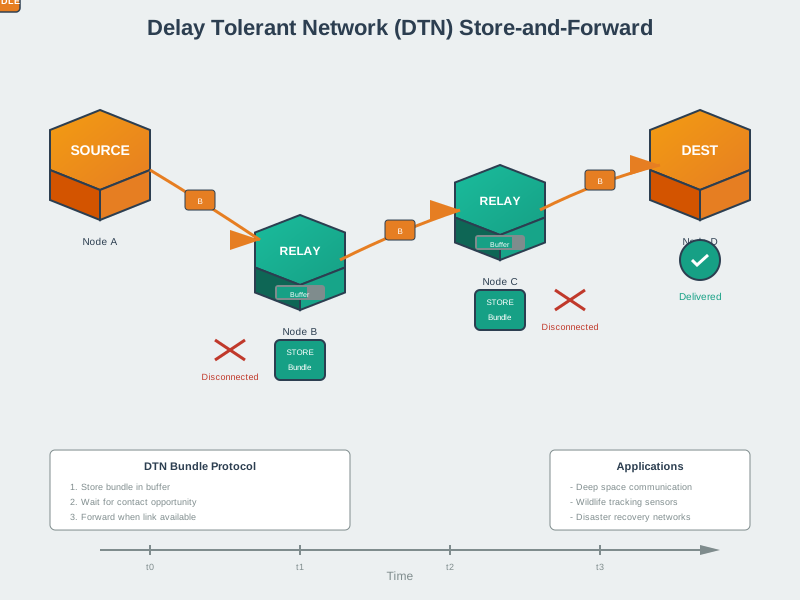
Store-and-forward mechanism enabling communication through disconnected networks.
427.5.2 Mobile Sink Routing
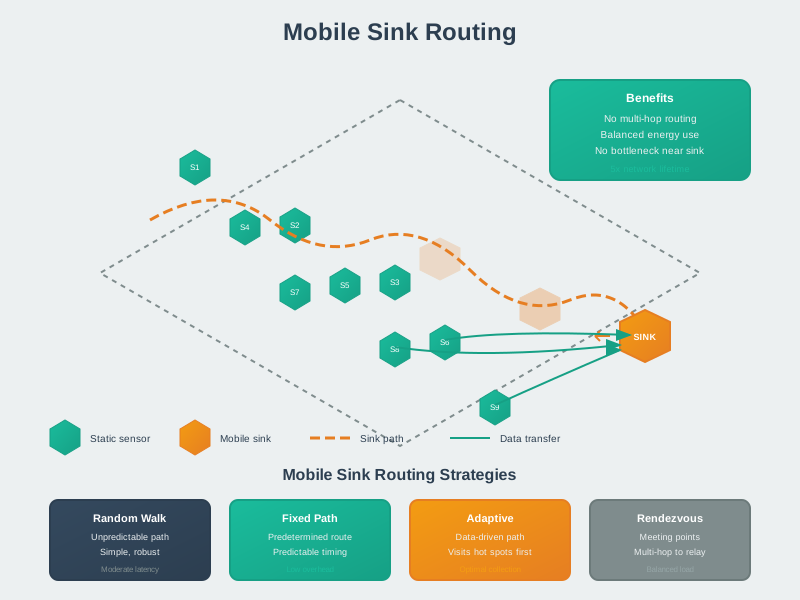
Mobile sink routing strategies for energy-efficient data collection.
427.6 What’s Next
The next chapter explores Sensing-as-a-Service: Fundamentals, covering the S2aaS paradigm shift, sensor virtualization, data ownership models, multi-tenancy architectures, and business models for monetizing shared sensor infrastructure.
TipCross-Hub Connections: Explore DTN Topics
Hands-On Simulations: - Simulations Hub features DTN routing simulators (THE ONE simulator) where you can experiment with Epidemic, Spray-and-Wait, and PRoPHET protocols, comparing delivery rates and overhead in different mobility scenarios
Test Your Knowledge: - Quizzes Hub contains DTN quizzes covering routing algorithms, store-carry-forward mechanisms, and protocol selection with detailed explanations
Video Learning: - Videos Hub offers curated videos on delay-tolerant networking in wildlife tracking, disaster recovery, and rural connectivity scenarios
Common Pitfalls: - Knowledge Gaps Hub explains misconceptions about DTN overhead (epidemic routing creates 100x copies), delivery guarantees, and when to use each routing protocol
NoteRelated Chapters
Human-Centric Sensing: - Human-Centric Sensing: Roles and Paradigms - Human roles in sensing systems - Participatory Sensing: Platforms and Applications - Crowdsourced data collection
WSN Fundamentals: - Wireless Sensor Networks - WSN architecture fundamentals - WSN Stationary vs Mobile: Fundamentals - Mobile sinks and data MULEs - WSN Overview: Fundamentals - Network basics
Routing & Protocols: - Sensor Network Routing - Data-centric routing approaches - RPL Routing - Low-power routing - MQTT - Lightweight messaging protocol
Learning Hubs: - Simulations Hub - DTN simulation tools - Videos Hub - Tutorial videos