%% fig-alt: "Detect and Avoid (DAA) system flowchart: Sensors (cameras, radar, ADS-B, lidar) detect objects, tracking system predicts trajectories calculating closest point of approach, risk assessment evaluates time to collision and severity, three-level decision based on risk (low risk continues monitoring, medium risk alerts pilot, high risk executes avoidance), avoidance maneuvers include altitude change, lateral offset, speed adjustment, or hover/loiter, followed by mission resumption and continuous loop back to detection"
%%{init: {'theme': 'base', 'themeVariables': {'primaryColor': '#2C3E50', 'primaryTextColor': '#fff', 'primaryBorderColor': '#16A085', 'lineColor': '#E67E22', 'secondaryColor': '#ECF0F1', 'tertiaryColor': '#fff', 'nodeTextColor': '#2C3E50'}}}%%
graph TB
    subgraph "Detect and Avoid (DAA) System"
        Sensors["Sensors<br/>(Cameras, Radar,<br/>ADS-B, Lidar)"]

        Detect["Object Detection<br/>& Tracking"]

        Predict["Predict Trajectory<br/>(Closest Point<br/>of Approach)"]

        Assess["Collision Risk<br/>Assessment<br/>(Time to collision,<br/>Severity)"]

        Decision{Risk Level?}

        Monitor["Continue<br/>Monitoring<br/>(Low Risk)"]

        Alert["Alert Pilot<br/>(Medium Risk)"]

        Avoid["Execute Avoidance<br/>Maneuver<br/>(High Risk)"]

        Maneuver["Avoidance Actions:<br/>- Altitude change<br/>- Lateral offset<br/>- Speed adjustment<br/>- Hover/loiter"]

        Resume["Resume Mission"]
    end

    Sensors --> Detect
    Detect --> Predict
    Predict --> Assess
    Assess --> Decision

    Decision -->|Low| Monitor
    Decision -->|Medium| Alert
    Decision -->|High| Avoid

    Monitor -.->|Continuous| Detect
    Alert -.->|If escalates| Avoid

    Avoid --> Maneuver
    Maneuver --> Resume
    Resume -.->|Continue| Detect

    style Sensors fill:#2C3E50,stroke:#16A085,color:#fff
    style Assess fill:#E67E22,stroke:#2C3E50,color:#fff
    style Avoid fill:#E74C3C,stroke:#2C3E50,color:#fff
    style Resume fill:#16A085,stroke:#2C3E50,color:#fff
458 UAV Missions, Collision Avoidance, and Labs
458.1 Learning Objectives
By the end of this chapter, you will be able to:
- Implement Collision Avoidance: Design Detect and Avoid (DAA) systems with appropriate separation standards
- Select Mission Patterns: Choose appropriate trajectory patterns for different mission types
- Plan Coverage Missions: Calculate flight parameters for area survey operations
- Simulate UAV Networks: Build and test trajectory control algorithms in simulation environments
458.2 Prerequisites
Before diving into this chapter, you should be familiar with:
- UAV Swarm Formation Control: Understanding formation patterns and multi-UAV coordination provides context for collision avoidance requirements
- UAV Energy-Aware Mission Planning: Knowledge of energy constraints and mission range helps in designing feasible mission profiles
458.3 Collision Avoidance
458.3.1 Detect and Avoid (DAA) System
NoteWorked Example: Collision Avoidance Time Budget for Converging UAVs
Scenario: Two UAVs from different operators are flying in the same airspace. UAV-A detects UAV-B approaching on a collision course. You need to calculate the time available for detect-and-avoid (DAA) response and determine if the current separation standards are adequate.
Given: - UAV-A velocity: 15 m/s heading East - UAV-B velocity: 20 m/s heading North - Initial positions: UAV-A at (0, 0, 100m), UAV-B at (500m, -600m, 105m) - Minimum safe separation: 50 m - Sensor detection range: 400 m - DAA system latency: 2 seconds (detection + processing) - Avoidance maneuver: 5 m/s vertical climb
Steps: 1. Calculate closing geometry: UAV-A moves (+15, 0, 0) m/s, UAV-B moves (0, +20, 0) m/s. Relative velocity = UAV-B relative to UAV-A = (-15, +20, +0.167) m/s (including altitude convergence of 5m over ~30 seconds) 2. Calculate initial 3D separation: d = √(500² + 600² + 5²) = √(250000 + 360000 + 25) = 781.0 m 3. Calculate time to closest point of approach (CPA): - Position of UAV-A at time t: (15t, 0, 100) - Position of UAV-B at time t: (500, -600+20t, 105) - Distance² = (500-15t)² + (-600+20t)² + 5² - d(Distance²)/dt = 0 → -30(500-15t) + 40(-600+20t) = 0 - -15000 + 450t - 24000 + 800t = 0 → 1250t = 39000 → t = 31.2 seconds 4. Calculate CPA distance: At t=31.2s: - UAV-A: (468, 0, 100) - UAV-B: (500, 24, 105) - CPA distance = √(32² + 24² + 5²) = √(1024 + 576 + 25) = 40.3 m < 50 m safe threshold! 5. Calculate detection time: UAV-B enters 400m detection range when: √((500-15t)² + (-600+20t)² + 5²) = 400 - Solving: t ≈ 11.8 seconds (UAV-B detected at ~400m range) 6. Calculate available response time: Time from detection to CPA = 31.2 - 11.8 = 19.4 seconds. Minus 2 second DAA latency = 17.4 seconds for avoidance 7. Verify avoidance maneuver: UAV-A climbs at 5 m/s for 17.4 seconds = 87 m altitude gain. New altitude separation = 5 + 87 = 92 m (vertical) at CPA time. New 3D separation at CPA = √(32² + 24² + 92²) = 99.6 m > 50 m (safe!)
Result: Without avoidance, the two UAVs would pass within 40.3 m (collision risk). With 400 m detection range and 2-second DAA latency, the system has 17.4 seconds to execute avoidance. A 5 m/s vertical climb provides 92 m altitude separation, achieving 99.6 m total separation at CPA - safely above the 50 m minimum.
Key Insight: Collision avoidance is a time-budget problem. Detection range, processing latency, and maneuver capability must combine to provide sufficient separation before CPA. The critical formula is: Required detection range = Closing speed × (DAA latency + Maneuver time + Safety margin). For high-speed convergences (>30 m/s combined), 400 m detection range may be insufficient, requiring either longer-range sensors (radar vs camera) or reduced operating speeds in congested airspace.
458.3.2 Separation Standards
| Scenario | Minimum Separation | Method |
|---|---|---|
| UAV-UAV (same swarm) | 5-10 m | Formation control |
| UAV-UAV (different operators) | 50-100 m | ADS-B, radar |
| UAV-Manned Aircraft | 500 m+ | ADS-B, TCAS |
| UAV-Obstacle (building) | 10-30 m | Lidar, camera |
| UAV-Ground | 30-120 m | Altitude hold |
458.4 Mission Types and Trajectory Patterns
458.4.1 Common Mission Profiles
| Mission | Pattern | Key Considerations |
|---|---|---|
| Area Survey | Lawnmower/Boustrophedon | Overlap for complete coverage |
| Perimeter Patrol | Circular/Racetrack | Continuous monitoring |
| Point Inspection | Hover + Spiral | High-resolution data |
| Search & Rescue | Expanding square | Prioritize likely areas |
| Delivery | Point-to-point | Obstacle avoidance |
| Relay/Comm | Station-keeping | Minimize position error |
458.4.2 Lawnmower Pattern for Area Coverage
%% fig-alt: "Lawnmower survey pattern showing UAV starting at corner, flying parallel tracks across survey area (Track 1 west to east, 180-degree turn, Track 2 east to west, turn, Track 3 west to east, turn, Track 4 east to west), with parameters of 80m altitude, 10 m/s speed, 115m track spacing with 20% overlap, completing survey and returning to base"
%%{init: {'theme': 'base', 'themeVariables': {'primaryColor': '#2C3E50', 'primaryTextColor': '#fff', 'primaryBorderColor': '#16A085', 'lineColor': '#E67E22', 'secondaryColor': '#ECF0F1', 'tertiaryColor': '#fff', 'nodeTextColor': '#2C3E50'}}}%%
graph TB
    subgraph "Lawnmower Survey Pattern"
        Start["Mission Start<br/>(Corner)"]

        Track1["Track 1<br/>(West to East)"]
        Turn1["180° Turn"]
        Track2["Track 2<br/>(East to West)"]
        Turn2["180° Turn"]
        Track3["Track 3<br/>(West to East)"]
        Turn3["180° Turn"]
        Track4["Track 4<br/>(East to West)"]

        Complete["Survey Complete"]
        Return["Return to Base"]

        Params["Parameters:<br/>- Altitude: 80m<br/>- Speed: 10 m/s<br/>- Track spacing: 115m<br/>- Overlap: 20%"]
    end

    Start --> Track1
    Track1 --> Turn1
    Turn1 --> Track2
    Track2 --> Turn2
    Turn2 --> Track3
    Track3 --> Turn3
    Turn3 --> Track4
    Track4 --> Complete
    Complete --> Return

    Params -.->|Configure| Track1

    style Start fill:#2C3E50,stroke:#16A085,color:#fff
    style Track1 fill:#E67E22,stroke:#2C3E50,color:#fff
    style Track2 fill:#E67E22,stroke:#2C3E50,color:#fff
    style Complete fill:#16A085,stroke:#2C3E50,color:#fff
458.5 Hands-On Lab: UAV Mission Planning
458.5.1 Lab Activity: Coverage Mission Design
Scenario: Plan a UAV survey mission for a 1 km × 1 km agricultural field.
Given: - UAV: DJI Mavic-class (30 min flight time, 15 m/s max speed) - Camera: 84° FOV, need 5 cm/pixel resolution - Wind: 5 m/s from the north
Tasks:
- Calculate Flight Altitude
- For 5 cm/pixel with given sensor, altitude ≈ 80 m
- Calculate Track Spacing
- At 80 m altitude, swath width = 2 × 80 × tan(42°) ≈ 144 m
- With 20% overlap: track spacing = 144 × 0.8 = 115 m
- Calculate Number of Tracks
- Field width: 1000 m ÷ 115 m = 9 tracks
- Calculate Flight Distance
- 9 tracks × 1000 m + 8 turns × 50 m = 9,400 m
- Calculate Flight Time
- At 10 m/s: 9,400 ÷ 10 = 940 s ≈ 16 minutes
- Add takeoff/landing: ~20 minutes total
- Verify Feasibility
- 20 min < 30 min battery → Mission feasible with 33% reserve
NoteSolution Verification
| Parameter | Value | Calculation |
|---|---|---|
| Flight altitude | 80 m | Resolution requirement |
| Track spacing | 115 m | 144 m × 0.8 overlap |
| Number of tracks | 9 | 1000 m ÷ 115 m |
| Total distance | 9.4 km | (9 × 1000) + (8 × 50) |
| Flight time | ~16 min | 9400 m ÷ 10 m/s |
| Battery reserve | 47% | 14 min remaining |
Result: Mission is feasible with good safety margin.
458.6 Knowledge Check
Test your understanding of these architectural concepts.
458.7 Visual Reference Gallery
NoteUAV Trajectory Planning Visualization
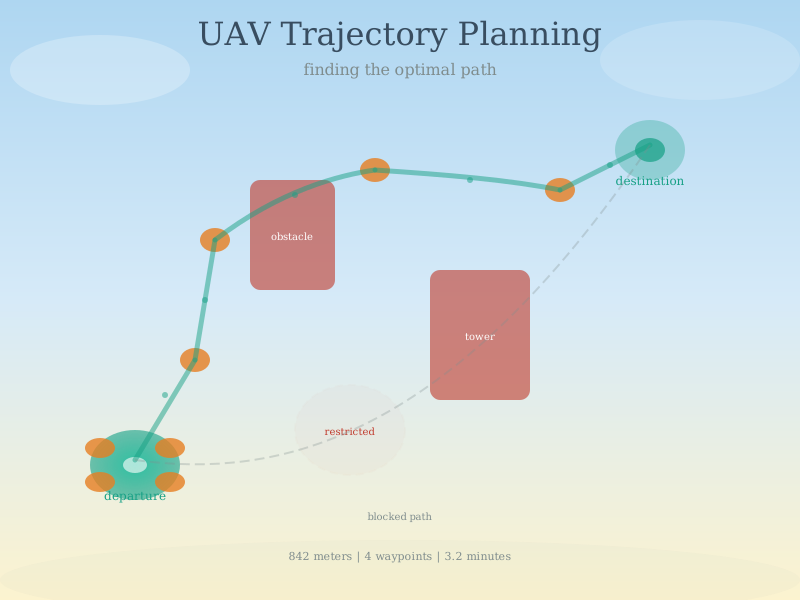
Dynamic path planning algorithms optimize UAV flight trajectories considering energy consumption, coverage requirements, and network connectivity constraints.
NoteUAV Swarm Coordination
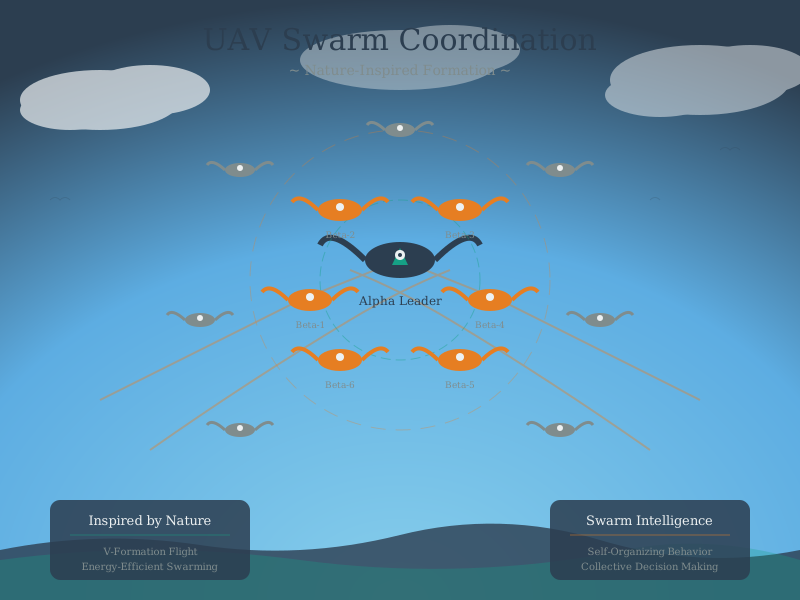
Consensus-based swarm coordination enables multiple UAVs to maintain formations while executing complex missions like area surveillance and search patterns.
NoteFANET Topology Visualization
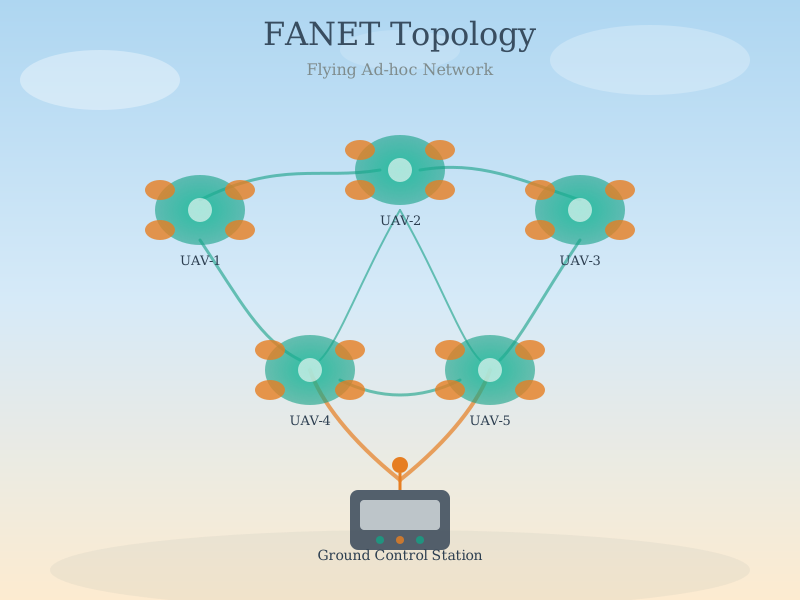
Flying Ad-hoc Networks (FANETs) provide the communication backbone for UAV swarms, adapting topology as vehicles move and missions evolve.
458.8 Summary
This chapter covered collision avoidance, mission types, and hands-on UAV mission planning:
- Detect and Avoid (DAA): Multi-sensor systems (cameras, radar, ADS-B, lidar) detect objects, predict trajectories, assess collision risk, and execute avoidance maneuvers when needed
- Separation Standards: Different scenarios require different minimum separations - from 5-10 m for same-swarm UAVs to 500+ m for UAV-manned aircraft encounters
- Mission Patterns: Different missions use different trajectory patterns - lawnmower for area survey, circular for perimeter patrol, expanding square for search and rescue
- Coverage Planning: Flight altitude, track spacing, and overlap requirements determine mission feasibility within battery constraints
NoteRelated Chapters
Deep Dives: - UAV Fundamentals and Topologies - Network architectures - UAV Production and Review - Complete system implementation - UAV FANET Integration - Protocol integration
Comparisons: - Mobile Ad-Hoc Networks - Ground vs aerial mobility - Wireless Sensor Networks - Static vs mobile collection
Applications: - Search and Rescue - Emergency missions - Precision Agriculture - Crop monitoring
Design: - Energy-Aware Design - Battery optimization - Network Simulation - Testing tools
Learning: - Simulations Hub - UAV flight simulators - Videos Hub - Mission planning tutorials
NotePhantom Figure Gallery
The following AI-generated figures provide alternative visual representations of concepts covered in this chapter. These “phantom figures” offer different artistic interpretations to help reinforce understanding.
458.8.1 Additional Figures

458.9 What’s Next
Having explored UAV trajectory control, energy-aware mission planning, swarm coordination, and collision avoidance, the next chapter examines ad hoc network routing protocols and simulation techniques for mobile IoT systems.
Continue to Ad Hoc Networks: Labs and Quiz →