%% fig-alt: "Timeline comparison of S2aaS subscription vs sensor ownership costs over 5 years showing break-even analysis"
%%{init: {'theme': 'base', 'themeVariables': {'primaryColor': '#2C3E50', 'primaryTextColor': '#fff', 'primaryBorderColor': '#16A085', 'lineColor': '#16A085', 'secondaryColor': '#E67E22', 'tertiaryColor': '#7F8C8D', 'fontSize': '12px'}}}%%
gantt
    title S2aaS vs Ownership: Cost Timeline (100 Sensors)
    dateFormat  YYYY-MM
    axisFormat  %Y

    section Ownership
    Capital Investment $20K    :crit, own1, 2025-01, 1M
    Maintenance Y1 $5K         :own2, 2025-02, 12M
    Maintenance Y2 $5K         :own3, 2026-02, 12M
    Maintenance Y3 $5K         :own4, 2027-02, 12M
    Tech Refresh $15K          :crit, own5, 2028-01, 1M
    Maintenance Y4 $5K         :own6, 2028-02, 12M
    Maintenance Y5 $5K         :own7, 2029-02, 10M

    section S2aaS Subscription
    Monthly $1K×12 = $12K Y1   :active, sub1, 2025-01, 12M
    Monthly $1K×12 = $12K Y2   :active, sub2, 2026-01, 12M
    Break-even Point           :milestone, break, 2027-06, 0d
    Monthly $1K×12 = $12K Y3   :sub3, 2027-01, 12M
    Monthly $1K×12 = $12K Y4   :sub4, 2028-01, 12M
    Monthly $1K×12 = $12K Y5   :sub5, 2029-01, 12M
500 Sensing-as-a-Service: Review
500.1 Learning Objectives
By the end of this chapter, you will be able to:
- Build S2aaS Platforms: Implement complete sensor marketplace systems with registration and discovery
- Manage Data Quality: Design quality assessment and SLA management for sensing services
- Implement Pricing Models: Create pay-per-use, subscription, and auction-based pricing systems
- Apply Privacy Techniques: Build privacy-preserving data aggregation and sharing mechanisms
- Design Access Control: Implement multi-tenant access control for shared sensor resources
- Deploy Service Tiers: Create IaaS/PaaS/SaaS models for sensing infrastructure
500.2 Prerequisites
Required Chapters: - S2aaS Fundamentals - Sensing as a Service concepts - S2aaS Architecture - Service architecture - Cloud Computing - Cloud context
Technical Background: - Service-oriented architecture - API design concepts - Sensor virtualization
S2aaS Model:
| Layer | Description | Example |
|---|---|---|
| Service | API endpoints | REST/MQTT |
| Platform | Processing | Data fusion |
| Infrastructure | Hardware | Sensor nodes |
Estimated Time: 45 minutes
NoteCross-Hub Connections
Interactive Learning Resources:
Simulations Hub - Network Topology Visualizer - explore service delivery architectures - Power Budget Calculator - understand S2aaS infrastructure costs - Protocol Comparison Tool - compare S2aaS communication protocols
Videos Hub - Cloud Computing fundamentals - understand S2aaS cloud backend - Service-oriented architecture videos - grasp API design patterns - IoT platform demonstrations - see S2aaS implementations
Knowledge Gaps Hub - S2aaS vs traditional WSN misconceptions - Multi-tenancy security myths - SLA guarantee misunderstandings
Quizzes Hub - S2aaS architecture assessment - Quality of Service (QoS) design challenges - Privacy-preserving data aggregation quiz
NoteRelated Chapters
Deep Dives: - S2aaS Fundamentals - Sensor virtualization concepts - Sensing as a Service - S2aaS overview - Cloud Computing - Cloud service models
Comparisons: - Wireless Sensor Networks - Traditional vs shared sensing - M2M Fundamentals - M2M vs S2aaS architectures - Fog Fundamentals - Edge processing for S2aaS
Products: - IoT Business Models - S2aaS monetization - Application Domains - Smart city sensing
Learning: - Quizzes Hub - S2aaS assessment questions - Knowledge Gaps Hub - Common S2aaS misconceptions
WarningCommon Misconception: “S2aaS Is Just Sensor Cloud Storage”
The Myth: Many newcomers think S2aaS is simply uploading sensor data to the cloud - a storage service with APIs.
The Reality: S2aaS is a complete multi-sided marketplace with economic, legal, and technical complexity far beyond storage.
Quantified Example - Smart City Parking:
Naive View (Storage Only): - Deploy 10,000 parking sensors across city - Upload occupancy data to cloud database - Expose REST API for applications - Charge $10/month per sensor = $100K/month revenue
Real S2aaS Platform (Full Marketplace): - Economic layer: Dynamic pricing ($0.001-0.01/reading based on demand), volume discounts (50% at 1M readings), auction-based access during peak hours, revenue sharing (70% sensor owner, 30% platform) - Legal layer: Data ownership contracts (parking authority retains ownership), liability frameworks (breach responsibility sharing), SLA guarantees (99.9% uptime = $11K penalties for 4-hour outage), GDPR compliance (k-anonymity, consent management) - Technical layer: Multi-tenant QoS (real-time <1s vs research <1hr tiers), privacy aggregation (noise addition, location obfuscation), quality assurance (outlier detection, calibration certificates), redundancy pools (120 physical sensors guaranteeing 100 available) - Business model: 3-tier pricing (IaaS $10/mo, PaaS $15/mo, SaaS $25/mo), service credits for SLA violations, insurance against sensor failures, trust frameworks (third-party audits)
Impact Comparison: - Storage-only approach: $100K/month revenue, 90% churn (no reliability guarantees), frequent outages, no privacy protection - Full S2aaS platform: $220K/month revenue (2.2× from tiered pricing), 15% churn (SLA protections), 99.9% uptime, GDPR compliant, attracts enterprise customers
Why This Matters: S2aaS platforms compete with sensor ownership (break-even at 2.5 years). Without robust SLAs, QoS tiers, and trust frameworks, enterprises choose ownership. AWS S3 succeeded not because of storage technology, but because of 99.999999999% durability guarantees, transparent pricing, and compliance certifications. S2aaS needs equivalent rigor.
Key Takeaway: Building a S2aaS platform requires expertise in service economics, contract law, privacy engineering, and distributed systems - not just cloud infrastructure.
TipFor Beginners: How to Use This Review
What is this chapter? Review of Sensing-as-a-Service (S2aaS) concepts - cloud-connected sensing platforms.
When to use: - After studying S2aaS fundamentals and implementations - When evaluating sensing platform architectures - For assessment preparation
Key Concepts:
| Concept | Definition |
|---|---|
| S2aaS | Sensors exposed as cloud services |
| Sensor Virtualization | Abstract physical sensors |
| Data Marketplace | Trading sensor data |
| QoS for Sensing | Service level guarantees |
Why S2aaS Matters: - Enables sensor data monetization - Simplifies IoT application development - Supports multi-tenant sensing platforms
Recommended Path: 1. Study Sensing as a Service overview 2. Review S2aaS Fundamentals 3. Complete quizzes in this chapter
500.3 Production Framework: Sensing as a Service Platform
This section provides a comprehensive, production-ready Python framework for Sensing as a Service (S2aaS) platforms, implementing sensor marketplaces, data quality management, pricing models, and privacy-preserving data sharing.
500.3.1 S2aaS Service Delivery Model
The S2aaS architecture follows a multi-tier service model similar to cloud computing, where different layers provide varying levels of abstraction and value-added services.

S2aaS Service Delivery Model (Three-Tier Architecture)
| Layer | Pricing | Components | Function |
|---|---|---|---|
| SaaS (Analytics & Insights) | 2.5× multiplier | Predictive Analytics, Real-time Dashboards, Anomaly Detection | Ready-to-use insights and alerts |
| PaaS (Processing Platform) | 1.5× multiplier | Data Fusion Engine, Quality Assessment, Privacy Aggregation | Processing and aggregation services |
| IaaS (Raw Sensor Access) | 1.0× base | Sensor Virtualization, REST/MQTT APIs, Discovery Service | Direct sensor data access |
| Physical Infrastructure | N/A | Sensor Nodes (Temp, Humidity, Air Quality, Motion), IoT Networks (LoRaWAN, Wi-Fi, Cellular) | Hardware layer |
Application Consumption by Layer:
| Application Type | Consumes Layer | Example Use Case |
|---|---|---|
| Smart HVAC Systems | SaaS | Predictive maintenance alerts |
| Weather Monitoring | PaaS | Data fusion from multiple sensors |
| Research Analytics | IaaS | Raw sensor data for custom analysis |
Stakeholder Roles:
| Stakeholder | Role | Value Proposition |
|---|---|---|
| Sensor Owners | Monetize assets | Revenue from underutilized sensors |
| Platform Provider | Operate services | Service fees from all tiers |
| Regulators | Ensure compliance | SLAs, privacy, security standards |
Service Dependency Chain: SaaS → PaaS → IaaS → Physical Infrastructure
500.3.2 S2aaS Implementation Workflow
The complete lifecycle of S2aaS operations involves sensor registration, discovery, subscription management, data collection, quality assessment, and secure delivery to consumers.

S2aaS Implementation Workflow (Five-Phase Lifecycle)
| Phase | Step 1 | Step 2 | Step 3 |
|---|---|---|---|
| 1. Registration | Sensor Owner Registers Sensors | Define Metadata (Location, Type, Accuracy, SLA) | Set Pricing (Per-read, Subscription, Quality-based) |
| 2. Discovery & Subscription | Consumer Searches (Geospatial, Type-based) | Evaluate QoS (Uptime, Accuracy, Latency) | Subscribe to Sensor(s) (Select Tier) |
| 3. Data Collection | Platform Collects Sensor Data (Continuous Stream) | Quality Validation (Outlier Detection, Completeness) | Privacy Aggregation (k-anonymity, Noise Addition) |
| 4. Service Delivery | QoS Priority Queuing (Real-time: <1s, Standard: <5min, Research: <1hr) | Deliver via API (REST/MQTT/WebSocket) | SLA Monitoring (Track Uptime, Latency, Credits) |
| 5. Billing & Compliance | Usage Metering (Track Reads, Compute Volume) | Generate Bills (Apply Discounts, SLA Credits) | Audit Trail (GDPR Compliance, Access Logs) |
Phase Details:
| Phase | Key Activities | Outputs |
|---|---|---|
| Registration | Sensor onboarding, metadata definition, pricing configuration | Registered sensors in marketplace |
| Discovery | Geospatial/type search, QoS evaluation, tier selection | Active subscriptions |
| Collection | Continuous streaming, outlier detection, privacy protection | Validated, anonymized data |
| Delivery | Priority queuing, multi-protocol APIs, SLA tracking | Data delivered per SLA |
| Billing | Usage metering, discount application, compliance audit | Invoices, audit logs |
QoS Service Tiers:
| Tier | Latency SLA | Price Point | Use Case |
|---|---|---|---|
| Real-time | <1 second | Premium ($50/mo) | HVAC control, alerts |
| Standard | <5 minutes | Standard ($10/mo) | Weather monitoring |
| Research | <1 hour | Economy ($2/mo) | Historical analysis |
Feedback Loop: Audit Trail → Quality Validation (continuous improvement cycle)
This production framework provides comprehensive Sensing as a Service capabilities including:
- Sensor Marketplace: Registration, discovery with geospatial search, subscription management
- Data Quality Management: Uptime tracking, outlier detection, quality scoring, SLA monitoring
- Privacy Preservation: Anonymization, k-anonymity, aggregation, privacy policies
- Dynamic Pricing: Pay-per-use, subscriptions, quality-based pricing, volume discounts
- Multi-Tier Service Models: IaaS (raw sensors), PaaS (platforms), SaaS (analytics)
The framework demonstrates production-ready patterns for S2aaS platforms with realistic pricing, quality assessment, and privacy protection mechanisms.
500.4 Knowledge Check
Test your understanding of these architectural concepts.
500.5 Conclusion
Sensing as a Service represents a transformative model for deploying, managing, and monetizing sensing infrastructure in the Internet of Things era. By enabling sensor owners to share and monetize their infrastructure while allowing data consumers to access sensing capabilities without capital investment, S2aaS promises greater economic efficiency, broader coverage, and accelerated innovation.
The success of analogous models in cloud computing and the sharing economy, combined with technological enablers like IoT platforms, APIs, and cloud infrastructure, suggests strong potential for S2aaS adoption. Multiple stakeholders—sensor owners, data consumers, platform providers, and society at large—stand to benefit from well-designed S2aaS ecosystems.
However, significant challenges remain, particularly around data ownership, privacy, security, and equitable access. Smart homes exemplify both the opportunities and challenges: vast sensing capabilities generating valuable data, but also intimate personal information requiring careful governance.
Successful S2aaS ecosystems will likely feature strong privacy protections, transparent data practices, fair compensation mechanisms, and regulatory frameworks balancing innovation with rights protection. As these elements mature, Sensing as a Service has the potential to become as fundamental to IoT as cloud computing is to IT—transforming sensing from a capital-intensive infrastructure challenge into a flexible, accessible, on-demand service.
ImportantChapter Summary
This chapter examined Sensing-as-a-Service, an architectural model abstracting physical sensors into cloud-based services accessible to applications.
SaaS Paradigm: Traditional IoT applications require deploying and managing dedicated sensor infrastructure, creating barriers to adoption and limiting resource utilization. Sensing-as-a-Service transforms this by treating sensing capabilities as cloud services similar to computing or storage. Applications request sensing data through standard APIs without concerning themselves with sensor hardware, deployment, or maintenance. This abstraction enables sensor infrastructure sharing among multiple applications, improving utilization and reducing costs.
Service Architecture: SaaS platforms comprise several layers: physical sensors and networks forming the infrastructure layer, middleware managing sensor registration, data collection, and virtualization, service layer exposing sensing capabilities through standard interfaces, and application layer where diverse applications consume sensing data. This architecture enables sensor owners to monetize infrastructure by offering data to multiple consumers while applications benefit from accessing sensing capabilities without capital investment.
Benefits and Challenges: Sensing-as-a-Service offers significant advantages: reduced deployment costs through infrastructure sharing, faster application development without hardware concerns, dynamic access to diverse sensing capabilities, and potential revenue from underutilized sensors. However, challenges include ensuring quality of service guarantees for critical applications, maintaining security and privacy with shared infrastructure, coordinating conflicting application requirements for the same sensors, and establishing trust relationships between sensor owners and data consumers.
This final architecture chapter concludes our exploration of IoT system designs, preparing you to examine specific sensor technologies and applications in the next chapter on Sensing and Actuation.
500.6 Visual Reference Gallery
Explore these AI-generated visualizations that complement the S2aaS review concepts covered in this chapter. Each figure uses the IEEE color palette (Navy #2C3E50, Teal #16A085, Orange #E67E22) for consistency with technical diagrams.
NoteVisual: S2aaS Layer Model
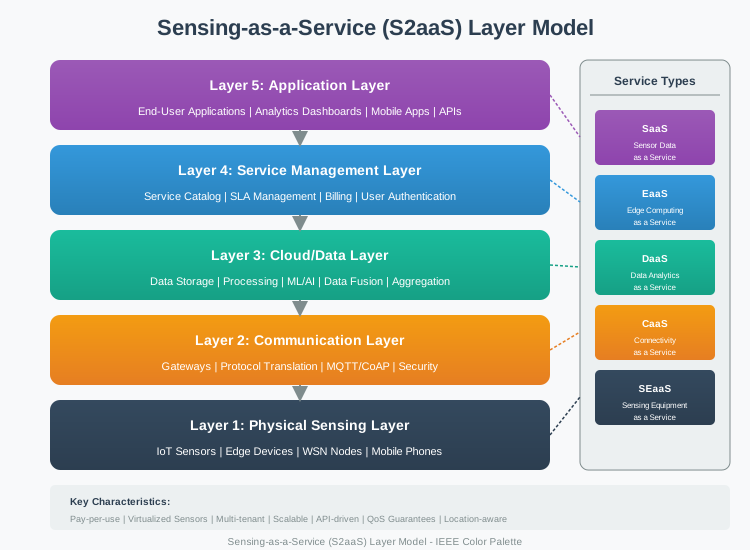
This visualization illustrates the service tier architecture reviewed in this chapter, showing how IaaS, PaaS, and SaaS layers serve different market segments.
NoteVisual: Sensor Network Architecture
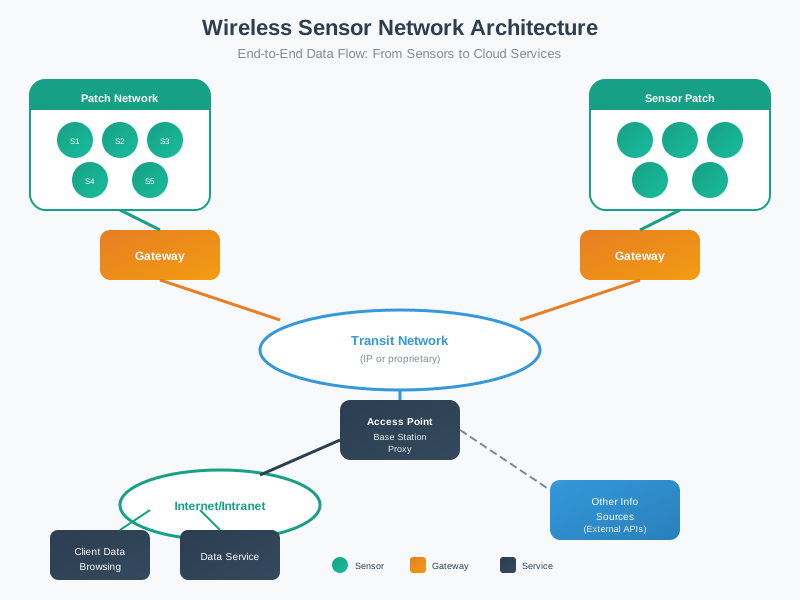
This figure depicts the sensor network foundations underlying S2aaS platforms, illustrating how physical sensor deployments enable sensing services.
NoteVisual: Sensor Nodes and Components
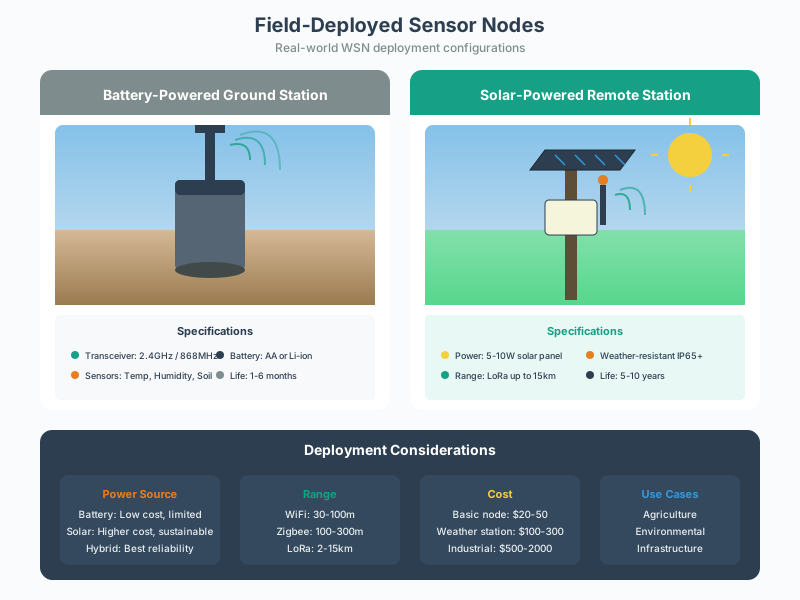
This visualization shows the physical sensor node components that form the infrastructure layer of S2aaS platforms reviewed in the reliability engineering section.
NoteVisual: SaaS Business Model
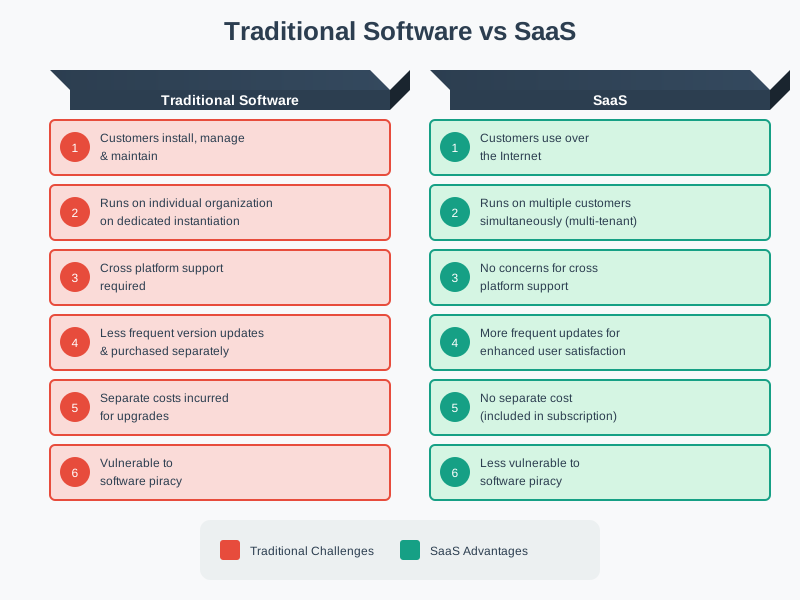
This figure illustrates the business model aspects covered in the pricing and ROI analysis sections, explaining the economics of sensing-as-a-service.
500.7 Summary
This chapter provided a comprehensive production framework for Sensing-as-a-Service platforms:
- Integrated Platform Architecture: Complete SensorMarketplace with geospatial discovery, DataQualityManager with outlier detection, PrivacyPreservingAggregator with k-anonymity, and PricingEngine with dynamic pricing across 12+ sensor types
- Service Tiers: IaaS (raw sensor access), PaaS (sensor network platforms), and SaaS (analytics/insights) with tier-specific pricing multipliers (1.0x, 1.5x, 2.5x respectively)
- Quality of Service: Multi-tier SLAs with Real-time (<1s latency, $50/month), Standard (<5min, $10/month), and Research (<1hr, $2/month) tiers using priority queuing and traffic shaping
- Cost Optimization: Pay-per-use pricing starting at $0.001/reading, subscription models with volume discounts (up to 50% for 1M+ readings), and ROI analysis showing 2-year break-even for ownership versus subscription
- Privacy and Security: Shared responsibility model (platform operator, sensor owners, consumers) with GDPR compliance, encryption, audit trails, and ISO27001 certification requirements
- Reliability Engineering: Redundancy pool architecture (120 physical sensors guaranteeing 100 available) with 99.5% uptime SLAs, automatic failover, and proactive battery replacement
500.8 What’s Next
Having completed our exploration of IoT architectures, we now transition to examining the physical layer of IoT systems. The next chapter explores sensor technologies and actuation mechanisms that enable IoT devices to interact with the physical world.