462.3.1 Case Study: John Deere - Agricultural Fleet Management with M2M
NoteFull Case Study: John Deere Agricultural Fleet Management
Industry: Agriculture (precision farming)
Challenge: John Deere operates 500,000+ connected farm equipment units globally (tractors, combines, sprayers). Initial M2M system used proprietary 2G cellular modems with custom protocols, creating vendor lock-in and limiting third-party app integration. When 2G networks began sunsetting, equipment faced connectivity loss with no migration path.
Solution Architecture:
M2M Device Layer (ETSI Architecture):
Upgraded equipment with Cat-M1 cellular modems (LTE-M, long-term network support)
M2M gateway per equipment: Translates CAN bus (tractor internal network) to IP/MQTT
Application Platform: Data integration from multiple sensor types, analytics for fuel efficiency and yield optimization
Access Platform: Mobile app for farmers, web dashboard for dealers, REST API for third-party app developers (agronomists, insurance companies)
Communication Architecture:
Cellular M2M: Cat-M1 (LTE-M) for wide-area coverage in rural areas with poor cellular coverage
LoRaWAN: For stationary equipment (irrigation systems) to reduce cellular data costs
Gateway aggregation: Tractor gateway aggregates data from multiple implements (planter, sprayer) before cellular transmission - reduces bandwidth by 70%
M2M Standards Compliance:
oneM2M: Device registration and management APIs
LwM2M (OMA): Lightweight M2M protocol for constrained devices and firmware updates
ETSI M2M scheduling: Devices report telemetry at distributed intervals (avoiding network congestion)
Results:
Network migration: Seamless transition from 2G to LTE-M without equipment replacement (firmware update to gateway)
Yield improvement: Precision planting data (M2M sensors) increased crop yields by 8% through optimal seed spacing
Uptime: Predictive maintenance via M2M telemetry reduced equipment downtime by 30% (predict failures before breakdowns)
Third-party ecosystem: 45 third-party apps now integrate via M2M platform API (weather services, agronomists, insurance telematics)
Lessons Learned:
M2M gateway architecture enabled network technology migration without replacing 500,000+ equipment units
ETSI M2M scheduling requirement critical for rural deployments - prevents cellular tower congestion during harvest season (100+ tractors per tower)
oneM2M standardization accelerated third-party integration - insurance companies built usage-based pricing apps in weeks instead of months
Gateway aggregation (70% bandwidth reduction) made cellular M2M economically viable for data-intensive agricultural applications
462.3.2 Case Study: Coca-Cola - Vending Machine M2M Network
NoteFull Case Study: Coca-Cola Vending Machine Network
Industry: Retail (smart vending machines)
Challenge: Coca-Cola operates 1.2 million vending machines globally. Manual inventory checks required field technicians to visit each machine weekly, costing $180M annually. Machines frequently ran out of popular items (lost sales) or overstocked slow sellers (waste from expiration).
Solution Architecture:
M2M Device Layer:
Retrofitted existing machines with M2M modules (Telit LTE-M modem + Raspberry Pi gateway)
Sensors: Inventory sensors (ultrasonic distance measuring beverage levels per column), temperature sensors (compressor health), payment system integration (sales data), door sensors (service technician visits)
M2M gateway: Aggregates sensor data, runs local analytics (predict stock-out within 24 hours)
Device Platform: 1.2M machine registrations, remote diagnostics, compressor health monitoring
Application Platform: Route optimization for restocking trucks (minimize visits), demand forecasting per machine
Billing: Usage-based cellular data charges, machines report telemetry hourly (scheduled to distribute network load)
M2M Standards and Protocols:
MQTT: Lightweight telemetry (machine status, inventory levels) sent hourly
CoAP: For constrained cellular bandwidth - binary protocol reduces data by 50% vs JSON/HTTP
ETSI M2M anonymity: Machine ID (not customer PII) transmitted; platform maps ID to location securely
Results:
Cost savings: $140M annually (78% reduction) in field service costs - machines only visited when needed, not on fixed weekly schedule
Sales increase: 12% revenue increase by eliminating stock-outs (M2M predicts depletion, triggers restocking before empty)
Waste reduction: 45% reduction in expired product waste (dynamic restocking based on actual sales patterns, not estimates)
Energy efficiency: 20% reduction in energy costs through M2M-enabled compressor optimization (adjust cooling based on ambient temperature and usage patterns)
Network efficiency: Path optimization (Wi-Fi-first, cellular-fallback) reduced cellular data costs by 60%
Lessons Learned:
M2M gateway’s path selection (ETSI requirement) critical for cost control - cellular data expensive at 1.2M scale, Wi-Fi preference saved $8M annually
Edge analytics (predict stock-out locally) reduced cloud data by 85% - only exceptions sent, not continuous inventory streams
ETSI M2M scheduling (hourly reports at distributed times) prevented cellular congestion - 1.2M machines reporting simultaneously would overwhelm towers
Retrofit approach (M2M gateway added to existing machines) enabled fast deployment without replacing entire vending machine fleet
462.4 Worked Example: M2M Gateway Sizing for Industrial Deployment
NoteWorked Example: Water Utility M2M Gateway Sizing
Scenario: A water utility needs to connect 500 smart water meters across a city to their central SCADA system. You must design the M2M gateway architecture.
Given:
Total meters: 500 smart water meters
Meter protocol: Wireless M-Bus (868 MHz, 100 kbps, 500m range)
Budget constraint: Minimize total cost of ownership over 5 years
Step 1: Calculate data volume per gateway
Hourly readings: 64 bytes x 24 hours x 30 days = 46,080 bytes/meter/month
Alert overhead (5%): 2,304 bytes/meter/month
Protocol overhead (20%): 9,677 bytes/meter/month
Total per meter: ~58 KB/month
Step 2: Determine gateway capacity
Wireless M-Bus range: 500m radius (urban with buildings: ~300m effective)
Coverage area per gateway: pi x 300 squared = 282,743 square meters
City deployment area: 25 square km with 500 meters = 20 meters/square km
Meters per gateway coverage: 282,743 sq m x 20/1,000,000 = ~6 meters/gateway
With clustering optimization (meters near roads): ~15 meters/gateway
Gateways needed: 500 / 15 = 34 gateways
Step 3: Calculate monthly data costs
Data per gateway: 15 meters x 58 KB = 870 KB/month
With acknowledgments and management: ~1.5 MB/month/gateway
Total data: 34 x 1.5 MB = 51 MB/month (well under 50 GB limit)
Monthly cost: 34 x $15 = $510/month
Step 4: Calculate 5-year TCO
Cost Category
Calculation
Total
Gateways (hardware)
34 x $350
$11,900
Installation
34 x $200
$6,800
Cellular (5 years)
$510 x 60 months
$30,600
Gateway replacement (10%)
3 x $350
$1,050
Cloud platform
$100/month x 60
$6,000
5-Year TCO
$56,350
Step 5: Compare alternatives
Architecture
Gateways
5-Year TCO
Per Meter
M-Bus + 4G Gateways
34
$56,350
$112.70
Direct cellular (NB-IoT per meter)
0
$90,000
$180.00
LoRaWAN (fewer gateways, longer range)
8
$38,400
$76.80
Result: The gateway-based M2M architecture costs $112.70/meter over 5 years. LoRaWAN would be 32% cheaper but requires meter hardware changes. Direct cellular costs 60% more but eliminates gateway maintenance.
Key insight: M2M gateway architecture trades hardware complexity (34 gateways to maintain) for lower per-device connectivity costs. The break-even point vs direct cellular is ~200 devices. For smaller deployments (<200 meters), NB-IoT per device is simpler despite higher per-unit costs.
You’re designing an M2M platform for a utility company monitoring 10,000 remote environmental sensors across oil and gas facilities. Each sensor transmits 250 bytes of data (temperature, pressure, gas levels) every hour via cellular connectivity. The ETSI M2M standard requires “scheduling” to prevent network congestion.
Your Current Architecture:
10,000 sensors distributed across 500 remote sites
Battery life: 3x improvement (no failed connection retries)
Network utilization: Smooth and predictable across full hour
Question 1: If 10,000 sensors must report once per hour, what is the average number of sensor transmissions per second when evenly distributed across 3600 seconds?
Explanation: 10,000 / 3600 = 2.78. Spreading reports across the hour turns a 10,000-connection spike into a steady ~3 transmissions/second load.
Question 2: In the original “report at :00:00” design, what most directly causes the 3x battery drain observed in the field?
Explanation: When most connection attempts fail, devices retry multiple times (often with backoff), keeping the cellular modem active much longer than a single successful transmit - this dominates the energy budget.
NoteQuiz 2: M2M Requirements (ETSI Standards)
Question: An M2M healthcare monitoring system connects 5,000 patient wearables (heart rate, blood pressure) to a hospital platform. ETSI M2M architecture requires “anonymity” for privacy. How should patient identity be handled in the M2M device layer?
Explanation: ETSI M2M anonymity requirement means M2M devices should not expose personally identifiable information (PII). Each wearable has a unique device ID (e.g., “DEVICE-8472-A3F2”) with no patient name stored on device. The M2M Service Platform maintains secure mapping to patient records. This provides privacy (network attackers can’t identify patients), security (stolen devices don’t reveal patient info), flexibility (device can be reassigned), and compliance (meets HIPAA, GDPR requirements).
Question: An M2M agricultural system monitors soil moisture in 500 fields. Each field has 10 sensors reporting every hour. The M2M platform uses ETSI’s “path optimization” requirement. What does this mean for the architecture?
Explanation: ETSI M2M “path optimization” requires optimizing communication paths to minimize bandwidth, cost, and latency while maximizing reliability. For clustered sensors, hierarchical architecture is optimal. Direct cellular costs $25,000/month for 5,000 SIMs. Hierarchical with gateways costs $5,000/month for 500 gateways (80% reduction). Battery life improves 10x (LoRa vs cellular). Gateway can aggregate, compress, and add local intelligence.
462.6 Knowledge Checks
NoteKnowledge Check: LwM2M Protocol
Show code
viewof kcLwm2m = {const container =html`<div id="kc-lwm2m-container"></div>`;if (container &&typeof InlineKnowledgeCheck !=='undefined') { container.innerHTML=''; container.appendChild(InlineKnowledgeCheck.create({question:"A company deploys 50,000 battery-powered NB-IoT sensors for agricultural soil monitoring. They need remote firmware updates, device configuration changes, and standardized data reporting. The devices have only 256KB flash and 64KB RAM. Which M2M protocol is most appropriate for device management?",options: [ {text:"HTTP REST APIs - standard web protocols work everywhere",correct:false,feedback:"Incorrect. HTTP has significant overhead: text-based headers add 200-500 bytes per request, TCP connection establishment requires multiple round trips, no built-in device management semantics, and HTTP libraries consume 50KB+ RAM."}, {text:"MQTT with custom topic structure for firmware updates and configuration",correct:false,feedback:"Incorrect. MQTT is excellent for telemetry but lacks standardized device management: no standard firmware update mechanism, no defined object/resource model, every vendor implements firmware-over-MQTT differently."}, {text:"LwM2M (Lightweight M2M) - OMA standard designed for constrained devices with built-in firmware update, bootstrap, and standardized object models",correct:true,feedback:"Correct! LwM2M is purpose-built for this scenario: binary CoAP transport (compact), runs on 256KB flash + 64KB RAM, standardized device management (Firmware Update Object 5, Device Object 3), bootstrap for secure onboarding, and major IoT platforms support it natively."}, {text:"SNMP (Simple Network Management Protocol) - industry standard for device monitoring",correct:false,feedback:"Incorrect. SNMP is designed for network equipment, not IoT sensors. SNMP agents require 100KB+ RAM, MIB structure is complex, no firmware update capability, and not designed for battery-powered devices."} ],difficulty:"hard",topic:"lwm2m-protocol" })); }return container;}
462.7 Cross-Hub Connections
NoteLearning Resources Across the Book
Interactive Learning:
Knowledge Map - Visual overview showing how M2M fundamentals connect to IoT protocols, network architectures, and application domains
Quizzes - Test your understanding of M2M vs IoT evolution, gateway architectures, and ETSI requirements
Simulations - Interactive M2M network topology explorer and protocol translator simulator
Video Resources:
Videos Hub - Curated explanations of M2M gateway configuration, cellular M2M deployments, and oneM2M standard implementations
Common Challenges:
Knowledge Gaps - Clarifies M2M/IoT terminology confusion, explains when to use gateways vs direct connectivity, and demonstrates ETSI scheduling requirements
462.8 Visual Reference Gallery
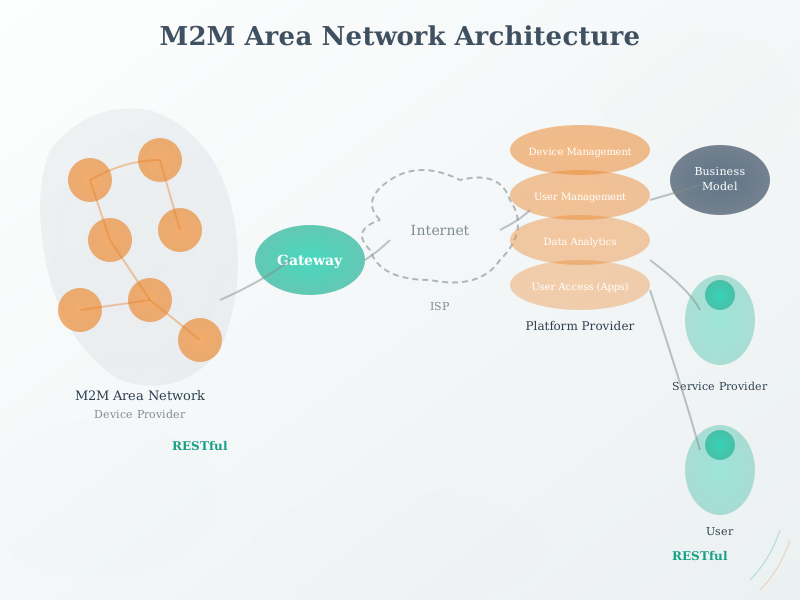
NoteM2M Architecture
M2M Architecture
M2M architecture with device, network, and application domains connected through gateways.
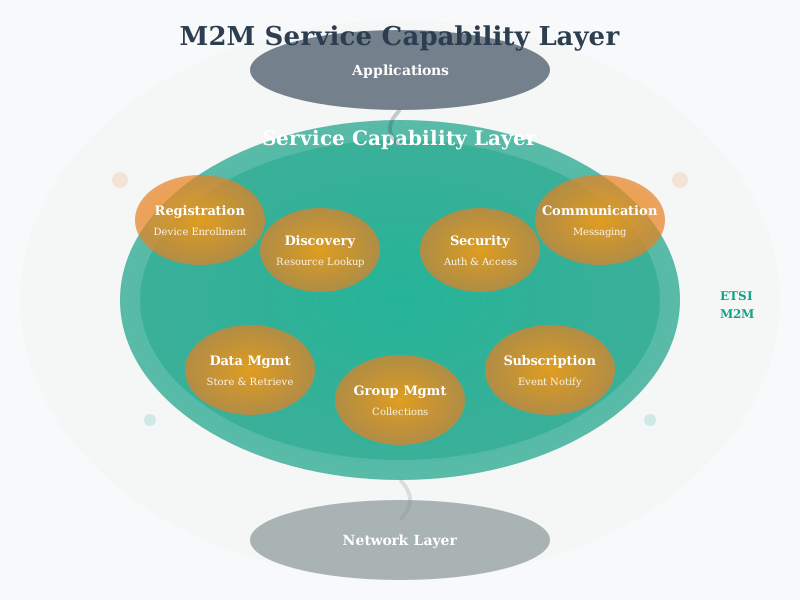
NoteM2M Service Capabilities
M2M Service Platform
M2M service capabilities layer providing common functions for application development.
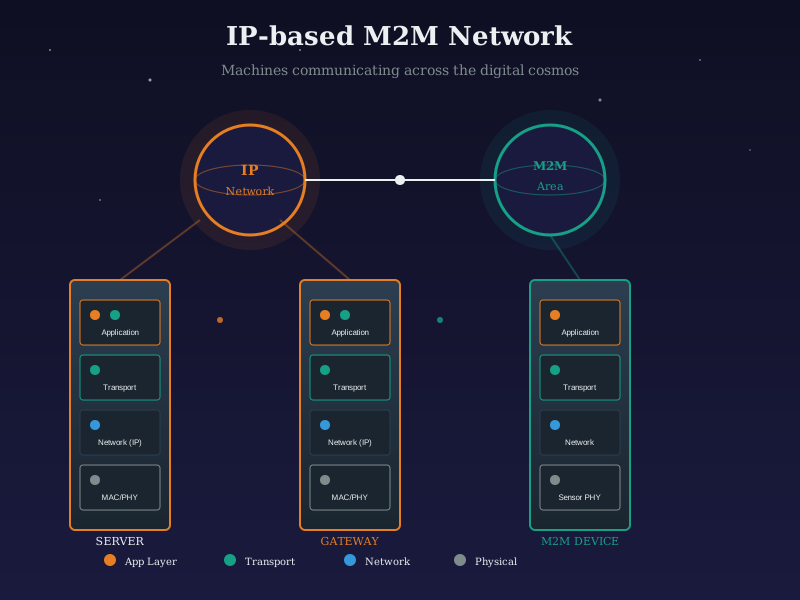
NoteIP-based M2M Network
IP-based M2M
IP-based M2M network architecture enabling end-to-end standard protocols.
NotePhantom Figure Gallery
The following AI-generated figures provide alternative visual representations of concepts covered in this chapter.
462.8.1 M2M Architecture
M2M Architecture
462.8.2 M2M Gateways
M2M Gateway
462.8.3 M2M Platform
M2M Platform
462.9 Summary
This chapter covered M2M case studies and industry applications:
John Deere Case Study: 500,000+ farm equipment units with gateway architecture, oneM2M compliance, 70% bandwidth reduction, 15% fuel savings
Coca-Cola Case Study: 1.2M vending machines with hybrid connectivity, $140M annual savings, 12% revenue increase, edge analytics
Worked Example: M2M gateway sizing for water utility with 5-year TCO analysis
Quiz Scenarios: Practical design challenges for scheduling, anonymity, and path optimization
Cross-Hub Connections: Links to knowledge maps, simulations, and videos for deeper learning
The next chapter provides the M2M Communication Lab, a hands-on Wokwi simulation demonstrating core M2M communication patterns including request/response, publish/subscribe, device discovery, and protocol translation.