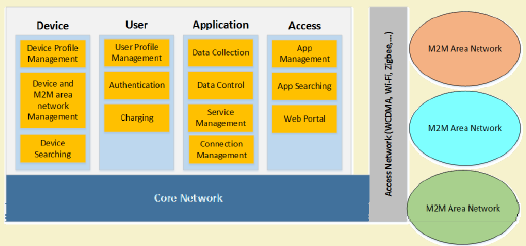
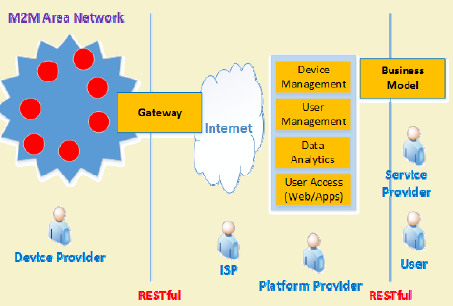
Figure 461.1: M2M Service Platform (M2SP) architecture with device, user, application, and access platforms providing end-to-end M2M services
The M2M Service Platform provides the middleware infrastructure for M2M applications, abstracting device heterogeneity and enabling service composition.
Graph diagram
Figure 461.2: M2M Service Platform four-layer architecture: Device Platform (device registration, management, firmware updates) connects M2M devices to Application Platform (orchestration, analytics) through User Platform (access control, billing) to Access Platform (web/mobile APIs).
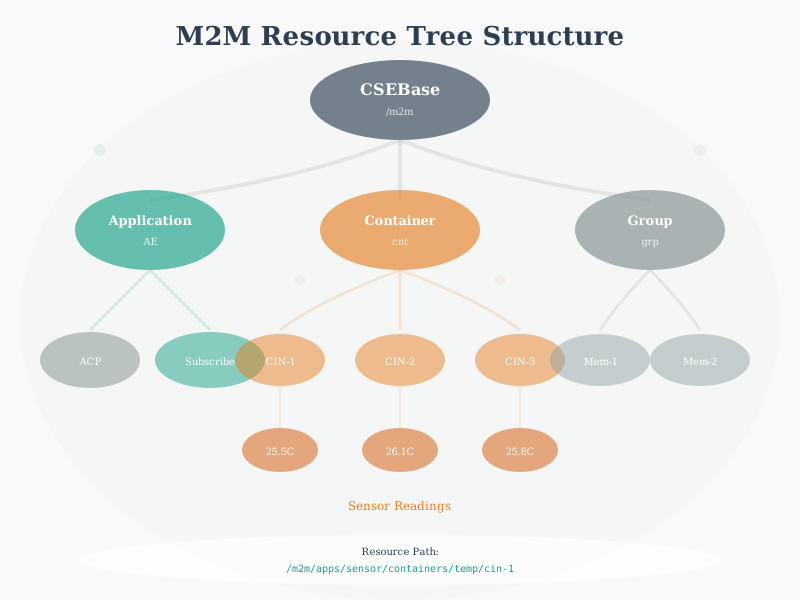
The M2M resource tree organizes device capabilities hierarchically, enabling standardized access to sensor data, configuration, and control endpoints across heterogeneous device types.
M2M Resource Tree Structure
Figure 461.3: M2M resource tree providing hierarchical organization of device capabilities for standardized access
NoteDeep Dive: oneM2M Resource Tree Design
The oneM2M standard defines a hierarchical resource tree structure that enables interoperable device management across heterogeneous IoT platforms.
461.3.2 oneM2M Resource Tree Fundamentals
The resource tree follows a RESTful design where every entity (device, sensor, data) is addressable via a URI. The tree structure enables:
Uniform access: Same operations (CREATE, RETRIEVE, UPDATE, DELETE) work on all resources
Discovery: Applications can navigate the tree to find available devices and data
Access control: Permissions are inherited down the tree hierarchy
Subscriptions: Applications subscribe to tree branches for change notifications
461.3.3 Core Resource Types
CSEBase (Common Services Entity Base)
|- AE (Application Entity)          # Applications registered on platform
|- Container                        # Data containers (like folders)
|   +- ContentInstance              # Actual sensor readings
|- Group                            # Logical groupings of resources
|- AccessControlPolicy              # Permission definitions
|- Subscription                     # Event notification registrations
|- RemoteCSE                        # Link to another M2M platform
+- Node                             # Physical device representation
    +- DeviceInfo                   # Hardware details
Access control (which users can access which devices)
Billing and charging
Administrative privileges
461.3.8 Application Platform
Responsibilities:
Service orchestration (compose services from multiple devices)
Data integration from heterogeneous sources
Analytics and intelligence
Connection management
461.3.9 Access Platform
Responsibilities:
Web and mobile app hosting
API gateway for external access
App management (registration, versioning)
Device-app mapping
461.3.10 M2M Security Model
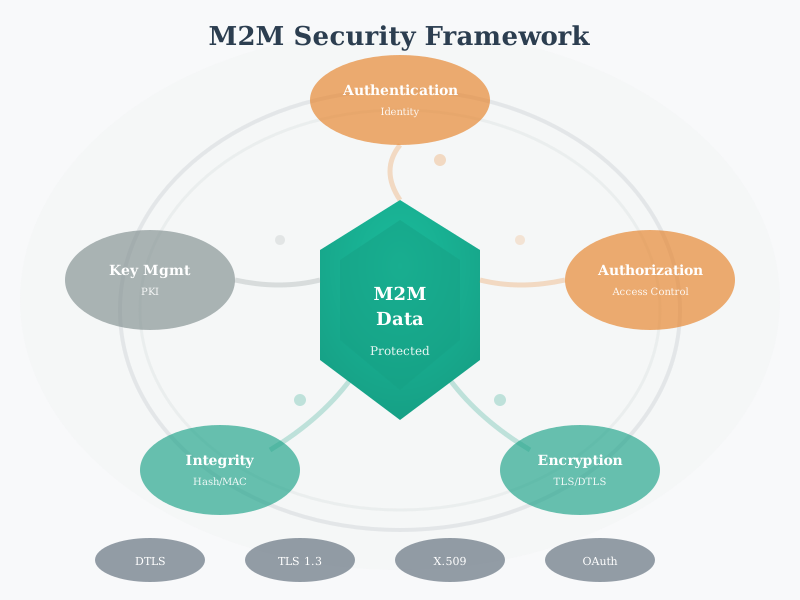
Security in M2M systems operates at multiple layers, from device authentication through encrypted communication channels to access control policies at the application level.
M2M Security Architecture
Figure 461.4: Multi-layered M2M security architecture from device authentication to application-level access control
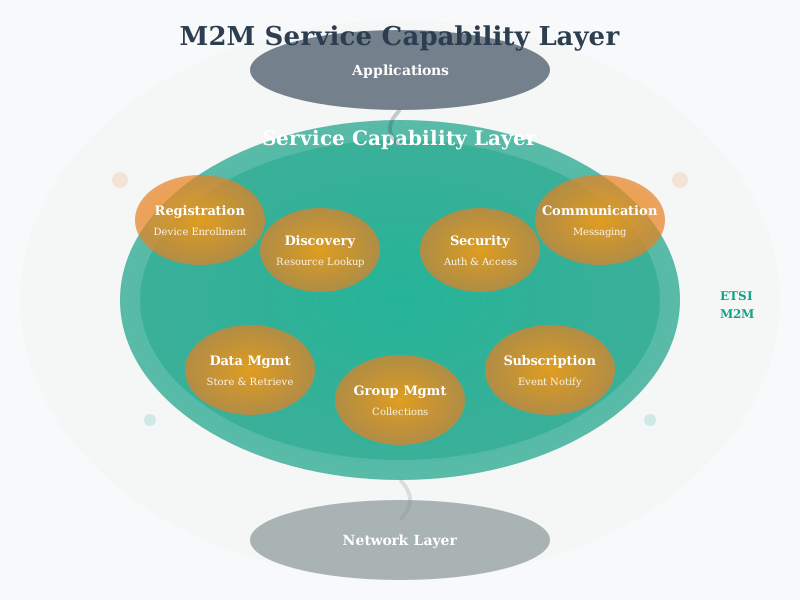
461.3.11 M2M Service Capabilities
M2M service capabilities define the standardized functions that platforms must provide, including device management, data management, security, and communication management.
M2M Service Capabilities Framework
Figure 461.5: Standardized M2M service capabilities enabling interoperable platform implementations
NoteKnowledge Check: M2M Service Platform Architecture
Show code
viewof kcM2mPlatform = {const container =html`<div id="kc-m2m-platform-container"></div>`;if (container &&typeof InlineKnowledgeCheck !=='undefined') { container.innerHTML=''; container.appendChild(InlineKnowledgeCheck.create({question:"A smart building M2M deployment has 2,000 devices (HVAC, lighting, access control) from 8 different vendors. The facility manager wants a unified dashboard, cross-vendor automations (e.g., 'when meeting room occupied, adjust HVAC and lighting'), and integration with the corporate calendar system. Which M2M Service Platform component is MOST critical?",options: [ {text:"Device Platform - device registration and firmware updates are the foundation",correct:false,feedback:"Incorrect. Device Platform handles device lifecycle but doesn't enable cross-vendor integration, unified dashboard, or calendar integration."}, {text:"User Platform - role-based access control determines who can see and control devices",correct:false,feedback:"Incorrect. User Platform handles authentication/authorization, but the core requirements are about data integration and service orchestration."}, {text:"Application Platform - service orchestration enables cross-vendor integration, unified data models, and third-party API connections like calendar systems",correct:true,feedback:"Correct! Application Platform provides service orchestration for cross-vendor automation, data integration for unified dashboard, and third-party API connectivity for calendar integration."}, {text:"Access Platform - API gateway enables the dashboard and mobile app interfaces",correct:false,feedback:"Incorrect. Access Platform provides interfaces but doesn't create the underlying functionality. The dashboard needs data integration from Application Platform."} ],difficulty:"medium",topic:"m2m-service-platform" })); }return container;}
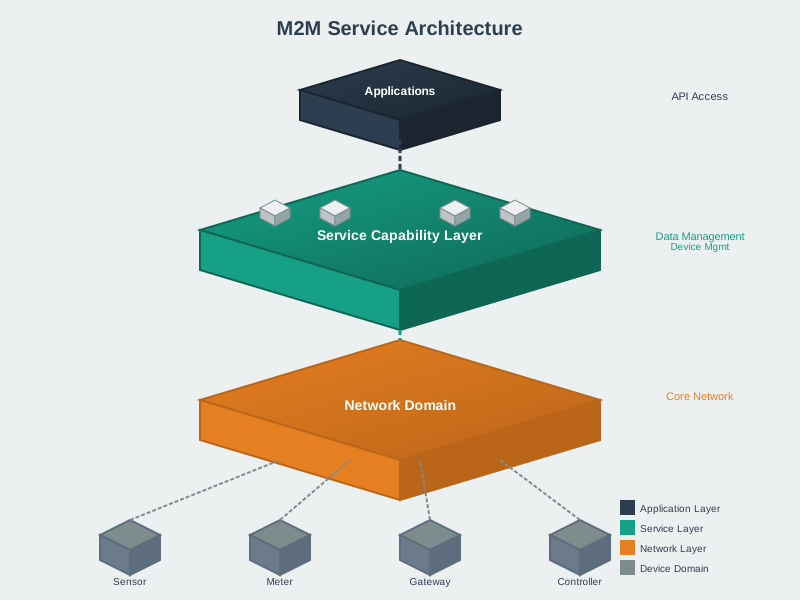
The M2M service architecture defines how services are composed and delivered across the platform, from device-level data collection through processing and analytics to application delivery.
M2M Service Architecture
Figure 461.7: Three-tier M2M service architecture enabling scalable platform deployments
461.4.2 M2M Protocol Stack
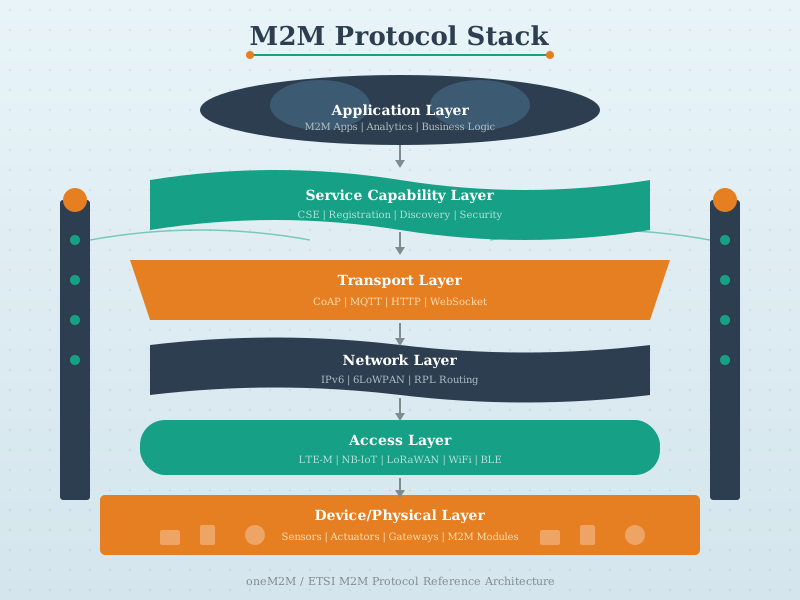
The M2M protocol stack defines the layered communication protocols from physical connectivity through application messaging.
M2M Protocol Stack
Figure 461.8: M2M protocol stack from physical connectivity to application messaging
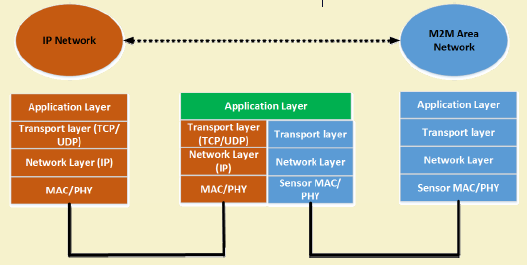
461.4.3 Non-IP Based M2M Network
Non-IP based M2M network
Figure 461.9: Non-IP based M2M network architecture using proprietary protocols and gateways for device connectivity
Legacy M2M networks using non-IP protocols remain common in industrial settings where reliability and deterministic behavior are prioritized over interoperability.
Characteristics:
Proprietary protocols (Modbus, BACnet, HART)
Limited interoperability
Gateway required for internet connectivity
Common in industrial automation
Flowchart diagram
Figure 461.10: Non-IP M2M architecture showing field devices (Modbus PLC, BACnet sensor, HART device) using legacy protocols connecting through gateways to IP networks and cloud platforms.
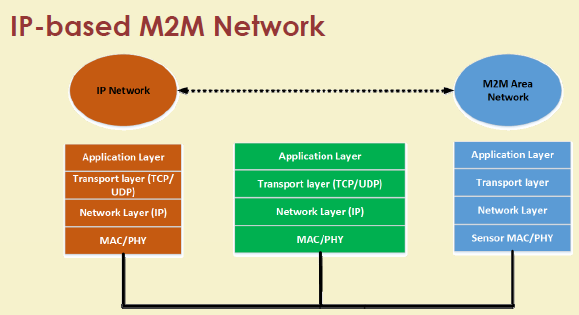
461.4.4 IP-Based M2M Network
IP-based M2M network
Figure 461.11: IP-based M2M network architecture where devices have IP addresses enabling direct internet connectivity
Modern M2M leverages IP connectivity end-to-end.
Characteristics:
Standard protocols (IPv6, 6LoWPAN, CoAP, MQTT)
Direct internet connectivity
Interoperable
Cloud-native
461.4.5 Practical M2M Gateway Configuration Example
1. Gateway polls Modbus device #7 every 10 seconds
   Modbus RTU: Read Holding Registers (FC=03, Address=7, Start=0, Count=10)
   Response: [temp: 45.2C, pressure: 3.5 bar, flow: 120 L/min, ...]

2. Gateway translates to JSON:
   {"device_id": "modbus_007", "timestamp": 1698765432,
    "temperature": 45.2, "pressure": 3.5, "flow_rate": 120}

3. Local processing (Node-RED):
   - Check thresholds (if temp > 50C -> local alarm)
   - Store in InfluxDB (local 7-day buffer)
   - Publish to local MQTT: factory/plc/007/data

4. Cloud sync (when network available):
   - Publish to AWS IoT Core: MQTT topic "factory/site_A/plc/007/data"
   - TLS encryption, X.509 certificate authentication
   - If offline: buffer in InfluxDB, sync when reconnected
Benefits:
Legacy integration: 50 Modbus devices connected without hardware changes
Protocol translation: Modbus RTU to MQTT (industry standard)
Offline resilience: Local operation + buffering during LTE outages
Bandwidth efficiency: 10-second polling + local filtering = ~50 KB/day per device
Security: TLS encryption, certificate authentication, local firewall
461.5 M2M Requirements (ETSI Standards)
The European Telecommunications Standards Institute (ETSI) defines comprehensive M2M system requirements:
461.5.1 1. Scalability
Support millions of connected devices
Efficient resource allocation as network grows
Distributed architecture for horizontal scaling
461.5.2 2. Anonymity
Hide device identity when required (privacy)
Support pseudonymous communication
Comply with regulatory requirements (GDPR)
461.5.3 3. Logging and Auditing
Record important events (failures, security incidents)
Tamper-proof logs for compliance
Accessible for forensics and debugging
461.5.4 4. Communication Principles
Support diverse communication techniques:
SMS for command and control
IP for data streaming
Peer-to-peer for local coordination
Multiple transport protocols (TCP, UDP, CoAP, MQTT)
461.5.5 5. Delivery Methods
Unicast: One-to-one communication
Multicast: One-to-many (group communication)
Anycast: One-to-nearest (server selection)
Broadcast: One-to-all (minimize when possible)
461.5.6 6. Message Scheduling
Control network access to prevent congestion
Schedule non-urgent messages during off-peak
Respect application delay tolerance
461.5.7 7. Communication Path Selection
Optimize paths based on:
Transmission failures (avoid bad links)
Delays (minimize latency)
Network costs (prefer Wi-Fi over cellular)
Support multi-path communication
NoteKnowledge Check: ETSI M2M Scheduling
Show code
viewof kcEtsiScheduling = {const container =html`<div id="kc-etsi-scheduling-container"></div>`;if (container &&typeof InlineKnowledgeCheck !=='undefined') { container.innerHTML=''; container.appendChild(InlineKnowledgeCheck.create({question:"A city deploys 8,000 smart parking sensors across downtown. Initial deployment configured all sensors to report occupancy status every 60 seconds at the same time (:00 of each minute). The cellular network experienced severe congestion with 40% packet loss during the first week. Based on ETSI M2M requirements, what scheduling change would solve this?",options: [ {text:"Increase cellular bandwidth capacity - the network needs more towers",correct:false,feedback:"Incorrect. Adding infrastructure doesn't solve the root cause. ETSI M2M message scheduling addresses this scenario. The problem is 8,000 simultaneous transmissions, not insufficient bandwidth."}, {text:"Reduce reporting frequency to every 5 minutes",correct:false,feedback:"Incorrect. Reducing frequency helps overall load but doesn't solve synchronization. 8,000 sensors reporting at the same instant still creates congestion."}, {text:"Assign each sensor a unique reporting offset (0-59 seconds) so transmissions are distributed evenly, averaging ~133 sensors per second instead of 8,000 simultaneous",correct:true,feedback:"Correct! ETSI M2M message scheduling requires distributing transmissions. With 8,000 sensors / 60 seconds = ~133 sensors/second average, the cellular network easily handles the distributed load."}, {text:"Switch to Wi-Fi instead of cellular for higher bandwidth",correct:false,feedback:"Incorrect. Downtown parking sensors are spread across streets with no Wi-Fi infrastructure. Cellular with proper ETSI scheduling is the appropriate solution."} ],difficulty:"medium",topic:"etsi-m2m-scheduling" })); }return container;}
NoteKnowledge Check: oneM2M Standards
Show code
viewof kcOnem2m = {const container =html`<div id="kc-onem2m-container"></div>`;if (container &&typeof InlineKnowledgeCheck !=='undefined') { container.innerHTML=''; container.appendChild(InlineKnowledgeCheck.create({question:"A multinational company needs to integrate M2M platforms from three different vendors (Europe, Asia, North America) into a unified global system. Each vendor uses different APIs, data formats, and device management protocols. Which M2M standard would enable interoperability?",options: [ {text:"ETSI M2M - the European standard that all vendors should adopt",correct:false,feedback:"Incorrect. ETSI M2M was a regional European standard that has been superseded. It's not the current global standard for cross-vendor interoperability."}, {text:"oneM2M - the global standard developed by international standards bodies (ETSI, TIA, ARIB, TTC, CCSA, TSDSI) that defines common APIs, resource models, and interworking specifications",correct:true,feedback:"Correct! oneM2M is THE global M2M interoperability standard, developed collaboratively by standards bodies from Europe, North America, Japan, China, and India. It defines common APIs, resource models, and interworking specifications."}, {text:"OPC-UA - the industrial automation standard",correct:false,feedback:"Incorrect. OPC-UA is excellent for industrial automation but isn't an M2M platform standard. It focuses on device-level communication in industrial settings."}, {text:"Custom REST APIs - build proprietary integration layer",correct:false,feedback:"Incorrect. Custom APIs create technical debt. oneM2M eliminates this by providing standard interfaces that any oneM2M client can use."} ],difficulty:"easy",topic:"onem2m-standards" })); }return container;}
NoteKnowledge Check: M2M Security
Show code
viewof kcM2mSecurity = {const container =html`<div id="kc-m2m-security-container"></div>`;if (container &&typeof InlineKnowledgeCheck !=='undefined') { container.innerHTML=''; container.appendChild(InlineKnowledgeCheck.create({question:"A smart meter deployment connects 50,000 electricity meters to a utility company's M2M platform. A security audit reveals that meters authenticate using a shared API key hardcoded in all device firmware. An attacker who extracts this key from one meter can impersonate any meter. What is the recommended M2M security fix?",options: [ {text:"Encrypt the shared API key with AES-256",correct:false,feedback:"Incorrect. Encryption doesn't solve the fundamental problem of a shared secret. Compromising one device still compromises all devices."}, {text:"Implement unique X.509 certificates per device provisioned during manufacturing, with certificate revocation capability for compromised meters",correct:true,feedback:"Correct! Per-device X.509 certificates solve the shared credential problem. Each meter has unique credentials, compromising one doesn't affect others, and certificates can be revoked individually."}, {text:"Add MAC address filtering on the M2M platform",correct:false,feedback:"Incorrect. MAC addresses can be spoofed trivially. This provides no real security against an attacker with the shared API key."}, {text:"Rotate the shared API key quarterly",correct:false,feedback:"Incorrect. Key rotation doesn't fix the architecture flaw. An attacker can extract the new key from any meter using the same vulnerability."} ],difficulty:"hard",topic:"m2m-security" })); }return container;}
461.6 Summary
This chapter covered M2M architectures and standards:
M2M Service Platform: Four-layer architecture (device, user, application, access) providing middleware for M2M applications
The next chapter explores M2M Design Patterns, covering common mistakes in M2M implementations, resilience strategies, and best practices for production deployments.