%% fig-alt: "XY chart showing duty cycle trade-off between battery life in days on Y-axis and maximum detection latency in seconds on X-axis. Points show: 100% duty cycle gives 4 days battery with 0s latency, 10% gives 40 days with 9s latency, 1% gives 417 days with 99s latency, 0.1% gives 2336 days with 999s latency. Shows clear inverse relationship - longer battery life requires accepting higher latency."
%%{init: {'theme': 'base', 'themeVariables': { 'primaryColor': '#2C3E50', 'primaryTextColor': '#fff', 'primaryBorderColor': '#16A085', 'lineColor': '#16A085', 'secondaryColor': '#E67E22', 'tertiaryColor': '#7F8C8D', 'fontSize': '14px'}}}%%
xychart-beta
    title "Duty Cycle: Battery Life vs Detection Latency"
    x-axis "Max Detection Latency (seconds)" [0, 100, 200, 300, 400, 500, 600, 700, 800, 900, 1000]
    y-axis "Battery Life (days)" 0 --> 2500
    line [4, 40, 100, 200, 417, 600, 800, 1000, 1200, 1500, 2336]
478 Duty Cycle Fundamentals
478.1 Learning Objectives
By the end of this chapter, you will be able to:
- Explain duty cycling concepts: Understand how sleep-wake cycles extend battery life in sensor networks
- Calculate energy budgets: Estimate battery consumption for different duty cycle configurations
- Compare MAC protocols: Distinguish between synchronous (S-MAC, T-MAC) and asynchronous (B-MAC, X-MAC, ContikiMAC) approaches
- Evaluate trade-offs: Balance energy savings against detection latency for specific applications
- Select appropriate protocols: Choose duty cycling strategies based on network size, traffic patterns, and reliability requirements
TipMVU: Minimum Viable Understanding
Core concept: Duty cycling lets sensors sleep 99% of the time to extend battery life from days to years. Why it matters: A 1% duty cycle can extend a sensor’s battery life 100x (from 4 days to over a year), making remote deployments practical without frequent maintenance visits. Key takeaway: Choose duty cycle based on detection latency requirements, not just minimal energy—and understand that wake-up overhead creates diminishing returns at ultra-low duty cycles.
478.2 Prerequisites
Before diving into this chapter, you should be familiar with:
- Wireless Sensor Networks: Understanding network topologies, multi-hop communication, and energy constraints in WSNs provides the foundation for why duty-cycling is critical for network lifetime
- Fog Fundamentals: Knowledge of edge and fog computing clarifies where local decision-making occurs for duty-cycle adaptation
TipFor Beginners: What is Duty Cycling?
Battery-powered sensors face a critical challenge: stay awake 24/7 and die in days, or sleep strategically and last years. Duty-cycling is the solution.
Duty-cycling: A sensor sleeps 99% of the time, wakes briefly to sense and transmit, then sleeps again. Like a security guard who patrols every hour instead of standing watch continuously—saves energy while still detecting events.
Example calculation: Sensor consuming 20mA when active, 10µA when sleeping. Battery: 2000mAh.
- Always on: 2000mAh / 20mA = 100 hours (4 days)
- 1% duty cycle (36s active/hour): Average current = 0.2mA → 2000mAh / 0.2mA = 10,000 hours (417 days / 1.1 years!)
| Term | Simple Explanation |
|---|---|
| Duty Cycle | Percentage of time sensor is active vs sleeping (1% = 36 seconds active per hour) |
| Sleep Scheduling | Coordinating when sensors sleep/wake to maintain coverage (neighbors take turns staying awake) |
| Preamble | Signal sent before data to wake up sleeping receivers |
| Clock Drift | Small timing errors that accumulate, causing nodes to lose synchronization |
Why it matters: Without duty-cycling, sensors die quickly (days). With proper duty-cycling, the same sensors can last years.
478.3 Understanding Duty Cycle Basics
Duty cycle is the percentage of time a sensor node spends in active mode versus sleep mode. It’s the primary mechanism for extending battery life in energy-constrained wireless sensor networks.
478.4 Understanding Wireless Power Consumption
Before diving into duty-cycling strategies, it’s important to understand the power states of wireless IoT devices. The dramatic difference in power consumption between active transmission, listening/receiving, and sleep modes makes duty-cycling essential for battery-powered deployments.
Key Power Consumption Insights:
Transmit Mode (TX): Highest power consumption ranging from 20mA (BLE/Zigbee) to 300mA (Wi-Fi). This is when the radio actively broadcasts data.
Receive/Listen Mode (RX): Medium power consumption (10-100mA) when radio listens for incoming messages. Often overlooked but can dominate energy budget if device listens continuously.
Sleep Mode: Ultra-low power (1-100µA) when radio and most peripherals are powered down. Deep sleep achieves 1-10µA, light sleep 50-100µA.
Wake-Up Overhead: Transitioning from sleep to active takes 10-50ms and consumes moderate power (15-30mA), creating fixed energy cost per wake cycle.
Power Ratio Example (Zigbee/802.15.4): - Transmit: 30mA (TX power) - Receive: 20mA (RX listening) - Sleep: 10µA (deep sleep) - Sleep is 3,000× more efficient than transmit!
This massive power differential (1,000× to 10,000×) explains why a 1% duty cycle can extend battery life 100×: the device spends 99% of time consuming 1/3,000th the power of active mode.

Key insight: Reducing duty cycle from 100% to 1% extends battery life 100× (4 days → 417 days). Further reducing to 0.1% extends life 1,900× (4 days → 7.6 years).
NoteAlternative View: Duty Cycle Energy-Latency Trade-off
This variant shows the inverse relationship between energy savings and response latency, helping designers balance application requirements.
Design Decision Framework: - Safety-critical (latency < 1s): Accept 100% duty cycle, plan for frequent battery replacement - Interactive (latency < 10s): Use 10% duty cycle, ~1 month battery life - Monitoring (latency < 100s): Use 1% duty cycle, ~1 year battery life - Rare events (latency < 1000s): Use 0.1% duty cycle, ~6 year battery life
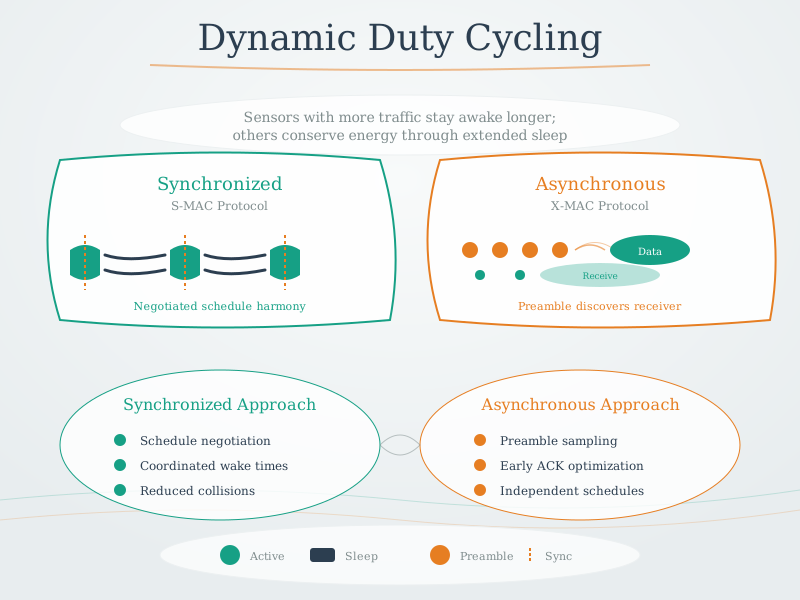
478.5 Duty Cycling MAC Protocols
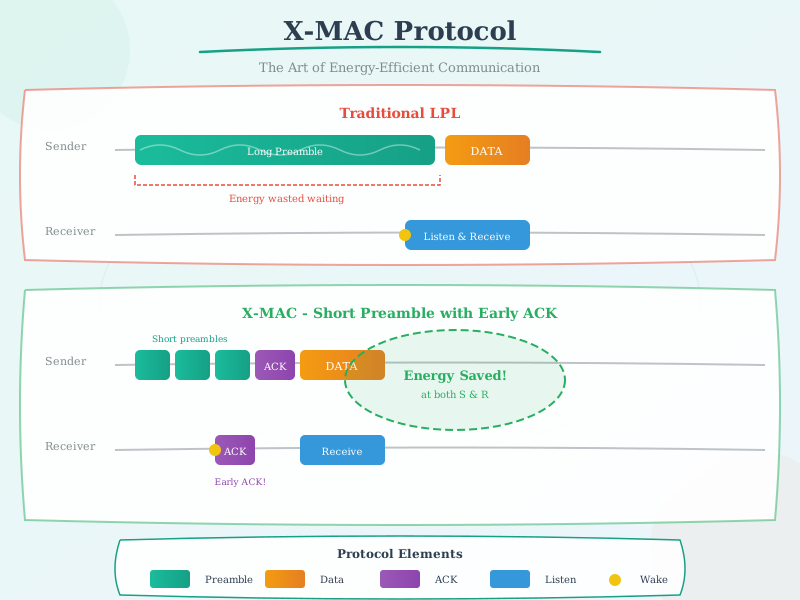
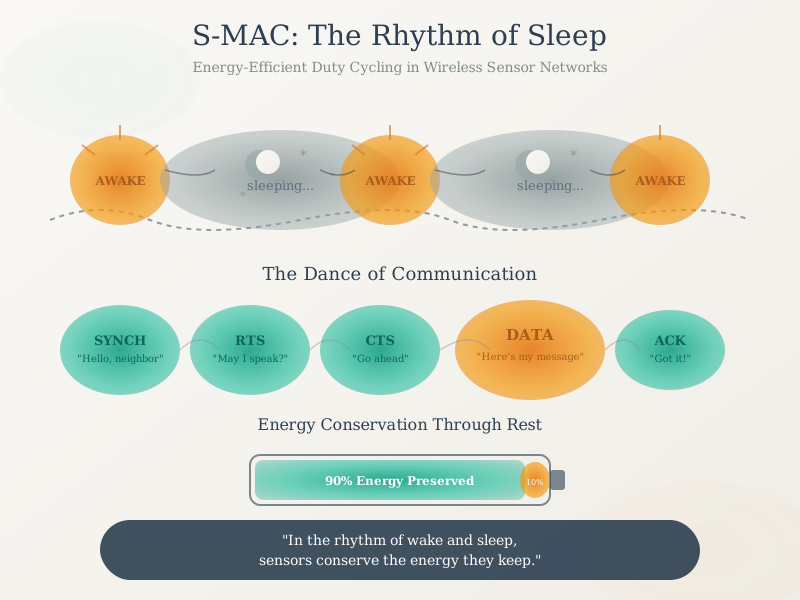
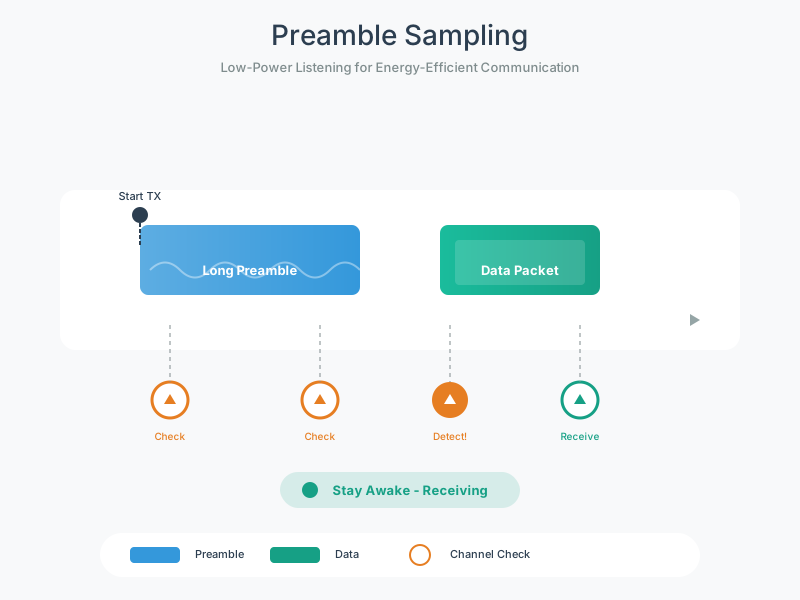
478.6 Protocol Comparison: Synchronous vs Asynchronous
%% fig-alt: "Comparison of duty cycling MAC protocols showing synchronous vs asynchronous approaches: S-MAC requires neighbors to synchronize schedules but achieves coordinated sleep with low overhead once synced; B-MAC uses long preambles allowing asynchronous operation but wastes energy on preamble transmission; X-MAC improves on B-MAC with short strobed preambles and early ACK; ContikiMAC uses phase-lock to learn neighbor wake times achieving best energy efficiency"
%%{init: {'theme': 'base', 'themeVariables': {'primaryColor': '#2C3E50', 'primaryTextColor': '#fff', 'primaryBorderColor': '#16A085', 'lineColor': '#16A085', 'secondaryColor': '#E67E22', 'tertiaryColor': '#7F8C8D', 'fontSize': '11px'}}}%%
graph TB
    subgraph SYNC["SYNCHRONOUS PROTOCOLS"]
        SMAC["S-MAC<br/>Synchronized schedules<br/>Low overhead once synced<br/>Clock drift requires resync"]
        TMAC["T-MAC<br/>Adaptive active period<br/>Ends early if no traffic<br/>Better for bursty traffic"]
    end

    subgraph ASYNC["ASYNCHRONOUS PROTOCOLS"]
        BMAC["B-MAC<br/>Long preamble (matches wake interval)<br/>No sync needed<br/>Energy wasted on preamble"]
        XMAC["X-MAC<br/>Short strobed preambles<br/>Early ACK from receiver<br/>50% energy savings vs B-MAC"]
        CMAC["ContikiMAC<br/>Phase-lock learns wake times<br/>Ultra-short wakeups<br/>Best energy efficiency"]
    end

    subgraph TRADEOFF["Selection Guide"]
        Q1{Network size?}
        Q2{Traffic pattern?}

        Q1 -->|"Small (<50 nodes)"| SMAC
        Q1 -->|"Large (>50 nodes)"| Q2
        Q2 -->|"Regular/Periodic"| CMAC
        Q2 -->|"Bursty/Event-driven"| XMAC
    end

    style SYNC fill:#16A085,stroke:#2C3E50,color:#fff
    style ASYNC fill:#E67E22,stroke:#2C3E50,color:#fff
    style TRADEOFF fill:#7F8C8D,stroke:#2C3E50,color:#fff
    style SMAC fill:#16A085,color:#fff
    style TMAC fill:#16A085,color:#fff
    style BMAC fill:#E67E22,color:#fff
    style XMAC fill:#E67E22,color:#fff
    style CMAC fill:#E67E22,color:#fff
478.7 Trade-offs in Duty Cycle Selection
| Duty Cycle | Active Time/Hour | Battery Life | Latency | Best For |
|---|---|---|---|---|
| 100% | 3600s (all) | 4 days | 0s (instant) | Critical monitoring, powered nodes |
| 10% | 360s | 40 days | 0-18s | Frequent sensing (HVAC, traffic) |
| 1% | 36s | 417 days | 0-180s | Periodic sensing (environment, agriculture) |
| 0.1% | 3.6s | 7.6 years | 0-1800s | Rare events (wildlife, infrastructure) |
| 0.01% | 0.36s | 76 years | 0-5 hours | Extremely rare events (seismic, pollution spikes) |
Latency calculation: Maximum detection delay = \((1 - \text{duty cycle}) \times \text{cycle period}\)
Example: 1% duty cycle with 60s cycle period → Max latency = \(0.99 \times 60s = 59.4s\)
WarningTradeoff: Synchronized Sleep Scheduling vs Asynchronous Sleep Scheduling
Option A (Synchronized Sleep - S-MAC, T-MAC): All neighboring nodes coordinate wake/sleep schedules. Nodes wake simultaneously for 50-200ms active period, then sleep together. Communication window: guaranteed rendezvous, no wasted listening. Clock synchronization required: 1-5 SYNC packets per minute. Overhead: 2-5% of energy budget for sync maintenance. Latency: bounded by schedule (e.g., 100ms wake period every 1 second = max 1s latency). Clock drift tolerance: ~30ppm requires resync every 60 seconds.
Option B (Asynchronous Sleep - B-MAC, X-MAC, ContikiMAC): Nodes wake independently at random or periodic intervals. Sender uses preamble (long carrier or strobed packets) to catch receiver wake. No synchronization overhead. Preamble energy cost: sender transmits for receiver’s full sleep interval (worst case). Latency: variable (0 to full sleep interval). Advantage: no sync maintenance, works with mobile nodes.
Decision Factors:
- Choose Synchronized Sleep when: Network topology is stable (fixed sensor deployment), nodes have accurate clocks (crystal oscillators with <50ppm drift), traffic is regular and predictable (periodic reporting), or bounded latency is required (control systems need guaranteed response).
- Choose Asynchronous Sleep when: Nodes are mobile or topology changes frequently, clock accuracy varies (cheap oscillators with >100ppm drift), traffic is sporadic and event-driven (alarm systems), or network has heterogeneous nodes that cannot coordinate.
- Quantified comparison: 100-node network, 1% duty cycle. Synchronized (S-MAC): 5ms sync overhead per 500ms cycle = 1% additional energy, 500ms max latency. Asynchronous (X-MAC with 50ms strobes): 25ms average preamble per packet, no sync overhead, 250ms average latency. S-MAC: 15% more energy-efficient for regular traffic. X-MAC: 30% more efficient for sporadic traffic (<1 packet/minute).
WarningTradeoff: Fixed Duty Cycle vs Adaptive Duty Cycle
Option A (Fixed Duty Cycle): All nodes operate at predetermined, constant duty cycle (e.g., 1% always). Simple implementation: timer-based wake/sleep. Predictable battery life: 2000mAh at 0.25mA average = 333 days. No adaptation overhead. Problem: wastes energy during quiet periods, may miss events during busy periods. Suitable for: uniform, predictable workloads (regular environmental monitoring).
Option B (Adaptive Duty Cycle): Nodes adjust duty cycle based on traffic, events, or external signals. Low activity: reduce to 0.1% duty cycle. Event detected: increase to 10-50% for rapid response. Traffic-adaptive: match wake rate to incoming packet rate. Overhead: 5-10% additional energy for adaptation logic and state tracking. Complexity: requires event detection, neighbor coordination, and hysteresis to avoid oscillation.
Decision Factors:
- Choose Fixed Duty Cycle when: Application has constant, predictable data rate (temperature logging every 10 minutes), simplicity and reliability are paramount, battery budget allows conservative (higher) duty cycle, or debugging and maintenance must be straightforward.
- Choose Adaptive Duty Cycle when: Event rates vary significantly (fire detection: rare events, but rapid response needed), energy harvesting provides variable power budget, network spans regions with different activity levels, or application has mixed traffic patterns (periodic + event-driven).
- Quantified comparison: Fire detection network over 1 year. Fixed 1% duty cycle: 267µA average, detects fire within 60 seconds, 95% of energy “wasted” on empty monitoring. Adaptive (0.1% normal, 10% on smoke hint): 35µA average during 99% quiet time, 2.7mA during 1% event periods = 62µA yearly average. Adaptive saves 77% energy while maintaining sub-second response during actual events.
WarningCommon Misconception: “Lower Duty Cycle = Longer Battery Life”
The Misconception: Reducing duty cycle from 1% to 0.1% gives 10× battery life.
Why It’s Wrong: - Wake-up overhead is fixed (boot time, radio startup, sync) - Very low duty cycles: Overhead dominates active time - Clock drift increases with longer sleep (more sync needed) - Deep sleep isn’t zero power (leakage current, RTC)
Real-World Example: - Sensor node: 100ms active, 25mA active, 10μA sleep - Wake overhead: 50ms at 15mA per wake - 1% duty cycle (wake every 10s): 0.26 mA average → 320 days - 0.1% duty cycle (wake every 100s): 0.035 mA average → 6.5 years - 0.01% duty cycle (wake every 1000s): 0.015 mA average → 15 years (NOT 65 years!)
The Correct Understanding: - Diminishing returns below ~0.1% duty cycle - Overhead becomes significant fraction of active time - Battery self-discharge may exceed device consumption - Optimal duty cycle depends on wake overhead
There’s a point of diminishing returns. Calculate your specific overhead.
478.8 Knowledge Check
478.9 Summary
This chapter covered the fundamentals of duty cycling for wireless sensor networks:
- Power consumption states: Understanding TX (highest), RX (medium), and sleep (1000-3000× lower) modes explains why duty cycling is so effective
- Battery life calculations: A 1% duty cycle can extend battery life 100× compared to always-on operation
- MAC protocol comparison: Synchronous protocols (S-MAC, T-MAC) provide bounded latency with coordination overhead; asynchronous protocols (B-MAC, X-MAC, ContikiMAC) offer flexibility without synchronization
- Trade-off considerations: Balancing energy savings against detection latency, network size, and traffic patterns
- Diminishing returns: Wake-up overhead creates a floor below which further duty cycle reduction provides minimal benefit
478.10 What’s Next
Continue to Duty Cycle Worked Examples to work through detailed battery life calculations for real deployment scenarios, including forest fire monitoring, agricultural sensing, and synchronization overhead analysis.