101 IoT Introduction: From Everyday Objects to Smart Devices
101.1 Learning Objectives
By the end of this chapter, you will be able to:
- Understand IoT basics: Recognize how everyday objects become “smart” through connectivity
- Apply the Three Ingredients Test: Determine if any device qualifies as IoT
- Use the Five Verbs Framework: Categorize IoT applications into SUSTAIN, MOVE, HEAL, FEED, and MAKE
- Appreciate IoT’s Global Impact: Understand the scale and economic value of IoT deployments
IoT Overview Series: - IoT Requirements and Characteristics - Minimum requirements and ideal IoT system characteristics - IoT Perspectives and Definitions - Different stakeholder views on IoT - Device Evolution - Embedded vs Connected vs IoT products - IoT History and Paradigm Shifts - Lessons from technology evolution - IoT Systems Evolution - Computing evolution enabling IoT - Industry 4.0 and Classification - Industrial IoT and device classification
Learning Hubs: - Quiz Navigator - Test your understanding - Simulation Playground - Interactive tools - Video Gallery - Visual learning resources
101.2 Prerequisites
This is a true entry-level chapter. You can read it without any prior IoT background, though basic familiarity with everyday networked devices (such as smartphones, Wi-Fi, and laptops) will make the examples easier to follow.
Have you ever talked to a smart speaker or seen lights turn on by themselves?
101.2.1 What Makes Things “Smart”?
Regular things just sit there. But SMART things can: - Feel what’s happening (too hot? too dark?) - Think about what to do - Talk to other things and to you! - Act to make things better
101.2.2 The Sensor Squad Explains IoT
Meet our friends who make things smart!
| Friend | Super Power | What They Help |
|---|---|---|
| Temperature Terry | Feels hot and cold | Keeps you comfortable |
| Light Lucy | Sees light and dark | Turns lights on/off automatically |
| Motion Marley | Notices movement | Knows when you enter a room |
| Signal Sam | Sends invisible messages | Helps devices talk to each other |
| Pressure Pete | Feels pushing and weather | Tells you if it will rain |
101.2.3 A Day With Smart Things
Morning: > You wake up. Light Lucy notices it’s bright outside and tells the blinds to open slowly. Temperature Terry checks if your room is comfy!
Going to School: > Your smart backpack (with a tracker inside) tells your parents’ phone you arrived safely at school. Signal Sam sent the message!
Coming Home: > Motion Marley notices you walking up to the door. The smart lock recognizes you and unlocks automatically. Welcome home!
Bedtime: > You say “Goodnight!” to your smart speaker. It turns off the lights, plays soft music, and sets the temperature just right for sleeping.
101.2.4 What is “IoT”?
Internet of Things = Smart things talking to each other through the internet!
“Things” can be ANYTHING: - Light bulbs that change colors - Refrigerators that know when you’re out of milk - Watches that count your steps - Pet feeders that give treats when you’re away - Doorbells that show you who’s there
101.2.5 Why IoT is Cool
- Saves time: Lights turn off by themselves when you leave
- Keeps you safe: Smoke detectors call for help automatically
- Helps everyone: Farmers know exactly when plants need water
- Fun to use: Control your room with your voice!
101.2.6 Key Words for Kids
| Word | What It Means |
|---|---|
| IoT | Internet of Things - smart stuff connected together |
| Smart | A thing that can feel, think, and talk to other things |
| Sensor | The part that feels (like eyes and ears for devices) |
| Internet | The invisible web that connects everything |
| App | A program on your phone that controls smart things |
Simple Definition: IoT = Everyday Objects Connected to the Internet
The Internet of Things (IoT) is like giving everyday objects a “digital brain” and connecting them to the internet. Imagine your coffee maker, thermostat, or even your trash can being able to communicate, think, and make decisions. It’s the transformation of ordinary “dumb” devices into “smart” ones that can sense their environment, process information, and take action automatically.
Everyday Examples You Already Use:
| Device | What It Does | Why It’s IoT |
|---|---|---|
| Smart Thermostat | Learns your schedule and adjusts temperature automatically | Senses temperature, connects to internet, learns patterns |
| Fitness Tracker | Monitors heart rate, steps, and sleep patterns | Sensors on wrist, syncs data to cloud, provides health insights |
| Smart Fridge | Tracks food expiration, suggests recipes, orders groceries | Cameras inside, Wi-Fi connected, analyzes contents |
| Voice Assistant | Controls lights, plays music, answers questions | Always listening, cloud-connected, AI-powered |
| Smart Doorbell | Shows who’s at the door from anywhere | Camera sensor, internet streaming, mobile alerts |
Why IoT Matters - Real Impact:
IoT is revolutionizing how we live and work by making our environments more responsive and intelligent:
- Convenience: Instead of manually adjusting your thermostat throughout the day, a smart thermostat learns your schedule and adjusts automatically
- Efficiency: Instead of guessing when factory machines need maintenance, IoT sensors detect problems before they cause breakdowns
- Insights: Instead of wondering “why is my energy bill high?”, IoT shows exactly which devices use the most power and when
Real Numbers - IoT’s Global Impact:
- 18-21 billion IoT devices deployed globally in 2025 (IoT Analytics/Statista), projected to reach 40+ billion by 2034
- $1.5 trillion annual IoT market creating millions of new jobs
- 25% reduction in factory downtime with predictive maintenance
- 30% energy savings in smart buildings
- 40% improvement in agricultural yields with precision farming
- 50% reduction in water waste with smart irrigation
Key Terms Table:
| Term | Simple Definition | Example |
|---|---|---|
| Thing | Any physical object that can be equipped with sensors and connectivity | Light bulb, car, refrigerator |
| Sensor | A device that detects and measures something in the environment | Temperature, motion, light level |
| Actuator | A device that takes physical action based on commands | Turns on a motor, opens a valve, dims a light |
| Connectivity | The ability to send and receive data over the internet | Wi-Fi, cellular, Bluetooth |
| Gateway | A bridge that connects IoT devices to the internet | Your Wi-Fi router, smartphone |
| Cloud | Remote servers that store data and run applications | Where your fitness data is stored and analyzed |
| Edge Computing | Processing data close to where it’s collected rather than sending everything to distant cloud servers | Smart camera detects faces locally before uploading |
| Digital Twin | A virtual copy of a physical device or system used for simulation and optimization | Virtual model of a factory for testing changes |
Core Concept: The IoT ecosystem is a multi-layered system where physical devices, connectivity, cloud platforms, applications, and business relationships must all work together to deliver value. Why It Matters: Understanding the ecosystem prevents siloed thinking - a brilliant sensor is worthless without reliable connectivity, and perfect connectivity is useless without meaningful applications and a sustainable business model. Key Takeaway: Successful IoT requires “T-shaped” expertise: deep knowledge in one area plus broad understanding across hardware, software, networking, security, data, and business dimensions.
101.3 Getting Started: From Everyday Objects to IoT
This section builds your understanding step by step - starting with devices you already know, then showing how they become “smart.”
Think about devices in your home right now:
| Traditional Device | What It Does | How You Control It |
|---|---|---|
| Regular Thermostat | Maintains temperature | Walk over and adjust dial |
| Basic Coffee Maker | Brews coffee | Press button manually |
| Standard Light Switch | Turns lights on/off | Flip switch by hand |
| Traditional Door Lock | Secures home | Use physical key |
Question: What do all these have in common? Answer: They require you to be physically present to control them!
Now imagine these same devices connected to the internet:
| Smart Device | New Capability | Why It’s Better |
|---|---|---|
| Smart Thermostat | Control from anywhere via phone | Adjust temperature from work before coming home |
| Smart Coffee Maker | Schedule brewing time | Wake up to fresh coffee automatically |
| Smart Light Bulb | Turn on/off remotely | Never come home to a dark house |
| Smart Lock | Lock/unlock from phone | Let in guests when you’re not home |
The Big Idea: IoT is like giving everyday objects the ability to talk, listen, and think.
Imagine your coffee maker could: - Talk: “I’m done brewing!” (sends you a notification) - Listen: “Alexa, start brewing coffee” (receives commands) - Think: “It’s 7am, time to brew” (makes decisions)
That’s the Internet of Things - ordinary objects connected to the internet, making them “smart.”

Every IoT device needs exactly three things:
| Ingredient | What It Means | Real Example |
|---|---|---|
| 1. A “Thing” | Physical object you can touch | Thermostat box on your wall |
| 2. Computation | Tiny computer chip inside | Processes temperature readings |
| 3. Connectivity | Link to the internet | Wi-Fi connection to your router |
Simple Test: If ANY ingredient is missing, it’s NOT an IoT device!

Why should you care about IoT? Because it’s already changing your life:
| Impact Area | Without IoT | With IoT | Real Savings |
|---|---|---|---|
| Home Energy | Manual thermostat adjustments | Learns your schedule, auto-optimizes | 30% lower energy bills |
| Factory Maintenance | Machines break unexpectedly | Sensors predict failures | 25% less downtime |
| Healthcare | Check vitals at doctor visits | Continuous monitoring at home | Early detection saves lives |
| Agriculture | Water entire field equally | Sensors water only dry areas | 50% less water waste |
| Transportation | Fixed traffic light timing | Adjusts to real-time traffic | 20% less congestion |
Global IoT Impact (2025): - 18-21 billion IoT devices deployed globally (IoT Analytics/Statista 2025) - $1.5 trillion market creating millions of jobs - 25-50% efficiency improvements across industries
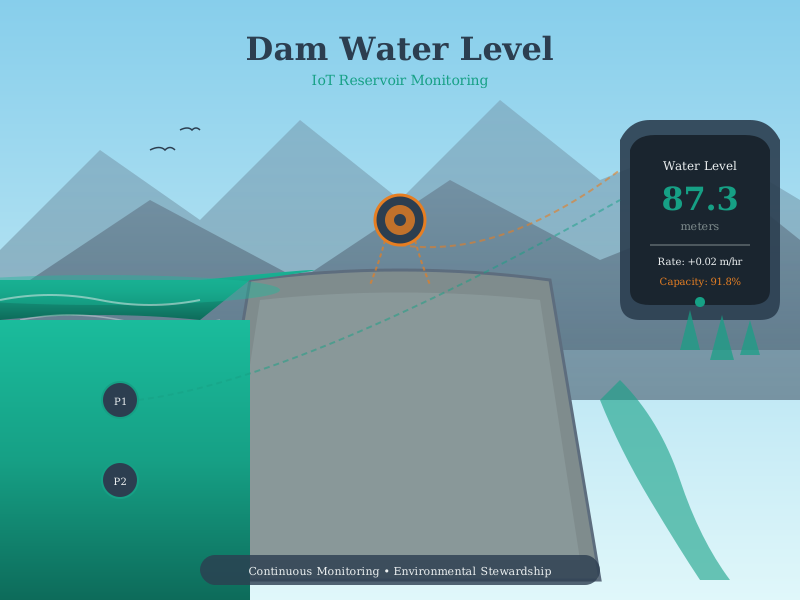
Water infrastructure monitoring exemplifies critical IoT applications where sensor data directly impacts public safety. Dam level systems provide real-time visibility that enables proactive flood management and optimized hydroelectric generation.
Before continuing, see if you can answer these:
Question 1: Your basic microwave has a digital timer and heating element. Is it an IoT device? - Think about: Does it have all three ingredients? - Answer: No! It has a Thing (microwave) and Computation (timer chip), but NO internet connectivity. It’s an embedded device, not IoT.
Question 2: Your fitness tracker measures steps and syncs to your phone via Bluetooth, then uploads to the cloud. Is it IoT? - Think about: Does it have all three ingredients? - Answer: Yes! Thing (wristband), Computation (step counting), Connectivity (Bluetooth to Phone to Internet). It’s a true IoT device.
Question 3: What’s ONE way IoT could improve your daily routine? - Example answers: - Smart coffee maker starts brewing when my alarm goes off - Smart lights gradually brighten to wake me naturally - Smart car pre-heats in winter before I leave for work - Smart fridge tells me what groceries I need to buy
101.4 The Five Verbs of IoT
One powerful way to understand IoT’s transformative impact is through the lens of five fundamental human activities: SUSTAIN, MOVE, HEAL, FEED, and MAKE. This framework, popularized by IoT thought leaders, helps categorize the vast landscape of IoT applications into memorable categories that reflect how technology enhances essential aspects of human civilization.

Making IoT Memorable and Actionable:
The Five Verbs framework transforms IoT from an overwhelming landscape of thousands of applications into five memorable categories that students, designers, and business leaders can easily understand and apply. Instead of trying to memorize “smart cities,” “connected healthcare,” “precision agriculture,” and dozens of other domains, you can organize everything under five fundamental human activities.
For Students: - Categorization Tool: When you encounter a new IoT application, ask “Which verb does this serve?” This simple question helps you understand its purpose and value proposition immediately. - Design Framework: When designing your own IoT solution, start with “Which human need am I addressing?” This keeps your design grounded in real-world value rather than technology for technology’s sake. - Career Pathfinding: The five verbs map to distinct career paths - sustainability engineering (SUSTAIN), transportation tech (MOVE), health tech (HEAL), ag-tech (FEED), or industrial automation (MAKE).
For Practitioners: - Market Analysis: The verbs reveal where investment is flowing ($3.3T total market) and which sectors have the highest growth rates - Cross-Pollination: Solutions from one verb often inspire innovations in another (e.g., fleet tracking algorithms from MOVE applied to ambulance routing in HEAL) - Business Storytelling: Executives and investors understand “We help manufacturers MAKE better products” more quickly than “We provide predictive maintenance IoT solutions”
Real-World Validation:
This framework isn’t academic theory - it’s how industry leaders at companies like GE, Siemens, and Cisco organize their IoT strategy. When you understand the Five Verbs, you understand how the world’s largest IoT deployments create value.
101.4.1 Understanding the Five Verbs
| Verb | What It Means | IoT Applications | Real-World Impact |
|---|---|---|---|
| SUSTAIN | Protecting our planet and managing resources wisely | Smart grids balance energy supply/demand, sensors monitor air/water quality, connected systems optimize waste collection | 30% reduction in energy consumption through smart buildings, early detection of environmental hazards |
| MOVE | Transporting people and goods efficiently | Connected cars communicate to prevent accidents, GPS trackers optimize delivery routes, smart traffic lights reduce congestion | 20% reduction in traffic congestion, 40% improvement in logistics efficiency |
| HEAL | Improving healthcare and extending healthy lifespans | Wearable devices monitor vital signs continuously, smart pills track medication adherence, connected medical devices alert doctors to problems | Early detection of cardiac events saves lives, 50% reduction in hospital readmissions with remote monitoring |
| FEED | Producing food sustainably to nourish the world | Soil sensors guide precise irrigation and fertilization, livestock trackers monitor animal health, connected systems track food from farm to table | 40% improvement in crop yields, 50% reduction in water waste, reduced food spoilage in supply chain |
| MAKE | Manufacturing products efficiently and sustainably | Factory sensors predict equipment failures before they happen, quality cameras inspect 100% of products, connected supply chains track every component | 25% reduction in downtime, 30% improvement in quality, just-in-time manufacturing reduces waste |
101.4.2 Deep Dive: Each Verb with Real Examples
101.4.2.1 SUSTAIN - Optimize Resources, Protect Environment
Core Mission: Use IoT to reduce waste, conserve energy, monitor ecosystems, and enable sustainable living at scale.
Key Applications:
- Smart Grid Energy Management: Two-way communication between utilities and consumers optimizes electricity distribution
- Example: Pacific Gas and Electric’s 5M+ smart meters reduced peak demand by 15% through real-time pricing
- Environmental Monitoring Networks: Distributed sensors track air quality, water pollution, deforestation, and wildlife
- Example: Copenhagen’s 200+ air quality sensors guide traffic routing to reduce emissions by 20%
- Waste Management Optimization: Fill-level sensors in bins route collection trucks only where needed
- Example: Barcelona saved $58M annually by reducing waste collection routes by 40%
- Smart Building Management: HVAC, lighting, and occupancy sensors reduce commercial building energy by 30%
- Example: The Edge building in Amsterdam uses 70% less electricity than typical offices
Related Chapters: Smart Cities, Energy-Aware Design
101.4.2.2 MOVE - Transform Transportation and Logistics
Core Mission: Use IoT to move people and goods faster, safer, cheaper, and with less environmental impact.
Key Applications:
- Fleet Management and Telematics: GPS, fuel sensors, and driver behavior monitoring optimize commercial fleets
- Example: UPS’s ORION system uses IoT to save 10M+ gallons of fuel annually through route optimization
- Autonomous and Connected Vehicles: V2V (vehicle-to-vehicle) and V2I (vehicle-to-infrastructure) communication enables self-driving
- Example: Waymo’s self-driving taxis completed 1M+ autonomous miles using LiDAR, cameras, and 5G connectivity
- Smart Traffic Management: Adaptive traffic signals adjust timing based on real-time traffic flow
- Example: Pittsburgh’s Surtrac system reduced travel time by 25% and emissions by 20%
- Supply Chain Visibility: Asset trackers monitor location, temperature, shock, and humidity throughout shipping
- Example: Maersk tracks 1M+ containers globally, reducing lost cargo by 60%
Related Chapters: Transportation and Logistics, Mobile Devices as Sensors
101.4.2.3 HEAL - Enable Smarter Healthcare
Core Mission: Use IoT to monitor patients continuously, deliver care remotely, accelerate diagnosis, and extend healthy lifespans.
Key Applications:
- Remote Patient Monitoring (RPM): Wearable and implantable sensors track vital signs 24/7 from home
- Example: Chronic heart failure patients with remote monitoring had 50% fewer hospital readmissions
- Medical Device Connectivity: Infusion pumps, ventilators, and monitors integrate with electronic health records
- Example: Philips’ eICU platform monitors 750+ ICU beds per clinician, improving outcomes by 20%
- Smart Medication Adherence: Connected pill bottles and digital pills confirm patients take medications correctly
- Example: Proteus Discover increased medication adherence from 30% to 85% for hypertension patients
- Elder Care and Safety: Motion sensors, fall detection, and activity monitoring enable aging in place
- Example: CarePredict’s wearable reduced elder falls by 40% through early intervention
Related Chapters: Healthcare IoT, Wearable Sensors
101.4.2.4 FEED - Revolutionize Agriculture and Food Systems
Core Mission: Use IoT to increase crop yields, reduce water/fertilizer waste, monitor livestock health, and ensure food safety from farm to table.
Key Applications:
- Precision Agriculture: Soil moisture sensors, drone imagery, and weather stations guide variable-rate irrigation and fertilization
- Example: John Deere’s See and Spray technology reduces herbicide use by 80% through targeted application
- Livestock Health Monitoring: Collar sensors track animal location, activity, temperature, and rumination patterns
- Example: Dairy farmers using Cowlar increased milk production 15% by detecting illness 3 days earlier
- Smart Irrigation Systems: Soil sensors and weather forecasts optimize watering schedules
- Example: California almond growers reduced water use by 50% while maintaining yields using IoT irrigation
- Cold Chain and Food Safety: Temperature and humidity sensors ensure safe food transport from farm to consumer
- Example: Walmart’s blockchain + IoT system reduced food waste by 30% through real-time spoilage detection
Related Chapters: Agriculture and Farming, Wireless Sensor Networks
101.4.2.5 MAKE - Advance Manufacturing and Production
Core Mission: Use IoT to build products faster, cheaper, with higher quality, and with less waste through Industry 4.0 transformation.
Key Applications:
- Predictive Maintenance: Vibration, temperature, and acoustic sensors detect equipment failures before they happen
- Example: Lufthansa Technik’s aircraft engine monitoring reduced unscheduled maintenance by 30%, saving $12M annually
- Quality Control and Inspection: Computer vision and sensor fusion inspect 100% of products at production speed
- Example: Siemens’ AI vision system detects defects 99.7% accurately at 10 items/second
- Digital Twin Manufacturing: Virtual replicas of factories simulate changes before implementation
- Example: GE’s wind turbine digital twins increased power output 20% through optimization testing
- Supply Chain and Inventory Management: RFID tags and sensors track every component through production
- Example: Boeing tracks 10M+ parts across 787 Dreamliner assembly, reducing build time from 30 to 12 days
Related Chapters: Industrial IoT, Industry 4.0 Evolution
101.4.3 Market Size and Growth by Verb
The Five Verbs represent distinct market segments with varying maturity levels and growth trajectories. Understanding these economics helps guide career decisions, investment priorities, and business strategies.
| Verb | 2024 Market Size | 2030 Projected Size | CAGR (Growth Rate) | Key Drivers | Leading Companies |
|---|---|---|---|---|---|
| SUSTAIN | $520B | $1.1T | 13.2% | Climate regulations, ESG mandates, carbon taxes, renewable energy transition | Schneider Electric, Siemens, Honeywell |
| MOVE | $380B | $950B | 16.5% | Autonomous vehicles, last-mile delivery, supply chain resilience | Tesla, Waymo, UPS, Maersk |
| HEAL | $290B | $650B | 14.3% | Aging populations, chronic disease management, healthcare cost reduction | Philips, Medtronic, Apple Health |
| FEED | $180B | $420B | 15.1% | Global food security, water scarcity, climate-resilient farming | John Deere, Climate Corp, Trimble |
| MAKE | $410B | $870B | 13.8% | Labor shortages, reshoring manufacturing, quality demands | GE Digital, Siemens, Rockwell |
| TOTAL | $1.78T | $4.0T | 14.5% | Digital transformation across all sectors | - |
Key Insights from Market Data:
MOVE has the highest growth rate (16.5%) - Driven by the autonomous vehicle revolution and e-commerce logistics boom. If you’re entering IoT today, transportation tech offers the most explosive growth potential.
SUSTAIN has the largest market ($1.1T by 2030) - Climate change isn’t going away, and every building, factory, and city needs energy optimization. This is the most stable, regulation-driven market.
FEED has the smallest but fastest-growing market - Agriculture is traditionally slow to adopt technology, but water scarcity and climate change are forcing rapid modernization.
HEAL and MAKE are steady mid-growth markets - Healthcare and manufacturing are conservative sectors with long sales cycles, but once adopted, IoT solutions generate recurring revenue for decades.
Total IoT market doubles every 5 years - From $1.78T (2024) to $4.0T (2030), creating millions of new jobs across all five verbs.
Categorizing IoT Solutions:
When you encounter a new IoT application, ask yourself: “Which fundamental human activity does this enhance?”
Examples:
- Smart thermostat -> SUSTAIN (optimizes energy use, reduces carbon footprint)
- Connected ambulance -> MOVE (transports patients) + HEAL (transmits vital signs to hospital en route)
- Greenhouse automation -> FEED (optimizes plant growth conditions)
- Factory robot -> MAKE (manufactures products with sensors and connectivity)
- Wearable fitness tracker -> HEAL (monitors health metrics)
Why Some Applications Span Multiple Verbs:
Many IoT solutions touch multiple categories - a connected delivery truck both MOVES goods efficiently (route optimization) and FEEDS people (food delivery) or HEALS patients (medical supply logistics). This overlap demonstrates IoT’s interconnected nature.
Design Thinking Application:
When designing a new IoT product, use the Five Verbs as a brainstorming tool: 1. Which verb does your solution primarily serve? 2. Could it extend to serve additional verbs? 3. What’s the measurable impact for each verb it touches? (quantify efficiency gains, cost savings, lives saved)
Key Insight: The Five Verbs framework transforms IoT from an abstract technical concept into concrete categories that address fundamental human needs. Every successful IoT application ultimately helps us SUSTAIN our planet, MOVE more efficiently, HEAL better, FEED more people sustainably, or MAKE products smarter. This human-centered perspective keeps technology discussions grounded in real-world value.
101.5 Summary
In this chapter, you learned:
- IoT transforms ordinary objects by adding computation and internet connectivity
- The Three Ingredients Test determines if any device is truly IoT: Thing + Computation + Internet
- The Five Verbs Framework organizes all IoT applications into SUSTAIN, MOVE, HEAL, FEED, and MAKE
- IoT’s global impact spans 18-21 billion devices and $1.5 trillion in market value
101.6 What’s Next?
Continue to IoT Requirements and Characteristics to learn what makes an ideal IoT system and the minimum requirements for IoT devices.