Time: ~12 min | Level: Intermediate | Unit: P03.C03.U11
135.2 Learning Objectives
By the end of this section, you will be able to:
Explain V2X communication types (V2V, V2I, V2P, V2N) and their applications
Compare DSRC and C-V2X technologies for vehicle communication
Analyze latency requirements for safety-critical applications
Understand V2X deployment challenges and real-world implementations
NoteVideo: Connected Vehicles and Autonomous Driving
Learn how IoT enables vehicle-to-vehicle communication and autonomous systems.
135.3 V2X Overview
Modern connected vehicles rely on V2X (Vehicle-to-Everything) communication to enable cooperative awareness, safety systems, and intelligent transportation infrastructure. V2X encompasses four primary communication types, each serving distinct but complementary roles in the connected vehicle ecosystem.
V2X Architecture
Figure 135.1: V2X (Vehicle-to-Everything) communication architecture showing four connectivity types: V2V (vehicle-to-vehicle) for collision avoidance and platooning with <10ms latency, V2I (vehicle-to-infrastructure) for traffic signal timing and road conditions up to 1km range, V2P (vehicle-to-pedestrian) for smartphone-based crosswalk warnings, and V2N (vehicle-to-network) for cloud-based traffic management and OTA updates.
135.4 The Four V2X Communication Types
135.4.1 V2V (Vehicle-to-Vehicle): Direct Car Communication
Purpose: Enable direct communication between vehicles to prevent collisions and coordinate maneuvers.
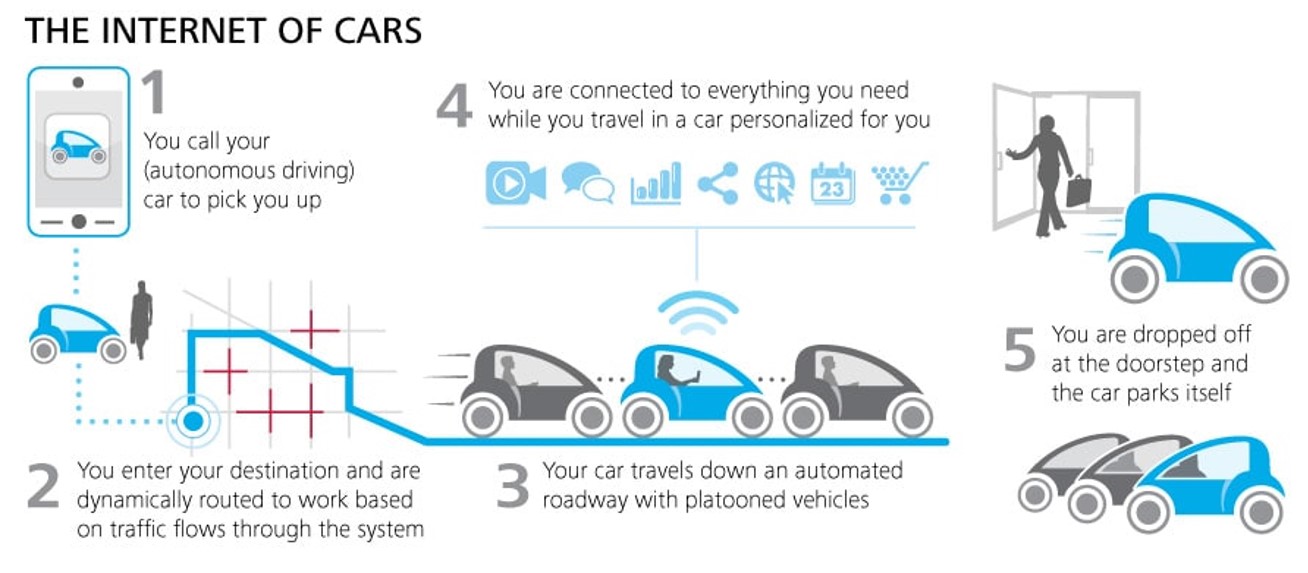
Key Applications: - Collision Avoidance at Intersections: Vehicles broadcast position, speed, and trajectory to warn of potential T-bone collisions - Emergency Brake Warnings: Hard braking triggers immediate alerts to following vehicles beyond visual range - Platooning (Convoy Driving): Multiple vehicles travel closely together with automated following, reducing air drag and improving fuel efficiency - Lane Change Assistance: Share blind spot information with adjacent vehicles
Why Low Latency Matters: At highway speeds (120 km/h or 33 m/s), a vehicle travels 33 meters per second. A 100ms delay means the vehicle has moved 3.3 meters before receiving a warning - potentially the difference between collision avoidance and impact.
135.4.2 V2I (Vehicle-to-Infrastructure): Smart Road Communication
Purpose: Enable vehicles to communicate with roadside infrastructure for traffic optimization and hazard awareness.
Key Applications: - Traffic Light Timing Optimization: Vehicles receive Signal Phase and Timing (SPaT) data to optimize speed and reduce idling at red lights - Speed Limit Warnings: Dynamic speed limits based on weather, construction, or traffic conditions - Road Condition Alerts: Infrastructure sensors detect icy roads, standing water, or potholes and broadcast warnings - Parking Availability: Real-time parking space availability to reduce congestion from circling vehicles
Technical Specifications: - Range: Up to 1 kilometer from roadside units (RSUs) - Latency: 50-100ms (less time-critical than V2V) - Infrastructure: Roadside Units (RSUs) at intersections, highway entry/exit ramps, and hazard locations - Data Types: SPaT (signal phase and timing), MAP (intersection geometry), TIM (traveler information messages)
Real-World Impact: A connected vehicle approaching an intersection with SPaT data can calculate the optimal speed to arrive during a green light, reducing fuel consumption by 15-25% and eliminating unnecessary stops.
135.4.3 V2P (Vehicle-to-Pedestrian): Vulnerable Road User Protection
Purpose: Protect pedestrians and cyclists by enabling detection and warning systems beyond line-of-sight.
Key Applications: - Smartphone-Based Pedestrian Detection: Pedestrian smartphones broadcast presence to nearby vehicles - Crosswalk Warnings: Vehicles detect pedestrians waiting at or entering crosswalks, even in low visibility - School Zone Alerts: Children with wearable V2P devices trigger speed reduction warnings - Cyclist Awareness: Bicycles equipped with V2P transmitters alert drivers to their presence in blind spots
Technical Specifications: - Range: 50-200 meters (sufficient for stopping distance) - Latency: <50ms (time-critical for collision avoidance) - Device Types: Smartphones, wearable tags, bicycle-mounted transmitters - Challenges: Not all pedestrians carry V2P-enabled devices; cannot fully replace camera/radar-based detection
Privacy Considerations: V2P systems must balance safety with privacy. Broadcasts should be anonymous (no persistent identifiers), short-range (to prevent tracking), and only active when needed (e.g., when crossing street).
Purpose: Connect vehicles to cloud platforms for navigation, traffic management, diagnostics, and over-the-air updates.
Key Applications: - Cloud-Based Traffic Management: Aggregate vehicle speed and location data to detect congestion and optimize routing - Route Optimization: Real-time navigation updates based on traffic conditions, weather, and road closures - Over-the-Air (OTA) Updates: Software updates for infotainment, safety features, and autonomous driving systems - Remote Diagnostics: Vehicle health monitoring with predictive maintenance alerts
Technical Specifications: - Connectivity: 4G LTE or 5G cellular (always-on connection) - Latency: 50-500ms (not time-critical for most applications) - Data Volume: 25 GB/hour generated by sensors, but only 25 MB/hour transmitted (edge filtering) - Business Models: Telematics, usage-based insurance, mobility-as-a-service
Data Flow: Vehicles send filtered telemetry to cloud -> Cloud performs analytics -> Cloud sends back navigation updates, traffic alerts, and software patches.
135.5 V2X Technology Comparison: DSRC vs C-V2X
Two competing technologies provide the physical layer for V2X communication:
Feature
DSRC (802.11p)
C-V2X (Cellular V2X)
Spectrum
5.9 GHz dedicated band
LTE/5G cellular spectrum
Range
300-500m (line-of-sight)
500m-1km (better non-line-of-sight)
Latency
3-5ms
10-20ms (LTE), 1-5ms (5G)
Maturity
Deployed since 2010s, proven
Newer standard (3GPP Release 14+)
Infrastructure
Requires roadside units (RSUs)
Leverages existing cellular towers
Cost
Lower device cost, higher infrastructure
Higher device cost, lower infrastructure
Network Dependency
Direct (ad-hoc) communication
Can work direct or via network
Evolution Path
Limited roadmap
Evolves with 5G (5G NR-V2X)
Adoption
US DOT pilots, Europe mandates
China mandate, growing global support
The Verdict: The industry is shifting toward C-V2X due to its integration with 5G, better non-line-of-sight performance, and alignment with cellular infrastructure investments. However, DSRC remains deployed in some regions and offers proven low-latency performance.
135.6 V2X Safety Applications and Requirements
Different safety applications have varying latency and reliability requirements:
Application
Latency Requirement
V2X Type
Typical Range
Reliability
Intersection collision avoidance
<10ms
V2V, V2I
300m
99.999%
Emergency brake warning
<20ms
V2V
300m
99.99%
Blind spot warning
<50ms
V2V
50m
99.9%
Curve speed warning
<100ms
V2I
500m
99%
Pedestrian crosswalk alert
<50ms
V2P
100m
99.9%
Traffic signal timing
<100ms
V2I
300m
99%
Navigation updates
<1s
V2N
N/A (cellular)
95%
OTA software updates
<10s
V2N
N/A (cellular)
99% (eventual)
Critical Insight: Safety-critical applications (collision avoidance, emergency braking) require V2V or V2I with direct communication and edge processing. Cloud-based V2N cannot meet <50ms latency requirements for life-critical decisions.
Technical Challenges: - Penetration Rate Problem: V2X safety benefits require critical mass (30-50% vehicle penetration) - Spectrum Allocation: Debate over dedicating 5.9 GHz band vs. sharing with Wi-Fi - Security: Prevent spoofing, replay attacks, and privacy leaks while maintaining low latency - Interoperability: Ensure vehicles from different manufacturers communicate reliably
Business Challenges: - Chicken-and-Egg Problem: Vehicles need infrastructure (RSUs), but infrastructure investment requires vehicles - ROI Uncertainty: Difficult to quantify safety benefits in dollars to justify infrastructure spending - Liability: Who is responsible if a V2X safety warning fails - vehicle manufacturer, infrastructure operator, or telecom provider?
Regulatory Challenges: - Standards Fragmentation: US (DSRC), Europe (C-V2X hybrid), China (C-V2X mandate) - Privacy Regulations: GDPR and similar laws restrict location data sharing - Spectrum Policy: US FCC debating whether to preserve 5.9 GHz for V2X or repurpose for Wi-Fi
135.8 Real-World V2X Deployments
US Department of Transportation Connected Vehicle Pilots: - Wyoming: I-80 corridor V2I for road weather warnings (500+ RSUs) - Tampa, Florida: Streetcars and buses with V2V/V2I (600+ vehicles) - New York City: Midtown Manhattan V2V/V2I for pedestrian safety (400+ vehicles)
Results: 80% reduction in intersection accidents, 40% reduction in rear-end collisions, 30% reduction in curve overspeed crashes.
General Motors OnStar: Over 12 million connected vehicles using V2N for navigation, diagnostics, and emergency services.
Volkswagen Car2X: European deployment using 802.11p DSRC for V2V emergency brake warnings and hazard alerts.
135.9 Connected Vehicle Data Architecture
Connected Vehicles Data Flow
Figure 135.2: Connected vehicles stream telemetry from the assembly line through to fleet operations for analytics and automation.
Vehicle Sensor Data Volumes:
Sensor Type
Data Rate
Key Applications
Camera (forward)
20-40 MB/s
Lane keeping, obstacle detection
LiDAR
100-300 MB/s
3D mapping, object classification
Radar
0.1-15 MB/s
Adaptive cruise control, blind spot
GPS/IMU
0.1 MB/s
Navigation, positioning
CAN bus (vehicle data)
0.5 MB/s
Engine, brakes, steering telemetry
Total raw data
~25 GB/hour
Autonomous driving training
Transmitted to cloud
~25 MB/hour
Filtered, aggregated insights
Edge Processing Importance: 99.9% of sensor data is processed on-vehicle. Only aggregated insights, anomalies, and training data samples are transmitted to the cloud, reducing bandwidth costs and enabling real-time decision-making.
135.10 Knowledge Check
Show code
{const container =document.getElementById('kc-usecase-v2x');if (container &&typeof InlineKnowledgeCheck !=='undefined') { container.innerHTML=''; container.appendChild(InlineKnowledgeCheck.create({question:"A city is deploying V2I (Vehicle-to-Infrastructure) communication at 50 high-accident intersections. Each intersection requires roadside units (RSUs) at $15,000 each plus 5G backhaul at $500/month. If V2I reduces intersection accidents by 80% and the average accident costs $45,000 (medical, property, traffic delays), how many accidents per intersection per year justify the investment?",options: [ {text:"1 accident prevented per intersection annually",correct:false,feedback:"At $45,000 saved per prevented accident with 80% reduction, 1 accident x 0.8 x $45,000 = $36,000 saved. Annual cost is $6,000 (connectivity) + ~$3,000 (amortized hardware over 5 years) = $9,000. One accident easily justifies the investment, but the break-even is even lower."}, {text:"Less than 1 accident - the system pays for itself quickly",correct:true,feedback:"Correct! Annual per-intersection cost: $15,000/5 years + $500x12 = $9,000. One prevented accident saves $45,000 x 0.8 = $36,000. Break-even = $9,000 / $36,000 = 0.25 accidents/year. Any intersection averaging more than 1 accident per 4 years justifies V2I deployment, which is why high-accident intersections are prioritized."}, {text:"5 accidents - need significant volume to justify infrastructure",correct:false,feedback:"V2I infrastructure costs are modest compared to accident costs. At 5 accidents with 80% reduction, savings would be $180,000 versus $9,000 annual cost - a 20x ROI. The actual break-even is much lower."}, {text:"Cannot calculate without knowing vehicle penetration rates",correct:false,feedback:"While V2I effectiveness increases with equipped vehicle percentage, even 10% penetration provides collision warnings that benefit all vehicles. The 80% reduction assumes adequate penetration in the pilot zone."} ],difficulty:"medium",topic:"iot-use-cases-v2x" })); }}
135.11 V2X Security Considerations
Connected vehicles face unique security challenges:
Threat
Attack Vector
Mitigation
Spoofing
Fake V2V messages (false brake warnings)
PKI certificates, message authentication
Replay
Re-transmit old messages to confuse vehicles
Timestamps, sequence numbers, freshness checks
Jamming
RF interference to disable V2X communication
Redundant channels, fallback to on-vehicle sensors
Privacy
Track vehicles via persistent identifiers
Rotating pseudonyms, short-lived certificates
Injection
Malicious OTA updates
Secure boot, code signing, staged rollouts
Security Architecture: V2X systems use a Security Credential Management System (SCMS) with short-lived certificates (typically 5-minute validity) that are frequently rotated to prevent tracking while ensuring message authenticity.
135.12 Summary
Connected vehicles and V2X communication represent transformative IoT applications: