129 IoT Use Cases: Smart Contact Lenses and Advanced Wearables
129.1 Smart Contact Lenses: Augmenting Reality and Sensing the Body
129.2 Learning Objectives
By the end of this section, you will be able to:
- Explain the technology behind smart contact lenses including sensing, display, and power delivery
- Analyze the potential of battery-free radio for ultra-low-power IoT applications
- Understand flexible bio-integrated electronics for medical monitoring
- Calculate ROI for retail IoT applications including refrigeration and traffic analytics
129.3 Smart Contact Lenses Overview
Smart contact lenses represent a fascinating convergence of microelectronics, biomaterials, and data analytics, embodying the core principles of the Internet of Things (IoT) by seamlessly integrating sensing, processing, and communication capabilities directly onto the human body. These devices transcend the traditional function of vision correction, evolving into sophisticated platforms for health monitoring and augmented reality (AR).
129.3.1 Sensing and Biometric Monitoring
One of the most promising applications of smart contact lenses lies in non-invasive biometric monitoring. By embedding miniaturized sensors, these lenses can measure various physiological parameters present in tears, such as glucose levels. This capability holds immense potential for individuals with diabetes, offering continuous and painless glucose monitoring and eliminating the need for frequent blood tests. Integrated pressure sensors can also measure intraocular pressure, providing valuable insights for managing glaucoma - a condition characterized by elevated pressure within the eye. The lens can wirelessly transmit this data to a paired device, enabling real-time monitoring and timely intervention.
129.3.2 Augmented Reality and Visual Interfaces
Beyond health monitoring, smart contact lenses are poised to revolutionize human-computer interaction through AR. By incorporating micro-displays and optical components, these lenses can project digital information directly onto the wearer’s retina, overlaying virtual elements onto the real-world view. This capability can enhance navigation, provide instant access to contextual information, and support immersive applications such as gaming and remote collaboration. Eye vergence tracking, facilitated by integrated sensors, allows for intuitive control of on-lens interfaces based on the user’s natural eye movements. In addition, integrated cameras within the lens enable first-person image and video capture, transforming domains like documentation and real-time assistance.
129.3.3 Security and Identification
The unique physiological characteristics of the iris make it a reliable biometric identifier. Smart contact lenses equipped with iris recognition capabilities can deliver secure authentication and access control, offering a discreet and convenient alternative to traditional methods such as passwords or external biometric devices.
129.3.4 Challenges and Future Directions
Despite the significant promise of smart contact lenses, several challenges remain. Achieving reliable wireless power delivery and storage, ensuring biocompatibility and long-term comfort, and upholding data privacy standards are among the most pressing issues. Advances in micro-fabrication, energy harvesting, and low-power wireless communication will be vital to overcoming these hurdles. As researchers continue to push the boundaries of materials science and miniaturized electronics, smart contact lenses are poised to play a pivotal role in the evolving IoT landscape, blurring the lines between the physical and digital realms and augmenting human capabilities in ways once thought impossible.
129.4 Supporting Technologies: Environmental Monitoring in Specialized Spaces
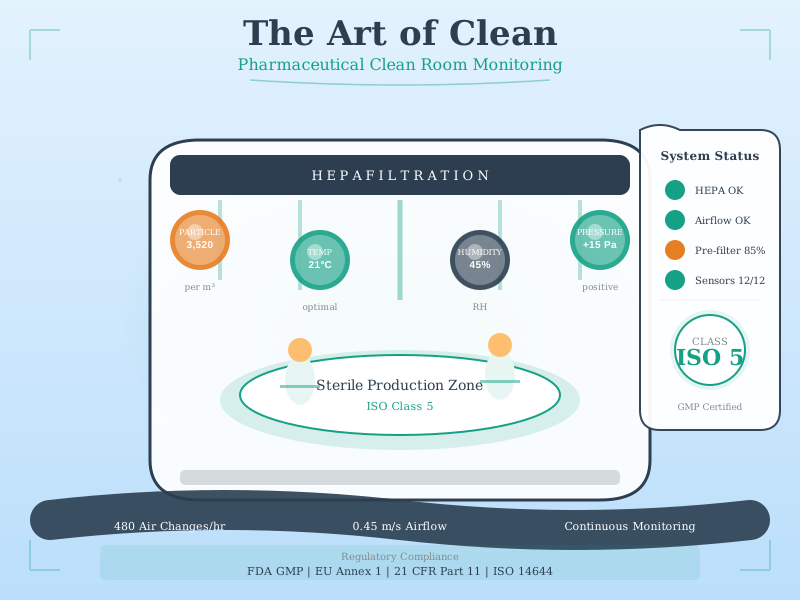
Clean room monitoring demonstrates how IoT enables continuous compliance verification in regulated industries. Real-time environmental data ensures product quality while providing the documentation trail required for GMP manufacturing.
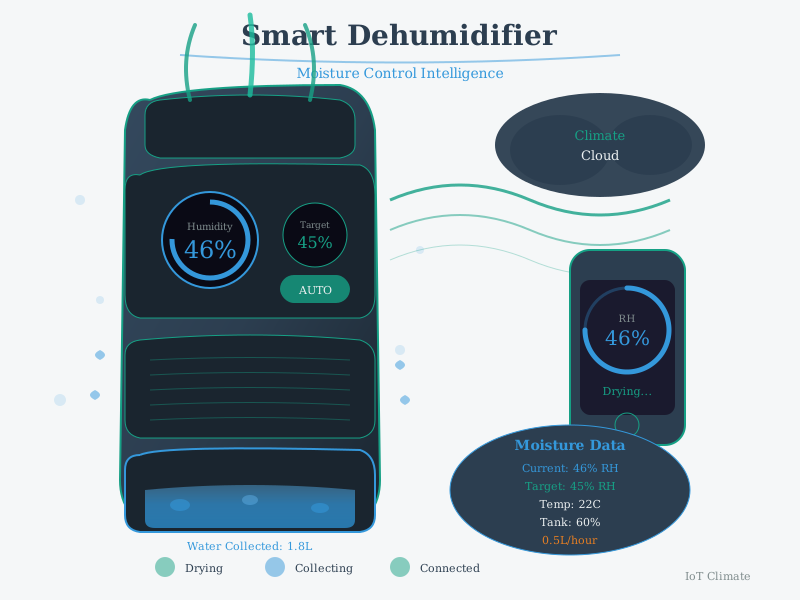
Smart dehumidification systems protect sensitive materials and products from moisture damage. IoT control enables precise humidity management across large facilities while minimizing energy consumption through intelligent staging.
Intelligent lighting controls combine multiple inputs to deliver optimal illumination while minimizing energy waste. Smart dimmers integrate with broader building automation systems to coordinate lighting with HVAC and occupancy management.
129.5 Retail IoT Applications
Connected display cases enable retailers to monitor food safety compliance while optimizing energy consumption. Real-time temperature monitoring prevents spoilage losses while predictive maintenance reduces service costs.
129.5.1 Worked Example: Refrigerated Display Case Energy and Spoilage Optimization
Scenario: A supermarket chain with 85 stores wants to reduce energy costs and product spoilage in refrigerated display cases. Each store averages 45 open-front refrigerated cases for dairy, meat, deli, and beverages.
Given: - Total refrigerated cases: 3,825 across 85 stores - Average case energy consumption: 12.8 kWh/day per case - Electricity cost: $0.12/kWh - Product spoilage rate: 4.2% of refrigerated inventory annually - Average refrigerated inventory value per store: $185,000 - Current maintenance: Reactive (repair when failure reported) - Temperature excursion events causing spoilage: 23 per store per year
Steps:
Deploy IoT monitoring: Install temperature sensors (evaporator, discharge air, product zone), door-open counters, defrost cycle monitors, and compressor current sensors on each case ($165 per case x 3,825 = $631,125).
Establish baseline performance: After 90 days, identify that 34% of cases operate outside optimal temperature range due to failed door gaskets, clogged condensers, or incorrect defrost schedules.
Implement predictive maintenance and optimization:
- Compressor current trending predicts failures 14 days in advance (vs. reactive failure)
- Defrost optimization based on actual frost accumulation reduces energy 8%
- Door gasket alerts prevent gradual temperature drift
- Night setback during closed hours saves 12% energy without product risk
Calculate energy savings:
- Daily energy per case: 12.8 kWh
- Reduction from defrost optimization: 8% = 1.02 kWh/day
- Reduction from night setback: 12% of 8 hours = 0.51 kWh/day
- Total daily savings per case: 1.53 kWh
- Annual energy savings: 1.53 kWh x 3,825 cases x 365 days = 2,137,271 kWh
- Annual energy cost savings: 2,137,271 x $0.12 = $256,473
Calculate spoilage reduction:
- Previous spoilage: 4.2% x $185,000 x 85 stores = $660,450/year
- Temperature excursion reduction: 23 to 4 events per store (83% reduction)
- Spoilage reduction: 65% (some spoilage from handling, rotation, not temperature)
- Spoilage savings: $660,450 x 0.65 = $429,293
Calculate maintenance efficiency:
- Previous emergency repairs: 2.8 per case per year at $285 average
- Predicted failures repaired proactively: 78% of issues
- Proactive repair cost: $145 (scheduled vs. emergency)
- Annual maintenance savings: 3,825 cases x 2.8 x 0.78 x ($285 - $145) = $1,170,234
Result: IoT-enabled display case management saves $1.86M annually ($256K energy + $429K spoilage + $1.17M maintenance). System investment of $631K achieves 2.9x ROI in Year 1. Food safety compliance improves with continuous temperature logging for regulatory audits.
Key Insight: Refrigeration IoT ROI is dominated by maintenance cost avoidance, not energy savings. While energy optimization is visible and easy to measure, preventing emergency compressor replacements (often $2,000-4,000 per incident including spoiled product) delivers 4.5x more value than energy efficiency gains. Prioritize failure prediction over consumption optimization.
129.5.2 Worked Example: Customer Traffic Analytics for Store Layout Optimization
Scenario: A department store chain wants to optimize floor layouts and staffing using customer traffic analytics. Management suspects that current layouts create congestion in some areas while leaving high-margin departments underexposed.
Given: - Store count: 32 locations averaging 65,000 square feet - Average daily foot traffic: 4,200 visitors per store - Current conversion rate: 28% (visitors who make a purchase) - Average transaction value: $87 - High-margin departments: Cosmetics (62% margin), Jewelry (58%), Home goods (45%) - Current high-margin department exposure: 35% of visitors pass through these areas - Staff labor cost: $18.50/hour, 85 floor staff per store during peak hours
Steps:
- Deploy traffic analytics infrastructure:
- Overhead people counters at entrances and department boundaries (18 per store x $425 = $7,650/store)
- Wi-Fi/Bluetooth probe analytics for path tracking (opt-in with loyalty app)
- Heat map cameras at key decision points (12 per store x $650 = $7,800/store)
- Total per store: $15,450 x 32 stores = $494,400
- Establish customer journey baseline: After 60 days, map typical customer paths revealing:
- 67% of traffic concentrates in 28% of floor space (entrance, checkout, main aisle)
- High-margin cosmetics receives only 22% exposure despite 35% target
- Dwell time in electronics (low margin) averages 8.2 minutes vs. 2.1 minutes in jewelry
- Implement data-driven optimizations:
- Relocate cosmetics to high-traffic path between entrance and anchor department
- Add secondary jewelry display near checkout (impulse exposure)
- Adjust staffing: Reduce electronics staff 15%, increase cosmetics staff 25%
- Create “speed bumps” (promotional displays) to slow traffic through high-margin zones
- Calculate exposure improvement:
- High-margin department exposure: 35% to 58% of visitors (66% improvement)
- Dwell time in high-margin areas: 2.1 to 3.8 minutes (81% improvement)
- Calculate conversion impact:
- Baseline high-margin purchases: 4,200 visitors x 35% exposure x 28% conversion x $87 = $36,162/day
- New high-margin purchases: 4,200 x 58% x 31% conversion x $87 = $65,693/day
- Daily revenue increase: $29,531 per store
- Annual revenue increase: $29,531 x 32 stores x 310 operating days = $292,947,920 (gross)
- Incremental margin (average 55%): $161,121,356 contribution
- Calculate staffing efficiency:
- Previous overstaffing in low-conversion areas: 12 hours/store/day at $18.50
- Annual labor reallocation savings: 12 x $18.50 x 32 stores x 365 = $2,599,920
Result: Customer traffic analytics drives $161M in incremental margin contribution plus $2.6M in labor savings. System investment of $494K achieves extraordinary ROI by unlocking latent store productivity. Conversion rate improves from 28% to 31% chain-wide.
Key Insight: Traffic analytics ROI comes from exposure optimization, not conversion optimization. Most retailers focus analytics on improving checkout conversion (28% to 30%), but the bigger lever is ensuring high-margin products are seen by more visitors (35% to 58% exposure). A 66% improvement in exposure multiplied by a 10% conversion lift delivers 5x the impact of conversion optimization alone.
129.6 Key Takeaways
Smart Contact Lenses represent the frontier of wearable IoT: - Non-invasive biometric monitoring (glucose, intraocular pressure) - Augmented reality displays projected directly to the retina - Iris recognition for secure authentication - Key challenges: power delivery, biocompatibility, privacy
Retail IoT Applications demonstrate practical ROI: - Refrigerated display case monitoring prioritizes predictive maintenance over energy savings - Customer traffic analytics unlock value through exposure optimization, not just conversion - Store layout decisions backed by actual customer path data outperform intuition
Common Pattern: The most valuable IoT applications focus on outcomes that are difficult to measure manually (equipment failure prediction, customer journey mapping) rather than outcomes that are merely inconvenient to measure (energy consumption, transaction counts).
129.7 What’s Next
Continue exploring healthcare applications in Healthcare IoT: Real-World Impact, which covers:
- Healthcare IoT ecosystem architecture
- Elderly fall detection systems
- Baby monitoring and infant care
- Medication adherence solutions