TipFor Beginners: How Do IoT Companies Make Money?
It’s not just about selling devices—it’s about ongoing relationships.
Unlike a regular lamp you buy once, a smart lamp connects to the internet, receives updates, and might offer premium features. This creates new ways for companies to make money over time.
Traditional vs. IoT Business Models:
Traditional
IoT-Enabled
Sell a thermostat for $200
Sell thermostat for $100, charge $10/month for energy analytics
One-time purchase
Ongoing subscription
Customer gone after sale
Customer relationship for years
Common IoT business models explained:
Model
How It Works
Real Example
Product-as-a-Service
Pay for what you use, not ownership
Rolls-Royce charges per flight hour, not per engine
Razor & Blade
Cheap hardware, profitable services
Amazon Echo sold at cost; makes money from Alexa purchases
Freemium
Basic free, premium costs money
Nest thermostat: free basic app, paid “Nest Aware” features
Data Monetization
Sell insights from collected data
Waze sells traffic patterns to cities
Platform
Connect buyers and sellers, take a cut
Apple HomeKit takes 30% from accessory sales
Why subscriptions dominate IoT:
Model
Initial
Over 36 Months
Customer Relationship
One-Time Sale
$200
$200 total
Transaction complete
Subscription
$10/month
$360 total
Ongoing relationship
Key business metrics you’ll hear:
Metric
What It Means
Why It Matters
LTV (Lifetime Value)
Total money from one customer
Higher = better subscription business
CAC (Customer Acquisition Cost)
Cost to get one customer
Must be less than LTV!
Churn
Percentage who cancel
Lower = stickier product
ARPU
Average revenue per user
Shows how much each customer is worth
Key insight: IoT transforms “one-and-done” product companies into ongoing service businesses. The device is just the foot in the door—the real money is in data, subscriptions, and ecosystem lock-in.
TipFor Kids: Meet the Sensor Squad!
IoT Business Models are like running a lemonade stand that never closes!
Imagine you have a magical lemonade stand. Instead of just selling one cup of lemonade and saying goodbye, you become friends with your customers and keep helping them get exactly the lemonade they love, every single day!
122.2.1 The Sensor Squad Adventure: The Never-Ending Lemonade Stand
Sammy the Sensor, Lila the LED, Max the Microcontroller, and Bella the Battery had a problem. They had invented the most amazing smart water bottle ever! It could tell you when to drink water, keep your drinks the perfect temperature, and even glow fun colors. But they only had enough money to make 10 bottles.
“We could sell each bottle for $50,” said Bella the Battery. “That’s $500 total, and then we’re done.”
But Max the Microcontroller had a clever idea. “What if we sell the bottles for only $20, but ask for $2 every month to unlock special features? We could add new games, fun challenges, and even let bottles talk to each other!”
“That’s brilliant!” cheered Lila the LED. “Instead of making $500 once, we could make $200 from selling bottles PLUS $20 every month from each person who subscribes. In one year, that’s $200 + $240 = $440 from each customer!”
Sammy the Sensor added, “And because we keep talking to our customers, we can learn what they like and make the bottle even better!”
The Sensor Squad learned the most important business lesson: sometimes giving more for less upfront means everyone wins in the long run. Their customers got an amazing bottle that kept getting better, and the Sensor Squad had money coming in every month to invent new features!
122.2.2 Key Words for Kids
Word
What It Means
Subscription
Paying a little bit regularly (like a magazine that comes every month) instead of a lot all at once
Lifetime Value
How much money a customer gives you over their whole friendship with your business
Freemium
When the basic thing is free, but cool extra stuff costs money
Platform
A place where lots of people come together (like an app store where many games are sold)
122.2.3 Try This at Home!
The Two Lemonade Stands Game
Get some play money or draw your own (make coins worth $1 and $5)
Pretend you’re running TWO lemonade stands:
Stand A: Sells one big cup for $5 - customer gets lemonade and leaves
Stand B: Sells a small cup for $1, but customers can pay $1 each week for unlimited refills
After 6 “weeks” (count them out), which stand made more money from the same customer?
Which stand knows their customer better? Which customer is happier?
This shows why subscription businesses (like Netflix or video game passes) are so popular!
NoteKey Takeaway
In one sentence: The device is the foot in the door - recurring revenue from services, subscriptions, and data generates 5-9x the lifetime value of hardware sales alone.
Remember this rule: If your LTV:CAC ratio is below 3:1, your business model is unsustainable. Hardware margins erode over time; recurring revenue compounds. Design subscription revenue into your product from day one, not as an afterthought.
122.3 Introduction to IoT Business Models
TipDefinition
An IoT business model describes how an organization creates, delivers, and captures value through Internet of Things technologies, products, and services. It encompasses revenue generation mechanisms, customer relationships, value propositions, and the ecosystem of partners involved in delivering IoT solutions.
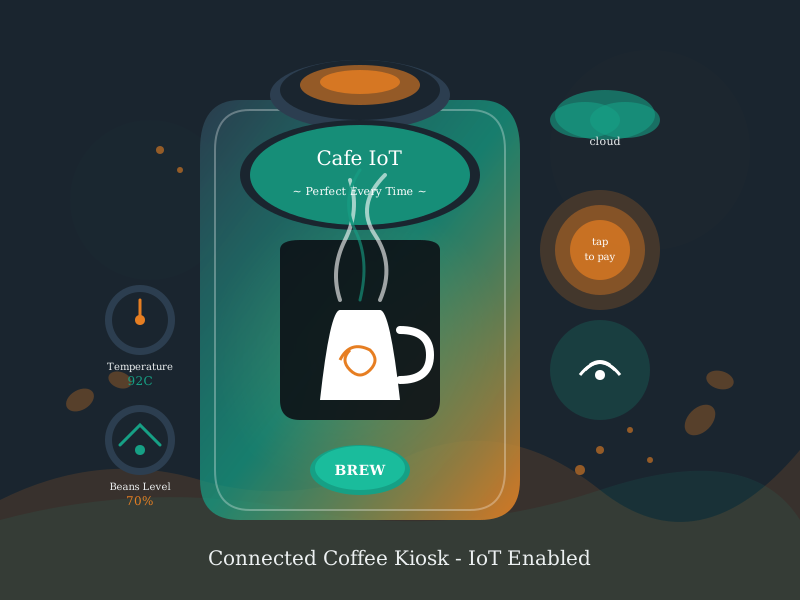
Coffee kiosk with IoT inventory management
Automated retail kiosks demonstrate the transformation from simple vending to IoT-enabled service businesses. Connected kiosks generate recurring revenue through consumables while reducing operating costs through predictive maintenance and remote monitoring.
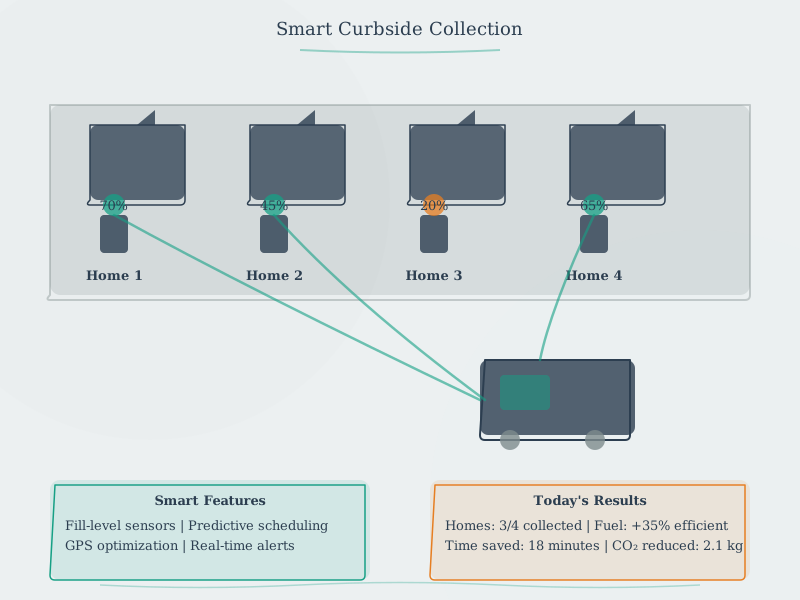
Curbside pickup system for retail
Curbside pickup represents an IoT-enabled service that creates competitive advantage through customer experience. These systems combine mobile apps, geolocation, and store operations to deliver convenience that builds loyalty and repeat business.
Delivery routing optimization system
Route optimization platforms exemplify data-driven services that create measurable value through efficiency gains. These IoT systems reduce delivery costs by 15-25% while improving customer satisfaction through reliable delivery windows.
The Internet of Things fundamentally transforms traditional business models by enabling new ways to monetize products, services, and data. Unlike conventional products that generate one-time purchase revenue, IoT solutions create ongoing relationships with customers through continuous connectivity, data exchange, and service delivery.
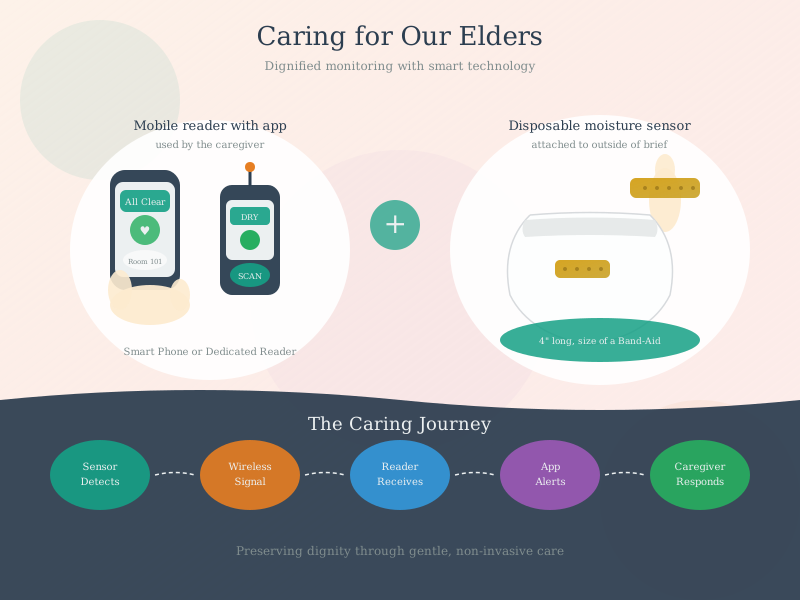
NoteVideo: IoT Benefits for People with Disabilities
Explore how IoT business models create social value through assistive technologies.
Key Characteristics of IoT Business Models:
Continuous Value Delivery: IoT devices provide ongoing value through software updates, data analytics, and service improvements
Data-Driven Revenue: Monetization of insights derived from device-generated data
Ecosystem Dependency: Success often requires partnerships across hardware, software, connectivity, and service providers
Customer Lock-in: Subscription and service-based models create long-term customer relationships
Scalability: Cloud-based architectures enable rapid scaling across geographies and use cases
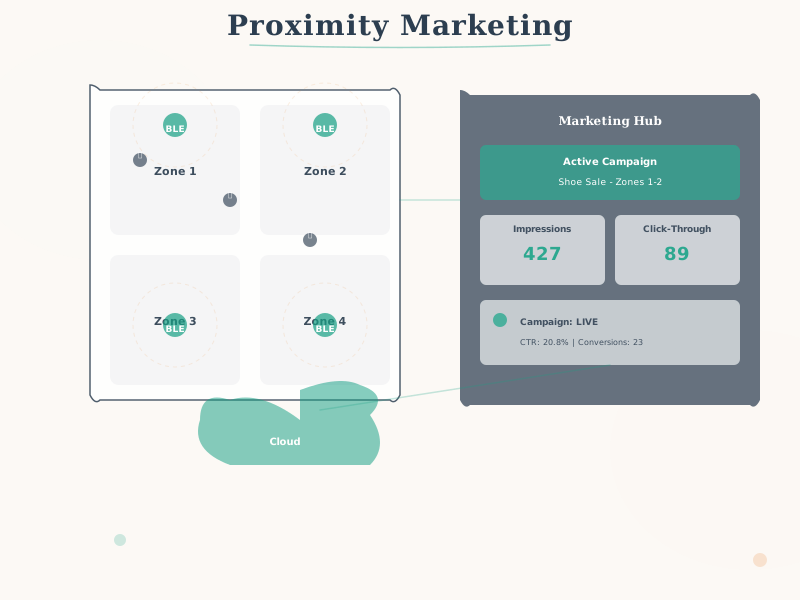
Beacon-Based Retail Marketing System
Beacon-based marketing represents a powerful IoT monetization opportunity for physical retailers. These low-cost Bluetooth devices enable proximity-based customer engagement that can increase conversion rates by 20-30% while generating valuable foot traffic data for store layout optimization and inventory planning.
122.4 The IoT Business Model Canvas
Flowchart diagram
Figure 122.1: IoT Business Model Canvas showing how value creation (devices, connectivity, analytics, services) flows through revenue streams to deliver customer value in cost savings, efficiency, capabilities, and risk reduction.
NoteAlternative View: IoT Value Stack with Real Costs
This layered diagram shows the IoT business model as a value stack with actual cost examples. Students can calculate margins: if customer pays $30/month and costs are ~$8/month, gross margin is 73%.
Four-layer IoT value stack diagram showing costs at each level. Top layer (teal, Customer Pays For): Subscription $10-50/month, Data Access premium tier, Support SLA guarantee. Second layer (orange, Platform Delivers): Dashboard visualization, Alerts notifications, Insights AI/ML analysis. Third layer (gray, Infrastructure Costs): Cloud Compute $0.05/device/month, Connectivity $1-5/device/month, Storage $0.02/GB/month. Bottom layer (navy, Device Investment): Sensors $5-50 BOM, Gateway $50-500, Installation $0-100. Arrows show value flowing from customer payments down through platform to infrastructure to hardware.
Figure 122.2: Customer payments (top) fund platform services which run on infrastructure built on hardware. Each layer shows real-world pricing.
IoT Business Model Canvas:
Value Creation
Revenue Stream
Customer Value
IoT Devices (Hardware)
Hardware Sales (One-time)
Cost Savings (OpEx vs CapEx)
Connectivity (Network)
Subscriptions (Recurring)
Operational Efficiency (Automation)
Data Analytics (Insights)
Data Monetization
New Capabilities (Innovation)
Services (Software)
Transaction Fees (Platform)
Risk Reduction (Predictive)
Each layer builds upon the previous to create sustainable business models.
Figure 122.3: IoT Business Plans framework highlighting six essential considerations for successful IoT product commercialization.
Figure 122.4: Example IoT Business Plan for a smart home energy monitoring product demonstrating practical application of the business model framework.
122.5 IoT Ecosystem Value Flows
Graph diagram
Figure 122.5: IoT ecosystem revenue and value flows: Device manufacturers generate data, platform operators process it (15-30% fees), connectivity providers enable transmission, developers deliver experiences (70-85% share), and customers receive value through subscriptions.
NoteAlternative View: Follow the Money
This diagram traces actual dollars through the IoT ecosystem. Students can see why platform operators fight for market share - small percentage fees compound at scale.
Revenue flow diagram showing how customer payments distribute through IoT ecosystem. Customer pays $50/month subscription (teal) which splits into: Platform $10 (20%), Developer $25 (50%), Connectivity $5 (10%), Support $5 (10%), and Margin $5 (10%). Separate one-time flow shows Device $200 customer purchase flowing to Manufacturer earning $80 margin. Orange box shows monthly revenue distribution percentages.
Figure 122.6: When a customer pays $50/month subscription, it splits: Platform takes 20% ($10), Developer receives 50% ($25), Connectivity costs 10% ($5), Support takes 10% ($5), leaving 10% ($5) profit margin.
IoT Value Proposition Framework:
Stakeholder
Revenue Model
Value Contribution
Device Manufacturers
Hardware sales, volume
Generates sensor data
Platform Operators
Transaction fees 15-30%
Processes and analyzes data
Connectivity Providers
Data usage fees
Stable network traffic
App Developers
App revenue 70-85%
Delivers user experience
End Customers
Pay for value
Receives services
Value Flow Pipeline: 1. Data Collection - Device sensors gather information 2. Data Processing - Cloud/Edge analytics transform raw data 3. Insights Generation - Actionable intelligence extracted 4. Service Delivery - User experience delivered to customers
Revenue sharing aligns incentives across all stakeholders in the ecosystem.
122.6 Revenue Model Comparison
Flowchart diagram
Figure 122.7: IoT business model revenue comparison showing how Product-as-a-Service generates 9x higher lifetime value ($1,800) than traditional one-time sales ($200) over 3 years, while freemium and data monetization models create different value streams through subscriptions and insights.
NoteAlternative View: Customer Revenue Journey
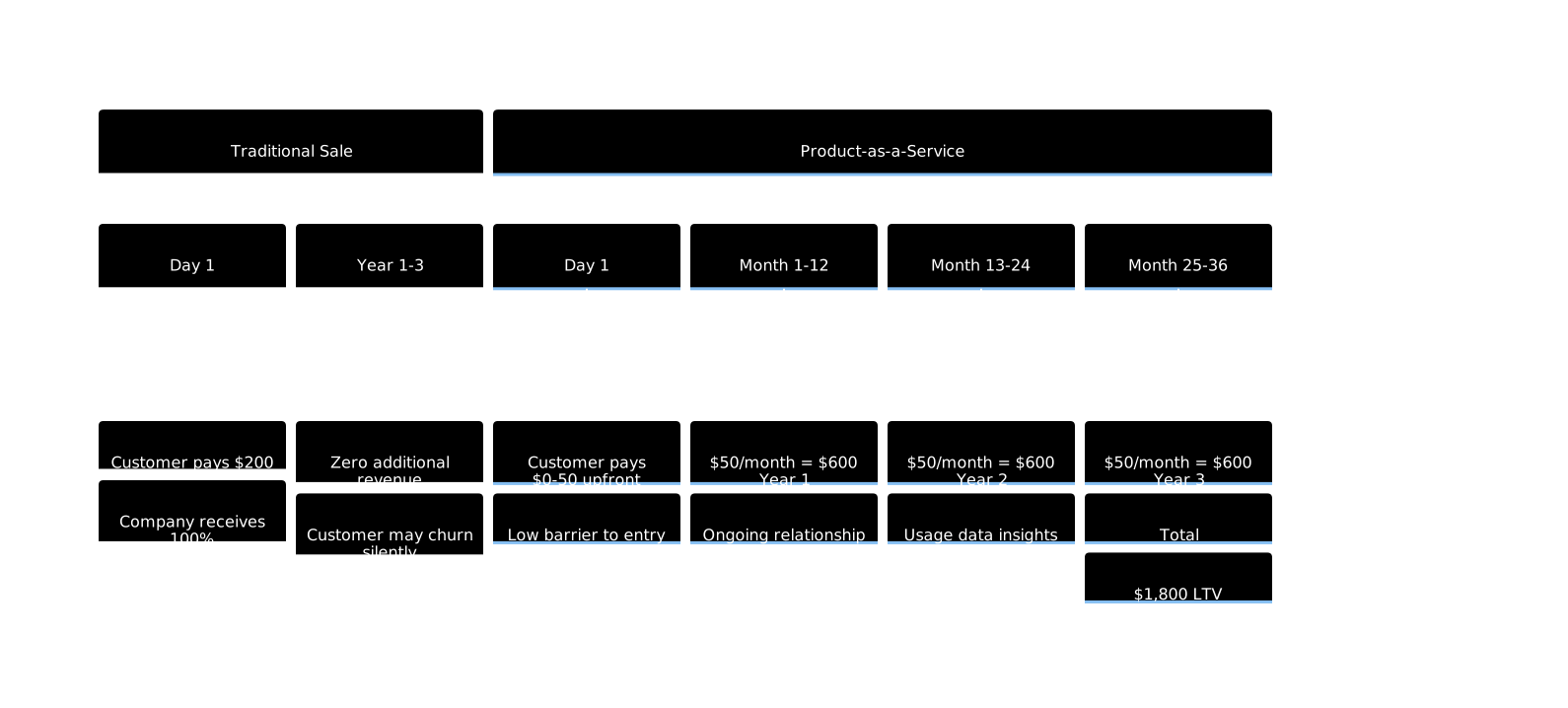
This timeline contrasts the revenue patterns of traditional vs subscription models over 3 years. The visual makes clear why subscription models generate 9x lifetime value.
Timeline comparison showing two customer revenue journeys over 3 years. Traditional Sale path: Day 1 customer pays $200 one-time, Years 1-3 show zero additional revenue and risk of silent churn. Product-as-a-Service path: Day 1 low $0-50 upfront barrier, Months 1-12 generate $600 in Year 1 with ongoing relationship, Months 13-24 generate $600 Year 2 plus usage insights, Months 25-36 generate $600 Year 3 for $1,800 total lifetime value.
Figure 122.8: Traditional sales capture all value on Day 1 ($200) then lose visibility into the customer. Product-as-a-Service starts with lower friction, builds recurring revenue, and maintains ongoing customer relationships.
Revenue Streams Comparison:
Business Model
Pricing Structure
3-Year Revenue
Key Metric
Traditional
$200 hardware sale
$200 LTV
One-time revenue
Product-as-a-Service
Device included + $50/month
$1,800 LTV
9x traditional LTV
Freemium Platform
Free + $10/month premium (12% convert)
$14.40 ARPU
Scales with users
Data Monetization
Free device, sell insights
$5-50/user/year
Grows with data volume
IoT business models generate significantly higher lifetime value (LTV) than traditional one-time sales by creating ongoing customer relationships.
Learning Hubs: - Quiz Navigator - Business model quizzes
122.7 Knowledge Check
Show code
{const container =document.getElementById('kc-bizmodel-1');if (container &&typeof InlineKnowledgeCheck !=='undefined') { container.innerHTML=''; container.appendChild(InlineKnowledgeCheck.create({question:"A startup is building a smart thermostat. Option A: Sell the device for $250 (manufacturing cost $120, one-time sale). Option B: Sell for $99 and charge $8/month for energy analytics (manufacturing cost $120). With 24-month average customer lifetime, which model generates higher profit per customer?",options: [ {text:"Option A generates more profit: $250 - $120 = $130 vs $99 + ($8 x 24) - $120 = $171",correct:false,feedback:"Incorrect calculation. Option A profit is correct at $130, but Option B should be calculated as: Revenue ($99 + $192) - Cost ($120) = $171. However, this doesn't account for ongoing service costs. The real advantage is the recurring relationship."}, {text:"Option B generates more profit: $171 vs $130, plus ongoing customer relationship for future upsells",correct:true,feedback:"Correct! Option B generates $41 more profit ($171 vs $130) over 24 months while creating an ongoing customer relationship. Beyond direct profit, the subscription model enables data collection for product improvement, reduces price sensitivity through gradual payments, and creates opportunities for tier upgrades. This is why IoT companies favor recurring revenue models even when hardware is sold at thin margins."}, {text:"Both options are equal because customers will simply buy the cheaper option",correct:false,feedback:"Incorrect. This ignores customer segmentation and value perception. Price-sensitive customers may choose Option A, but those valuing ongoing energy insights and analytics prefer Option B. Many IoT companies successfully sell both models to different segments (e.g., Nest sells standalone thermostats AND offers Nest Aware subscriptions)."}, {text:"Option A is better because it eliminates ongoing service costs",correct:false,feedback:"Incorrect. While Option A avoids service costs, it also eliminates the most valuable aspect of IoT business models: ongoing customer relationships. One-time sales mean no data on usage patterns, no opportunity for feature updates, and no expansion revenue. The subscription model's service costs are offset by higher lifetime value and customer insights."} ],difficulty:"medium",topic:"iot-business-models" })); }}
Show code
{const container =document.getElementById('kc-bizmodel-2');if (container &&typeof InlineKnowledgeCheck !=='undefined') { container.innerHTML=''; container.appendChild(InlineKnowledgeCheck.create({question:"An IoT platform connects smart home device makers, app developers, and consumers. It currently has 1,000 devices and 50 apps. A competitor launches with better features. If 30% of developers switch to the competitor, predict the cascade effect on the platform ecosystem.",options: [ {text:"Only developers leave; device makers and consumers stay because hardware is already purchased",correct:false,feedback:"Incorrect. This underestimates network effects. When 30% of developers leave, app selection decreases, making the platform less attractive to new consumers. Reduced consumer growth signals to device makers that the platform is losing momentum, causing them to shift resources to competitors. Platform business models are interconnected ecosystems where weakness in one stakeholder group cascades to others."}, {text:"Developers leave, then consumers notice fewer new apps and reduce purchases, then device makers reduce investment - a negative spiral",correct:true,feedback:"Correct! This demonstrates negative network effects (the opposite of positive network effects). When developers leave, app selection stagnates. Consumers notice fewer innovative apps and slow their purchases. Device makers see declining consumer growth and reduce platform investment. This creates a 'death spiral' where each stakeholder group's exit accelerates others' departure. Historical examples: Windows Phone lost developer support then app gap then consumers left then manufacturers abandoned platform. This is why platform operators fight aggressively to retain developers."}, {text:"The platform can compensate by lowering transaction fees to attract new developers",correct:false,feedback:"Partially correct but incomplete. Lower fees may slow developer exodus, but won't stop the cascade if the platform loses momentum. Once negative network effects begin, price changes rarely reverse them. Microsoft tried this with Windows Phone, offering developers better revenue shares than Apple/Google, but couldn't overcome the ecosystem momentum gap. Compensation strategies work best before significant attrition begins."}, {text:"Consumers will leave first because they notice missing apps immediately",correct:false,feedback:"Incorrect sequence. Developers typically leave before consumers notice because developers make forward-looking decisions based on platform trajectory. By the time consumers notice app gaps (3-6 months later), developer exodus is already advanced. The lag between developer departure and consumer awareness is why platform companies monitor developer metrics obsessively as leading indicators of platform health."} ],difficulty:"hard",topic:"iot-business-models" })); }}
122.8 Summary
This chapter introduced the fundamental concepts of IoT business models:
Six Primary Business Models: Product-as-a-Service, Platform Models, Data Monetization, Freemium, Outcome-Based Pricing, and Razor-and-Blade
Value Creation: How IoT transforms one-time product sales into ongoing service relationships
Ecosystem Dynamics: The multi-stakeholder nature of IoT platforms and network effects
Key Metrics: Understanding LTV, CAC, ARPU, and churn rate as foundation for business model analysis
122.9 What’s Next
Continue exploring IoT business models in the following chapters: