Industrial environments require specialized communication protocols that differ fundamentally from consumer IoT protocols. Where consumer IoT might tolerate seconds of latency, industrial control loops often demand sub-millisecond response times with guaranteed delivery. This chapter explores the protocols that make modern manufacturing possible.
147.4 Protocol Requirements
Time: ~15 min | Difficulty: Advanced | Unit: P03.C06.U03
Industrial environments require specialized communication protocols that differ fundamentally from consumer IoT protocols:
Requirement
Consumer IoT
Industrial IoT
Latency
100ms-1s acceptable
<1ms-10ms required
Reliability
95-99% typical
99.999% required
Determinism
Best effort
Guaranteed timing
Safety
Not critical
Safety-rated
Security
User data protection
Process integrity critical
Lifespan
2-5 years
20-30 years
147.5 Legacy Industrial Protocols
147.5.1 Modbus (1979)
Modbus is one of the oldest and most widespread industrial protocols:
Characteristics:
Simple: Easy to implement, minimal overhead
Master-slave: Single master polls multiple slaves
Serial or TCP/IP: Modbus RTU (serial) or Modbus TCP (Ethernet)
Limited: 247 devices per network, no built-in security
Still widely used: Over 7 million devices worldwide
Typical applications: Building automation, energy management, simple machine control
147.5.2 PROFIBUS (1989)
Process Field Bus, dominant in European process automation:
Characteristics:
Token-passing: Deterministic bus access
Fast: 12 Mbps on copper, up to 100 devices
Multi-master: Multiple PLCs can coexist
Process automation focused: Chemical plants, refineries
147.5.3 DeviceNet (1994)
CAN-based protocol for discrete manufacturing:
Characteristics:
CAN physical layer: Automotive-grade reliability
Producer-consumer model: Efficient broadcasting
Low-level device control: Sensors, drives, valves
Embedded power: Can power devices over the network
147.6 Modern Industrial Ethernet
147.6.1 PROFINET (2003)
Siemens’ industrial Ethernet successor to PROFIBUS:
Performance tiers:
PROFINET IO: Standard I/O, <100ms cycle time
PROFINET IRT (Isochronous Real-Time): <1ms, deterministic, motion control
CIP protocol: Common Industrial Protocol (same as DeviceNet)
Standard TCP/IP: Uses unmodified Ethernet
Producer-consumer: Efficient multicast messaging
Widely adopted: North American manufacturing
147.6.3 EtherCAT (2003)
Ethernet for Control Automation Technology, ultra-low latency:
Architecture:
Graph diagram
Figure 147.1: EtherCAT network architecture showing master-slave topology: EtherCAT master (PLC in navy) sends a single Ethernet frame that passes through four s…
Performance:
Cycle time: <100μs for 1,000 I/O points
Jitter: <1μs (critical for synchronized motion)
Topology: Line, tree, star, or any combination
Data processing: Each slave processes data as frame passes through
Use cases: High-speed motion control, packaging machines, robotics
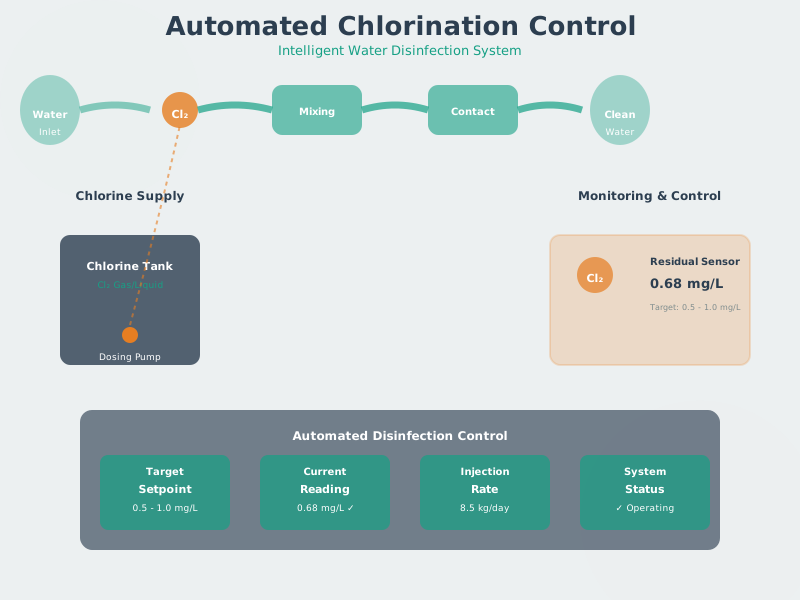
Water chlorination control system
Water treatment automation demonstrates critical infrastructure IoT where precise control directly impacts public health. Chlorination systems maintain safe disinfection levels while optimizing chemical consumption through real-time feedback control.
147.7 Protocol Comparison
Protocol
Year
Max Speed
Cycle Time
Determinism
Security
Use Case
Modbus
1979
10 Mbps
100ms+
None
None
Simple control
PROFIBUS
1989
12 Mbps
10ms
Good
Basic
Process automation
PROFINET
2003
100 Mbps
<1ms
Excellent
Good
Factory automation
EtherNet/IP
2001
1 Gbps
1-10ms
Good
Good
Discrete manufacturing
EtherCAT
2003
100 Mbps
<100μs
Excellent
Good
Motion control
OPC-UA
2008
1 Gbps+
Variable
Configurable
Excellent
IT/OT integration
Show code
{const container =document.getElementById('kc-iiot-protocols');if (container &&typeof InlineKnowledgeCheck !=='undefined') { container.innerHTML=''; container.appendChild(InlineKnowledgeCheck.create({question:"A pharmaceutical company needs to upgrade their batch processing control system. They require sub-millisecond timing for precise ingredient dosing, safety certification for FDA compliance, and the system must operate reliably for 20+ years. Which protocol combination is most appropriate?",options: [ {text:"MQTT + Wi-Fi for flexibility and easy IT integration",correct:false,feedback:"MQTT is excellent for IoT but lacks deterministic timing guarantees. Wi-Fi latency (10-100ms typical) cannot meet sub-millisecond requirements for precise dosing control."}, {text:"EtherCAT for motion control + OPC-UA for IT integration",correct:true,feedback:"Correct! EtherCAT provides <100μs deterministic timing for precise control, while OPC-UA handles IT integration, historian connectivity, and MES communication. This separation of concerns is standard in modern pharmaceutical plants."}, {text:"Modbus TCP for simplicity and wide device support",correct:false,feedback:"Modbus lacks determinism (100ms+ typical), has no built-in security, and cannot meet safety certification requirements. It's suitable for monitoring but not for critical dosing control."}, {text:"Standard Ethernet with custom protocols for maximum speed",correct:false,feedback:"Custom protocols create vendor lock-in, validation nightmares for FDA, and maintenance challenges over 20+ years. Industrial standards exist specifically to avoid these problems."} ],difficulty:"hard",topic:"industrial-protocols" })); }}
147.8 Industrial IoT System Components Gallery
The following figures illustrate key components and systems in modern Industrial IoT deployments, from sensor networks to process control equipment.
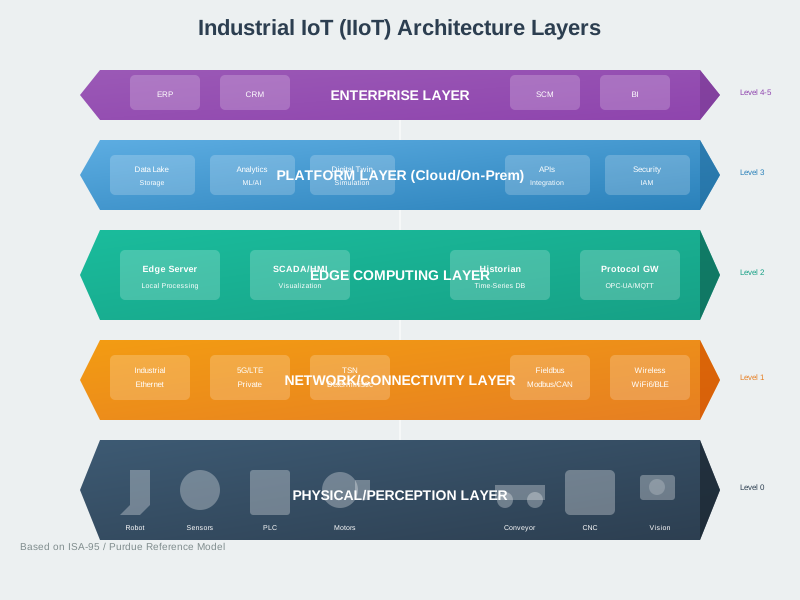
Industrial IoT Architecture Layers
Figure 147.2: Industrial IoT architectures organize functionality into distinct layers aligned with the ISA-95 model, enabling clear separation of concerns while supporting integration across operational technology (OT) and information technology (IT) domains.
The convergence of Operational Technology (OT) and Information Technology (IT) creates unprecedented security challenges. This deep dive explores the unique threat landscape, architectural patterns, and practical strategies for securing converged industrial environments.
147.8.1 Understanding the OT/IT Security Gap
Fundamental Differences:
Aspect
IT Security
OT Security
Primary goal
Confidentiality first
Availability first
Acceptable downtime
Hours for maintenance
Zero - production never stops
Patch frequency
Monthly or more often
Annually or less (scheduled shutdowns)
System lifespan
3-5 years
15-30 years
Network isolation
Connected to internet
Historically air-gapped
Authentication
Strong passwords, MFA
Often none, shared credentials
Encryption
Standard practice
Often breaks OT protocols
Vendor support
Ongoing updates
May be end-of-life
Why Convergence Creates Risk:
When IT networks connect to OT systems, threats that previously required physical access can now be launched remotely. The 2015 Ukraine power grid attack demonstrated this risk: attackers used IT network access (phishing emails to administrative staff) to pivot into SCADA systems and disconnect 230,000 customers from electricity for hours.
147.8.2 The OT Threat Landscape
Attack Vectors Unique to OT:
Protocol exploitation: Industrial protocols (Modbus, PROFINET, EtherCAT) were designed for reliability, not security. Many lack authentication entirely.
Legacy system vulnerabilities: 20-year-old PLCs running Windows XP cannot be patched without risking production stability.
Physical process manipulation: Unlike IT attacks that steal data, OT attacks can cause physical harm (explosions, spills, equipment destruction, product contamination).
Supply chain compromise: Malware inserted into PLC firmware updates or engineering software (as seen in the SolarWinds and Codecov attacks) bypasses perimeter security entirely.
Insider threat amplified: OT systems often use shared credentials, making attribution nearly impossible when incidents occur.
Notable OT Security Incidents:
Incident
Year
Impact
Entry Point
Stuxnet (Iran centrifuges)
2010
Destroyed 1,000 centrifuges
USB drive, targeted PLC code
Ukraine power grid
2015
230,000 customers without power for hours
Phishing email to IT staff
Triton/TRISIS (Saudi Arabia)
2017
Safety system compromise (prevented disaster)
IT network, pivoted to safety controllers
Norsk Hydro ransomware
2019
$75M loss, manual operations for weeks
Phishing email
Colonial Pipeline
2021
5,500 miles of pipeline shut down
Compromised VPN credential
147.8.3 Security Architecture for Converged Environments
The Purdue Model (ISA-95/IEC 62443):
The Purdue Enterprise Reference Architecture defines five levels of network segmentation:
Level
Name
Examples
Security Focus
0
Physical Process
Sensors, actuators, valves
Physical security, tamper detection
1
Basic Control
PLCs, RTUs, DCS controllers
Firmware integrity, secure boot
2
Area Supervisory
SCADA, HMI, engineering workstations
Access control, network segmentation
3
Site Operations
Historians, MES, batch management
Demilitarized zone (DMZ), monitoring
3.5
Industrial DMZ
Jump servers, data diodes
Strict access control, inspection
4
Enterprise
ERP, email, office IT
Standard IT security practices
5
External
Cloud, internet, remote access
Perimeter security, zero trust
Critical Principle: Never allow direct connections between Levels 4-5 (IT/internet) and Levels 0-2 (process control). All traffic must traverse the Industrial DMZ (Level 3.5).
147.8.4 Network Segmentation Strategies
Micro-segmentation for OT:
Unlike IT networks where flat architectures are common, OT environments require granular segmentation:
Zone-based architecture: Group devices by function and criticality (safety systems separate from production, production separate from quality systems)
Conduit control: Define specific allowed communication paths between zones with explicit protocol and port restrictions
Unidirectional gateways (data diodes): For highest-security zones, use hardware that physically prevents traffic from flowing backward into OT
East-west traffic inspection: Even within zones, monitor lateral movement using OT-aware intrusion detection
Phase 2 (Months 7-18): Segmentation and Monitoring
Implement Industrial DMZ between IT and OT
Deploy OT-aware network monitoring
Establish baseline behaviors for anomaly detection
Develop OT-specific incident response procedures
Phase 3 (Months 19-36): Hardening and Governance
Implement role-based access control
Establish patch management program
Conduct tabletop exercises and red team assessments
Achieve IEC 62443 certification for critical systems
OT/IT convergence is inevitable for Industry 4.0 benefits. The organizations that succeed will be those that invest in security as a foundation, not an afterthought.
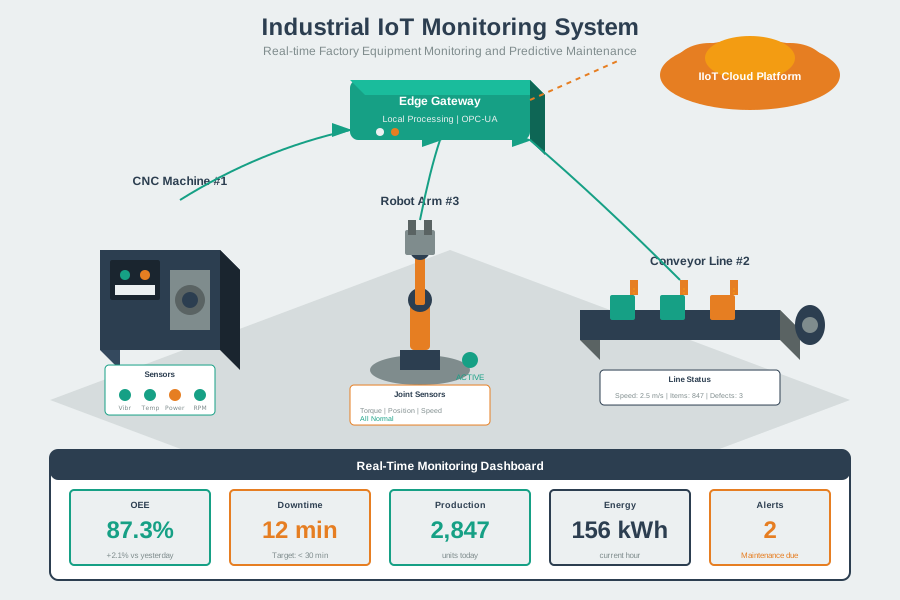
Industrial Monitoring System
Figure 147.3: Modern industrial monitoring systems aggregate data from thousands of sensors across manufacturing facilities, enabling real-time visibility into equipment health, production rates, and energy consumption with historical trend analysis for optimization.
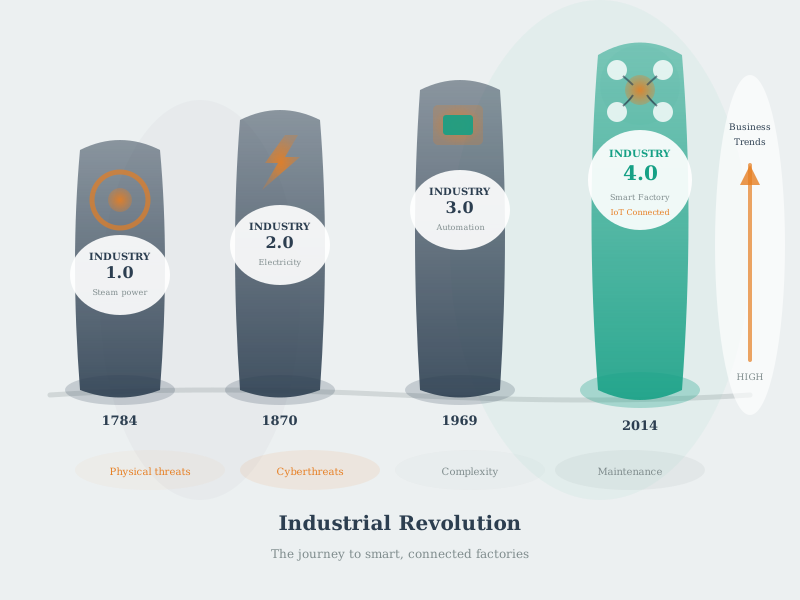
Industry 4.0 Ecosystem
Figure 147.4: The Industry 4.0 paradigm integrates previously isolated automation systems into interconnected cyber-physical networks that enable autonomous decision-making, predictive maintenance, and mass customization in manufacturing operations.
147.9 Summary
Industrial communication protocols form the backbone of modern manufacturing automation:
Legacy protocols like Modbus and PROFIBUS established foundational communication patterns but lack the security and speed required for modern Industry 4.0 applications.
Modern industrial Ethernet protocols (PROFINET, EtherNet/IP, EtherCAT) provide deterministic, high-speed communication while maintaining compatibility with standard IT infrastructure.
Protocol selection depends on application requirements: EtherCAT for motion control (<100μs), PROFINET for factory automation (<1ms), and OPC-UA for IT/OT integration.
Security considerations are critical as OT/IT convergence exposes previously isolated industrial systems to cyber threats. The Purdue Model provides a framework for network segmentation and defense-in-depth.
147.10 What’s Next
Continue your learning journey:
Next Chapter: OPC-UA Standard - The unifying standard for industrial interoperability