After completing this chapter, you will be able to:
Define Industry 4.0 and its relationship to Industrial IoT
Explain the evolution through four industrial revolutions
Understand cyber-physical systems and their characteristics
Describe digital twin concepts and use cases
Explain smart manufacturing and its enabling technologies
Understand horizontal and vertical integration in Industry 4.0
146.2 Prerequisites
Before diving into this chapter, you should be familiar with:
IoT Reference Models: Basic IoT architecture and how data flows from devices to platforms.
Edge and Fog Computing: Why industrial systems push analytics and control closer to the machines.
Networking Basics: Latency, bandwidth, and reliability fundamentals.
146.3 Introduction
A modern automotive factory can house hundreds to thousands of robots and tens of thousands of sensors, making control decisions on sub-millisecond timescales. In high-volume manufacturing, a stopped production line can cost tens of thousands of dollars per minute once you account for lost throughput, scrap, and downstream disruption. This is Industrial IoT (IIoT) at scale—where milliseconds matter, reliability targets are often “five nines” (99.999%) for critical systems, and a single early warning can prevent major losses.
Industry 4.0 represents the fourth industrial revolution, fundamentally transforming how products are designed, manufactured, distributed, and maintained. Unlike consumer IoT, which focuses on convenience and user experience, Industrial IoT operates in environments where safety is critical, latency can be sub-millisecond, and systems must run continuously for years without failure.
NoteKey Takeaway
In one sentence: IIoT ROI comes from preventing unplanned downtime, not from efficiency gains - one prevented outage can pay for a year of sensors.
Remember this rule: In industrial settings, a stopped production line costs $10,000-$50,000 per minute. Predictive maintenance that prevents even one major failure per year delivers 10-100x return on sensor investment. Focus first on high-cost failure modes, not incremental efficiency improvements.
TipFor Beginners: What is Industry 4.0?
Think of the four industrial revolutions as major upgrades to how we make things:
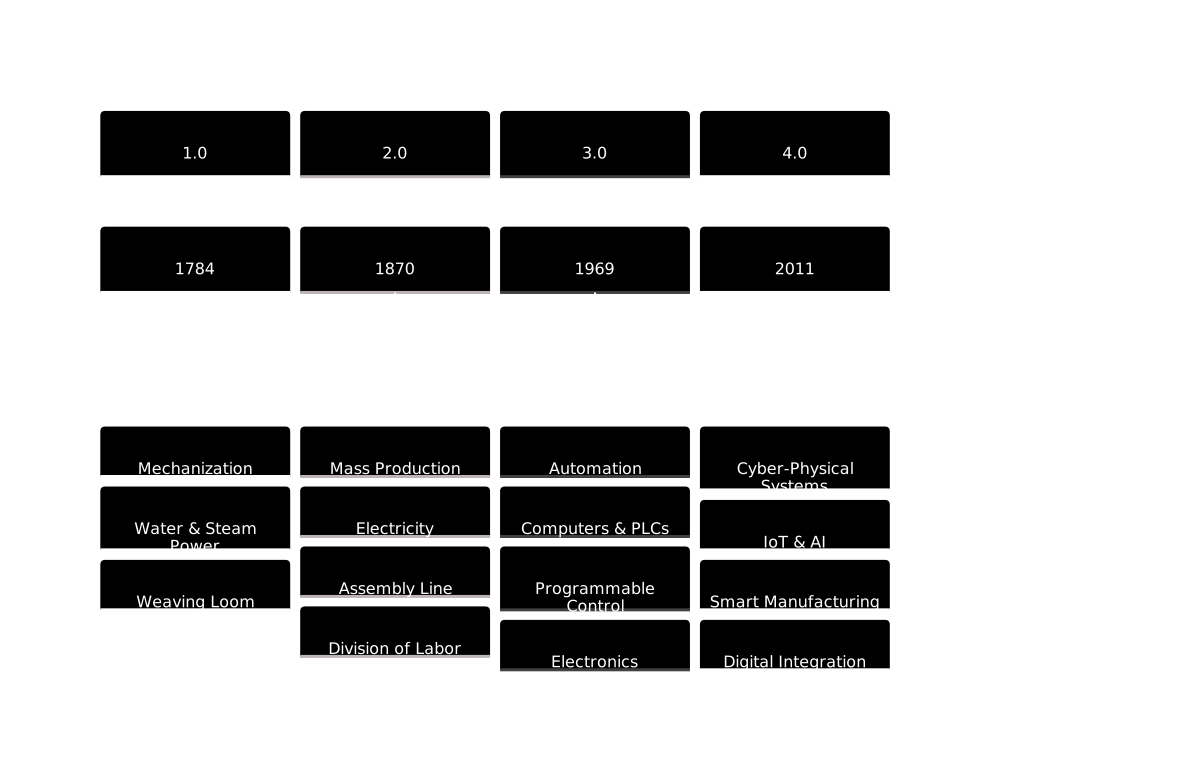
Industry 1.0 (1784): Steam engines replaced manual labor. Instead of making things by hand, water and steam power drove machines.
Industry 2.0 (1870): Electricity enabled mass production. Assembly lines like Henry Ford’s car factories made identical products cheaply.
Industry 3.0 (1969): Computers and automation. Programmable Logic Controllers (PLCs) could run machines automatically based on programs.
Industry 4.0 (2011): Machines talk to each other and make decisions together. When one machine breaks, the factory reorganizes itself automatically. Sensors predict problems before they happen.
Industry 4.0 is like giving the entire factory a nervous system and a brain. Instead of just following programmed instructions, machines sense their environment, communicate status, learn from data, and optimize themselves continuously.
TipFor Kids: Meet the Sensor Squad!
A smart factory is like a giant robot team where every machine can talk to its friends and ask for help!
146.3.1 The Sensor Squad Adventure: The Factory That Fixed Itself
Welcome to ToyMaker Factory, where robots build the world’s best toy cars! But today, something strange was happening…
Thermo the Temperature Sensor was keeping watch on Big Red, the giant robot arm that painted toy cars. “Uh oh, team! Big Red is getting warmer than usual - 85 degrees instead of 70!” Motion Mo the Motion Detector noticed something too: “Big Red is also shaking a tiny bit when she moves. Something’s not right!”
The sensors immediately called for help. Signal Sam the Communication Expert sent a message zooming through the factory’s computer network: “ATTENTION FACTORY BRAIN! Big Red needs help!” Within seconds, the factory’s smart computer figured out the problem - Big Red’s motor bearings were starting to wear out.
But here’s the amazing part: instead of waiting for Big Red to break down completely (which would stop ALL the toy cars from being painted!), Power Pete the Battery Manager helped reduce Big Red’s speed just a little bit. Then the factory computer sent a message to order new bearings AND scheduled a repair for next Tuesday during lunch break when the factory was already taking a rest.
Sunny the Light Sensor chimed in from the quality check station: “I’m still checking every toy car with my camera eyes, and they all look perfect! Big Red is still doing great work, just a little slower.” A week later, a repair technician arrived with the new bearings, fixed Big Red in just 30 minutes, and the factory never had to stop at all!
146.3.2 Key Words for Kids
Word
What It Means
Smart Factory
A factory where all the machines have sensors and can talk to each other through computers
Predictive Maintenance
When sensors notice small problems early so machines can be fixed BEFORE they break down completely
Robot Arm
A machine that can move and grab things, like a human arm, but much stronger and more precise
Assembly Line
A row of machines where each one does one job, and the product moves from machine to machine until it’s finished
Digital Twin
A computer copy of a real machine that lets engineers test ideas without touching the real thing
146.3.3 Try This at Home!
Build a “Smart Factory” Warning System!
You’ll need: A spinning top or fidget spinner, and your hand
Spin your top or spinner on a smooth table
Gently touch the table while it spins - feel the tiny vibrations?
Now press down on the spinner to slow it or make it wobble
Notice how the vibrations change? They get rougher and less smooth!
This is exactly how factory sensors work! When a machine is healthy, it vibrates smoothly. When something starts to go wrong (like a bearing wearing out), the vibrations become bumpy and irregular. Thermo and Motion Mo feel these changes and warn the factory computer before anything breaks. It’s like the machine saying “I don’t feel so good” before it gets really sick!
WarningCommon Misconception: “Industry 4.0 is just adding sensors to machines”
Misconception: Many believe Industry 4.0 is simply connecting existing machines to the internet and collecting data.
Reality: Industry 4.0 requires fundamental rethinking of manufacturing systems:
Not just connectivity: Requires vertical integration (field devices to ERP) and horizontal integration (supply chain partners)
Not just data collection: Requires real-time analytics, machine learning models, and autonomous decision-making
Not just technology: Requires organizational culture change, worker upskilling, and new business models
Not a quick fix: Takes 3-5 years to implement properly, not a simple sensor retrofit
Example of the difference:
Sensor retrofit: Add temperature sensor to motor, log data to spreadsheet, manually check for problems weekly
Industry 4.0: Edge gateway collects vibration/temperature/current at 10 kHz, runs FFT analysis locally, sends features to cloud ML model trained on 100,000 motors, automatically schedules maintenance when RUL drops below 14 days, orders replacement bearing, and notifies technician with AR-guided repair instructions
The difference is not incremental - it’s a complete transformation of how manufacturing systems operate, make decisions, and create value.
The mistake: Planning IIoT projects with timelines and budgets that assume modern, well-documented equipment, when the factory floor contains decades-old PLCs, proprietary protocols, and undocumented configurations.
Symptoms:
Projects stalling when trying to extract data from 1990s-era PLCs with no documentation
Discovering that “standard” protocols have vendor-specific implementations that do not interoperate
Budget overruns as integration specialists spend months reverse-engineering legacy systems
Critical machines running obsolete operating systems that cannot be patched or connected safely
Why it happens: Pilot projects often use newer equipment that integrates easily, creating false confidence. Vendors demonstrate connectivity with modern reference architectures, not real factory floors. IT teams unfamiliar with OT underestimate protocol diversity (Modbus RTU, PROFIBUS, DeviceNet, proprietary serial). Equipment documentation was lost years ago or was never complete.
The fix: Conduct thorough OT inventory BEFORE planning the IIoT project, documenting every PLC model, firmware version, and communication protocol. Budget 2-3x initial estimates for legacy integration. Plan for protocol conversion gateways (like Kepware, Ignition, or custom solutions). Accept that some equipment will require replacement rather than integration.
Prevention: Start with a detailed asset discovery and network audit. Classify equipment into integration tiers: (1) Modern with standard APIs, (2) Legacy with documented protocols, (3) Legacy requiring reverse engineering, (4) Replacement required. Build integration timelines based on tier distribution, not best-case assumptions. Include OT engineers with legacy system experience on project teams.
The mistake: Justifying IIoT investments using incomplete downtime cost calculations that miss the true impact of production interruptions, leading to either under-investment or unrealistic ROI expectations.
Symptoms:
ROI projections based only on direct labor costs during downtime
No accounting for scrap, rework, expedited shipping, or contractual penalties
Underestimating the cascade effects where one machine stoppage halts the entire line
Overpromising savings that never materialize, damaging credibility for future projects
Why it happens: Finance teams calculate downtime using simple formulas (hourly labor cost times hours), missing operational complexity. Manufacturing managers know true costs but struggle to quantify them. Different stakeholders use different definitions of “downtime” (planned vs unplanned, full stop vs degraded performance).
The fix: Build comprehensive downtime cost models that include: direct costs (labor, energy, materials in process), indirect costs (expedited shipping, overtime for recovery, quality issues from restart), opportunity costs (lost sales, customer penalties, damaged relationships), and cascade costs (downstream process starvation, inventory buffers consumed). Use historical incident data to validate models.
Prevention: Create a standardized downtime cost calculator specific to each production line. Document cost per minute/hour for different failure scenarios (single machine, line section, full line). Track actual costs after incidents to refine estimates. Present IIoT business cases using conservative, validated numbers rather than theoretical maximums. Include sensitivity analysis showing ROI under different downtime reduction scenarios.
146.4 The Four Industrial Revolutions
Time: ~10 min | Difficulty: Foundational | Unit: P03.C06.U01
TipMVU: Industry 4.0 Fundamentals
Core Concept: Industry 4.0 is the fourth industrial revolution, integrating cyber-physical systems, IoT sensors, AI, and digital twins to create smart factories where machines communicate, predict failures, and self-optimize with minimal human intervention. Why It Matters: Unlike consumer IoT (convenience-focused), IIoT operates where milliseconds matter, “five nines” reliability (99.999%) is mandatory, and a single prevented failure can pay for years of sensor investment. A stopped production line costs $10,000-$50,000 per minute. Key Takeaway: Industry 4.0 is not just “adding sensors to machines” - it requires vertical integration (field devices to ERP), horizontal integration (supply chain partners), real-time analytics, and organizational transformation over 3-5 years.
Each industrial revolution fundamentally changed manufacturing capabilities, productivity, and the nature of work:
Mermaid diagram
Figure 146.1: Timeline showing the four industrial revolutions: Industry 1
NoteKnowledge Check: Industry 4.0 Fundamentals
Show code
{const container =document.getElementById('kc-industry40');if (container &&typeof InlineKnowledgeCheck !=='undefined') { container.innerHTML=''; container.appendChild(InlineKnowledgeCheck.create({question:"A manufacturing plant manager wants to implement Industry 4.0. They plan to add temperature sensors to 50 machines and log data to a spreadsheet for weekly review. Is this Industry 4.0?",options: [ {text:"Yes - adding IoT sensors to machines is the definition of Industry 4.0",correct:false,feedback:"This is a common misconception! Simply adding sensors and collecting data is Industry 3.0 with better sensors. Industry 4.0 requires autonomous decision-making, real-time analytics, and system integration."}, {text:"No - Industry 4.0 requires real-time analytics, autonomous decisions, and system integration",correct:true,feedback:"Correct! Industry 4.0 means: (1) Edge analytics processing data in real-time, (2) ML models predicting failures before they happen, (3) Automatic maintenance scheduling and ordering, (4) Integration with ERP and supply chain. Weekly spreadsheet review is fundamentally different from autonomous, real-time cyber-physical systems."}, {text:"Yes - any IoT sensors in a factory qualifies as Industry 4.0",correct:false,feedback:"Industry 4.0 isn't about the presence of sensors - it's about what you DO with the data. Real-time autonomous decision-making, predictive maintenance with ML, and vertical/horizontal integration distinguish Industry 4.0 from simple monitoring."}, {text:"No - Industry 4.0 requires replacing all equipment with new 'smart' machines",correct:false,feedback:"Industry 4.0 can be retrofitted onto existing equipment with sensors and edge gateways. The key is not new machines, but new intelligence: real-time processing, AI-driven decisions, and system-wide integration."} ],difficulty:"medium",topic:"industry40" })); }}
Instead of a timeline, this diagram compares the four revolutions across three dimensions: power source, productivity gains, and workforce skills. Notice how each revolution builds on the previous: electricity enabled factory flexibility, computing enabled automation, and now IoT enables intelligence.
Four-column comparison of industrial revolutions. Industry 1.0 (gray): Power Source steam/water, Productivity 10-50x manual, Workers machine operators. Industry 2.0 (orange): Power Source electricity, Productivity additional 10x, Workers assembly line. Industry 3.0 (teal): Power Source computing, Productivity additional 5-10x, Workers PLC programmers. Industry 4.0 (navy): Power Source data and AI, Productivity additional 10-30%, Workers data scientists. Arrows between columns show transitions: Electricity enables flexibility, Computers enable automation, IoT enables intelligence.
Figure 146.2: Four-column comparison of industrial revolutions showing how each revolution builds on the previous, with changing workforce requirements from machine operators to data scientists.
Graph diagram
Figure 146.3: Industry 4.0 Maturity Model - Most organizations don’t jump directly to full Industry 4.0. This six-stage maturity model shows the typical progression path. Stage 1-2 (gray) represent foundational connectivity. Stage 3-4 (orange) enable visibility and understanding of operations. Stage 5-6 (teal/navy) achieve the predictive and autonomous capabilities that define true Industry 4.0. Organizations should assess their current maturity level and plan incremental improvements rather than attempting transformation all at once. {fig-alt=“Industry 4.0 maturity model showing six progressive stages. Stage 1 Computerization (gray): Isolated systems, Manual data entry, No integration. Stage 2 Connectivity (gray): Systems networked, Some data exchange, IT/OT still separate. Stage 3 Visibility (orange): Real-time monitoring, Digital shadow, Know what’s happening. Stage 4 Transparency (orange): Root cause analysis, Why did it happen, Data analytics. Stage 5 Predictive (teal): What will happen, ML models, Proactive maintenance. Stage 6 Adaptable (navy): Autonomous decisions, Self-optimizing, Full Industry 4.0. Arrows show progression: Connect, Instrument, Analyze, Predict, Automate between each stage.”}
146.4.1 Industry 1.0: Mechanization (1784)
The first industrial revolution began with the mechanization of production using water and steam power. Key innovations:
Water wheels and steam engines replaced human and animal power
Mechanical looms automated weaving
Factory system centralized production
Productivity increased by 10-50x for textile manufacturing
146.4.2 Industry 2.0: Mass Production (1870)
Electricity enabled division of labor and mass production:
Electric power made factories more flexible
Assembly lines (Henry Ford, 1913) reduced car production time from 12 hours to 90 minutes
Interchangeable parts enabled standardization
Telegraph and telephone improved coordination
Productivity increased another 10x
146.4.3 Industry 3.0: Automation (1969)
Computers and electronics automated repetitive tasks:
Programmable Logic Controllers (PLCs) replaced relay logic with software
SCADA systems enabled centralized monitoring
CNC machines automated precision manufacturing
Industrial robots (Unimation, 1961) performed dangerous tasks
Productivity and quality improvements of 5-10x
146.4.4 Industry 4.0: Cyber-Physical Systems (2011)
The fourth revolution integrates physical and digital systems:
IoT sensors provide real-time visibility
Digital twins create virtual replicas of physical assets
AI and machine learning enable predictive analytics
Horizontal and vertical integration connects supply chains
Cloud and edge computing process data at scale
Expected productivity gains of 10-30% with 50% reduction in downtime
146.5 Industry 4.0 Technologies
Time: ~12 min | Difficulty: Intermediate | Unit: P03.C06.U02
Industry 4.0 relies on the convergence of multiple technologies:
Graph diagram
Figure 146.4: Industry 4
NoteAlternative View: Industry 4.0 Stack with Timing Requirements
This diagram emphasizes the critical timing requirements at each layer of the industrial automation hierarchy. Understanding these timing constraints is crucial because mixing layers inappropriately (e.g., using cloud for motor control) violates fundamental latency requirements.
Five-tier Industry 4.0 stack showing latency requirements at each level. Enterprise Layer (gray, seconds to minutes): ERP order management response minutes-hours, Supply Chain inventory response hours-days. MES Layer (navy, 100ms to seconds): MES production scheduling response seconds, Quality SPC analysis response seconds. SCADA Layer (orange, 10-100ms): SCADA process monitoring response 100ms, Historian data logging response 100ms. Control Layer (teal, less than 10ms): PLC machine control cycle 1-10ms, Drives motor control cycle less than 1ms. Field Layer (teal, less than 1ms): Sensors read values response less than 1ms, Actuators execute response less than 1ms. Arrows show data flowing from enterprise down to field level.
Figure 146.5: Five-tier Industry 4.0 stack showing latency requirements at each level: Field devices operate in sub-millisecond cycles; control loops run at 1-10ms; SCADA provides 100ms monitoring; MES operates in seconds; and enterprise systems work in minutes to hours.
146.5.1 Cyber-Physical Systems (CPS)
Cyber-Physical Systems integrate computation, networking, and physical processes:
Tight coupling: Physical processes affect computations, computations control physical processes
Real-time constraints: Must respond within strict time limits (often <1ms)
Networked: Distributed components communicate over industrial networks
Autonomous: Make local decisions without human intervention
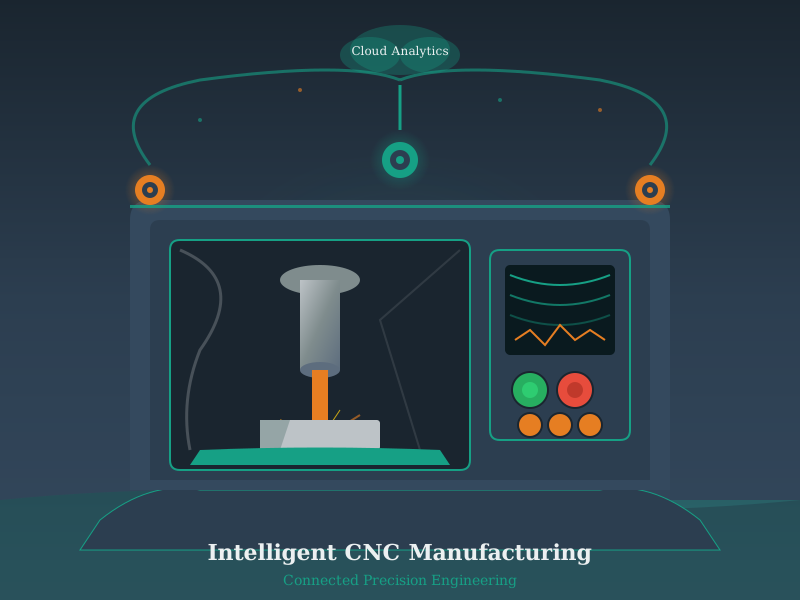
CNC machines represent a core Industry 3.0 technology now enhanced with IoT capabilities. Modern connected CNC systems continuously stream operational data to analytics platforms, enabling predictive maintenance that reduces unplanned downtime by 30-50% compared to reactive maintenance approaches
CPS differs from traditional embedded systems through continuous feedback loops, network connectivity, and autonomous decision-making capabilities.
146.5.2 Digital Twins
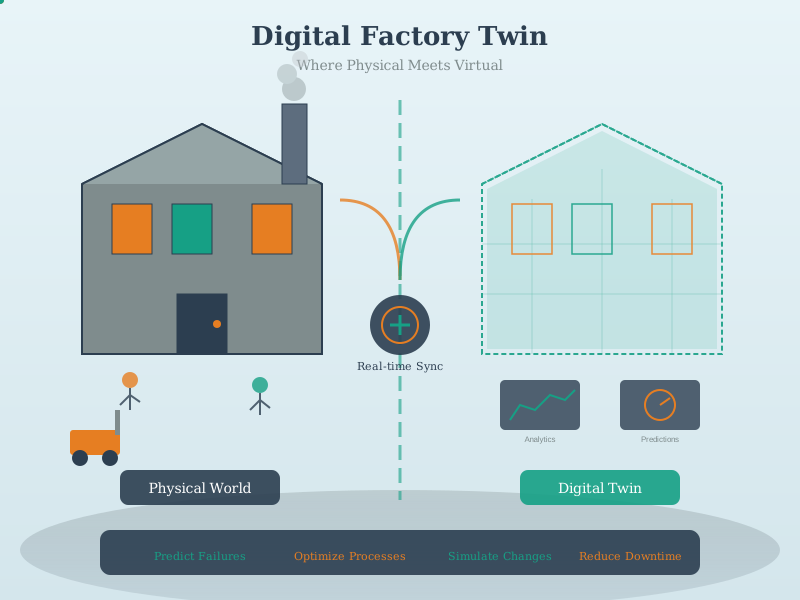
A digital twin is a real-time virtual replica of a physical asset, process, or system:
Key characteristics:
Bi-directional data flow: Physical sensors feed the digital model; digital simulations inform physical operations
Real-time synchronization: Updates reflect physical state within milliseconds
Predictive capabilities: Run simulations to test scenarios without disrupting production
Product design: Test virtual prototypes before building physical ones
Process optimization: Simulate production changes without stopping the line
Predictive maintenance: Model asset degradation to schedule maintenance
Operator training: Train on virtual replicas without risk
Example: Siemens uses digital twins to simulate entire factories, reducing commissioning time by 30% and enabling virtual optimization before physical changes.
Digital factory twin visualization
Digital factory twins enable manufacturers to test process changes, train operators, and optimize production schedules in simulation before committing to physical changes. This virtual environment reduces commissioning time and minimizes the risk of costly production disruptions.
146.5.3 Smart Manufacturing
Smart manufacturing applies IoT, AI, and automation to create adaptive, self-optimizing production systems:
Characteristics:
Connectivity: All assets networked and communicating
Visibility: Real-time monitoring of all processes
Transparency: Understanding cause-and-effect relationships through data
Predictability: Forecasting future states using AI models
Adaptability: Automatic response to changing conditions
Key technologies:
Industrial IoT sensors: Temperature, vibration, pressure, vision systems
Advanced robotics: Collaborative robots (cobots) working alongside humans
Additive manufacturing: 3D printing for customized production
Augmented reality: AR glasses for maintenance guidance
Industrial control room with SCADA visualization
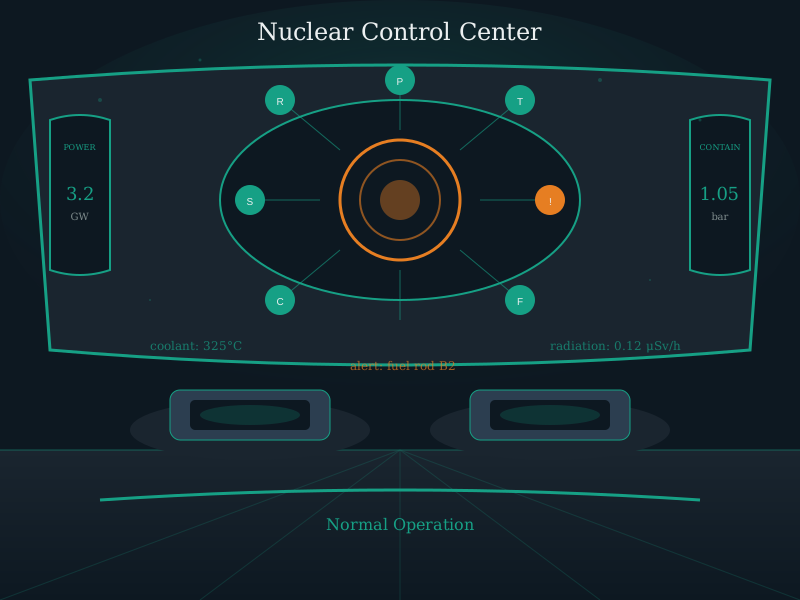
Centralized control rooms provide operators with comprehensive visibility across distributed production facilities. Modern SCADA systems aggregate data from thousands of sensors into intuitive dashboards that highlight anomalies and guide rapid response to equipment issues.
146.5.4 Horizontal and Vertical Integration
Industry 4.0 requires integration across two dimensions:
TipMVU: ISA-95 Automation Levels
Core Concept: Industrial systems are organized into five ISA-95 levels with strict timing requirements: Level 0-1 (field devices and PLCs, sub-millisecond control loops), Level 2 (SCADA, 10-100ms monitoring), Level 3 (MES, seconds-level scheduling), Level 4 (ERP, minutes-to-hours business planning). Why It Matters: Mixing layers inappropriately violates fundamental latency requirements. You cannot use cloud computing for motor control (requires sub-millisecond response) or expect real-time process control from ERP systems designed for business planning. Key Takeaway: Each ISA-95 level has appropriate technology and timing constraints. Understand which level your application operates at before selecting protocols, computing infrastructure, and communication patterns.
Vertical Integration (within a factory):
%% fig-alt: "Vertical integration hierarchy showing five ISA-95 levels with bidirectional data flow: Level 0 (field devices like sensors and actuators in green), Level 1 (basic control with PLCs in navy), Level 2 (supervisory SCADA and HMI in navy), Level 3 (operations with MES in orange), and Level 4 (enterprise ERP and SCM in orange)"
%%{init: {'theme': 'base', 'themeVariables': {'primaryColor': '#2C3E50', 'primaryTextColor': '#fff', 'primaryBorderColor': '#16A085', 'lineColor': '#E67E22', 'secondaryColor': '#7F8C8D', 'tertiaryColor': '#fff'}}}%%
graph BT
    L0[Level 0: Field Devices<br/>Sensors, Actuators]
    L1[Level 1: Basic Control<br/>PLCs, Controllers]
    L2[Level 2: Supervisory<br/>SCADA, HMI]
    L3[Level 3: Operations<br/>MES, Batch]
    L4[Level 4: Enterprise<br/>ERP, SCM]

    L0 <--> L1
    L1 <--> L2
    L2 <--> L3
    L3 <--> L4

    style L0 fill:#16A085
    style L1 fill:#2C3E50
    style L2 fill:#2C3E50
    style L3 fill:#E67E22
    style L4 fill:#E67E22
Figure 146.6: Vertical integration hierarchy showing five ISA-95 levels with bidirectional data flow: Level 0 (field devices like sensors and actuators in green)…
NoteAlternative View: ISA-95 Levels with Real Data Examples
Instead of abstract level names, this diagram shows concrete examples of what happens at each level. This practical view helps students understand what information flows between levels and why each layer exists.
ISA-95 automation pyramid with concrete examples at each level. Level 4 Business Planning (gray): Customer order 1000 widgets deadline Friday, SAP creates production order. Level 3 MES (orange): Schedule machines allocate materials, Track 847 of 1000 done estimated Thursday 3pm. Level 2 SCADA (navy): Monitor 95 RPM temperature 42C, Alarm Motor 7 vibration high. Level 1 Control (teal): PLC loop set speed 100 RPM, Response time 5ms. Level 0 Field (teal): Sensor reads 95 RPM, Motor running. Arrows show data flowing down through levels from business order to field execution.
Figure 146.7: ISA-95 automation pyramid with concrete examples: Level 4 receives customer order (1000 widgets by Friday); Level 3 schedules and tracks progress; Level 2 monitors real-time values and raises alarms; Level 1 executes control loops in 5ms; Level 0 reports sensor values.
Horizontal Integration (across supply chain):
Suppliers provide real-time inventory data
Manufacturers share production schedules
Logistics partners track shipments
Customers trigger production through orders
End-to-end visibility from raw materials to customer
This integration breaks down traditional IT/OT (Information Technology/Operational Technology) silos, enabling data-driven decision making across the entire value chain.
WarningTradeoff: Brownfield Retrofit vs Greenfield Deployment
Option A (Brownfield Retrofit): Integrate IIoT sensors and connectivity into existing factory equipment. Lower initial capital ($50K-500K for pilot), preserves existing investments, and maintains production during phased rollout. However, legacy PLCs (15-30 years old) may require protocol gateways ($5K-15K each), integration takes 6-18 months due to undocumented systems, and maximum achievable OEE improvement limited to 15-25% due to fundamental equipment constraints. Option B (Greenfield Deployment): Purpose-built smart factory with native IIoT capabilities. Higher initial capital ($5M-50M+ for new production line), but achieves 30-40% OEE improvement potential, enables sub-millisecond latency for synchronized multi-robot cells, and reduces integration complexity with vendor-supported Industry 4.0 architectures. Deployment timeline 18-36 months including commissioning. Decision Factors: Choose brownfield when equipment is less than 10 years old with documented protocols, capital budget is constrained, or production cannot tolerate extended downtime. Choose greenfield when equipment replacement is already planned within 5 years, competitive pressure demands step-change improvements, or existing facility cannot meet quality/throughput requirements regardless of digitization.
WarningTradeoff: OT-First vs IT-First Integration Strategy
Option A (OT-First): Start integration from the plant floor up, beginning with PLC/SCADA connectivity before enterprise integration. Maintains operational stability (99.99% uptime priority), security posture keeps OT networks air-gapped longer, and integration cost per device is $200-500. However, business insights are delayed 6-12 months until IT integration completes, and requires OT-specialized integrators charging $150-250/hour. Option B (IT-First): Start from enterprise systems (ERP, MES) and extend downward to plant floor. Faster time-to-business-value (3-6 months for dashboards), leverages existing IT infrastructure and skills, and cloud-native analytics available immediately. However, risks production disruption if poorly executed (potential $50K-500K per incident), may require costly network segmentation retrofits, and OT engineers may resist perceived IT overreach. Decision Factors: Choose OT-first when production uptime is the primary KPI (24/7 continuous process industries), OT systems use legacy protocols requiring specialized translation, or cybersecurity requirements mandate strict network separation. Choose IT-first when business intelligence and analytics are the immediate priority, factory already has modern PLCs with Ethernet connectivity, or organization has stronger IT than OT capabilities.
146.6 Summary
Industry 4.0 represents the digital transformation of manufacturing through cyber-physical systems, IoT connectivity, and artificial intelligence:
Historical context: Four industrial revolutions have each increased productivity by 10-50x through mechanization, electrification, automation, and now digitalization.
Core technologies: Digital twins, smart manufacturing, cyber-physical systems, and horizontal/vertical integration converge to create adaptive, self-optimizing factories.
ISA-95 levels: Industrial systems span from sub-millisecond field devices (Level 0) through enterprise systems operating in hours to days (Level 4), each with appropriate technologies and timing constraints.
Integration strategies: Both vertical (field-to-enterprise) and horizontal (supply chain) integration are required, with careful consideration of brownfield vs greenfield deployment approaches.
146.7 What’s Next
Continue your learning journey:
Next Chapter: Industrial Protocols - Learn about Modbus, PROFINET, EtherCAT, and protocol selection
Related: OPC-UA Standard - The unifying standard for industrial interoperability