114 Smart Cities: Urban IoT Infrastructure
114.1 Smart Cities
Smart cities represent one of the most ambitious IoT deployments, integrating sensors across parking, lighting, waste management, traffic, air quality, and public safety to create more livable, efficient, and sustainable urban environments.
114.2 Learning Objectives
By the end of this chapter, you will be able to:
- Identify the nine major smart city initiatives and their sensor requirements
- Calculate sensor density requirements for parking, lighting, and waste management
- Evaluate LoRaWAN vs. NB-IoT trade-offs for city-wide deployments
- Design cross-domain integration strategies for unified city operations
- Avoid common smart city deployment pitfalls including maintenance planning and data silos
Core Concept: Smart city IoT success depends on sensor density thresholds that vary dramatically by application - parking needs 1 sensor per space, while air quality monitoring works with 1 sensor per 500m grid.
Why It Matters: Under-deploying sensors creates blind spots that undermine system value, while over-deploying wastes capital. Barcelona achieved 40% reduction in waste collection trips only after reaching 3,500 bins with sensors (80%+ coverage). NYC parking guidance requires 95%+ space coverage to be trusted by drivers.
Key Takeaway: Target 80% minimum coverage before launch for any smart city application; below this threshold, users distrust the system and adoption fails. Budget $150-500 per sensor node including installation, with 5-year battery life for LoRaWAN deployments.
A smart city is like a giant video game where sensors help keep everyone safe and happy!
114.2.1 The Sensor Squad Adventure: Helpers of Metro City
Welcome to Metro City, where the Sensor Squad works together to make the whole city run smoothly - not just one house, but thousands of streets, parks, and buildings!
It’s Monday morning rush hour. Motion Mo the Motion Detector is stationed at every traffic light, counting cars. “Whoa, Main Street is getting really crowded!” Mo alerts the city’s computer brain. The smart traffic lights change their timing - giving Main Street more green lights and helping cars move faster. Less waiting means less pollution from idling cars!
Meanwhile, Sunny the Light Sensor is checking every streetlight in the city. “The sun is coming up - we can dim the lights by 50% to save energy!” At night, when people walk by, motion sensors brighten the lights for safety, then dim them again when the street is empty. It’s like having a helper at every single lamp post!
Over in the park, Thermo the Temperature Sensor is checking the air quality. “Uh oh, pollution levels are getting high near the highway!” The city sends an alert to a phone app so people with asthma know to stay inside or take a different jogging route.
And down every block, special sensors sit inside trash cans. When a bin gets full, it sends a message: “Come empty me!” The garbage trucks don’t have to drive to every single can anymore - they only go to the full ones. This saves fuel and keeps streets cleaner!
Power Pete the Battery Manager makes sure all these thousands of sensors stay powered up. “Some of us run on tiny solar panels, others have batteries that last 10 years! We’re always watching over the city, even when everyone’s asleep.”
Signal Sam the Communication Expert ties it all together, making sure messages from every sensor reach the city’s control center. “One sensor is helpful, but thousands of us working together? That’s a SMART city!”
114.2.2 Key Words for Kids
| Word | What It Means |
|---|---|
| Smart City | A city that uses lots of sensors and computers to manage traffic, lights, trash, and safety automatically |
| Traffic Sensor | A device that counts cars and tells traffic lights when to change |
| Air Quality | How clean or dirty the air is to breathe - sensors can measure tiny particles we can’t see |
| Connected | When all the sensors can talk to each other and share information with a central computer |
114.2.3 Try This at Home!
Be a Smart City Traffic Engineer!
- Pick a window that looks out at a street or sidewalk
- For 10 minutes, count how many cars, bikes, or people pass by
- Write down the numbers for each 2-minute period
- Make a simple bar graph of your data!
What this teaches: - Real smart cities use sensors to count traffic just like you did - The data helps decide when to change traffic lights - Rush hour vs. quiet times show patterns - sensors spot these automatically!
Bonus: Do this twice - once in the morning and once in the afternoon. Compare your results! Smart city sensors do this 24/7 to find patterns.
114.3 The Nine Smart City Initiatives
| No. | Initiative | Description |
|---|---|---|
| 01 | Smart Parking | Monitoring of parking space availability in the city. |
| 02 | Structural Health | Monitoring of vibrations and material conditions in buildings, bridges, and historical monuments. |
| 03 | Noise Urban Maps | Real-time sound monitoring in bar areas and central zones. |
| 04 | Smartphones Detection | Detection of iPhone, Android, and any other Wi-Fi/Bluetooth-enabled devices. |
| 05 | Electromagnetic Field Levels | Measurement of energy radiated by cell stations and Wi-Fi routers. |
| 06 | Traffic Congestion | Monitoring of vehicle and pedestrian levels to optimize driving and walking routes. |
| 07 | Smart Lighting | Intelligent and weather-adaptive street lighting. |
| 08 | Waste Management | Detection of rubbish levels in containers to optimize collection routes. |
| 09 | Smart Roads | Intelligent highways with warning messages and diversions based on weather or unexpected events. |
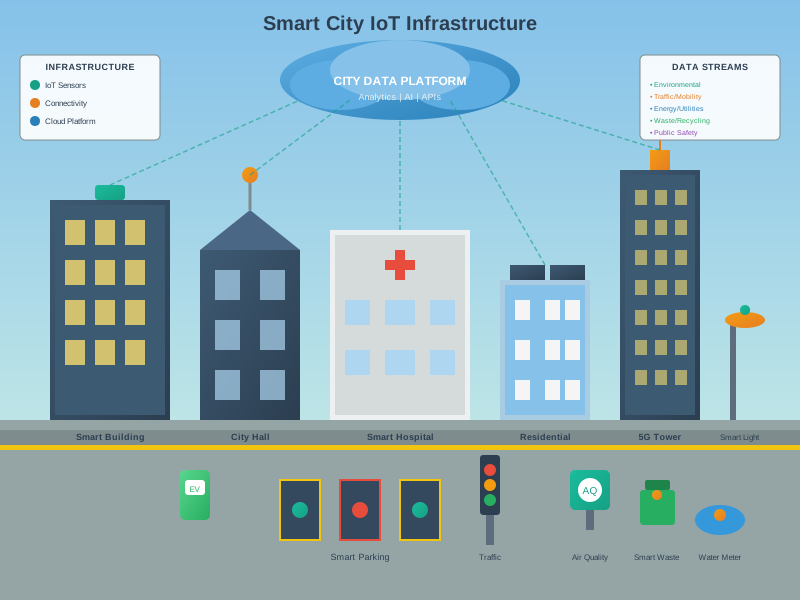
Explore how IoT transforms urban infrastructure through smart parking, traffic management, and municipal services.
114.4 Industry Framework: Verizon Smart Cities Taxonomy
An alternative way to organize smart city initiatives is by functional domain rather than specific application:
| Domain | Key Applications | Shared Infrastructure |
|---|---|---|
| Energy | Smart buildings, predictive maintenance, outage management | Building management systems, power grid sensors |
| Utility | Water/gas monitoring, equipment control, emergency response | SCADA systems, municipal networks |
| Vehicle | Parking, EV charging, traffic enforcement | Street-level sensors, payment systems |
| Transit | Fleet management, passenger information, asset tracking | GPS networks, real-time feeds |
| Public Safety | Surveillance, emergency alerts, adaptive lighting | Camera networks, city-wide comms |
Why This Framework Matters: When planning smart city deployments, grouping by functional domain helps identify: - Shared infrastructure (a parking sensor gateway can also serve EV chargers) - Common stakeholders (Transit and Vehicle both involve transportation department) - Integration opportunities (Energy + Public Safety share street light poles)
114.5 Smart Parking: Solving the “Cruising” Problem
The Hidden Cost of Parking Search:
One of the most overlooked sources of urban congestion is “cruising” - drivers circling blocks searching for available parking spots. Research consistently shows:
| City | Finding | Source |
|---|---|---|
| Average (all cities) | 30%+ of urban traffic is drivers searching for parking | Multiple studies |
| New York City | 29% of commuters spend 20+ minutes searching; 10% spend 40+ minutes | NYC DOT Survey |
| San Francisco | Average driver spends 17 minutes per trip cruising for parking | SFMTA Study |
| Los Angeles | Drivers cruise an average of 3.3 miles per parking attempt | UCLA Study |
Why This Matters for IoT:
The “cruising” problem represents a perfect IoT opportunity because:
- Real-time data is essential: Static parking maps are useless - spaces change minute-to-minute
- Small sensors, big impact: Each $150 magnetic sensor can eliminate thousands of miles of unnecessary driving
- Network effects: The more sensors deployed, the more valuable the system becomes
- Multiple stakeholders win: Drivers save time, cities reduce emissions, businesses gain foot traffic
Simple math: If a city has 50,000 parking spaces and each space turns over 5x/day, that’s 250,000 parking events. If IoT guidance saves just 5 minutes per event, that’s 20,000+ hours saved daily - equivalent to removing thousands of cars from roads.
Sensor Types for Vehicle Detection:
| Sensor Type | How It Works | Pros | Cons | Cost |
|---|---|---|---|---|
| Magnetic | Detects disturbance in Earth’s magnetic field when vehicle is present | Very accurate, low power, works in all weather | Requires road surface mounting | $150-300 |
| Infrared (IR) | Measures IR reflection from vehicle undercarriage | Fast detection, easy installation | Affected by debris, weather | $100-200 |
| Ultrasonic | Measures time-of-flight of sound waves to detect vehicle height | Works overhead, no road cutting | Weather-sensitive, limited range | $200-400 |
| Camera + AI | Computer vision analyzes video feed for vehicle presence | Multi-spot coverage, additional analytics | Higher power, privacy concerns | $500-1500 |
Key Design Insights: - Mesh networks with street lights: Sensors use low-power Zigbee to reach nearby street light poles, which aggregate data and relay via LoRaWAN/cellular - Dynamic pricing integration: Real-time occupancy enables surge pricing (higher rates during peak demand) - Multi-use infrastructure: Same sensors can detect traffic flow, illegal parking, and emergency vehicle priority
Scenario: The city of Austin, Texas (population 1,015,000) plans to deploy smart parking sensors downtown to reduce cruising-for-parking traffic by 25%.
Given: - Downtown parking inventory: 18,500 on-street spaces across 42 city blocks - Average driver spends 18 minutes searching for parking - Downtown traffic: 30% attributed to parking search - Target: 80% sensor coverage for reliable guidance (industry minimum) - Sensor cost: $185 per unit (magnetic sensor + installation) - Gateway coverage: 1 LoRaWAN gateway per 2 km radius ($2,400 each) - Downtown area: 8 km2
Steps:
- Calculate required sensor count for 80% coverage:
- Target sensors = 18,500 spaces x 80% = 14,800 sensors
- Calculate gateway requirements:
- Gateway coverage = pi x (2 km)2 = 12.57 km2 per gateway
- Downtown 8 km2 requires minimum 1 gateway, but for reliability: 3 gateways (overlap for redundancy)
- Calculate capital expenditure:
- Sensors: 14,800 x $185 = $2,738,000
- Gateways: 3 x $2,400 = $7,200
- Platform integration: $150,000 (one-time)
- Total CapEx: $2,895,200
- Calculate annual operating costs:
- Connectivity: 14,800 sensors x $1.50/month = $266,400/year
- Cloud platform: $4,500/month = $54,000/year
- Maintenance (5% replacement): 740 sensors/year x $185 = $136,900/year
- Total OpEx: $457,300/year
- Calculate projected savings:
- Current parking search traffic: 30% of downtown vehicle-hours
- Reduced search time: 18 min to 5 min (72% reduction)
- Traffic reduction: 30% x 72% = 21.6% downtown traffic reduction
- Fuel saved: ~890,000 gallons/year at $3.50 = $3,115,000/year
- Time saved: 1.2 million driver-hours x $12 avg wage = $14,400,000/year
- Parking revenue increase (better turnover): +$1,800,000/year
- Total annual benefit: $19,315,000
Result: ROI = 6,600% over 5 years with payback period of 2.1 months. Initial investment of $2.9M generates $19.3M annual benefit. The 80% coverage threshold is critical; at 50% coverage, driver trust drops and adoption fails.
Key Insight: Sensor density determines system credibility. Barcelona achieved success only after exceeding 80% coverage; NYC’s initial 40% pilot underperformed until expanded. Budget for complete coverage from the start rather than phased deployment that leaves gaps.
114.6 Smart Lighting and Street Infrastructure
See how smart lighting systems use sensors to adapt brightness based on pedestrian presence and ambient light levels.
Smart street lights serve as the backbone of city-wide IoT networks by providing: - Power: Continuous electricity for gateways and high-power sensors - Height: Optimal mounting positions for wide-area coverage - Connectivity: Integration points for multiple sensor types - Ubiquity: Street lights exist on virtually every block
DALI (Digital Addressable Lighting Interface) is the standard protocol for smart lighting control:
| Feature | DALI Specification |
|---|---|
| Topology | Bus-based, up to 64 devices per line |
| Communication | Bidirectional, query device status |
| Dimming | 0.1-100% logarithmic, 254 levels |
| Addressing | Individual or group control |
| Diagnostics | Lamp failure, hours, power consumption |
Open Loop Control (OLC) Architecture: - Street lights form a mesh network communicating via LoRaWAN to central management - Dimming schedules pushed daily, emergency overrides in real-time - Motion sensors trigger temporary full brightness for pedestrian safety - Energy savings of 30-50% compared to fixed schedules
114.7 Smart Waste Management
Dublin Airport’s smart waste system demonstrates 40% reduction in collection costs through fill-level monitoring.
Smart waste management uses ultrasonic sensors to measure bin fill levels and optimize collection routes:
Technology Stack: - Sensors: Ultrasonic fill-level (10-15 cm accuracy), temperature (fire detection), tilt (overflow/vandalism) - Connectivity: LoRaWAN or NB-IoT with 5-10 year battery life - Analytics: Route optimization algorithms, fill-level prediction, seasonal pattern recognition - Integration: Fleet management, citizen reporting apps, recycling tracking
Case Study: Dublin Airport - Deployed sensors in 500+ bins across terminal and grounds - 40% reduction in collection routes - 25% fuel savings - ROI achieved in 14 months
114.8 Cross-Domain Integration: The Smart City Platform
Scenario: Copenhagen, Denmark (population 805,000) evaluates deploying a unified IoT platform to integrate parking, street lighting, air quality, and waste management rather than four separate systems.
Given:
- Separate systems cost (current approach):
- Smart parking: $4.2M deployment + $380K/year ops
- Smart lighting: $8.5M deployment + $520K/year ops
- Air quality monitoring: $1.8M deployment + $180K/year ops
- Smart waste: $2.1M deployment + $240K/year ops
- Total separate: $16.6M deployment + $1.32M/year ops
- Unified platform cost (proposed):
- Shared LoRaWAN network: 45 gateways x $2,400 = $108K
- Multi-function sensor nodes: 12,000 nodes x $320 = $3.84M
- Integration platform (Sentilo-style): $950K
- Single ops team instead of four: $680K/year
Steps:
- Calculate unified deployment cost:
- Infrastructure: $108,000 + $3,840,000 + $950,000 = $4,898,000
- Savings vs. separate: $16.6M - $4.9M = $11.7M saved (70% reduction)
- Calculate annual operational savings:
- Separate ops: $1,320,000/year (4 teams, 4 platforms)
- Unified ops: $680,000/year (1 team, 1 platform)
- Annual savings: $640,000/year (48% reduction)
- Calculate cross-domain value creation:
- Air quality routing: Redirecting 15% of traffic from pollution hotspots reduces health costs by $2.8M/year
- Waste truck secondary sensing: Pothole detection saves $180K/year in reactive repairs
- Coordinated street light dimming: 8% additional energy savings = $340K/year
- Cross-domain value: $3,320,000/year
- Calculate 10-year total cost of ownership:
- Separate systems: $16.6M + (10 x $1.32M) = $29.8M
- Unified platform: $4.9M + (10 x $0.68M) - (10 x $3.32M) = -$21.5M (net positive)
Result: Unified platform delivers $51.3M advantage over 10 years compared to separate systems. Initial deployment saves $11.7M, annual ops saves $640K, and cross-domain analytics generate $3.32M/year in new value.
Key Insight: The biggest smart city mistake is deploying siloed systems. Shared infrastructure (gateways, connectivity, platform) reduces costs by 70%, and cross-domain data correlation unlocks value impossible with separate systems.
114.9 Smart City Deployment Tradeoffs
Option A: Deploy private LoRaWAN network - Lower per-device costs ($2-5/device/year), city owns infrastructure and data, works in unlicensed spectrum with no carrier dependency. Requires upfront gateway investment (~$1,000-3,000 per gateway covering 2-5 km radius).
Option B: Use carrier NB-IoT network - No infrastructure deployment needed, better building penetration, carrier-managed reliability with SLAs. Higher per-device costs ($5-15/device/year) with dependency on mobile operator coverage and pricing.
Decision factors: Scale of deployment (LoRaWAN economies improve above 5,000 devices), coverage requirements (NB-IoT penetrates underground parking better), data sovereignty concerns (government data on carrier infrastructure), and long-term cost projections (LoRaWAN infrastructure paid off in 3-5 years).
Option A: Single centralized IoT platform - Unified dashboard across all city services (parking, lighting, waste, water), easier cross-domain analytics, simpler vendor management. Risks: single point of failure, vendor lock-in, massive data privacy exposure, and political resistance from departments losing control.
Option B: Federated architecture with API integration - Each department maintains domain expertise and data ownership, incremental adoption possible, reduced privacy risk through data minimization. Challenges: interoperability complexity, duplicate infrastructure costs, harder to achieve cross-domain insights.
Decision factors: Organizational culture (centralized IT vs. departmental autonomy), privacy regulations (GDPR favors data minimization), procurement constraints (single large contract vs. multiple smaller ones), and the value of cross-domain analytics.
Option A: Real-time streaming data (sub-minute updates) - Enables dynamic responses like adaptive traffic signals, immediate parking availability apps, and instant leak detection. Higher infrastructure costs, more complex systems, and potential data overload for human operators.
Option B: Batch reporting (hourly, daily) - Sufficient for strategic planning, trend analysis, and most municipal decisions. Lower costs, simpler systems, and easier to audit. Cannot support time-sensitive applications like emergency response optimization.
Decision factors: Use case requirements (parking apps need real-time; urban planning needs monthly aggregates), budget constraints (real-time infrastructure costs 3-5x more), staff capacity to act on real-time data, and citizen expectations.
114.10 Common Smart City Pitfalls
The Mistake: Cities install thousands of sensors (parking, air quality, waste) with 3-5 year budgets but no ongoing maintenance allocation, expecting “set and forget” operations.
Why It Happens: Initial deployments focus on installation costs and immediate ROI demonstrations. Maintenance is viewed as an operational expense rather than capital investment. Political cycles favor visible new projects over sustaining existing infrastructure.
The Fix: Budget 15-20% of initial deployment cost annually for maintenance, battery replacement, and calibration. Include sensor lifecycle management in procurement contracts with mandatory 5+ year support terms. Create dedicated IoT operations teams rather than adding responsibilities to existing IT staff. Implement remote diagnostics to identify failing sensors before they impact service quality.
The Mistake: Deploying parking sensors, air quality monitors, traffic cameras, and waste sensors as independent systems with separate dashboards, missing the cross-domain insights that justify smart city investments.
Why It Happens: Different city departments (transportation, environment, sanitation) have separate budgets, vendors, and IT systems. Procurement processes favor specialized vendors over integrated platforms. Data governance policies create barriers to cross-department data sharing.
The Fix: Establish a unified data platform (like Barcelona’s Sentilo) with standardized APIs before deploying domain-specific sensors. Create cross-functional smart city teams with representation from all departments. Define data sharing agreements upfront that specify what data can be correlated across domains. Start with 2-3 high-value cross-domain use cases to demonstrate integration value before expanding.
The Mistake: Incrementally adding surveillance capabilities to smart city infrastructure without public awareness or explicit policy approval.
Symptoms: - Public backlash when citizens discover surveillance capabilities they did not know existed - Legal challenges under GDPR, CCPA, or local privacy regulations - Sensors collecting personally identifiable information (PII) without documented purpose - No clear data retention policies across different sensor types
Why it happens: Incremental upgrades seem harmless (“we already have the pole, why not add a camera?”), technology enables capabilities faster than policy can keep up, and vendors bundle features that cities did not specifically request.
The fix: Implement Privacy by Design principles from the start. Create a public registry of all city sensors with their data collection capabilities. Establish a citizen privacy board that must approve new sensor deployments. Use privacy-preserving techniques like differential privacy, edge processing, and aggregate-only analytics.
Prevention: Document the explicit purpose and retention period for each data type BEFORE deployment. Conduct Privacy Impact Assessments (PIAs) for all new sensor installations. Publish an annual transparency report showing what data is collected and how it is used.
114.11 Smart City Value Chain
Core Concept: Smart city success requires a unified data platform that connects disparate systems (parking, traffic, waste, lighting) through standard APIs - without this foundation, each deployment becomes an isolated silo that cannot share insights or coordinate responses.
Why It Matters: Cities deploying vertical solutions independently end up with 5+ citizen apps, redundant sensors measuring the same parameters, and emergency services lacking unified situational awareness. Barcelona avoided this trap by implementing Sentilo as a city-wide data platform, enabling cross-domain optimization (parking data improves traffic routing, traffic data triggers adaptive lighting).
Key Takeaway: Require all smart city vendors to expose data via FIWARE NGSI-LD or similar open standards. Establish a Chief Data Officer with cross-departmental authority before deploying any sensors. Budget 15-20% of smart city investments for integration infrastructure - this pays back through 30-50% better ROI on individual deployments.
Smart cities create value through a multi-stage process that transforms raw sensor data into actionable insights:
| Stage | Layer | Components | Examples |
|---|---|---|---|
| 1. Collection | Data Collection | Sensors and Detectors | Parking occupancy, Traffic cameras, Waste fill-levels, Light/motion sensors |
| 2. Transport | Connectivity | Network Technologies | LoRaWAN (long-range), Cellular (high bandwidth), Mesh (self-healing) |
| 3. Process | Analytics | Computing and ML | Edge (real-time), Cloud (patterns), ML (prediction/optimization) |
| 4. Action | Services | Applications | Citizen apps, Traffic control, Operations routing, Infrastructure efficiency |
| 5. Value | Outcomes | Measurable Benefits | 15-30% less congestion, 20-40% CO2 reduction, 30-50% cost savings |
114.12 Real-World Success Story: Barcelona
Barcelona, Spain demonstrates how IoT transforms urban infrastructure across multiple domains simultaneously:
Smart Parking (5,000+ sensors): - Technology: In-ground magnetic sensors + NB-IoT connectivity - Impact: 30% reduction in traffic searching for parking, saving 2.5 million hours/year - ROI: 50M EUR investment generated 50M EUR annual savings in reduced congestion + emissions
Smart Lighting (19,500 LED streetlights): - Technology: LoRaWAN-connected adaptive lighting with motion sensors - Impact: 30% energy savings = 9M EUR/year, LED lifespan 4x longer than sodium bulbs - Features: Remote dimming, fault detection, air quality sensors integrated
Smart Waste (3,500 bins with fill-level sensors): - Technology: Ultrasonic sensors + LoRaWAN, optimized collection routing - Impact: 20% reduction in collection routes = 12M EUR/year savings, 25% less CO2 emissions - Data: Real-time fullness alerts prevent overflows, improve urban cleanliness
Smart Water (1,000+ sensors across water network): - Technology: Pressure/flow sensors detect leaks, acoustic monitoring - Impact: Saved 25% of water (42,000 m3/year), reduced losses from 25% to 15% - Value: 58M EUR invested in sensor network, saving 75M EUR annually in water conservation
Cross-Domain Integration: - Unified IoT platform (Sentilo) connects all 4 domains - Open data portal provides citizen access to real-time city metrics - Total annual savings: 200M+ EUR across all smart city initiatives - Job creation: 47,000+ jobs in smart city tech sector
114.13 Summary
Smart cities represent the most ambitious application of IoT technology, integrating multiple domains to create more livable, efficient, and sustainable urban environments. Key success factors include:
- Sensor density thresholds: 80%+ coverage is the minimum for user trust and system value
- Shared infrastructure: LoRaWAN gateways, street light poles, and data platforms serve multiple domains
- Cross-domain integration: The biggest ROI comes from correlating data across parking, traffic, lighting, air quality, and waste
- Maintenance planning: Budget 15-20% annually for ongoing operations, not just initial deployment
- Privacy by design: Implement data governance before deploying surveillance-capable sensors
Cities that succeed treat smart city infrastructure as a platform for continuous improvement, not a one-time technology project.
114.14 What’s Next
With an understanding of city-scale IoT deployments, explore related domains:
- Transportation and Connected Vehicles - V2X communication and autonomous mobility
- Smart Grid and Energy - Electrical grid modernization
- Smart Home and Building Automation - Building-scale optimization