%%{init: {'theme': 'base', 'themeVariables': {'primaryColor': '#2C3E50', 'primaryTextColor': '#fff', 'primaryBorderColor': '#16A085', 'lineColor': '#16A085', 'secondaryColor': '#E67E22', 'tertiaryColor': '#7F8C8D'}}}%%
flowchart LR
    P["Position<br/>(meters)"]
    V["Velocity<br/>(m/s)"]
    A["Acceleration<br/>(m/s²)"]

    A -->|"integrate"| V
    V -->|"integrate"| P
    P -->|"d/dt differentiate"| V
    V -->|"d/dt differentiate"| A
1642 Mathematical Foundations for IoT
NoteKey Takeaway
In one sentence: You don’t need to be a mathematician to succeed in IoT engineering - focus on understanding what each concept means and when to apply it, not memorizing proofs.
Remember this rule: When you encounter a formula in IoT documentation, use this appendix to understand the intuition behind it and see practical examples before attempting implementation.
TipMVU: Mathematics for IoT Engineers
Core Concept: IoT engineering relies on a handful of mathematical tools - derivatives for measuring change, logarithms for managing large ranges, probability for handling uncertainty, and linear algebra for sensor fusion.
Why It Matters: Understanding these foundations lets you read datasheets, interpret signal measurements, configure PID controllers, and estimate battery life without guessing.
Key Takeaway: You do not need to derive formulas from scratch - focus on recognizing which tool applies to each problem and understanding the intuition behind the math.
1642.1 Purpose of This Appendix
This appendix provides the mathematical background needed to understand advanced IoT concepts. Unlike a mathematics textbook, we focus on intuition and application rather than rigorous proofs. Each section explains:
- What the mathematical concept is
- Why it matters for IoT
- How to apply it (with examples)
You don’t need to be a mathematician to succeed in IoT engineering. These foundations give you the vocabulary and intuition to understand technical documentation and make informed design decisions.
1642.2 A. Calculus Concepts for IoT
1642.2.1 A.1 Rates of Change (Derivatives)
TipThe Core Idea
A derivative measures how fast something is changing at any instant. In IoT, we constantly deal with changing quantities: temperature rising, battery depleting, signals fluctuating.
Notation: \(\frac{dx}{dt}\) means “the rate at which x changes with respect to time t”
IoT Applications:
| Scenario | What’s Changing | Derivative Meaning |
|---|---|---|
| Temperature monitoring | Temperature (T) | \(\frac{dT}{dt}\) = heating/cooling rate (°C/second) |
| Battery drain | Charge (Q) | \(\frac{dQ}{dt}\) = current flow (Amperes) |
| Vehicle tracking | Position (x) | \(\frac{dx}{dt}\) = velocity (m/s) |
| Signal processing | Voltage (V) | \(\frac{dV}{dt}\) = rate of voltage change |
Practical Example - PID Controller:
The PID formula uses derivatives: \[P(t) = K_p \cdot e(t) + K_i \cdot \int e(t)dt + K_d \cdot \frac{de(t)}{dt}\]
- P term: Current error (how far off are we?)
- D term (\(\frac{de}{dt}\)): How fast is the error changing? (prevents overshooting)
- I term: Accumulated error over time (corrects persistent drift)
Intuition: The derivative term is like a driver who slows down when approaching a stop sign - you react to how fast you’re approaching, not just how far away you are.
1642.2.2 A.2 Accumulation (Integrals)
TipThe Core Idea
An integral adds up many small pieces to get a total. Think of it as “continuous summation.”
Notation: \(\int f(x)dx\) means “sum up all the tiny pieces of f(x)”
IoT Applications:
| Scenario | What We’re Summing | Result |
|---|---|---|
| Energy consumption | Power × time | Total energy used (Joules) |
| Data transfer | Bits per second × time | Total data transferred (bytes) |
| Sensor noise | Small random fluctuations | Average reading (smoothing) |
| Battery capacity | Current × time | Charge used (mAh) |
Practical Example - Energy Budget:
Total energy consumed by an IoT device: \[E_{total} = \int_0^T P(t) \, dt\]
If power varies during operation: - Active mode: \(P_{active} = 50mW\) for 10ms - Sleep mode: \(P_{sleep} = 0.01mW\) for 990ms
\[E_{cycle} = (50mW \times 10ms) + (0.01mW \times 990ms) = 0.5mJ + 0.0099mJ \approx 0.51mJ\]
Intuition: Integration is like measuring water in a tank by tracking how fast it fills over time, even if the flow rate changes.
1642.2.3 A.3 The Derivative-Integral Relationship
Derivatives and integrals are inverses: - Derivative: Tells you the rate of change - Integral: Tells you the accumulated total
In sensor fusion, we often: - Integrate accelerometer data to get velocity - Integrate velocity to get position - Differentiate position to get velocity
1642.3 B. Exponential and Logarithmic Functions
1642.3.1 B.1 Exponential Growth and Decay
TipThe Core Idea
Exponential functions describe processes where change is proportional to the current value. Things grow (or decay) faster when there’s more of them.
The exponential function: \(y = e^x\) where \(e \approx 2.718\)
IoT Applications:
| Phenomenon | Formula | Description |
|---|---|---|
| Capacitor discharge | \(V(t) = V_0 \cdot e^{-t/\tau}\) | Voltage decays exponentially |
| Signal attenuation | \(P = P_0 \cdot e^{-\alpha d}\) | Power decreases with distance |
| Sensor warm-up | \(T(t) = T_{final}(1 - e^{-t/\tau})\) | Approaches target exponentially |
| Battery self-discharge | \(Q(t) = Q_0 \cdot e^{-\lambda t}\) | Charge slowly leaks away |
Time Constant (τ): - After \(1\tau\): Value drops to 37% of initial (\(e^{-1} \approx 0.37\)) - After \(3\tau\): Value drops to 5% of initial - After \(5\tau\): Value drops to 0.7% (essentially zero for practical purposes)
Practical Example - RC Time Constant:
A sensor with a 100Ω resistor and 10µF capacitor: \[\tau = R \times C = 100\Omega \times 10\mu F = 1ms\]
This sensor can respond to signals changing up to ~1000 Hz.
1642.3.2 B.2 Logarithms
TipThe Core Idea
A logarithm asks: “What power do I raise the base to, to get this number?” Logarithms compress large ranges into manageable scales.
Definition: If \(b^x = y\), then \(\log_b(y) = x\)
Common bases: - \(\log_{10}\) (common log) - used in dB calculations - \(\ln\) or \(\log_e\) (natural log) - used in signal processing - \(\log_2\) (binary log) - used in information theory (bits)
IoT Applications:
1. Decibels (dB) - Compress power ratios: \[dB = 10 \log_{10}\left(\frac{P_{out}}{P_{in}}\right)\]
| Power Ratio | dB Value |
|---|---|
| 1× (no change) | 0 dB |
| 2× (double) | +3 dB |
| 10× | +10 dB |
| 100× | +20 dB |
| 0.5× (half) | -3 dB |
| 0.1× | -10 dB |
2. Shannon Capacity - Maximum data rate: \[C = B \log_2(1 + SNR)\]
Where: - \(C\) = channel capacity (bits/second) - \(B\) = bandwidth (Hz) - \(SNR\) = signal-to-noise ratio
Why logarithm? Doubling SNR doesn’t double capacity - you get diminishing returns.
3. dBm (Power in milliwatts): \[dBm = 10 \log_{10}(P_{mW})\]
| Power | dBm |
|---|---|
| 1 mW | 0 dBm |
| 10 mW | 10 dBm |
| 100 mW | 20 dBm |
| 0.001 mW (1 µW) | -30 dBm |
1642.4 C. Linear Algebra Basics
1642.4.1 C.1 Vectors
TipThe Core Idea
A vector is an ordered list of numbers representing multiple related quantities. In IoT, sensors often produce vector outputs (e.g., 3-axis accelerometer gives [x, y, z]).
Notation: \(\vec{v} = \begin{bmatrix} x \\ y \\ z \end{bmatrix}\) or simply \([x, y, z]\)
IoT Applications:
| Data Type | Vector Representation |
|---|---|
| 3-axis accelerometer | \([a_x, a_y, a_z]\) in g-force |
| GPS position | \([latitude, longitude, altitude]\) |
| RGB color | \([red, green, blue]\) values 0-255 |
| IMU (9-axis) | \([a_x, a_y, a_z, g_x, g_y, g_z, m_x, m_y, m_z]\) |
Vector Operations:
Magnitude (Length): How “big” is the vector? \[|\vec{v}| = \sqrt{x^2 + y^2 + z^2}\]
Example: Accelerometer reads \([0.5, 0.3, 0.8]g\) \[|\vec{a}| = \sqrt{0.5^2 + 0.3^2 + 0.8^2} = \sqrt{0.98} \approx 0.99g\]
This tells us the total acceleration magnitude (useful for fall detection).
1642.4.2 C.2 Matrices
TipThe Core Idea
A matrix is a 2D array of numbers. Matrices transform vectors - rotate them, scale them, or combine multiple measurements.
Notation: \[M = \begin{bmatrix} a & b \\ c & d \end{bmatrix}\]
IoT Applications:
1. Coordinate Transformation:
Rotating sensor data to align with a reference frame: \[\begin{bmatrix} x' \\ y' \end{bmatrix} = \begin{bmatrix} \cos\theta & -\sin\theta \\ \sin\theta & \cos\theta \end{bmatrix} \begin{bmatrix} x \\ y \end{bmatrix}\]
2. Kalman Filter State:
State vector might be \([position, velocity, acceleration]\): \[\vec{x} = \begin{bmatrix} p \\ v \\ a \end{bmatrix}\]
State transition predicts next state: \[\vec{x}_{k+1} = F \cdot \vec{x}_k\]
3. Covariance Matrix:
Describes uncertainty in measurements: \[P = \begin{bmatrix} \sigma_x^2 & \sigma_{xy} \\ \sigma_{xy} & \sigma_y^2 \end{bmatrix}\]
Diagonal elements: Variance (uncertainty) in each variable Off-diagonal: How variables correlate (change together)
1642.4.3 C.3 Matrix Multiplication
NoteQuick Rule
To multiply matrix A (m×n) by matrix B (n×p), the inner dimensions must match. Result is (m×p).
Example: Transforming a 3D point \[\begin{bmatrix} 2 & 0 & 0 \\ 0 & 2 & 0 \\ 0 & 0 & 2 \end{bmatrix} \begin{bmatrix} 1 \\ 2 \\ 3 \end{bmatrix} = \begin{bmatrix} 2 \\ 4 \\ 6 \end{bmatrix}\]
This scales the vector by 2 in all directions.
1642.5 D. Probability and Statistics
1642.5.1 D.1 Basic Probability
TipThe Core Idea
Probability quantifies uncertainty. In IoT, sensor readings are never perfect - probability helps us reason about noise, errors, and reliability.
Key Concepts:
| Term | Definition | IoT Example |
|---|---|---|
| Probability P(A) | Chance of event A (0 to 1) | P(packet loss) = 0.02 |
| Expected Value E[X] | Average outcome | Average sensor reading |
| Variance Var(X) | Spread around average | Noise level |
| Standard Deviation σ | √Variance | ±σ covers 68% of readings |
Practical Example - Sensor Reliability:
If a sensor has 99.9% uptime: - P(working) = 0.999 - P(failure) = 0.001
For 100 sensors, expected failures = 100 × 0.001 = 0.1 per unit time
1642.5.2 D.2 Gaussian (Normal) Distribution
TipThe Core Idea
The Gaussian distribution (bell curve) describes random noise in most physical systems. It’s characterized by mean (μ) and standard deviation (σ).
\[p(x) = \frac{1}{\sigma\sqrt{2\pi}} e^{-\frac{(x-\mu)^2}{2\sigma^2}}\]
Properties: - 68% of values within μ ± 1σ - 95% of values within μ ± 2σ - 99.7% of values within μ ± 3σ
IoT Application - Sensor Noise:
A temperature sensor with: - Mean reading: μ = 25.0°C - Noise: σ = 0.5°C
95% of readings will be between 24.0°C and 26.0°C.
1642.5.3 D.3 Sensor Fusion: Combining Measurements
When you have two noisy measurements of the same thing, the optimal combination is:
\[x_{combined} = \frac{\sigma_2^2 \cdot x_1 + \sigma_1^2 \cdot x_2}{\sigma_1^2 + \sigma_2^2}\]
Intuition: Weight each measurement inversely by its uncertainty. Trust the more precise sensor more.
Example: - GPS says position is 100m (σ = 10m) - Accelerometer integration says 95m (σ = 5m)
\[x_{combined} = \frac{25 \times 100 + 100 \times 95}{100 + 25} = \frac{2500 + 9500}{125} = 96m\]
The combined estimate is closer to the accelerometer (more precise).
1642.6 E. Modular Arithmetic for Cryptography
1642.6.1 E.1 The Modulo Operation
TipThe Core Idea
Modular arithmetic is “clock arithmetic.” After reaching a maximum value, numbers wrap around to zero.
Notation: \(a \mod n\) = remainder when a is divided by n
Examples: - \(7 \mod 5 = 2\) (7 = 1×5 + 2) - \(25 \mod 7 = 4\) (25 = 3×7 + 4) - \(12 \mod 12 = 0\) (clock wraps at midnight)
1642.6.2 E.2 Why Modular Arithmetic for Cryptography?
Key Property: Easy to compute forward, hard to reverse.
Example - Discrete Logarithm:
Given: \(g = 5\), \(p = 23\)
Forward (easy): Calculate \(5^7 \mod 23\) \[5^7 = 78125 \mod 23 = 17\]
Reverse (hard): Given 17, find x where \(5^x \mod 23 = 17\)
This “trapdoor” property enables public-key cryptography.
1642.6.3 E.3 Diffie-Hellman Key Exchange
Two IoT devices can agree on a shared secret over an insecure channel:
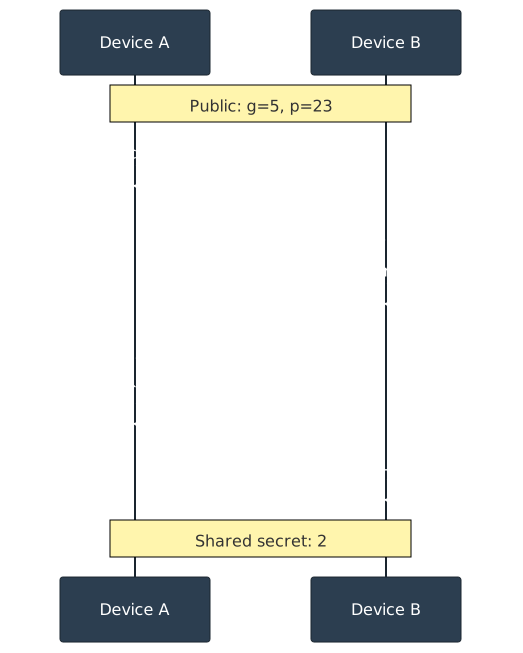
%%{init: {'theme': 'base', 'themeVariables': {'primaryColor': '#2C3E50', 'primaryTextColor': '#2C3E50', 'primaryBorderColor': '#16A085', 'lineColor': '#16A085'}}}%%
flowchart TB
    subgraph PUBLIC["Public Information (Eavesdropper Sees)"]
        SHARED["🟡 Shared Base Color<br/>Yellow (g=5, p=23)"]
        MSG_A["🟠 A's Public Message<br/>Orange = Yellow + Red"]
        MSG_B["🟢 B's Public Message<br/>Green = Yellow + Blue"]
    end

    subgraph DEV_A["Device A (Private)"]
        SECRET_A["🔴 Secret Color: Red<br/>(a = 6, private)"]
        COMPUTE_A["🟤 Compute: Green + Red<br/>= Brown (shared secret)"]
    end

    subgraph DEV_B["Device B (Private)"]
        SECRET_B["🔵 Secret Color: Blue<br/>(b = 15, private)"]
        COMPUTE_B["🟤 Compute: Orange + Blue<br/>= Brown (shared secret)"]
    end

    SHARED --> MSG_A
    SHARED --> MSG_B
    SECRET_A --> MSG_A
    SECRET_B --> MSG_B
    MSG_B --> COMPUTE_A
    MSG_A --> COMPUTE_B
    SECRET_A --> COMPUTE_A
    SECRET_B --> COMPUTE_B

    style PUBLIC fill:#F5F5F5,stroke:#7F8C8D,stroke-width:2px
    style DEV_A fill:#E8F4F8,stroke:#16A085,stroke-width:2px
    style DEV_B fill:#E8F4F8,stroke:#16A085,stroke-width:2px
    style SHARED fill:#F1C40F,stroke:#2C3E50,stroke-width:1px
    style MSG_A fill:#E67E22,stroke:#2C3E50,stroke-width:1px
    style MSG_B fill:#27AE60,stroke:#2C3E50,stroke-width:1px
    style SECRET_A fill:#E74C3C,stroke:#2C3E50,stroke-width:1px,color:#fff
    style SECRET_B fill:#3498DB,stroke:#2C3E50,stroke-width:1px,color:#fff
    style COMPUTE_A fill:#8B4513,stroke:#2C3E50,stroke-width:2px,color:#fff
    style COMPUTE_B fill:#8B4513,stroke:#2C3E50,stroke-width:2px,color:#fff
An eavesdropper sees only 8 and 19 - computing the shared secret requires solving the discrete logarithm problem (computationally infeasible for large numbers).
1642.7 F. Complex Numbers for Signal Processing
1642.7.1 F.1 What Are Complex Numbers?
TipThe Core Idea
Complex numbers extend real numbers to include \(i = \sqrt{-1}\). They’re essential for representing signals that have both amplitude and phase.
Form: \(z = a + bi\) - \(a\) = real part - \(b\) = imaginary part
Alternative (Polar) Form: \(z = r \cdot e^{i\theta}\) - \(r\) = magnitude (amplitude) - \(\theta\) = phase angle
1642.7.2 F.2 Why Complex Numbers in IoT?
1. Representing Sinusoidal Signals:
A sensor reading: \(v(t) = A \cos(\omega t + \phi)\)
Using Euler’s formula: \(e^{i\theta} = \cos\theta + i\sin\theta\)
We can write: \(v(t) = \text{Re}[A \cdot e^{i(\omega t + \phi)}]\)
2. Fourier Transform:
Converts time-domain signals to frequency-domain: \[X(f) = \int_{-\infty}^{\infty} x(t) \cdot e^{-i2\pi ft} \, dt\]
The result is complex: - Magnitude \(|X(f)|\) tells you “how much” of each frequency - Phase \(\angle X(f)\) tells you “when” each frequency component peaks
3. I/Q Signals in Radio:
LoRa and other radios use I/Q (In-phase/Quadrature) representation: - I = real part of signal - Q = imaginary part of signal
This allows representing any modulation scheme.
1642.7.3 F.3 Complex Number Operations
| Operation | Formula | Signal Processing Meaning |
|---|---|---|
| Addition | \((a+bi) + (c+di) = (a+c) + (b+d)i\) | Superimposing signals |
| Magnitude | \(|a+bi| = \sqrt{a^2+b^2}\) | Signal amplitude |
| Phase | \(\angle(a+bi) = \arctan(b/a)\) | Signal timing |
| Multiplication | Magnitudes multiply, phases add | Mixing/modulation |
1642.8 G. Information Theory Basics
1642.8.1 G.1 Bits and Entropy
TipThe Core Idea
Entropy measures information content or uncertainty. More unpredictable data requires more bits to represent.
Entropy formula: \[H = -\sum_i p_i \log_2(p_i)\]
Where \(p_i\) is the probability of each outcome.
Example - Sensor Alarm: - Alarm triggers 1% of the time - \(H = -(0.01 \log_2 0.01 + 0.99 \log_2 0.99)\) - \(H = -(0.01 \times -6.64 + 0.99 \times -0.014) = 0.08\) bits
The alarm provides only 0.08 bits of information per reading (very predictable).
1642.8.2 G.2 Shannon Capacity
The maximum rate at which information can be reliably transmitted:
\[C = B \log_2(1 + SNR)\]
Practical Implications:
| SNR | Capacity (per Hz of bandwidth) |
|---|---|
| 1 (0 dB) | 1 bit/s/Hz |
| 3 (5 dB) | 2 bit/s/Hz |
| 7 (8.5 dB) | 3 bit/s/Hz |
| 15 (12 dB) | 4 bit/s/Hz |
| 31 (15 dB) | 5 bit/s/Hz |
Key Insight: To double capacity, you need to roughly quadruple SNR. This explains why LoRa trades data rate for range (lower SNR = lower rate but still works).
1642.9 H. Quick Reference Card
1642.9.1 Essential Formulas for IoT
1642.9.1.1 Signal Processing
| Formula | Expression |
|---|---|
| Nyquist Rate | \(f_{sample} \geq 2 \times f_{max}\) |
| Shannon Capacity | \(C = B \times \log_2(1 + SNR)\) |
| dB conversion | \(dB = 10 \times \log_{10}(P_2/P_1)\) |
| dBm from mW | \(dBm = 10 \times \log_{10}(P_{mW})\) |
1642.9.1.2 Wireless
| Formula | Expression |
|---|---|
| Free Space Loss | \(FSPL = 20\log_{10}(d) + 20\log_{10}(f) + 20\log_{10}(4\pi/c)\) |
| Link Budget | \(P_{rx} = P_{tx} + G_{tx} + G_{rx} - L_{path}\) |
| Path Loss (approx) | \(L \propto d^n\) (n = 2 free space, 3-4 urban) |
1642.9.1.3 Electronics
| Formula | Expression |
|---|---|
| Ohm’s Law | \(V = I \times R\) |
| Power | \(P = V \times I = I^2R = V^2/R\) |
| RC Time Constant | \(\tau = R \times C\) |
| Capacitor Voltage | \(V(t) = V_0 \times e^{-t/\tau}\) |
1642.9.1.4 Battery Life
| Formula | Expression |
|---|---|
| Average Current | \(I_{avg} = (I_{active} \times D) + (I_{sleep} \times (1-D))\) |
| Battery Life | \(Hours = mAh / mA_{average}\) |
1642.9.1.5 Sensor Fusion
| Formula | Expression |
|---|---|
| Weighted Average | \(x = (\sigma_2^2 \times x_1 + \sigma_1^2 \times x_2) / (\sigma_1^2 + \sigma_2^2)\) |
| Combined Variance | \(\sigma^2 = (\sigma_1^2 \times \sigma_2^2) / (\sigma_1^2 + \sigma_2^2)\) |
1642.9.1.6 Probability
| Formula | Expression |
|---|---|
| Gaussian 68-95-99 | \(\mu \pm 1\sigma\) (68%), \(\mu \pm 2\sigma\) (95%), \(\mu \pm 3\sigma\) (99.7%) |
| Expected Value | \(E[X] = \sum(x \times P(x))\) |
1642.10 Visual Reference Gallery
NoteKalman Filter Visualization

The Kalman filter optimally combines predictions with noisy measurements, essential for sensor fusion in navigation and tracking applications.
NoteSignal Processing Pipeline
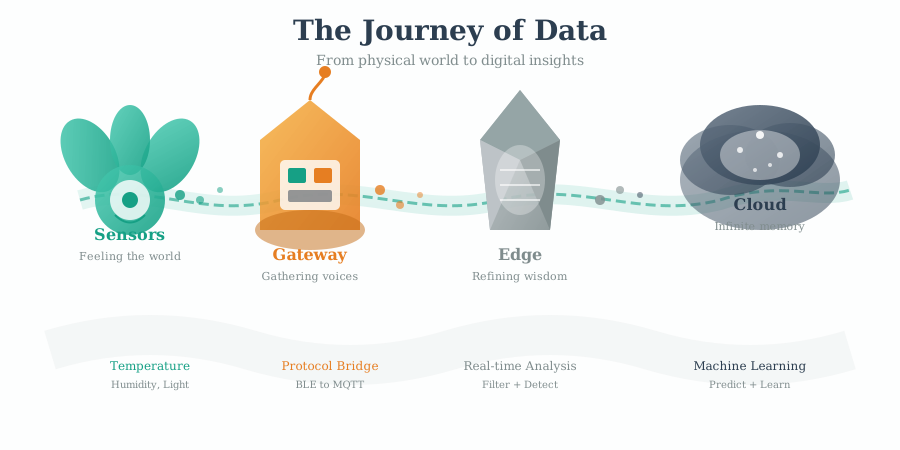
Signal processing transforms raw sensor data into meaningful information through filtering, sampling, and mathematical transformations.
1642.11 Summary
This appendix covered the mathematical foundations used throughout the IoT textbook:
| Topic | Key Concept | Primary Use |
|---|---|---|
| Calculus | Rates & accumulation | PID control, energy budgets |
| Exponentials | Growth/decay | Signal attenuation, battery life |
| Logarithms | Compression | dB scales, Shannon capacity |
| Linear Algebra | Vectors, matrices | Sensor fusion, Kalman filter |
| Probability | Uncertainty | Noise modeling, reliability |
| Modular Arithmetic | Wraparound math | Cryptography |
| Complex Numbers | Amplitude + phase | Signal processing, radio |
| Information Theory | Bits, entropy | Channel capacity, compression |
1642.12 Knowledge Check
1642.13 What’s Next
With these mathematical foundations, you’re equipped to understand:
- Signal Processing Essentials - Applying Fourier transforms and filtering
- Multi-Sensor Data Fusion - Kalman filtering in practice
- Encryption Principles - Cryptographic algorithms
- Energy-Aware Design - Power calculations
Return to the Main Appendix for quick reference tables and formulas.