1641 Appendix
In one sentence: This appendix is your quick-reference companion for IoT terminology, protocol comparisons, sensor specifications, and essential engineering formulas.
Remember this rule: Use this appendix to refresh your memory during design decisions or study sessions, but return to the detailed chapters for deeper explanations and context.
1641.1 Learning Objectives
By using this appendix, you will be able to:
- Look up IoT terminology: Find definitions for acronyms and technical terms used throughout the book
- Compare protocols: Use reference tables to evaluate different IoT technologies
- Reference sensor specifications: Access common sensor parameters for design decisions
- Apply engineering formulas: Use networking, electronics, and battery life calculations
- Find standards references: Access links to IEEE, IETF, and industry specifications
1641.2 A. Glossary of IoT Terms
| Term | Definition |
|---|---|
| 6LoWPAN | IPv6 over Low-Power Wireless Personal Area Networks - Adaptation layer enabling IPv6 on IEEE 802.15.4 networks |
| ADC | Analog-to-Digital Converter - Hardware that converts continuous analog signals to discrete digital values |
| AMQP | Advanced Message Queuing Protocol - Message-oriented middleware protocol for reliable messaging |
| BLE | Bluetooth Low Energy - Low-power variant of Bluetooth designed for IoT applications |
| CoAP | Constrained Application Protocol - Lightweight protocol for resource-constrained IoT devices |
| DTLS | Datagram Transport Layer Security - Security protocol for UDP-based communications |
| Edge Computing | Processing data near the source rather than in a centralized cloud |
| Fog Computing | Distributed computing layer between edge devices and cloud |
| Gateway | Device that bridges different network protocols or technologies |
| GPIO | General Purpose Input/Output - Configurable pins on microcontrollers |
| I²C | Inter-Integrated Circuit - Two-wire serial communication protocol |
| IoT | Internet of Things - Network of physical devices connected to the internet |
| LoRa | Long Range - Spread spectrum modulation technique for LPWAN |
| LoRaWAN | LoRa Wide Area Network - MAC layer protocol built on LoRa |
| LPWAN | Low-Power Wide-Area Network - Network designed for long range, low power IoT |
| M2M | Machine-to-Machine - Direct communication between devices |
| MAC | Media Access Control - Protocol layer managing access to shared medium |
| MCU | Microcontroller Unit - Integrated circuit containing processor, memory, and I/O |
| MQTT | Message Queuing Telemetry Transport - Lightweight publish/subscribe protocol |
| NB-IoT | Narrowband IoT - Cellular LPWAN technology using licensed spectrum |
| NFC | Near Field Communication - Short-range wireless technology (~10cm) |
| OTA | Over-The-Air - Wireless delivery of updates or configuration |
| PHY | Physical Layer - Lowest layer of the OSI model handling raw bit transmission |
| PWM | Pulse Width Modulation - Technique for controlling power to devices |
| QoS | Quality of Service - Mechanism for prioritizing network traffic |
| REST | Representational State Transfer - Architectural style for web services |
| RFID | Radio-Frequency Identification - Wireless identification using radio waves |
| RPL | Routing Protocol for Low-Power and Lossy Networks |
| RSSI | Received Signal Strength Indicator - Measure of signal power |
| RTT | Round-Trip Time - Time for a signal to travel to destination and back |
| SDN | Software-Defined Networking - Network architecture with centralized control |
| Sigfox | Proprietary LPWAN technology using ultra-narrow band |
| SPI | Serial Peripheral Interface - Synchronous serial communication protocol |
| TLS | Transport Layer Security - Cryptographic protocol for secure communication |
| UART | Universal Asynchronous Receiver/Transmitter - Serial communication hardware |
| UDP | User Datagram Protocol - Connectionless transport protocol |
| WSN | Wireless Sensor Network - Network of distributed sensor nodes |
| Zigbee | IEEE 802.15.4-based specification for low-power mesh networks |
| Z-Wave | Proprietary wireless protocol for home automation |
1641.3 B. Protocol Comparison Tables
1641.3.1 Short-Range Wireless Protocols
| Protocol | Range | Data Rate | Power | Topology | Use Cases |
|---|---|---|---|---|---|
| Wi-Fi | 50-100m | 1-1000+ Mbps | High | Star | High-bandwidth applications |
| Bluetooth | 10-100m | 1-3 Mbps | Medium | Point-to-point | Audio, data transfer |
| BLE | 10-100m | 1-2 Mbps | Low | Star, Mesh | Wearables, beacons |
| Zigbee | 10-100m | 250 kbps | Very Low | Mesh | Home automation |
| Z-Wave | 30-100m | 100 kbps | Very Low | Mesh | Home automation |
| Thread | 10-30m | 250 kbps | Very Low | Mesh | Smart home |
| NFC | <10cm | 424 kbps | Very Low | Point-to-point | Payments, access |
1641.3.2 LPWAN Technologies
| Technology | Range | Data Rate | Spectrum | Topology | Battery Life |
|---|---|---|---|---|---|
| LoRaWAN | 2-15 km | 0.3-50 kbps | Unlicensed | Star | 10+ years |
| Sigfox | 10-50 km | 100-600 bps | Unlicensed | Star | 10+ years |
| NB-IoT | 1-10 km | 20-250 kbps | Licensed | Star | 10+ years |
| LTE-M | 1-10 km | 1 Mbps | Licensed | Star | 10+ years |
| Weightless | 5-10 km | 0.1-10 Mbps | Varies | Star | 10+ years |
1641.3.3 Application Layer Protocols
| Protocol | Transport | Message Pattern | QoS | Overhead | Best For |
|---|---|---|---|---|---|
| MQTT | TCP | Pub/Sub | 0,1,2 | Low | Real-time telemetry |
| CoAP | UDP | Request/Response | Confirmable | Very Low | Constrained devices |
| HTTP/REST | TCP | Request/Response | N/A | High | Web integration |
| AMQP | TCP | Queue-based | Yes | Medium | Enterprise messaging |
| XMPP | TCP | Pub/Sub | N/A | High | Presence, messaging |
1641.4 C. Common Sensor Specifications
1641.4.1 Temperature Sensors
| Sensor | Range | Accuracy | Interface | Power |
|---|---|---|---|---|
| DHT22 | -40 to 80°C | ±0.5°C | Digital | 1.5mA |
| DS18B20 | -55 to 125°C | ±0.5°C | 1-Wire | 1.5mA |
| BME280 | -40 to 85°C | ±1°C | I²C/SPI | 3.6µA |
| LM35 | -55 to 150°C | ±0.5°C | Analog | 60µA |
| TMP117 | -55 to 150°C | ±0.1°C | I²C | 3.5µA |
1641.4.2 Motion/Orientation Sensors
| Sensor | Type | Range | Interface | Features |
|---|---|---|---|---|
| MPU6050 | 6-axis IMU | ±16g, ±2000°/s | I²C | Gyro + Accel |
| MPU9250 | 9-axis IMU | ±16g, ±2000°/s | I²C/SPI | + Magnetometer |
| ADXL345 | Accelerometer | ±16g | I²C/SPI | Low power |
| HC-SR501 | PIR Motion | 3-7m | Digital | Adjustable |
1641.4.3 Distance/Proximity Sensors
| Sensor | Technology | Range | Accuracy | Interface |
|---|---|---|---|---|
| HC-SR04 | Ultrasonic | 2-400cm | ±3mm | GPIO |
| VL53L0X | ToF Laser | 0-200cm | ±3% | I²C |
| Sharp GP2Y0A21 | IR | 10-80cm | ±5% | Analog |
1641.5 D. ESP32 Pin Reference
1641.5.1 GPIO Capabilities
| GPIO | Input | Output | ADC | DAC | Touch | Notes |
|---|---|---|---|---|---|---|
| 0 | ✓ | ✓ | ✓ | - | ✓ | Boot mode (pull-up) |
| 1 | - | ✓ | - | - | - | TX0 |
| 2 | ✓ | ✓ | ✓ | - | ✓ | On-board LED |
| 3 | ✓ | - | - | - | - | RX0 |
| 4 | ✓ | ✓ | ✓ | - | ✓ | General purpose |
| 5 | ✓ | ✓ | - | - | - | VSPI CS |
| 12-15 | ✓ | ✓ | ✓ | - | ✓ | HSPI |
| 16-17 | ✓ | ✓ | - | - | - | UART2 |
| 18-19 | ✓ | ✓ | - | - | - | VSPI |
| 21-22 | ✓ | ✓ | - | - | - | I²C |
| 23 | ✓ | ✓ | - | - | - | VSPI MOSI |
| 25-26 | ✓ | ✓ | ✓ | ✓ | - | DAC capable |
| 27 | ✓ | ✓ | ✓ | - | ✓ | General purpose |
| 32-39 | ✓ | * | ✓ | - | * | ADC1 (34-39 input only) |
1641.5.2 Common Pin Assignments
Default I²C:  SDA = GPIO 21, SCL = GPIO 22
Default SPI:  MOSI = GPIO 23, MISO = GPIO 19, SCK = GPIO 18, CS = GPIO 5
UART0:        TX = GPIO 1, RX = GPIO 3 (USB Serial)
UART2:        TX = GPIO 17, RX = GPIO 16
1641.6 E. Unit Conversions
1641.6.1 Data Rate
| Unit | Equivalent |
|---|---|
| 1 bps | 1 bit/second |
| 1 kbps | 1,000 bps |
| 1 Mbps | 1,000,000 bps |
| 1 Gbps | 1,000,000,000 bps |
| 1 Byte/s | 8 bps |
1641.6.2 Signal Strength (dBm)
| dBm | mW | Typical Use |
|---|---|---|
| 30 | 1000 | Max Wi-Fi (US) |
| 20 | 100 | Typical router |
| 10 | 10 | - |
| 0 | 1 | - |
| -10 | 0.1 | Good Wi-Fi signal |
| -50 | 0.00001 | Excellent Wi-Fi |
| -70 | 0.0000001 | Good Wi-Fi |
| -90 | 0.000000001 | Weak Wi-Fi |
| -120 | - | LoRa sensitivity |
1641.6.3 Power Consumption
| Current | @ 3.3V | Battery Life (2000mAh) |
|---|---|---|
| 1 mA | 3.3 mW | 83 days |
| 100 µA | 330 µW | 833 days (2.3 years) |
| 10 µA | 33 µW | 22.8 years |
| 1 µA | 3.3 µW | 228 years |
1641.7 F. Useful Formulas
1641.7.1 Networking
Free Space Path Loss (dB): \[FSPL = 20 \log_{10}(d) + 20 \log_{10}(f) + 20 \log_{10}\left(\frac{4\pi}{c}\right)\]
Link Budget: \[P_{rx} = P_{tx} + G_{tx} + G_{rx} - L_{path} - L_{other}\]
Shannon Capacity: \[C = B \log_2(1 + SNR)\]
1641.7.2 Electronics
Ohm’s Law: \[V = I \times R\]
Power: \[P = V \times I = I^2 \times R = \frac{V^2}{R}\]
Voltage Divider: \[V_{out} = V_{in} \times \frac{R_2}{R_1 + R_2}\]
RC Time Constant: \[\tau = R \times C\]
Cutoff Frequency (RC Filter): \[f_c = \frac{1}{2\pi RC}\]
1641.7.3 Battery Life
Battery Life (hours): \[Life = \frac{Battery_{mAh}}{I_{average_{mA}}}\]
Duty Cycle Average Current: \[I_{avg} = (I_{active} \times D) + (I_{sleep} \times (1-D))\]
Where D = duty cycle (0-1)
1641.8 G. References and Further Reading
Core Concept: IoT standards come from different organizations - IEEE for physical/MAC layers (802.11, 802.15.4), IETF for internet protocols (CoAP, 6LoWPAN, RPL), and industry alliances for application-specific specs (LoRaWAN, Zigbee, Matter).
Why It Matters: Knowing which organization owns a standard tells you where to find official documentation, certification requirements, and future roadmaps for the technology you are using.
Key Takeaway: When researching a protocol, start with the standards body that owns it - IEEE for wireless PHY/MAC, IETF for IP-based protocols, and alliance websites for ecosystem-specific features.
1641.8.1 Standards Organizations
- IEEE: ieee.org - 802.11, 802.15.4 standards
- IETF: ietf.org - CoAP, 6LoWPAN, RPL RFCs
- LoRa Alliance: lora-alliance.org - LoRaWAN specification
- Zigbee Alliance: csa-iot.org - Zigbee, Matter standards
- Bluetooth SIG: bluetooth.com - Bluetooth specifications
1641.8.2 Key RFCs and Standards
| Document | Title |
|---|---|
| RFC 7252 | CoAP - Constrained Application Protocol |
| RFC 6550 | RPL - Routing Protocol for LLNs |
| RFC 4944 | IPv6 over 802.15.4 (6LoWPAN) |
| RFC 6282 | 6LoWPAN Header Compression |
| IEEE 802.15.4 | Low-Rate Wireless PANs |
| IEEE 802.11 | Wireless LAN (Wi-Fi) |
1641.9 Visual Reference Gallery
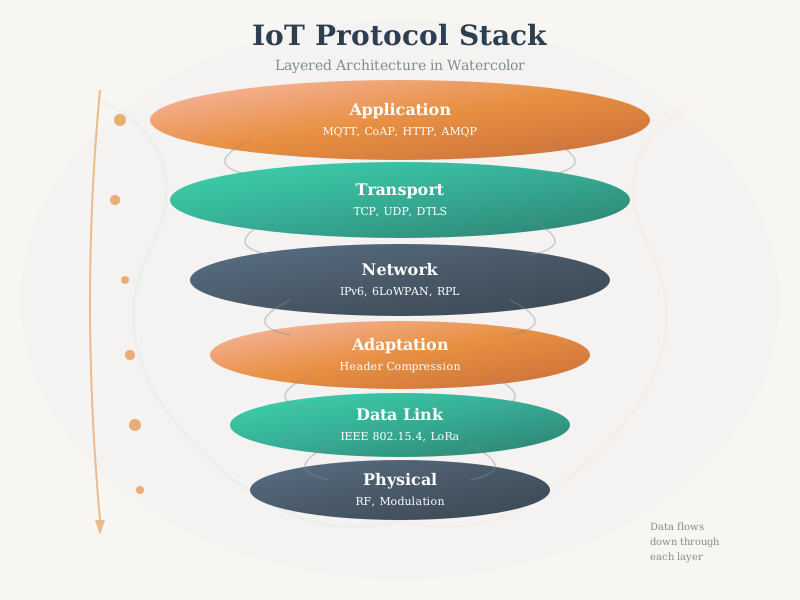
The IoT protocol ecosystem spans multiple layers, each with specialized protocols optimized for constrained devices and networks.
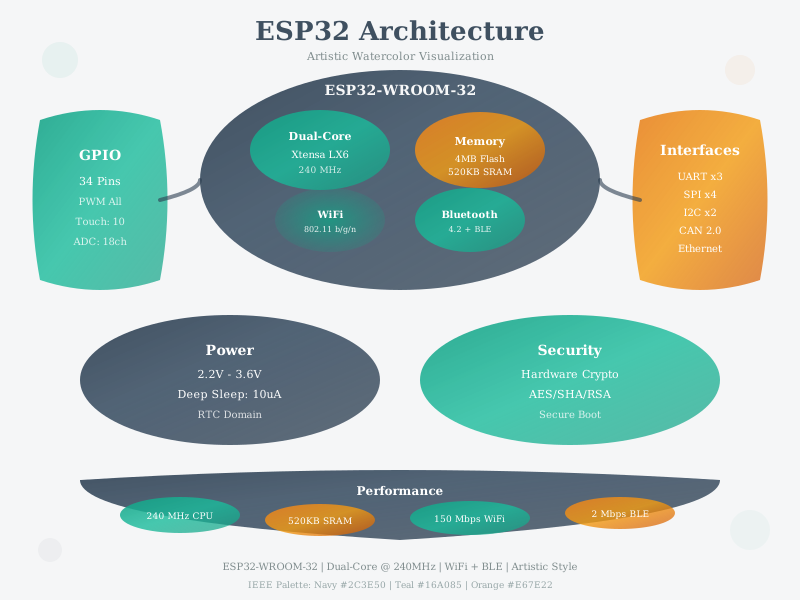
The ESP32 combines dual-core processing with integrated wireless connectivity, making it a popular choice for IoT prototyping and production.
1641.10 Summary
This appendix serves as a quick reference companion to the main textbook:
- Glossary: 45+ IoT terms with concise definitions
- Protocol Comparisons: Side-by-side tables for wireless, LPWAN, and application protocols
- Sensor Specifications: Common temperature, motion, and distance sensors with specs
- ESP32 Pin Reference: GPIO capabilities and common pin assignments
- Engineering Formulas: Essential calculations for link budgets, battery life, and electronics
1641.11 Knowledge Check
1641.12 What’s Next
Use this appendix as a reference while studying:
- Return to specific chapters for detailed explanations of concepts
- Use the Quiz Navigator to test your understanding
- Try the Simulation Playground to apply these concepts hands-on