44 Security Papers Guide

More
Depth: Practitioner
Progress saves as you read. Mark sections complete as you go; your progress appears in the sidebar.
44.1 In 60 Seconds
This section: In 60 Seconds — Imagine a team using an old research paper to approve a new connected lock.
Imagine a team using an old research paper to approve a new connected lock. The paper may explain a lasting risk, but its devices and controls may no longer match the product. A protocol is a set of rules for exchanging messages.
Start by writing the paper’s main claim in plain words. Find the evidence, assumptions, and limits that support it. Then compare those facts with the device, network, people, and threat being reviewed today. Check a newer source when a standard or attack has changed. Record what the paper helps decide and what it cannot decide.
Read the title and ending first. Then inspect how the authors reached that ending. Count the systems or sources they studied. Look for missing groups and old assumptions. Mark a claim that still fits. Mark one that needs a current check. Use the paper to sharpen a question, not to avoid a product test.
Use a one-page reading record. Write the question you brought to the paper. Name the system the authors studied. Mark the year and threat setting. List the evidence they collected. Separate a measured result from an author opinion. Note what was outside the study. Check whether the devices and network still match your case. Find one newer source for a claim that may have changed. Keep the exact section that supports your decision.
End with a bounded statement. Say what the paper helps you believe. Say what it does not prove. Name the product test or review that must come next.
This guide does not turn two surveys into current deployment rules. Research supports judgment; it does not replace product evidence. The Practitioner section compares the papers by theme. Under the Hood follows their security, privacy, and trust arguments. This chapter helps you read two IoT security survey papers without turning them into outdated deployment recipes. Roman et al. focus on why distributed IoT systems are difficult to secure when devices are exposed, heterogeneous, and not always governed by one central authority. Sicari et al. show why security, privacy, and trust must be reviewed together rather than as separate checkboxes.
44.2 Start With the Story
This section: Start With the Story — You will turn security and privacy survey claims into explicit trust boundaries and checks for a connected product.
You will turn security and privacy survey claims into explicit trust boundaries and checks for a connected product. Start with an asset, the actors who access it, and the assumptions each paper makes about them.
Follow the connected-lock review across four beats to keep durable paper evidence separate from current product proof.
-

Bex: “Start with the design question, then ask what each paper can support.”
-

Test Tessa: “The risk may last, but these devices and controls no longer match our product.”
-

Packet Pete: “Keep the claim, evidence, assumptions, and limits attached to the record.”
-

Test Tessa: “The paper sharpens the review; current evidence still decides the product.”
Read the story panels from the two surveys to the product test. Their security and privacy concerns remain useful, but the mismatch panel exposes device, gateway, and trust assumptions that no longer describe the connected lock. The bounded record keeps each claim attached to its evidence and limits. Independent tests of the present system then decide acceptance, so older research sharpens the threat model without supplying unearned assurance.
44.3 Learning Objectives
This section: Learning Objectives — The two lanes in Figure 44.1 give the papers different jobs.
By the end of this chapter, you will be able to:
- Read security survey papers as structured threat and design evidence.
- Separate paper-era taxonomy from modern security implementation choices.
- Explain why distributed IoT changes trust, authentication, update, and privacy assumptions.
- Use the security-privacy-trust triad to find blind spots in an IoT design.
- Build a reading record that preserves claims, evidence, assumptions, and follow-up checks.
- Avoid copying paper examples, old incident framing, or mechanism lists into a current design without verification.
Use these papers to learn the vocabulary of risk, trust, privacy, and evidence. Use current device-security baselines, protocol RFCs, implementation guidance, and threat modeling for engineering decisions.
The two lanes in Figure 44.1 give the papers different jobs. Roman et al. starts with the system shape, network boundary, and distributed trust path; the reading check asks where an attacker is assumed to stand. Sicari et al. places security, privacy, and trust controls together, then asks where a gain in one dimension could weaken another. The map ends at present-day review work: a device-security baseline, protocol RFC, threat or privacy review, and implementation test. Use the papers to frame a question and name an assumption. Use current guidance and product evidence to decide whether the proposed control works in this deployment.
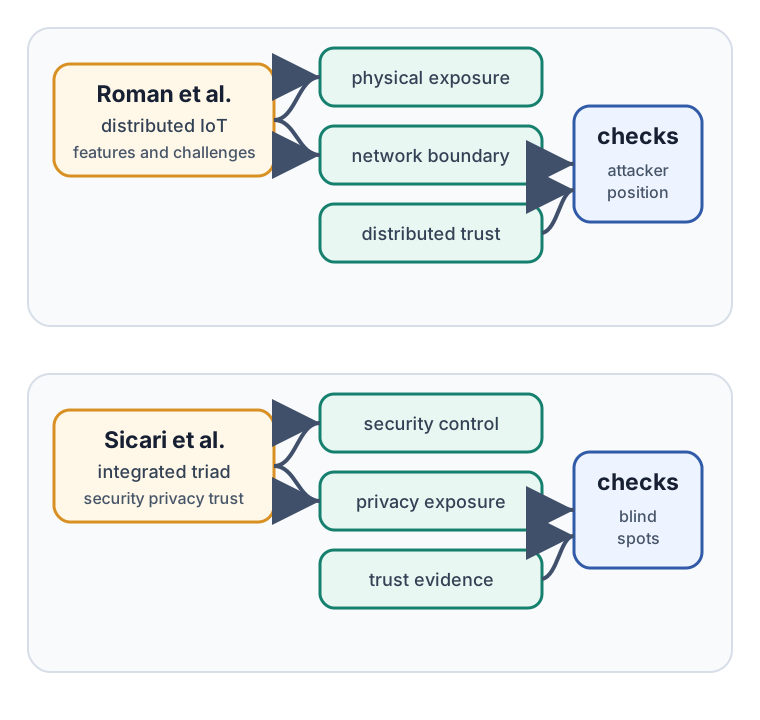
The lanes in Figure 44.1 link Roman and Sicari to trust and privacy checks; use both in review.
44.4 Papers Covered
This section: Papers Covered — This guide focuses on two papers because they frame IoT security from complementary angles: distributed-system risk and integrated security governance.
This guide focuses on two papers because they frame IoT security from complementary angles: distributed-system risk and integrated security governance.
R. Roman, J. Zhou, and J. Lopez, “On the features and challenges of security and privacy in distributed internet of things.”
- Venue: Computer Networks, 57(10), 2266-2279
- DOI: https://doi.org/10.1016/j.comnet.2012.12.018
- Read for: distributed IoT features, attack surfaces, trust assumptions, and privacy challenges when devices operate outside a clean central perimeter.
S. Sicari, A. Rizzardi, L. A. Grieco, and A. Coen-Porisini, “Security, privacy and trust in Internet of Things: The road ahead.”
- Venue: Computer Networks, 76, 146-164
- DOI: https://doi.org/10.1016/j.comnet.2014.11.008
- Read for: the security-privacy-trust triad, taxonomy of mechanisms, and gap analysis across device, network, data, and application responsibilities.
44.5 Standards And Framework Trail
This section: Standards And Framework Trail — The goal is not to memorize every later document.
These papers are not standards, but they are useful starting points for later checks:
- RFC 8576 for an IETF view of IoT security challenges.
- RFC 8613 for OSCORE object security.
- RFC 9147 for DTLS 1.3.
- RFC 9528 for EDHOC key establishment.
- NISTIR 8259 series for IoT device cybersecurity capability baselines.
- ETSI EN 303 645 for consumer IoT cybersecurity baseline expectations.
The goal is not to memorize every later document. The goal is to see when a paper’s vocabulary needs a modern standard, baseline, or product-specific evidence check.
Inspect Figure 44.2 and look for a control that improves one review dimension while weakening another.
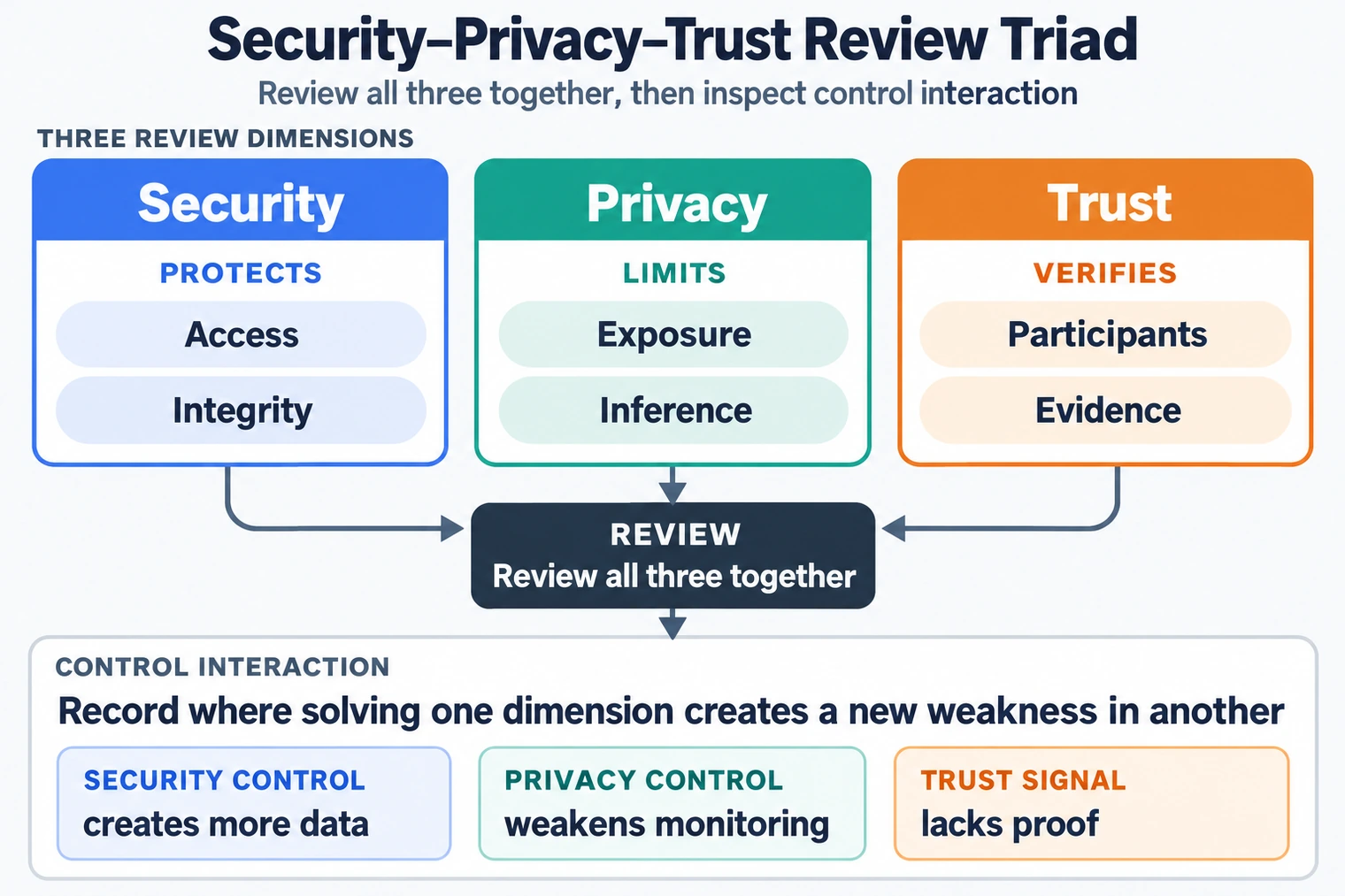
Read Figure 44.2 across security, privacy, and trust. Security guards access and data integrity. Privacy limits what data may reveal. Trust checks the actors and the proof. The three overlap, but one cannot stand in for another. More logs may create more personal data. Less data may make a fault harder to find. A trust signal may also lack proof from an outside source. The review arrow asks the team to save both the planned control and any new weak point it creates. Class the research claim, inspect these cross-effects, and choose local proof for the full control set.
44.6 Lane 1: Roman et al.
This section: Lane 1: Roman et al.
44.6.1 How to Use: Why Read It
Roman et al. are useful because they treat IoT security as a distributed-system problem. The paper asks what changes when sensing, actuation, communication, and local decision-making are spread across many constrained and physically exposed nodes.
Read it to answer four questions:
- Where does the system lose the clean perimeter assumed by traditional IT security?
- Which threats appear because devices are physically reachable or operationally unattended?
- What trust assumptions are made between devices, gateways, services, and users?
- Which privacy risks come from observation, location, behavior inference, or data combination?
44.6.2 What To Extract
System shape: Record whether the paper describes centralized, distributed, peer-to-peer, or gateway-mediated IoT.
Threat boundary: Separate physical access, network access, application behavior, and data exposure.
Trust assumption: Record who is allowed to introduce, authenticate, revoke, or update a device.
Privacy assumption: Record what data can identify, locate, profile, or infer behavior about a person or organization.
44.6.4 Checkpoint: Checks While Reading
- Do not treat every old taxonomy item as equally important for a current design.
- Do not map “distributed” to “more secure” or “less secure” by default. It changes where evidence is needed.
- Do not copy incident anecdotes into a design decision unless the attack path still exists in the target system.
- Do not ignore maintenance. Authentication, update, revocation, and inventory controls are part of the trust model.
44.7 Lane 2: Sicari et al.
This section: Lane 2: Sicari et al.
44.7.1 How to Use: Why Read It
Sicari et al. are useful because they show that IoT security decisions often fail when security, privacy, and trust are reviewed separately. Encryption can protect data in transit while still enabling unnecessary data collection. Privacy controls can reduce exposure while still accepting unauthenticated input. Trust labels can be meaningless without evidence.
Read it to answer four questions:
- Which requirement is about security, which is about privacy, and which is about trust?
- Where does solving one dimension create a new weakness in another?
- Which controls require constrained-device support and which can be handled by gateways, services, or operations?
- Which gaps in the paper are now covered by later standards, and which still require project-specific design?
44.7.2 What To Extract
Security control: Record confidentiality, integrity, availability, authentication, authorization, update, and monitoring requirements.
Privacy control: Record minimization, purpose limitation, aggregation, retention, and inference-risk controls.
Trust control: Record identity proofing, attestation, reputation, provenance, revocation, and accountability mechanisms.
Interaction risk: Record where a security control creates more data, where a privacy control weakens monitoring, or where a trust signal lacks proof.
Inspect Figure 44.3 and ask what local product evidence must follow a research claim before it changes a security design.
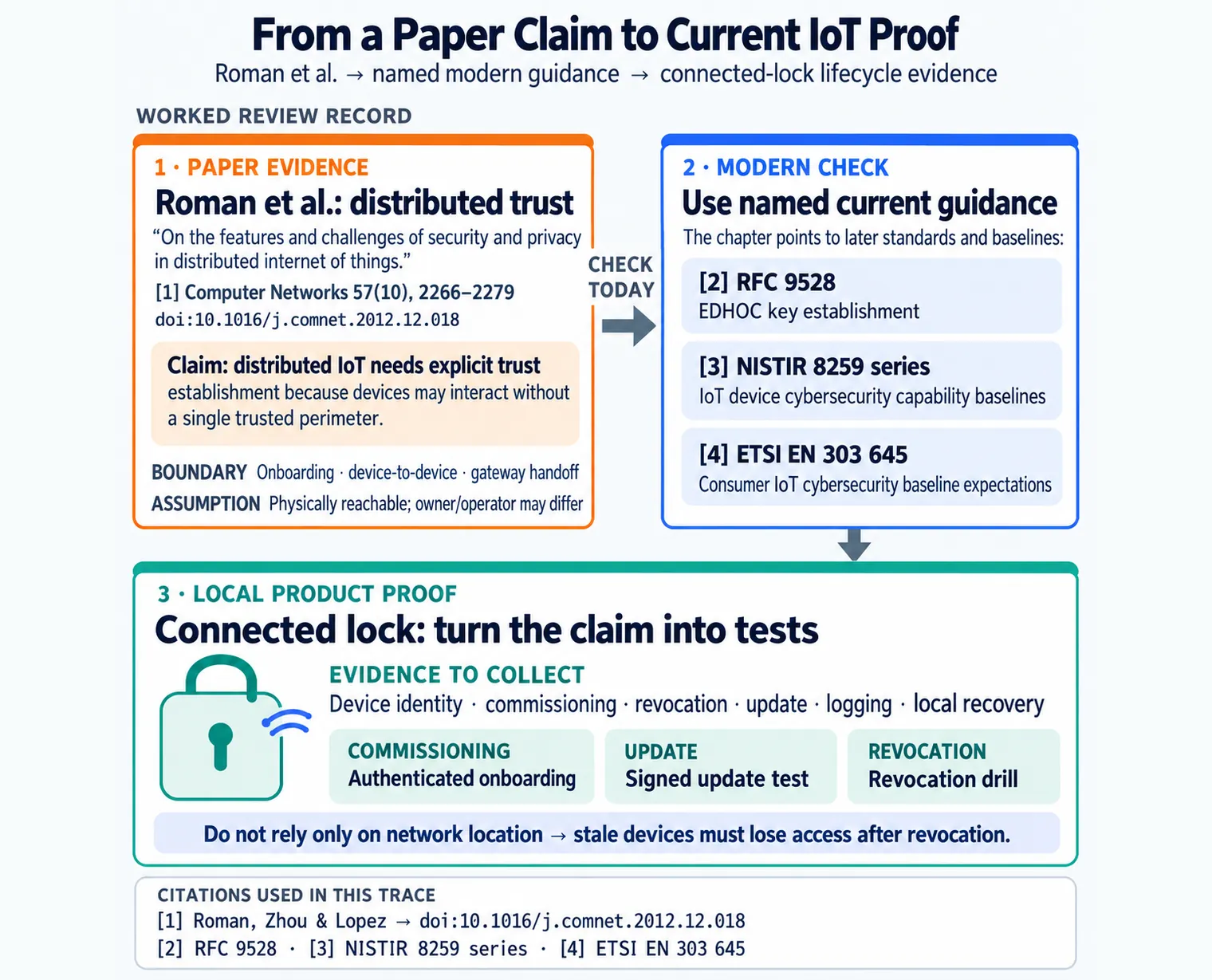
Move through Figure 44.3 from the claim to the product choice. Restate the paper’s security, privacy, or trust claim in plain words. Name the risk type so an access result is not used as privacy proof. Save the device limits, topology, attacker place, staff process, and data risk. A current RFC, device baseline, threat map, privacy review, or code test checks if the claim still holds. Local proof then names the next product test. Only after that may the record change setup, updates, identity, logs, data use, or fault response. Research informs the review; it does not replace site proof.
44.7.4 Checkpoint: Checks While Reading
- Do not reduce the paper to a list of cryptographic mechanisms.
- Do not assume privacy is solved by encryption. Exposure, retention, inference, and purpose still matter.
- Do not assume trust is solved by one certificate or one onboarding event. Revocation, update, and monitoring still matter.
- Do not claim regulatory compliance from a survey paper. Use the paper to identify questions, then verify against the applicable policy and governance process.
44.8 Cross-Paper Synthesis
This section: Cross-Paper Synthesis — Read the two papers together as an evidence-building exercise.
Read the two papers together as an evidence-building exercise.
Roman helps you locate where IoT trust breaks down in distributed environments. Sicari helps you prevent one-dimensional fixes by reviewing security, privacy, and trust together.
44.8.1 How to Use: Synthesis Record
Use this format for each reusable claim:
- Paper: Roman or Sicari.
- Claim: The paper’s security, privacy, or trust point in one sentence.
- Affected boundary: Physical, network, application, data, operations, or user boundary.
- Assumption: Device capability, topology, attacker position, operator process, or data sensitivity.
- Modern check: RFC, device-security baseline, threat model, privacy review, or implementation test.
- Design consequence: What the claim changes in onboarding, update, identity, logging, data handling, or incident response.
44.8.2 Example Synthesis
Claim: Distributed IoT systems need explicit trust establishment because devices may interact without a single trusted perimeter.
Affected boundary: Device onboarding, device-to-device communication, and gateway handoff.
Assumption: Devices can be physically reachable and may not share the same owner or operator.
Modern check: Device identity, commissioning, revocation, update, logging, and local recovery evidence.
Design consequence: The design cannot rely only on network location. It needs authenticated onboarding, revocation path, and evidence that stale devices lose access.
44.9 Common Pitfalls
This section: Common Pitfalls
Survey papers organize the problem space; they do not freeze best practice. Use them to find questions, then verify against current standards, implementation evidence, and project constraints.
Encryption and authentication can still support surveillance or excessive retention if the data model is wrong. Always ask what is collected, why it is needed, how long it persists, and what can be inferred.
Trust is not only device onboarding. A design also needs update, revocation, ownership transfer, monitoring, and recovery evidence.
Historical incidents can help explain a threat path, but they should not replace a threat model. Record the actual precondition: default credential, exposed service, unpatched firmware, weak update path, or missing segmentation.
44.10 Knowledge Check
This section: Knowledge Check
44.10.1 Knowledge Check: Roman Reading Lens
44.10.2 Knowledge Check: Sicari Reading Lens
44.10.3 Matching Check
44.10.4 Ordering Check
44.11 Deep Dive: Security Papers As Boundary Evidence
This section: Deep Dive: Security Papers As Boundary Evidence — Read Roman et al.
Read Roman et al. and Sicari et al. as evidence for where an IoT system needs proof, not as a menu of controls to copy. Roman’s distributed-IoT framing starts with boundary loss: sensors, gateways, users, and services may sit under different owners, in exposed locations, and on constrained networks where a traditional enterprise perimeter is a weak assumption. Sicari’s security-privacy-trust framing adds a second discipline: every control should be checked for what it protects, what it exposes, and what evidence makes it trustworthy over the device lifecycle.
The classic CIA triad still matters: confidentiality protects who can read data, integrity protects whether data can be changed undetected, and availability protects whether the system keeps working. IoT reading notes should add authentication, authorization, update, revocation, and privacy inference because field devices create failure modes that office systems often hide. A sensor can be stolen, a gateway can bridge trust zones, a cloud service can retain too much data, and a device identity can remain active after ownership changes.
| Review field | Security-paper question | Evidence to seek |
|---|---|---|
| Boundary | Which device, gateway, service, operator, or user boundary is crossed? | Data-flow diagram, trust-boundary map, threat model |
| Attacker position | Is the attacker local, radio-adjacent, network-adjacent, remote, insider, or supply-chain? | Abuse case, access precondition, test setup |
| Control placement | Is the control on the device, gateway, cloud, manufacturing line, or operations process? | Architecture decision, owner, fallback path |
| Lifecycle proof | How are identity, updates, revocation, transfer, and recovery handled? | Commissioning logs, signed update test, revocation drill |
| Privacy proof | What is collected, retained, inferred, shared, and deleted? | Data inventory, retention rule, inference-risk review |
44.11.1 Control Placement And CoAP Security
Turn the surveys into an engineering worksheet by separating risk dimension, control placement, and verification evidence. A control can sit on the device, in the gateway, in the cloud service, in manufacturing, or in operations. Roman helps you ask whether a device can trust its neighbor, gateway, update channel, or cloud endpoint. Sicari helps you ask whether that trust proof also respects privacy and whether the control creates new data that needs retention and access rules.
| Goal | Mechanism | IoT realization | Verification evidence |
|---|---|---|---|
| Confidentiality | Encryption | DTLS for CoAP over UDP, TLS for MQTT over TCP, OSCORE for CoAP object protection | Cipher suite, endpoint identity, packet capture, proxy behavior |
| Integrity | MAC or signature | DTLS/TLS records, signed firmware, authenticated messages | Tamper test, update verification, replay behavior |
| Authentication | Identity proof | X.509 certificates, raw public keys, pre-shared keys, EDHOC-established OSCORE contexts | Provisioning record, uniqueness check, rotation plan |
| Availability | Resilience | Rate limiting, watchdogs, rollback-safe firmware, graceful offline behavior | Load test, failure injection, recovery drill |
| Privacy | Minimization and governance | Local aggregation, retention limits, access logging, purpose limitation | Data inventory, retention test, role review |
| Trust | Lifecycle evidence | Commissioning, attestation, revocation, ownership transfer, audit accountability | Join log, revocation test, transfer checklist |
A CoAP sensor makes the distinction concrete. If the sensor uses coaps://, CoAP is protected by DTLS, the datagram cousin of TLS. Confidentiality and integrity come from DTLS record protection; authentication can use a pre-shared key, raw public key, or certificate depending on provisioning cost and fleet-management needs. If the design uses OSCORE instead, the review record should say that object security protects CoAP messages across proxies while DTLS protects a transport channel. The paper note should not say “use encryption”; it should say which endpoint is authenticated, who provisions credentials, how keys rotate, and how a lost or sold device loses access.
44.11.2 Constrained Crypto And Lifecycle Proof
At the protocol layer, the papers’ trust language becomes concrete key-establishment and identity evidence. Strong authentication often rests on public-key cryptography, but classic RSA keys are large and slow for small microcontrollers. Constrained devices often use elliptic-curve cryptography, such as NIST P-256 or Ed25519 where the protocol and ecosystem support it, because comparable security levels can use much smaller keys than RSA. Where public-key operations are still too costly, pre-shared keys can reduce handshake cost, but they raise lifecycle questions about uniqueness, rotation, compromise blast radius, and manufacturing control.
Cryptography alone is not security. Roman’s distributed-boundary problem includes physical tampering, debug ports, firmware extraction, radio replay, gateway compromise, cloud API misuse, and human onboarding errors. Sicari’s triad adds the cases where a secure channel still enables privacy harm because the product collects too much data, keeps it too long, or exposes inference through logs and analytics. A rigorous reading note separates the cipher from the system property: TLS, DTLS, OSCORE, and EDHOC can protect messages or keys, but they do not automatically prove secure boot, patch delivery, least privilege, data minimization, or deletion.
A vendor shipping locks with a single hard-coded password creates a fleet-wide failure without any cryptographic break. The fix is architectural: unique per-device credentials, authenticated commissioning, encrypted transport, signed firmware, local recovery, and revocation that can remove a stale or transferred device. The review record should also ask what the lock logs, whether access events reveal occupancy patterns, who can view those logs, and when they are deleted.
The highest-quality synthesis is a trace from paper claim to testable evidence. A Roman-inspired claim about distributed trust should end in tests for onboarding, key storage, gateway handoff, revocation, update rollback, and offline behavior. A Sicari-inspired claim about security-privacy-trust interaction should end in tests for collection limits, authorization scopes, audit accountability, and residual-risk signoff. That trace prevents a survey citation from turning into a vague “secure by design” assertion.
44.12 Summary
This section: Summary — Roman et al.
Roman et al. and Sicari et al. are most useful when they make your review more precise. Roman helps you find distributed trust and boundary problems. Sicari helps you keep security, privacy, and trust from drifting apart. Together they support a disciplined reading workflow: extract the claim, identify the assumption, check current guidance, and record what the design must prove.
44.14 What’s Next
This section: What’s Next — Next, continue with the remaining paper-reading guides and use the same review record format: paper claim, affected boundary, assumption, modern check, and design consequence.
Next, continue with the remaining paper-reading guides and use the same review record format: paper claim, affected boundary, assumption, modern check, and design consequence.
44.15 Key Takeaway
This section: Key Takeaway — Security papers depend on threat models.
Security papers depend on threat models. Track the adversary, assumptions, assets, mitigations, evidence, and residual risk before applying a paper to an IoT design.
Find help
3 reviewed answers.
Where should I start in a module?
Open the module page from the sidebar to see its chapters in order. Use the module map to return to a topic you need.
Modules and pathsReviewed
What can I try when a project does not work?
Check the symptom, then work through the diagnostic steps. Keep the error message and the smallest example that reproduces it.
When you are stuckReviewed
How do interactive examples work?
Use the interactive guide to check how examples and simulations work before changing your project.
Interactive examples guideReviewed