40 How to Read Research Papers

More
Depth: Practitioner
Progress saves as you read. Mark sections complete as you go; your progress appears in the sidebar.
40.1 In 60 Seconds
This section: In 60 Seconds — Picture a design meeting where someone cites a paper to prove that a network choice is best.
Turn One Research Claim Into a Testable Question
Picture a design meeting where someone cites a paper to prove that a network choice is best. The study may be careful, but it tested a different place, device set, and year. A strong paper can still be weak evidence for the decision in front of the team.
A protocol is an agreed set of message and timing rules. If a paper compares protocols, first write the exact claim in one sentence. Name the people or system studied, the conditions, the measured result, and the limit stated by the authors. Keep those facts separate from your own conclusion.
Read in three passes. First decide whether the paper matches the question. Next trace the method, evidence, and main result. Last, inspect assumptions, missing cases, and sources. Change one condition from your project and ask whether the claim would still hold. Record the follow-up test and the design choice it could change.
This method does not make one paper final proof. Later work or field evidence may disagree. The deeper sections show how to choose a reading lane and build a review record that carries claims without turning them into folklore.
The paper guides help you read foundational IoT research without copying old numbers, old platform choices, or citation-count rankings into current designs. Start with the engineering question, choose the matching paper lane, read in three passes, and finish with a review record: claim, assumption, evidence, follow-up check, and design consequence.
40.2 Start With the Story
This section: Start With the Story — You will read a research paper in three passes and produce a record of its claims, evidence, assumptions, and limits.
You will read a research paper in three passes and produce a record of its claims, evidence, assumptions, and limits. Start with your design question, then choose the reading lane that can help answer it.
Follow one design review across four beats to see how a paper becomes bounded engineering evidence instead of folklore.
-

Packet Pete: “This paper looks relevant to our design question.”
-

Bex: “A memorable claim without its boundaries turns into folklore.”
-

Test Tessa: “Separate what the paper claims from how and where it was tested.”
-

The team: “Carry the insight forward, then verify the current decision independently.”
Read the story panels from the promising paper to the bounded design consequence. Relevance begins with a question, but the folklore panel shows what happens when a memorable claim loses its test conditions. Three passes recover the problem, method, evidence, assumptions, and limits. Only then does the review inform one present decision, paired with a fresh validation check that keeps inherited insight separate from current proof.
40.3 Paper Reading Guides
This section: Paper Reading Guides — This overview explains how to use the four focused guide chapters in this section.
Research papers are useful when they explain design pressure: why a protocol exists, which assumptions shaped an architecture, where a security model draws its boundary, or why low-power sensing systems behave the way they do. They are less useful when treated as timeless implementation recipes.
This overview explains how to use the four focused guide chapters in this section. Each guide helps you extract durable ideas while keeping historical context, current standards, and target-system measurement separate.
40.4 Learning Objectives
This section: Learning Objectives
By the end of this chapter, you will be able to:
- Choose the right paper-guide lane for a WSN, protocol, architecture, or security question.
- Apply a three-pass reading workflow before investing deep reading time.
- Separate paper contribution, assumption, evidence, and modern follow-up check.
- Use citation history as context without treating it as an engineering ranking.
- Build a reusable review record that links paper claims to current design decisions.
- Decide when to read an older survey, a focused protocol paper, a standard, or a later deployment study.
40.5 Quick Check: Reading A Paper
This section: Quick Check: Reading A Paper
40.6 Reading Contract
This section: Reading Contract — Read papers to improve engineering judgment.
Read papers to improve engineering judgment. Do not treat old survey tables, platform examples, energy ratios, threat lists, or protocol rankings as current guidance unless you can connect them to present standards, target measurements, or deployment evidence.
The map in Figure 40.1 moves from sensor networks to standards, design, and security; follow that order.
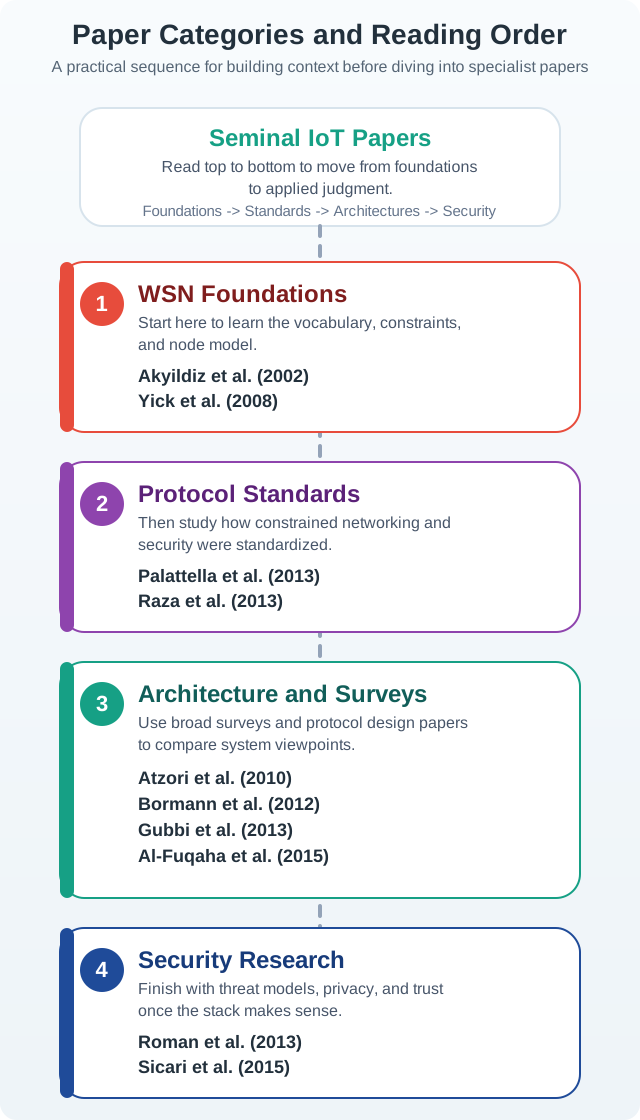
View Figure 40.1 as a hand-off: Start with vocabulary, constraints, first highlights Start with vocabulary, constraints,, and node model then uses and node model to test technical feasibility, and Protocol Standards finally highlights Protocol Standards. For Reading Contract, these labelled responsibilities give Paper Categories and Reading Order its place in the running narrative.
40.7 Choose The Right Reading Lane
This section: Choose The Right Reading Lane — Start with the question you need to answer.
Start with the question you need to answer. The best first paper is not always the oldest paper, the most cited paper, or the paper with the broadest title.
40.7.1 WSN Papers Guide
Use this lane when the question is about constrained sensing, node energy, radio behavior, routing pressure, aggregation, topology, or the roots of low-power sensor-network design.
Best output: a record of which WSN assumption still matters and what must be measured on the target system.
40.7.2 Protocol Papers Guide
Use this lane when the question is about constrained IPv6 stacks, 6TiSCH, DTLS on small devices, OSCORE, EDHOC, standards evolution, or protocol-design trade-offs.
Best output: a record of which paper claim belongs to research context and which follow-up belongs to an RFC or implementation profile.
40.7.3 Architecture Papers Guide
Use this lane when the question is about IoT vocabulary, system boundaries, layer models, cloud and edge placement, taxonomy, or the design rationale behind CoAP.
Best output: a record of the architecture model, its assumptions, and the current chapter or standard that should validate it.
40.7.4 Security Papers Guide
Use this lane when the question is about threat boundaries, distributed trust, privacy risk, security taxonomy, and how to turn survey-era security language into a review checklist.
Best output: a record of asset, threat, trust boundary, privacy impact, and the control or verification step that must follow.
40.8 The Three-Pass Workflow
This section: The Three-Pass Workflow — The three-pass method prevents a common failure mode: reading every page before you know whether the paper answers your question.
The three-pass method prevents a common failure mode: reading every page before you know whether the paper answers your question.
Inspect Figure 40.2 and ask at which pass a paper claim becomes consequential enough to affect a design decision.
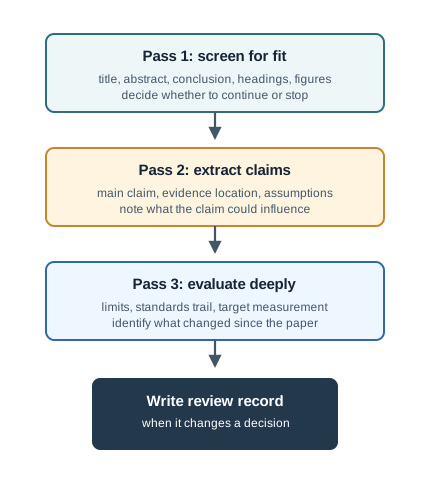
Use Figure 40.2 as a narrowing workflow. The first pass screens title, abstract, introduction, conclusion, headings, figures, and tables to record the paper’s role, system scope, and a reason to continue or stop. The second pass extracts the main claim, evidence location, assumptions, evaluation setup, and the part of the design it could influence. The third evaluates important claims against follow-up standards, later papers, and the present system, classifying them as durable principle, historical context, or unresolved question. The final review record is the product of reading. This sequence supports the chapter’s efficiency argument because scrutiny increases only when a source could change an actual decision.
40.8.1 How to Use: Pass 1: Screen For Fit
Spend a short first pass on title, abstract, introduction, conclusion, section headings, figures, and tables. Decide what kind of paper it is and whether it answers the current question.
Record:
- The paper role: survey, design rationale, measurement study, standardization paper, security taxonomy, or deployment report.
- The system scope: node, link, network, application, cloud, edge, security boundary, or operations.
- The reason to continue or stop.
40.8.2 How to Use: Pass 2: Extract Claims
Use the second pass to read the sections that contain the paper’s useful contribution. Study figures, tables, assumptions, evaluation setup, and definitions. Skip derivations or specialized proofs unless the current decision depends on them.
Record:
- The paper’s main claim in one sentence.
- The evidence location: figure, table, section, experiment, model, survey taxonomy, or design rationale.
- The assumptions that make the claim true.
- The part of your design the claim could influence.
40.8.3 Pass 3: Evaluate And Connect
Use the third pass only when the paper is important enough to change a design, a review checklist, or a learning path. Work through details, compare with follow-up standards or later papers, and identify what must be verified in the current system.
Record:
- What still applies as a durable principle.
- What is historical context only.
- What requires a current standard, measurement, deployment study, or security review.
- What unresolved question remains.
40.9 Build A Review Record
This section: Build A Review Record — The review record is the useful artifact.
The review record is the useful artifact. It keeps paper reading from turning into trivia and makes it possible to revisit decisions later.
The record in Figure 40.3 links a decision to a paper claim, proof, and next check.
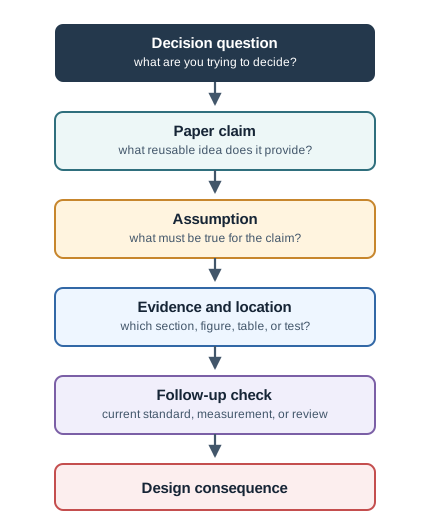
Inspect Figure 40.3 at Decision question and note that it uses Decision question to mark a decision point. Compare Paper claim, which uses Paper claim to state a required condition, before reading Assumption as the place that highlights Assumption. The comparison turns Paper review record workflow: start with the decision question, capture the paper claim, record assumptions and evidence, then add a modern follow-up check and design consequence into a bounded Build A Review Record choice.
Use this compact record for each claim worth keeping:
40.9.1 How to Use: Review Record Template
Copy this structure into notes when a paper affects a design:
- Decision question: What are you deciding?
- Paper and role: Which paper, and is it a survey, standardization paper, design rationale, or evaluation?
- Claim: What reusable idea does the paper provide?
- Evidence location: Which section, figure, table, experiment, or taxonomy supports the claim?
- Assumption: What node, traffic, topology, threat, workload, or deployment condition must hold?
- Modern check: What current standard, target measurement, implementation test, or later paper must be checked?
- Design consequence: What changes in protocol choice, architecture boundary, energy plan, security control, or learning path?
- Open question: What remains unverified?
40.10 Use Citation History Carefully
This section: Use Citation History Carefully — Citation history can tell you which papers shaped vocabulary and research direction.
Citation history can tell you which papers shaped vocabulary and research direction. It cannot tell you whether a claim is safe to reuse in a current system.
Do not read papers in citation-count order and assume the highest-count paper is the best engineering answer. A foundational survey may be the right source for vocabulary, while a later standard or focused measurement paper may be the right source for implementation.
Use this rule instead:
- Need vocabulary or historical framing: start with the foundational survey.
- Need protocol behavior: read the design paper, then follow the standards trail.
- Need security controls: identify the threat boundary, then check current controls and deployment assumptions.
- Need a current design choice: combine the paper principle with measurement, standards, and target-system constraints.
40.11 Cross-Lane Synthesis
This section: Cross-Lane Synthesis — Many good IoT design questions cross paper lanes.
Many good IoT design questions cross paper lanes. A gateway architecture question may require architecture vocabulary, constrained protocol behavior, and security boundary checks. A battery-operated sensing question may require WSN foundations, energy measurement, and protocol overhead review.
Use one paper to frame the question, another paper or standard to constrain the design, and a target-system check to prove whether the idea applies now.
40.11.1 Example: Low-Power Sensing
Start with the WSN lane to identify energy and topology assumptions. Then use protocol chapters to check packet overhead and reliability behavior. Finish with target-device measurement.
40.11.2 Example: Constrained Security
Start with the security lane to define assets and trust boundaries. Then use the protocol lane to check DTLS, OSCORE, EDHOC, or other relevant constrained-security options.
40.11.3 Example: System Architecture
Start with the architecture lane to define boundaries and data flow. Then use WSN or protocol papers to check whether device, network, and application assumptions match reality.
40.12 Common Pitfalls
This section: Common Pitfalls
Reading from page one without a decision question makes it hard to separate useful claims from background. Write the design or learning question first.
Older papers often include platform tables, energy ratios, packet examples, or scenario assumptions. Keep the principle, but verify the number with current standards, current hardware, and target measurements.
Survey categories organize the literature. They are not proof that a protocol, topology, or architecture pattern is best for your system.
A paper may predate later RFCs, security practices, cloud and edge patterns, or deployment evidence. A good review record explicitly names the follow-up check.
40.13 Knowledge Check
This section: Knowledge Check
40.13.1 Knowledge Check: First Pass
40.13.2 Knowledge Check: Using Older Papers
40.13.3 Matching Check
40.13.4 Ordering Check
40.14 Deep Dive: Map Paper Claims To Standards Owners
This section: Deep Dive: Map Paper Claims To Standards Owners — Reading IoT literature is much easier once you know who defines each technology, because a paper’s terms belong to different standards development organizations.
Reading IoT literature is much easier once you know who defines each technology, because a paper’s terms belong to different standards development organizations. Broadly, the IETF owns internet protocols such as IPv6, 6LoWPAN, RPL, and CoAP; the IEEE owns link and physical layers such as 802.15.4, 802.11 Wi-Fi, and Ethernet; and 3GPP owns cellular technologies such as NB-IoT, LTE-M, and 5G.
Alongside these formal bodies sit industry alliances that define higher-level or product-facing specifications: OASIS for MQTT, the LoRa Alliance for LoRaWAN, the Thread Group for Thread, and the Connectivity Standards Alliance for Zigbee and Matter. Placing a technology with its standards owner tells you what kind of document to read and where authoritative definitions, conformance language, and later corrections will live.
The practical habit is to read from the design decision backward. If the decision is whether a sensor network should use 6LoWPAN and RPL, start with IETF terminology and RFC trails. If the decision is radio range or interference, expect IEEE 802.15.4 or 802.11 material. If the decision is cellular coverage, power saving, or roaming, expect 3GPP language such as NB-IoT, LTE-M, PSM, and eDRX. The standards owner does not make a paper true, but it tells you what current source must be checked before you reuse the claim.
That prevents a common mistake: treating an old experiment as a current recommendation. A 2009 WSN routing paper may still explain energy pressure and topology trade-offs, but its radio assumptions, security defaults, and deployment tooling may be obsolete. The review record separates the durable idea from the follow-up check needed before reusing it in a modern IoT design.
40.14.1 Technology-To-Standards Map
| Technology | Standards owner | Kind |
|---|---|---|
| IPv6, 6LoWPAN, RPL, CoAP | IETF RFCs | Open internet protocols |
| 802.15.4, 802.11 Wi-Fi | IEEE | Link and physical layer |
| NB-IoT, LTE-M, 5G | 3GPP | Licensed cellular |
| MQTT | OASIS, also ISO/IEC 20922 | Application messaging |
| LoRaWAN | LoRa Alliance | LPWAN MAC; LoRa PHY is Semtech |
| Thread; Zigbee, Matter | Thread Group; CSA | Mesh and application ecosystem |
A paper claim such as “we send CoAP over Thread” spans several bodies. CoAP is an IETF RFC, Thread is defined by the Thread Group, and Thread itself runs on IEEE 802.15.4 radios. That immediately tells you the claim is about an open IETF application protocol layered on an alliance-defined mesh over an IEEE radio, and it tells you where to find the authoritative specification for each piece.
Before deep reading, make a two-column note: paper term and standards trail. “CoAP observe” points to IETF CoAP work and later observe/notification behavior. “6TiSCH schedule” points to IETF work over IEEE 802.15.4e time-slotted links. “LoRaWAN Class A” points to LoRa Alliance device-class rules rather than to a generic low-power-radio claim. That small map changes what you verify: protocol papers need RFC or specification follow-up, architecture surveys need boundary and vocabulary checks, and empirical WSN papers need measurement-context checks.
Use the table as a triage tool, not a citation list. If the paper makes a performance claim, ask whether the standards version, PHY, channel plan, security mode, payload size, and duty-cycle limits match your target. If it makes an interoperability claim, ask which layer is actually interoperable: radio, IP adaptation, transport, application payload, commissioning, or cloud API. These questions turn reading time into engineering evidence instead of a pile of quotes.
A useful review record also marks authority. A peer-reviewed paper can explain a design insight; an RFC, IEEE standard, 3GPP technical specification, OASIS specification, or alliance document defines the interface; and a deployment report shows what happened under field constraints. Strong design work uses all three kinds of evidence without letting any one source do the job of the others.
40.14.2 One Product Spans Many Bodies
Real IoT products almost never sit inside a single standards body. They stack pieces from several. Thread combines an IEEE 802.15.4 radio, IETF IPv6 and 6LoWPAN, and the Thread Group’s mesh and commissioning. Matter, the smart-home interoperability layer from the CSA, then runs on top of Thread or Wi-Fi using IPv6. A single light bulb can therefore embody four organizations’ work at once.
This layering explains a recurring story in the literature: fragmentation and consolidation. Because many bodies defined overlapping options, early IoT was a maze of incompatible ecosystems; Matter exists to unify the application layer across them. When you read a survey lamenting fragmentation or celebrating convergence, it is describing this multi-SDO reality. Knowing the map lets you see exactly which layers a new standard is trying to unify.
A smart bulb advertised as “Matter over Thread” decodes this way: IEEE provides the 802.15.4 radio, the IETF provides IPv6 and 6LoWPAN, the Thread Group provides the mesh network, and the CSA’s Matter provides the application layer so the bulb works with any Matter controller. The value proposition, cross-vendor interoperability, comes from those specifications stacking cleanly.
Every layer carries different evidence rules. A radio-layer claim depends on channel model, antenna placement, transmit power, duty cycle, receiver sensitivity, and interference. A network-layer claim depends on addressing, fragmentation, routing state, retransmission behavior, and congestion. An application-layer claim depends on payload schema, security context, commissioning flow, and user-visible compatibility. When a paper reports one layer’s success, do not silently promote it into proof for the whole stack.
This is especially important for constrained systems because cross-layer effects are real. A CoAP block-wise transfer can be logically correct while causing fragmentation pressure on a small 802.15.4 frame; a secure commissioning method can be cryptographically sound but hard to recover after a field gateway reset; a cellular power-saving mode can save energy while delaying downlink commands. The deeper reading question is: which layer owns this claim, and which adjacent layer could invalidate it?
For a final review record, write the handoff explicitly: paper claim, standards owner, adjacent dependency, current follow-up check, and design consequence. That record is short enough to reuse in an architecture decision, but specific enough to prevent stale literature from becoming a hidden requirement.
40.15 Summary
This section: Summary — Paper reading is most useful when it produces a decision-quality record.
Paper reading is most useful when it produces a decision-quality record. Choose the lane that matches your question, use the three-pass method to control reading depth, record claim and assumption separately, and verify older ideas with current standards, measurements, and deployment evidence. The goal is not to memorize paper lists; it is to improve how you reason about IoT systems.
40.16 See Also
This section: See Also
40.16.1 WSN Papers Guide
40.16.2 Protocol Papers Guide
40.16.3 Architecture Papers Guide
40.16.4 Security Papers Guide
40.16.5 IoT Ecosystem
40.16.6 Packet Protocol Overhead
40.17 What’s Next
This section: What’s Next
Choose the guide that matches your current question:
40.17.1 Start With WSN
Read the WSN papers guide when you need low-power sensing, topology, and aggregation context.
40.17.2 Start With Protocols
Read the protocol papers guide when you need constrained IPv6, 6TiSCH, DTLS, or RFC context.
40.17.3 Start With Architecture
Read the architecture papers guide when you need vocabulary, system boundaries, taxonomy, or CoAP rationale.
40.17.4 Start With Security
Read the security papers guide when you need threat, privacy, trust, and control-boundary context.
40.18 Key Takeaway
This section: Key Takeaway — Read papers for claims, evidence, assumptions, and limitations.
Read papers for claims, evidence, assumptions, and limitations. The useful question is not whether the paper is interesting, but whether its result applies to the system you are designing.
Find help
3 reviewed answers.
Where should I start in a module?
Open the module page from the sidebar to see its chapters in order. Use the module map to return to a topic you need.
Modules and pathsReviewed
What can I try when a project does not work?
Check the symptom, then work through the diagnostic steps. Keep the error message and the smallest example that reproduces it.
When you are stuckReviewed
How do interactive examples work?
Use the interactive guide to check how examples and simulations work before changing your project.
Interactive examples guideReviewed