2 The IoT Ecosystem

More
Depth: Practitioner
Progress saves as you read. Mark sections complete as you go; your progress appears in the sidebar.
2.1 In 60 Seconds
This section: In 60 Seconds — An IoT product is never just the device you can hold.
An IoT product is never just the device you can hold. A working connected system is a chain of layers, devices, the links that carry their data, the platform that stores and processes it, and the application people actually use, plus the operators who keep all of it running over time. IoT systems usually fail not because one part is bad, but because a layer, an interface, or a responsibility had no owner. Ecosystem thinking keeps the whole chain visible.
2.2 Start With the Story
This section: Start With the Story — Picture a door sensor that sends an alert to a phone.
Picture a door sensor that sends an alert to a phone. The small box is only one part of the path that makes the alert useful.
First, trace the event from the real world to the person or tool that acts. Name who owns each handoff and how they know it worked.
Adding a service can make one job easy, but it also adds cost, trust, and a new fault point. Keeping all work on one device can make care and growth hard.
The layer map names system roles, while the life-cycle map shows which owner must maintain each role after deployment.
Use the Practitioner section to review the full path. Use Under the Hood to study models, shared meaning, change, and end-of-life work in more depth.
Plain check
- Name the real event. Name the user act. Trace the full path. Mark each handoff.
- Name each owner. Name each proof. Name each safe state. Name each support task.
- Test one dead device. Test one lost link. Test one down service. Save each result.
- Plan safe updates. Plan safe removal. Plan data end. Keep the full life clear.
- Use Practitioner to review. Use deeper model checks. Find hidden work. Fix the weak handoff.
You will map an IoT service across its devices, networks, platforms, users, and lifecycle responsibilities. Start with one useful event and name the owner of each handoff needed to deliver it.
Follow the door alert across four ecosystem handoffs to see where usefulness and accountability are created.
-

Motion Marley: “One door event starts at the sensor, not at the phone.”
-

Remi, Gus, and Clara: “A lost handoff turns one easy service into a fault point.”
-

Bina and Tessa: “Name each owner, proof, and safe response before scaling.”
-

The team: “Now the alert path is visible, testable, and accountable end to end.”
Read the story panels from the door event to the operator’s alert. Detection begins at the installed sensor, then a broken radio-to-gateway handoff reveals how one missing dependency can erase the service outcome. The owner-and-proof map assigns responsibility before the path is restored. The verified alert at the end supports the chapter’s ecosystem view: usefulness is produced across accountable handoffs, not by the device in isolation.
2.3 What Is IoT? Why the Definition Keeps Moving
This section: What Is IoT? Why the Definition Keeps Moving — There is no single authoritative definition of “Internet of Things,” and that is normal rather than a gap in the field.
There is no single authoritative definition of “Internet of Things,” and that is normal rather than a gap in the field. The most durable working definition is a minimum requirement rather than a formal statement: take an everyday thing, add enough computation for it to reason about its own state, and add internet communication capability — direct, or indirect through a gateway — and it qualifies as a “thing” in the IoT sense. A plug, a washing machine, and a recycling bin all clear that bar the moment they can compute and can reach the network.
The term has also been defined differently as the technology matured, and the history explains why. Mark Weiser’s 1988 “ubiquitous computing” vision at Xerox PARC came first and described something narrower: computers “in the woodwork” everywhere, used without anyone noticing, but not necessarily internet-connected. Around 1999-2002, Neil Gershenfeld observed that the Web’s growth looked in hindsight like “just the trigger charge” for a bigger explosion as physical things started to use the network, and Kevin Ashton — working on RFID supply-chain tracking — coined “Internet of Things” while calling for “a standardized way for computers to understand the real world” (the fuller ARPANET-to-IoT story is in History of the Internet). The ITU formalized a version of the idea in 2005 around always-on, RFID- and sensor-enabled networked devices; the European Commission’s 2009 IoT action plan described a network of interconnected objects, some carrying their own IP addresses, using sensors and actuators to sense and act on their surroundings; and Cisco coined “Internet of Everything” in 2013 to fold people, process, and data into the same picture alongside things. Each definition describes the same trend from wherever the field stood at the time, which is why the ecosystem view in this chapter — layers, owners, and interfaces — is a more durable working definition than any one sentence.
A short checklist of recurring ingredients is more useful day to day than a formal definition: small form factor, low power and low cost, sensors or actuators, wireless communication, an internet connection, some programmability, and a degree of autonomy. That checklist also separates IoT from two ideas it gets confused with. A wireless sensor network (WSN) is usually built for one application; IoT is closer to a platform that accommodates many heterogeneous applications on shared infrastructure. And Weiser’s ubiquitous computing is pervasive like IoT, but IoT’s defining move is connecting those pervasive devices to the Internet rather than only making them ambient. The scale motivating this chapter is substantial: in October 2025, IoT Analytics projected 21.1 billion active IoT connections by year-end 2025, based on first-half data. IoT Analytics This is an estimate of IoT connections, not a count of every Internet device.
2.4 The Device Is the Tip of the System
This section: The Device Is the Tip of the System — Turning on a tap is simple, but the water depends on pipes, pumps, a reservoir, treatment, and a utility that maintains all of it.
Turning on a tap is simple, but the water depends on pipes, pumps, a reservoir, treatment, and a utility that maintains all of it. Judge only the tap and you miss the system that makes it work. A connected device is the same: the sensor or gadget is the visible tip, but it relies on connectivity, a data platform, an application, and an operations team standing behind it.
The important idea is that an IoT system is only as reliable as its weakest layer and its least-owned interface. A flawless device on a network nobody maintains, feeding a platform with no update plan, is not a working product.
For a first review, follow one ordinary event through the whole chain. A temperature reading starts as a physical measurement, becomes a digital value, travels through a local link or gateway, reaches a service that checks and stores it, and finally appears in an alert, dashboard, automation rule, or report. The reverse path matters too: configuration, credentials, commands, and firmware updates must move back toward the device without breaking the field system.
If you only need the intuition, this layer is enough: IoT is an ecosystem, not a single device. Every layer needs an owner, an interface, and a failure plan, and the whole system must keep working over its lifetime, not just on demo day.
Hold the ecosystem as four reference layers from the physical world upward. Devices sense or act; Connectivity carries telemetry and control; Platform services ingest, validate, store, and expose data; and Applications turn that data into decisions and value. A gateway or edge node may sit within the device estate or across the device-to-connectivity boundary, but it is an optional tier rather than a fifth top-level layer. Telemetry and events move upward, while configuration, credentials, commands, and firmware move back down. People, operations, and governance surround the stack because every layer and every boundary needs accountable ownership, failure behaviour, and a managed change path.
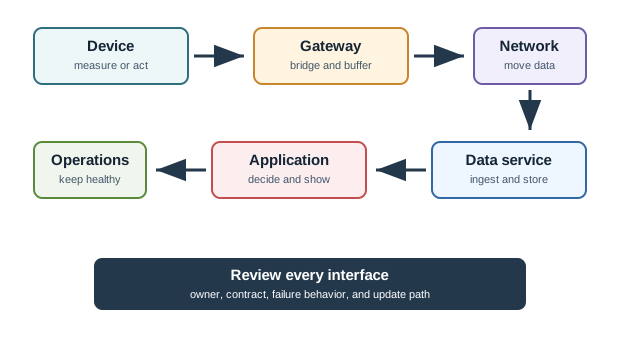
Read the centre first from the physical world upward using one real event, then follow the return path downward for configuration, credentials, commands, or updates. At each seam, stop and ask which owner is accountable and what evidence proves that protocol, data model, identity, offline behaviour, and change handling agree. A layer can work correctly in isolation while the ecosystem still fails at an unowned boundary; the One-Minute View turns those observations into three practical review habits.
The One-Minute View
It is layers, not a device
Devices, connectivity, platform, and application each do a distinct job and depend on the others.
Every layer needs an owner
An interface with no owner is where failures get passed between teams instead of fixed.
It must last over time
Provisioning, updates, and retirement matter as much as the first successful reading.
Beginner Examples
- A classroom prototype can be drawn as device, link, and dashboard so learners see the sensor is only one layer.
- A smart building needs someone who owns network changes, gateway updates, and data-quality problems.
- A polished app is useless if the devices feeding it lose connectivity and nobody is responsible for fixing them.
Ecosystem Layer Knowledge Check
The review habit is simple: trace a real event through devices, connectivity, platform, application, and operations, then check that each layer and each interface has an owner and a failure plan.
2.5 Apply It: Review the Ecosystem Layer by Layer
This section: Apply It: Review the Ecosystem Layer by Layer — A practical ecosystem review walks the layers, names an owner for each, checks the interfaces between them, and confirms the system can be operated over its life.
A practical ecosystem review walks the layers, names an owner for each, checks the interfaces between them, and confirms the system can be operated over its life. The goal is to find the unowned gap before it becomes an incident.
Make the review evidence-based. Do not write "the platform handles identity" unless you can point to a provisioning flow, credential issuer, revocation step, and log that proves what happens when a device is replaced or retired. Do not write "the network is reliable" unless you know the coverage assumption, offline behavior, retry path, and owner for field incidents. The ecosystem review turns broad claims into checkable records.
Walkthrough: An Ecosystem Review
- Map the layers. Identify the devices, connectivity, platform, and application, plus the operations function around them.
- Assign owners. Name who maintains each layer and each interface between layers.
- Check interfaces. Confirm protocols, data models, identifiers, and credentials line up across each boundary.
- Test interoperability. Prove the real devices, network, and services work together, not just that each part works alone.
- Plan the lifecycle. Decide how provisioning, updates, monitoring, replacement, and retirement will be handled before scaling.
The Four Layers and Their Gaps
Stakeholders to Name
Device maker
Owns hardware design, firmware behavior, build quality, and field replaceability.
Network and platform
Own coverage and service quality, plus ingestion, APIs, identity, and data-model stability.
Integrator and operators
Connect the pieces, document assumptions, and handle updates, incidents, and replacements over time.
Inspect Figure 2.1 and look for who owns each handoff when hardware data becomes an application service.
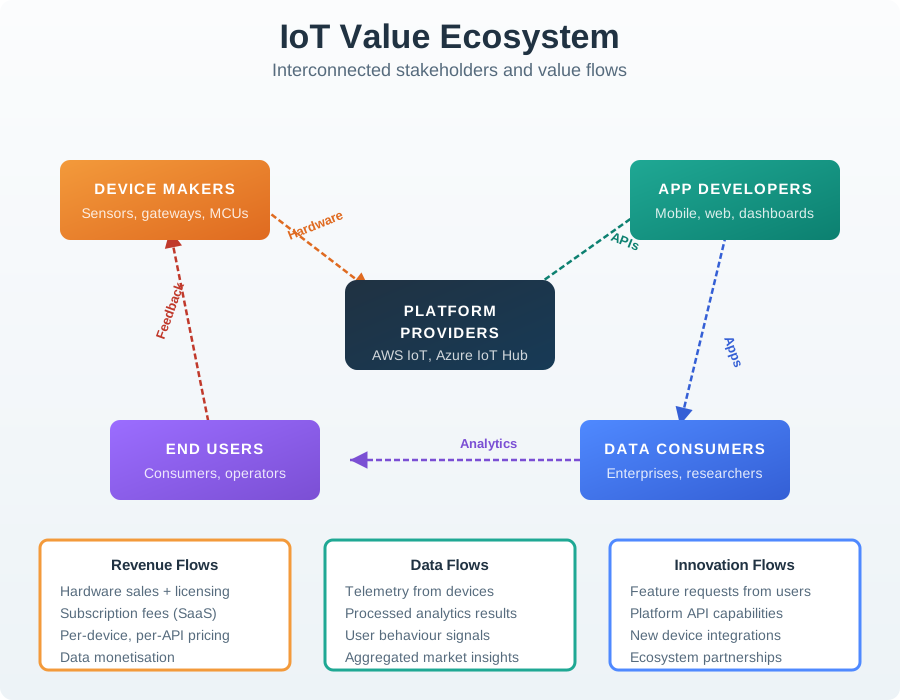
Trace Figure 2.1 from device makers to the platform and apps. Hardware teams own design, firmware acts, build quality, and part swaps. Network and platform teams own coverage, data intake, identity, APIs, and stable data forms. Integrators and operators turn those services into setup, updates, fault work, and repair. App feedback may change an earlier choice. Money, data, and ideas can flow in different ways, so value alone does not assign blame. For each handoff, record what the actor gives, gets, measures, and must restore when the service fails.
Ownership Gap Knowledge Check
An ecosystem review is useful when it turns broad claims into named owners, checkable interfaces, lifecycle records, and evidence that the real pieces work together.
2.6 Under the Hood: Reference Model, Interoperability, and Lifecycle
This section: Under the Hood: Reference Model, Interoperability, and Lifecycle — Consider a replacement door sensor whose message arrives correctly but uses 1 for OPEN where the application expects 0.
Consider a replacement door sensor whose message arrives correctly but uses 1 for OPEN where the application expects 0. Transport succeeded; meaning failed. The layer model helps locate the disagreement, interoperability testing checks the actual exchange, and lifecycle ownership decides who updates the mapping when hardware changes. These are three views of the same service.
A useful deeper review therefore follows a change as well as an ordinary reading. Replace a device, change a schema, or revoke a credential in a test environment. Check what breaks and who restores it. Treating the architecture diagram as a permanent guarantee misses the fact that its parts will change at different times.
The four-layer view is a simplification of a layered reference model. Looking closer at how the layers connect, and how a system is governed over time, shows where the hardest ecosystem risks actually live.
The Layered Reference Model
Layer names describe jobs rather than separate boxes. A gateway may filter readings locally while a remote platform stores them; one physical machine can perform several jobs. To classify it, ask what happens to the event at each step. Forwarding a message is connectivity work; validating its fields is platform work. Keep the boundary explicit even when both happen on the same computer.
Most IoT reference architectures stack similar layers: a device or perception layer that senses and acts, often with an edge or gateway tier; a connectivity layer that moves data; a platform or data layer that ingests, stores, and processes; and an application or business layer that delivers value. Data flows upward through these layers, while configuration, commands, and firmware updates flow back down. Each boundary between layers is an interface with its own protocol, data model, and owner, and each is a place where two teams must agree.
Interoperability Needs Evidence, Not Logos
Standards reduce integration risk, but they do not remove the need to test. Two products can each conform to the same standard yet still fail to interoperate because they chose different versions, optional profiles, or data-model details. The review areas that matter are concrete and checkable.
Lifecycle and Governance
An ecosystem is a commitment over time, so ownership must cover the whole life of the system, not just launch.
- Provisioning: how devices receive identity, keys, and configuration when they join.
- Operation: who watches health, responds to incidents, and replaces failed devices.
- Updates: how firmware, schemas, and credentials change without breaking deployed devices, including over-the-air delivery.
- Retirement: how data, credentials, and physical assets are removed, and how access is revoked.
Governance ties these together: who is accountable for security updates, who decides data retention, and who guarantees a portable exit if a supplier changes. Unanswered governance questions become the gaps that strand a deployment.
Inspect Figure 2.2 and ask which owner remains accountable when a device is updated, replaced, or retired after launch.
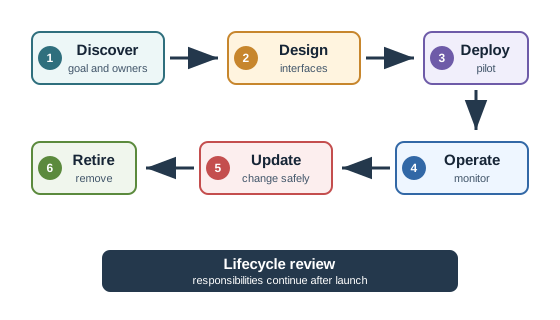
Follow Figure 2.2 from setup to final removal. Identity, keys, and settings decide who may join. Health checks and fault response keep the live path visible. Repair work replaces failed physical parts. Firmware, data-form, and key updates must not break old devices without warning. Final removal takes out hardware and data, ends access, and keeps only required records. Security fixes, storage rules, and a way to leave a vendor span the whole loop. Launch is one handoff in a long service life. Each interface needs an owner, failure plan, and proof that duties can survive a team or vendor change.
Common Pitfalls
A practical way to catch these mistakes is to rehearse a supplier change. Ask whether a replacement device can join, whether its event uses the same units and identifiers, and whether the application still gives the intended alert. Then ask who removes the old device's access. If the answers depend on an unnamed team or undocumented setting, record that gap before scaling. The purpose is to find a specific repairable weakness, not to produce a longer architecture diagram.
- Reviewing only the device. A working device is not a working ecosystem; check every layer and interface.
- Mistaking a standard for proof. A standard name does not guarantee compatible versions, profiles, or data models.
- Leaving interfaces unowned. Failures at an unowned boundary get passed between teams instead of fixed.
- Forgetting the exit. Without a portability and retirement plan, a system cannot change suppliers or shut down cleanly.
Interoperability Evidence Knowledge Check
At this depth, the ecosystem is a layered model held together by owned interfaces and governed over a lifetime. Reliable systems align devices, connectivity, platforms, applications, and operations, prove interoperability with real tests, and answer the update, portability, and retirement questions before they scale.
2.7 Checkpoint: Summary
This section: Checkpoint: Summary
- An IoT system is a chain of layers, devices, connectivity, platform, and application, wrapped by operations and people, not a single device.
- Reliability is set by the weakest layer and the least-owned interface, so every layer needs an owner and a failure plan.
- Data flows up the stack while configuration and updates flow back down, and each boundary is an interface two teams must agree on.
- Standards reduce integration risk but do not prove interoperability; versions, profiles, and data models still need real tests.
- Lifecycle ownership must cover provisioning, operation, updates, and retirement, including credential revocation.
- Governance answers who owns security updates, data retention, and a portable exit before the system scales.
The IoT ecosystem is far more than devices. Reliable systems align sensors and actuators, connectivity, platforms, applications, people, and operations, with a clear owner for every layer and interface across the whole lifecycle.
2.8 See Also
This section: See Also
Architecture Planner
Turn ecosystem thinking into a concrete system-design record.
Protocol Selection Framework
Connect ecosystem requirements to the connectivity-layer protocol choice.
Sensor to Network Pipeline
Trace how measurements move from devices up through the ecosystem to applications.
Find help
3 reviewed answers.
Where should I start in a module?
Open the module page from the sidebar to see its chapters in order. Use the module map to return to a topic you need.
Modules and pathsReviewed
What can I try when a project does not work?
Check the symptom, then work through the diagnostic steps. Keep the error message and the smallest example that reproduces it.
When you are stuckReviewed
How do interactive examples work?
Use the interactive guide to check how examples and simulations work before changing your project.
Interactive examples guideReviewed