38  IoT Business Models

38.1 Learning Objectives

By the end of this chapter series, you will be able to:

  • Identify Core IoT Business Models: Distinguish between product-as-a-service, platform, freemium, and data monetization models
  • Analyze Revenue Streams: Evaluate hardware, software, subscription, and data-based revenue opportunities
  • Calculate Key Business Metrics: Apply LTV, CAC, ARPU, and churn rate to IoT business cases
  • Design Pricing Strategies: Create tiered pricing and subscription models for IoT products
  • Assess Platform Dynamics: Evaluate network effects and ecosystem value in IoT platforms
  • Develop Go-to-Market Strategy: Plan market entry and customer acquisition for IoT products

IoT business model success depends on calculating the lifetime value to customer acquisition cost ratio:

\[\text{LTV:CAC Ratio} = \frac{\text{Lifetime Value}}{\text{Customer Acquisition Cost}}\]

A sustainable IoT business requires LTV:CAC > 3:1.

Worked example: IoT platform charges $50/month with 36-month average customer lifetime, spending $200 to acquire each customer through sales efforts.

LTV = $50/month × 36 months = $1,800 per customer. CAC = $200 per customer.

LTV:CAC = $1,800 / $200 = 9:1 ratio.

This 9:1 ratio exceeds the 3:1 survival threshold, indicating excellent unit economics. The company could invest more in customer acquisition to accelerate growth while remaining profitable. At 1:1 ratio, the business loses money on every customer; at 2:1, margins are too thin for sustainable growth.

38.2 Prerequisites

This chapter assumes:

  • Prior Reading: Overview of IoT and Application Domains
  • Basic Business Concepts: Familiarity with revenue, costs, and profit concepts
  • No Advanced Finance: Complex financial modeling not required
Key Concepts

This chapter introduces fundamental IoT business model structures and monetization strategies:

  • Product-as-a-Service (PaaS): Customer pays for outcomes rather than ownership (e.g., Rolls-Royce “Power-by-the-Hour”)
  • Platform Models: Multi-sided markets connecting device makers, developers, and users with network effects
  • Data Monetization: Generating revenue from insights, analytics, or raw data collected by IoT devices
  • Freemium & Tiered Services: Free basic features with paid premium upgrades and multiple pricing tiers
  • Outcome-Based Pricing: Payment tied to measurable results like energy savings or downtime reduction
  • Revenue Metrics: LTV (Lifetime Value), CAC (Customer Acquisition Cost), ARPU (Average Revenue Per User), churn rate
MVU: Minimum Viable Understanding

Core concept: IoT transforms one-time product sales into recurring revenue through subscriptions, data monetization, and platform services–the hardware is just the “foot in the door.”

Why it matters: Traditional hardware margins are shrinking (5-10%), while software and services deliver 60-80% margins. IoT companies that master recurring revenue models achieve 3-5x higher valuations than hardware-only competitors.

Key takeaway: Design your business model before building the device. The winning IoT companies monetize data, services, and ecosystems–not just devices. LTV/CAC ratio must exceed 3:1 for sustainable growth.

38.3 The IoT Business Model Landscape

The transition from traditional hardware sales to IoT-enabled business models represents a fundamental shift in how companies create, deliver, and capture value. The diagram below maps the six major IoT business model archetypes along two critical dimensions: margin potential (how profitable the model can be) and revenue predictability (how reliably income flows over time).

Two-dimensional chart mapping six IoT business models (one-time sale, razor-and-blade, subscription, platform, data monetization, outcome-based) across margin potential and revenue predictability axes, showing platform and subscription models in the high-margin high-predictability quadrant
Figure 38.1: IoT business model landscape

The quadrant chart reveals a clear pattern: the most successful IoT companies occupy the upper-right quadrant, combining high margins with predictable revenue. This is why subscription and platform models dominate the IoT landscape. One-time hardware sales sit in the least attractive position–low margins with no recurring revenue.

38.3.1 From Product Sales to Recurring Revenue

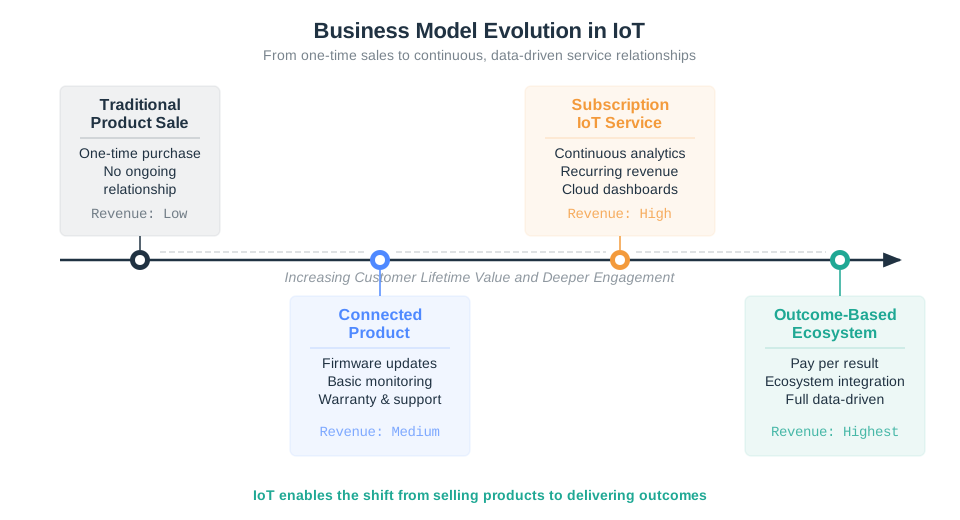
Understanding the revenue evolution is critical. Traditional hardware companies face a “feast or famine” cycle: revenue spikes at product launch, then drops until the next version. IoT business models solve this by creating continuous revenue streams from connected devices.

Revenue comparison chart showing traditional hardware sales generating a one-time spike versus IoT subscription model generating continuous recurring revenue over time
Figure 38.2: Revenue evolution comparison

The IoT-enabled model generates 87.5% more revenue per customer in year one ($375 vs. $200), and the gap widens dramatically over time as recurring revenue compounds while the traditional model produces nothing further.

38.3.2 IoT Value Chain

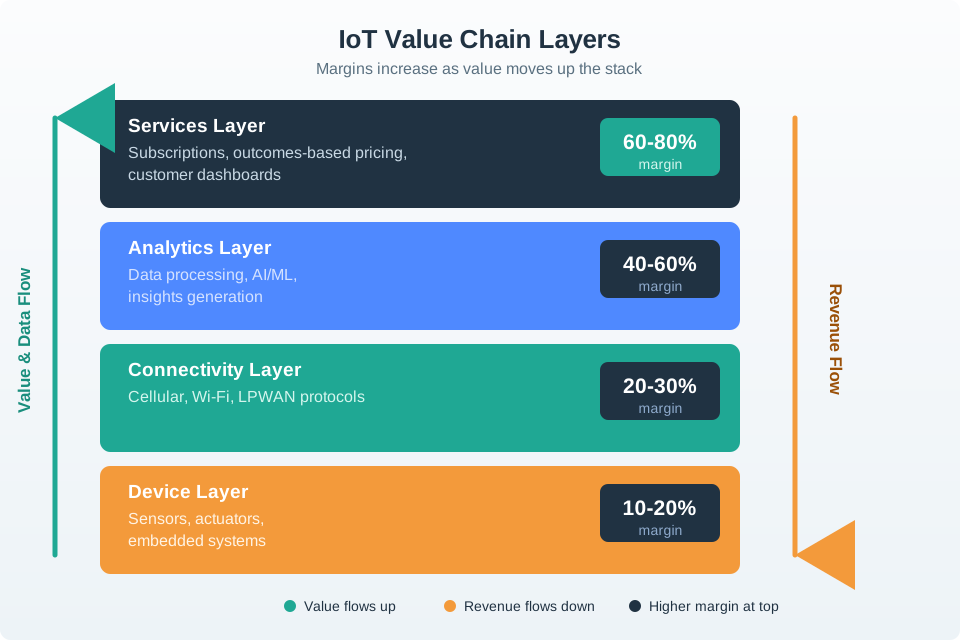
Every IoT business model draws revenue from one or more layers of the IoT value chain. Understanding which layers you control determines your monetization strategy.

IoT value chain diagram showing five layers from devices to applications, with margins increasing from 5-15% at device layer to 70-90% at application layer
Figure 38.3: IoT value chain layers

Key insight: Margins increase as you move up the value chain. Companies that control only the device layer (Layer 1) are trapped in commodity hardware competition. Companies that reach Layers 4-5 capture the highest margins because they deliver actionable insights rather than raw data.

38.4 Business Model Decision Framework

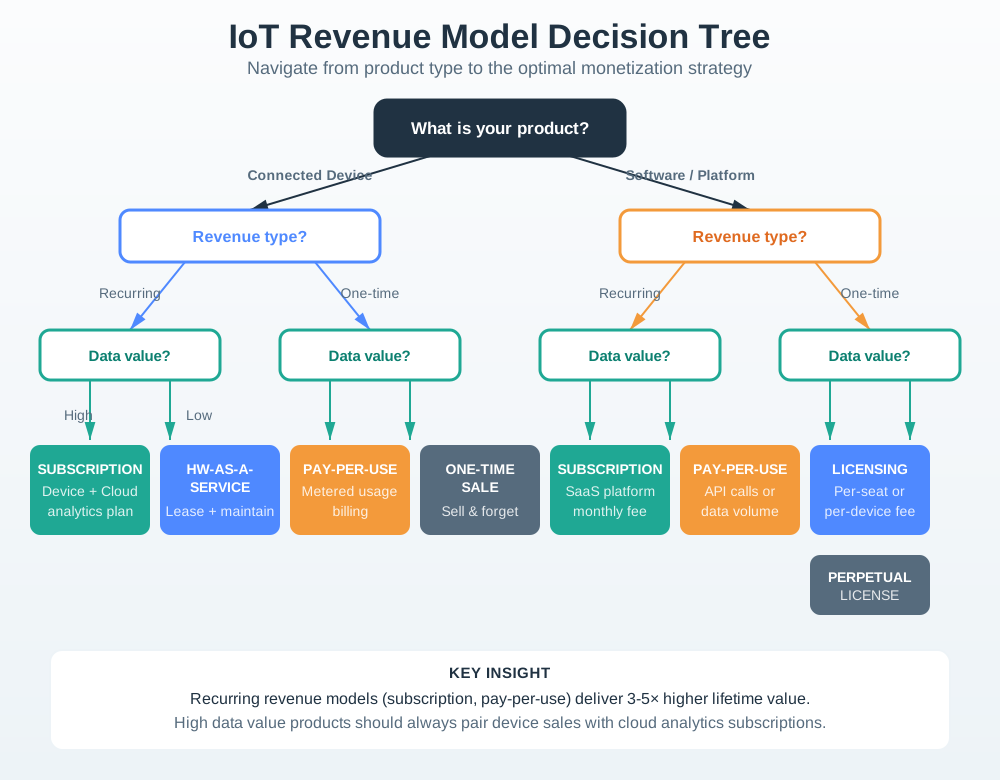
Choosing the right business model depends on your product characteristics, market position, and growth strategy. Use this decision tree as a starting point:

Decision tree flowchart for selecting IoT business model based on product characteristics, market position, and recurring revenue potential
Figure 38.4: Business model decision tree
Common Pitfall: Choosing the Wrong Business Model

Many IoT startups default to one-time hardware sales because it feels familiar. This is almost always the wrong choice for connected devices. Consider: a $200 device sold once generates $200. That same device at $99 with a $10/month subscription generates $459 over three years – and the customer relationship provides data for continuous product improvement. Always evaluate recurring revenue models before defaulting to one-time sales.

Compare how different business models affect your revenue over time.

Key Insight: Adjust the sliders to see how different pricing strategies affect total revenue. Notice how subscription models generate lower Year 1 revenue but significantly higher cumulative revenue over the customer lifetime.

Calculate whether your IoT business model is sustainable using the LTV/CAC ratio.

Key Insight: The 3:1 ratio is the survival threshold. Below this, you’re spending too much on acquisition relative to customer value. Adjust monthly churn to see its dramatic impact on effective lifetime and ratio.

38.5 Chapter Overview

This chapter has been organized into focused sections for easier learning. Work through them in order, or jump to the topic most relevant to your current needs:

38.5.1 1. Introduction to IoT Business Models

How IoT transforms traditional business models

Understand the fundamental shift from one-time sales to recurring revenue. Learn why subscriptions dominate IoT and how connected devices create ongoing customer relationships.

  • Traditional vs. IoT business models
  • Value chain analysis (devices, connectivity, analytics, services)
  • Ecosystem dynamics and stakeholder roles
  • Sensor Squad: The Never-Ending Lemonade Stand

38.5.2 2. Business Model Fundamentals

Core IoT business model patterns

Deep dive into the major IoT business model archetypes: Product-as-a-Service, Platform, Freemium, Data Monetization, and Razor-and-Blade models.

  • Product-as-a-Service (Rolls-Royce Power-by-the-Hour)
  • Platform models and network effects
  • Freemium and tiered services
  • Data monetization strategies
  • Razor-and-blade approach

38.5.3 3. Pricing Strategies

Designing IoT pricing models

Learn to create effective pricing structures for IoT products and services. Covers subscription tiers, outcome-based pricing, and usage-based models.

  • Tiered pricing design
  • Subscription model structures
  • Outcome-based pricing (pay-per-result)
  • Usage-based and transaction pricing
  • Bundling strategies

38.5.4 4. Financial Metrics for IoT

Key metrics for IoT business analysis

Master the financial metrics that matter for IoT businesses. Calculate LTV, CAC, ARPU, and churn rate with worked examples.

  • Lifetime Value (LTV) calculation
  • Customer Acquisition Cost (CAC)
  • Average Revenue Per User (ARPU)
  • Churn rate and retention
  • LTV/CAC ratio and unit economics

38.5.5 5. Case Studies

Real-world IoT business model success stories

Analyze successful IoT business models from companies like Nest, Peloton, John Deere, and Tesla. Understand what works and why.

  • Nest: From thermostat to ecosystem
  • Peloton: Hardware + content subscription
  • John Deere: Agricultural data platform
  • Tesla: Software-defined vehicle
  • Lessons learned and patterns

38.5.6 6. Go-to-Market Strategy

Launching and scaling IoT products

Develop strategies for market entry, customer acquisition, and scaling IoT businesses. Includes competitive positioning and channel strategies.

  • Market sizing and segmentation
  • Customer acquisition strategies
  • Channel partner development
  • Competitive positioning
  • Scaling from pilot to production

38.6 Quick Reference: IoT Business Models

Model Revenue Source Margin Key Risk Examples
One-Time Sale Hardware 5-15% No recurring revenue Traditional electronics
Razor-and-Blade Hardware + consumables 20-40% Customer lock-in backlash Printer + ink, Coffee machine + pods
Subscription Monthly/annual fees 60-80% Churn rate Nest Aware, Ring Protect
Platform Transaction fees + ecosystem 50-70% Chicken-and-egg problem Apple HomeKit, AWS IoT
Data Monetization Analytics, insights 70-90% Privacy regulations Waze, fleet telematics
Outcome-Based Results achieved 40-60% Measurement complexity Rolls-Royce Power-by-the-Hour

38.7 Key Metrics Quick Reference

Metric Formula Healthy Target Warning Sign
LTV/CAC Ratio Lifetime Value / Acquisition Cost > 3:1 Below 1:1 means losing money per customer
Payback Period CAC / Monthly Revenue < 12 months > 18 months signals cash flow risk
Monthly Churn Cancellations / Total Customers < 5% > 10% means product-market fit issues
Gross Margin (Revenue - COGS) / Revenue > 50% for SaaS < 30% makes scaling unsustainable
ARPU Total Revenue / Active Users Varies by market Declining ARPU signals commoditization

38.8 Real-World Revenue Comparison

To make the business model differences concrete, consider how the same smart thermostat product would perform under different business models over three years with 10,000 customers:

Model Year 1 Revenue Year 3 Revenue 3-Year Total Customer LTV
One-Time Sale ($200) $2,000,000 $0 $2,000,000 $200
Razor-and-Blade ($50 device + $5/mo filter) $1,100,000 $600,000 $2,900,000 $290
Subscription ($99 device + $10/mo) $2,190,000 $1,200,000 $4,590,000 $459
Platform ($99 device + 15% ecosystem cut) $1,590,000 $1,800,000 $5,190,000 $519

The platform model generates 2.6x more total revenue than one-time sales, and its revenue actually grows over time as the ecosystem expands. This is why platform-based IoT companies like Amazon (Alexa), Google (Nest), and Apple (HomeKit) invest billions in IoT ecosystems.

Design your IoT business model using the 9-component Business Model Canvas framework.

Start with what matches your background:

  • I’m an engineer: Start with Introduction to understand why business models matter for technical decisions, then read Pricing Strategies to learn how pricing affects product requirements.

  • I’m a business student: Start with Business Model Fundamentals for the core frameworks, then Financial Metrics for analytical tools.

  • I’m an entrepreneur: Jump to Case Studies for inspiration, then Go-to-Market Strategy for execution planning.

  • I’m in a hurry: Read just the MVU box at the top of this page and the Quick Reference tables. They give you 80% of the key insights in 5 minutes.

The Sensor Squad Learns About Making Money with IoT!

Sammy the Sensor, Lila the LED, Max the Microcontroller, and Bella the Battery were sitting around their workshop, trying to figure out how to pay for their next adventure.

“I have an idea!” said Sammy. “Let’s build a smart weather station and sell it!”

“Great!” said Bella. “We could sell each one for $50.”

Max the Microcontroller scratched his head. “But once someone buys it, they never need to talk to us again. What if we sold the weather station for $20 and then charged $2 a month to send fun weather facts and forecasts to their phone?”

“Ooh!” Lila the LED lit up bright orange. “That way, even after they buy it, we keep being friends with them! And $2 a month times 12 months is $24 – plus the $20 they paid for the station, that’s $44 in the first year instead of just $50!”

“Wait,” said Bella, “that’s actually less in year one…”

“But in year TWO,” said Max, grinning, “we get another $24 without building anything new! So after two years, it’s $68 total instead of still just $50!”

The Sensor Squad learned three big ideas:

  1. Selling once = one payment: Like selling a toy at a garage sale
  2. Subscriptions = ongoing payments: Like a magazine that comes every month
  3. More time = more money: Subscriptions earn more the longer someone stays

Sammy’s Question for You: If you had a smart piggy bank that could count your coins, would you rather sell it for $30 once, or sell it for $15 and charge $1 a month for a savings game? Which makes more money after 2 years?

Answer: The subscription! $15 + ($1 x 24 months) = $39, which is $9 more than the one-time sale of $30!

When launching an IoT product, choosing between freemium (free tier with paid upgrades) and paid-only (no free option) is critical. This decision affects growth rate, support costs, and revenue predictability.

Factor Freemium Paid-Only
User acquisition Fast (low barrier) Slow (friction to pay)
Support burden High (many free users) Lower (paying customers only)
Infrastructure costs High (scale for all users) Lower (scale with revenue)
Conversion rate 2-10% typical 100% (by definition)
Time to revenue Longer (convert later) Immediate
Market education Easier (try before buy) Harder (convince to pay first)
Network effects Stronger (large user base) Weaker (small user base)
Best for Novel products, platforms Proven categories, B2B

Decision Tree:

Q1: Is your IoT product in a proven category where customers understand the value?

  • Yes (smart thermostats, security cameras) → Paid-only (customers know what they’re buying)
  • No (novel use case, new behavior) → Freemium (education through trial)

Q2: Does your product benefit from network effects?

  • Yes (platform connecting users/devices) → Freemium (need critical mass)
  • No (standalone device/service) → Paid-only works fine

Q3: Can you afford to support many non-paying users?

  • Yes (VC-funded, high gross margin) → Freemium viable
  • No (bootstrapped, low margin) → Paid-only to control costs

Q4: Is customer lifetime value high enough to justify delayed conversion?

  • Yes (LTV > $500, multi-year subscriptions) → Freemium (convert 5% = $25 ARPU)
  • No (LTV < $100) → Paid-only (can’t afford low conversion)

Real Examples:

  • Nest (paid-only $249): Proven smart thermostat category, customers understood value
  • Ring (paid-only for device, freemium for storage): Hardware paid, service freemium
  • Fitbit (freemium): Free tracking to build user base, $10/month Premium for advanced insights
  • Particle (freemium): Free dev platform to drive IoT platform adoption, paid for production

Hybrid Strategy (Common Pattern): 1. Launch paid-only to validate willingness to pay with early adopters 2. Add free tier 6-12 months later once you’ve proven core value 3. Optimize funnel by identifying which features drive conversion from free to paid

Key Insight: Freemium is a growth strategy, not a pricing strategy. Use it when you need scale (user base) before monetization. Use paid-only when you need revenue immediately or when the category is already validated.

38.9 Knowledge Check

Test your understanding of IoT business model fundamentals before diving into the sub-chapters.

38.9.1 Question 1: Revenue Model Comparison

A smart home company sells a security camera for $150 (one-time). A competitor sells a similar camera for $50 but charges $10/month for cloud storage. After 24 months, which company has earned more revenue per customer?

B) The subscription company ($290) is correct.

  • One-time sale: $150 total
  • Subscription: $50 + ($10 x 24 months) = $50 + $240 = $290

The subscription model generates 93% more revenue over 24 months. This demonstrates why IoT companies prefer recurring revenue models. Even with the lower upfront hardware price, the ongoing service fees far exceed the one-time premium.

Note: In practice, churn would reduce the subscription revenue, but even at 5% monthly churn, the subscription model typically outperforms within 18-24 months.

38.9.2 Question 2: LTV/CAC Ratio

An IoT company spends $120 to acquire each customer (CAC). Each customer generates $15/month in subscription revenue and stays for an average of 18 months. What is the LTV/CAC ratio, and is this business sustainable?

B) 2.25:1 – borderline, needs improvement is correct.

Calculation:

  • LTV = $15/month x 18 months = $270
  • CAC = $120
  • LTV/CAC = $270 / $120 = 2.25:1

The industry benchmark for sustainable growth is LTV/CAC > 3:1. At 2.25:1, this company is profitable per customer but lacks sufficient margin to fund growth, handle unexpected costs, or invest in product development. They should focus on either increasing LTV (through upselling, reducing churn, or raising prices) or decreasing CAC (through more efficient marketing or product-led growth).

38.9.3 Question 3: Business Model Selection

A startup is building an IoT-enabled commercial HVAC (heating, ventilation, air conditioning) system. Their sensor data can predict equipment failures 72 hours in advance, saving building managers an average of $5,000 per prevented failure. Which business model is best suited?

C) Outcome-based pricing tied to prevented failures is correct.

When you can directly measure the value your product delivers (preventing $5,000 failures), outcome-based pricing aligns your revenue with customer success. The startup could charge a percentage (e.g., 20-30%) of each prevented failure cost, making the value proposition crystal clear: “Pay us $1,000-$1,500 per prevented failure that would have cost you $5,000.”

Why the others are weaker:

  • A (One-time sale): Leaves recurring value on the table. The predictive capability improves over time with more data.
  • B (Freemium): Giving away predictive maintenance for free undervalues the core proposition.
  • D (Platform): Could work long-term, but requires scale that a startup lacks initially. Start with outcome-based, then evolve to a platform.

38.9.4 Question 4: Platform vs. Subscription

What is the key difference between a platform business model and a subscription business model in IoT?

C) Platforms create value by connecting multiple user groups; subscriptions deliver value directly to one user group is correct.

A platform model (like Apple HomeKit or AWS IoT) derives value from network effects by connecting device makers, developers, and end users. The more participants, the more valuable the platform becomes for everyone.

A subscription model (like Nest Aware or Ring Protect) delivers services directly to customers for a recurring fee. Value comes from the service itself, not from connecting to other users.

The critical difference is that platforms exhibit network effects (value increases with each additional user), while subscriptions exhibit linear scaling (value to each customer is independent of other customers). This is why platforms can achieve much higher valuations – but they are also much harder to bootstrap due to the chicken-and-egg problem of needing both supply and demand simultaneously.

Concept Relationships: IoT Business Models
Concept Relates To Relationship
Six Business Models Value Capture Strategy One-time sale (5-15% margin) → Subscription (40-60%) → Platform (70-90%) progression up value chain
LTV:CAC > 3:1 Business Viability Customer lifetime value must exceed acquisition cost by 3x minimum for sustainable business model
Platform Network Effects Market Dominance Two-sided markets create winner-take-all dynamics but require critical mass to bootstrap
Recurring Revenue Customer Lifetime Value Subscription and platform models generate 2-5x more lifetime revenue than one-time hardware sales

Cross-module connection: Business Model Fundamentals explains detailed LTV:CAC calculations, churn rate analysis, and ARPU metrics for each of the six business model types.

Common Pitfalls

Adding too many features before validating core user needs wastes weeks of effort on a direction that user testing reveals is wrong. IoT projects frequently discover that users want simpler interactions than engineers assumed. Define and test a minimum viable version first, then add complexity only in response to validated user requirements.

Treating security as a phase-2 concern results in architectures (hardcoded credentials, unencrypted channels, no firmware signing) that are expensive to remediate after deployment. Include security requirements in the initial design review, even for prototypes, because prototype patterns become production patterns.

Designing only for the happy path leaves a system that cannot recover gracefully from sensor failures, connectivity outages, or cloud unavailability. Explicitly design and test the behaviour for each failure mode and ensure devices fall back to a safe, locally functional state during outages.

38.10 Summary and Key Takeaways

This chapter provides a comprehensive framework for understanding how IoT companies create, deliver, and capture value. The six core IoT business models – one-time sale, razor-and-blade, subscription, platform, data monetization, and outcome-based pricing – represent a spectrum from low-margin hardware to high-margin services.

Five principles to remember:

  1. Recurring revenue beats one-time sales: Subscription and platform models generate 2-5x more lifetime revenue per customer than one-time hardware sales.

  2. Move up the value chain: Margins increase from 5-15% at the device layer to 70-90% at the application layer. Control analytics and services, not just hardware.

  3. LTV/CAC > 3:1 is the survival threshold: If you spend more than one-third of a customer’s lifetime value to acquire them, your business model is unsustainable.

  4. Business model choice drives technical decisions: Your pricing model determines data architecture, update frequency, security requirements, and API design. Decide the business model before building the device.

  5. Platform models win long-term but are hardest to bootstrap: Network effects create winner-take-all dynamics, but you need critical mass on both sides of the market. Start with a focused subscription model and evolve toward a platform.

38.11 See Also

  • Business Model Fundamentals — Detailed breakdown of Product-as-a-Service, Platform, Freemium, Data Monetization, and Outcome-Based models
  • Pricing Strategies — Tiered subscription structures, usage-based pricing, and freemium conversion optimization
  • Case Studies — Philips LaaS ($1.1B ARR), Amazon Echo (540% ROI), John Deere data monetization real-world examples
  • Go-to-Market Strategy — Phased launch frameworks, customer segmentation, and channel strategy for B2B IoT products
In 60 Seconds

This chapter covers iot business models, explaining the core concepts, practical design decisions, and common pitfalls that IoT practitioners need to build effective, reliable connected systems.

38.12 Knowledge Check

38.13 What’s Next

If you want to… Read this
Explore application domains for this technology Application Domains Overview
Learn about UX design for connected devices UX Design for IoT
Start prototyping with the concepts covered Prototyping Essentials