Time: ~12 min | Level: Intermediate | Unit: P03.C03.U11
Key Concepts
Telematics: GPS, accelerometer, and OBD-II data collected from vehicles to track location, driver behaviour, and engine diagnostics.
Electronic Logging Device (ELD): FMCSA-mandated device recording truck driver hours of service to enforce regulations electronically.
Over-the-Air (OTA) Update: Wireless firmware or map delivery to vehicles without requiring a physical connection or dealership visit.
Geofence Alert: Automated notification triggered when an asset enters or exits a defined geographic boundary.
Dynamic Route Optimisation: Real-time rerouting incorporating live traffic, weather, and delivery constraints to minimise fleet travel time.
Cold Chain Logistics: Temperature-controlled transportation with continuous IoT monitoring ensuring product integrity from origin to destination.
Vehicle-to-Everything (V2X): Communication standard enabling vehicles to exchange safety messages with other vehicles, infrastructure, and pedestrians.
36.2 Learning Objectives
By the end of this section, you will be able to:
Explain V2X communication types (V2V, V2I, V2P, V2N) and their applications
Compare DSRC and C-V2X technologies for vehicle communication
Analyze latency requirements for safety-critical applications
Design V2X security architectures using PKI and rotating pseudonyms
Evaluate deployment tradeoffs between infrastructure cost, vehicle penetration, and safety outcomes
Assess V2X deployment challenges including penetration rate thresholds and real-world implementation barriers
MVU: Minimum Viable Understanding
Core concept: V2X (Vehicle-to-Everything) communication enables vehicles to exchange safety-critical data with other vehicles, infrastructure, pedestrians, and the cloud – transforming roads from isolated driving environments into cooperative, networked systems where vehicles can “see” beyond their sensors.
Why it matters: Over 38,000 people die annually in US traffic crashes alone. V2X can prevent up to 80% of intersection collisions and 40% of rear-end crashes. The technology is not hypothetical – US DOT pilots have demonstrated these results, and regulatory mandates are advancing in Europe and China. Understanding V2X is essential for IoT professionals working in transportation, smart cities, or automotive systems.
Key terms to know:
V2X (Vehicle-to-Everything): Umbrella term for all vehicle communication types (V2V, V2I, V2P, V2N)
DSRC (Dedicated Short-Range Communications): IEEE 802.11p-based direct vehicle communication on the 5.9 GHz band
C-V2X (Cellular V2X): 3GPP-standardized vehicle communication using cellular (LTE/5G) technology
BSM (Basic Safety Message): Standardized V2V message containing position, speed, heading, and brake status broadcast 10 times per second
For Kids: Meet the Sensor Squad!
Connected vehicles are like cars that can talk to each other and to the road!
36.2.1 The Sensor Squad Adventure: Cars That Chat
Meet the Smart Traffic Team! These are special helpers that make driving safer for everyone.
Radar Rick sits on the front of the car. “I can see cars ahead of me, even in the fog!” Rick explained. “But here’s my problem – I can only see what’s right in front of me. If a car is around a corner, I have no clue it’s there.”
That’s where Radio Rita comes in. “I’m the V2X radio!” Rita said proudly. “I let cars talk to each other using invisible radio waves. When a car around the corner slams on its brakes, it sends me a message: ‘STOPPING FAST!’ – and I warn our driver before Radar Rick can even see the problem!”
Tower Tom stands at the traffic intersection. “I’m a Roadside Unit,” Tom explained. “I tell every car when the traffic light will change. So instead of racing to catch a green light, cars can slow down just right and arrive when it turns green – saving fuel and keeping everyone safe!”
Signal Sally works with pedestrians. “When kids are walking to school, their crossing guard badge sends a signal that tells nearby cars: ‘Watch out, children crossing!’ Even if the driver can’t see the kids behind a parked truck, they get a warning!”
The coolest part is when they all work together. “Imagine this,” said Rita. “A pothole appears on the highway. The first car that hits it tells me. I tell Tower Tom. Tom warns ALL the other cars coming that way. Within minutes, hundreds of cars safely drive around the pothole. That’s the power of connected vehicles!”
“The big challenge,” said Professor Protocol, “is that not all cars can talk yet. It’s like having a classroom where only half the kids speak the same language. The more cars that can chat, the safer everyone becomes!”
Video: Connected Vehicles and Autonomous Driving
Learn how IoT enables vehicle-to-vehicle communication and autonomous systems.
36.3 How It Works: V2X Collision Avoidance
How It Works: How Cars Warn Each Other of Danger
The big picture: V2X (Vehicle-to-Everything) gives cars a “sixth sense” beyond cameras and radar - the ability to know about hazards they cannot physically see by receiving radio messages from other vehicles and infrastructure.
Step-by-step breakdown:
Continuous broadcasting: Every V2X-equipped vehicle broadcasts Basic Safety Messages (BSMs) 10 times per second containing position, speed, heading, and brake status. Real example: A car traveling at 120 km/h broadcasts its GPS coordinates (±1.5m accuracy), speed (±0.5 km/h), and heading angle 10× per second.
Threat detection: Receiving vehicles process incoming BSMs to identify collision risks - vehicles on intersecting paths, hard braking ahead, or vehicles in blind spots. Real example: Your car receives a BSM from a vehicle two cars ahead reporting emergency braking; your system calculates you’ll reach that location in 3.2 seconds at current speed.
Warning delivery: Within 10-20ms of threat detection, the system alerts the driver visually/audibly or triggers automated braking. Real example: US DOT pilots showed 80% reduction in intersection collisions when both vehicles were V2X-equipped, because warnings arrived 5-10 seconds before visual detection.
Why this matters: At highway speeds, a vehicle travels 33 meters per second. A 100ms communication delay means 3.3 meters of travel before receiving a warning - potentially the difference between collision avoidance and impact. This is why V2X requires <10ms latency.
36.4 V2X Overview
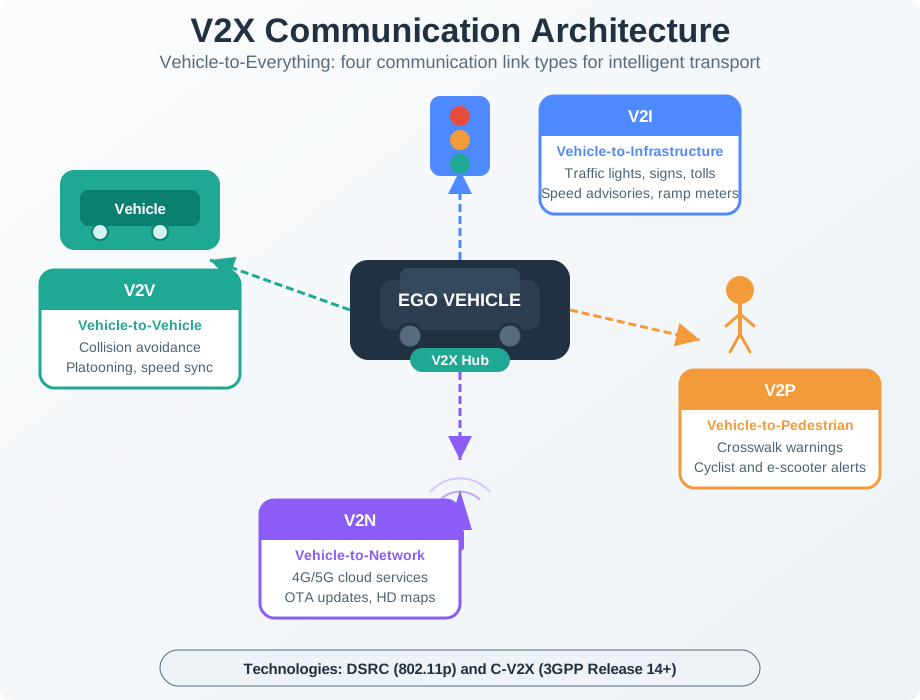
Modern connected vehicles rely on V2X (Vehicle-to-Everything) communication to enable cooperative awareness, safety systems, and intelligent transportation infrastructure. V2X encompasses four primary communication types, each serving distinct but complementary roles in the connected vehicle ecosystem.
V2X Architecture
Figure 36.1: V2X (Vehicle-to-Everything) communication architecture showing four connectivity types: V2V (vehicle-to-vehicle) for collision avoidance and platooning with <10ms latency, V2I (vehicle-to-infrastructure) for traffic signal timing and road conditions up to 1km range, V2P (vehicle-to-pedestrian) for smartphone-based crosswalk warnings, and V2N (vehicle-to-network) for cloud-based traffic management and OTA updates.
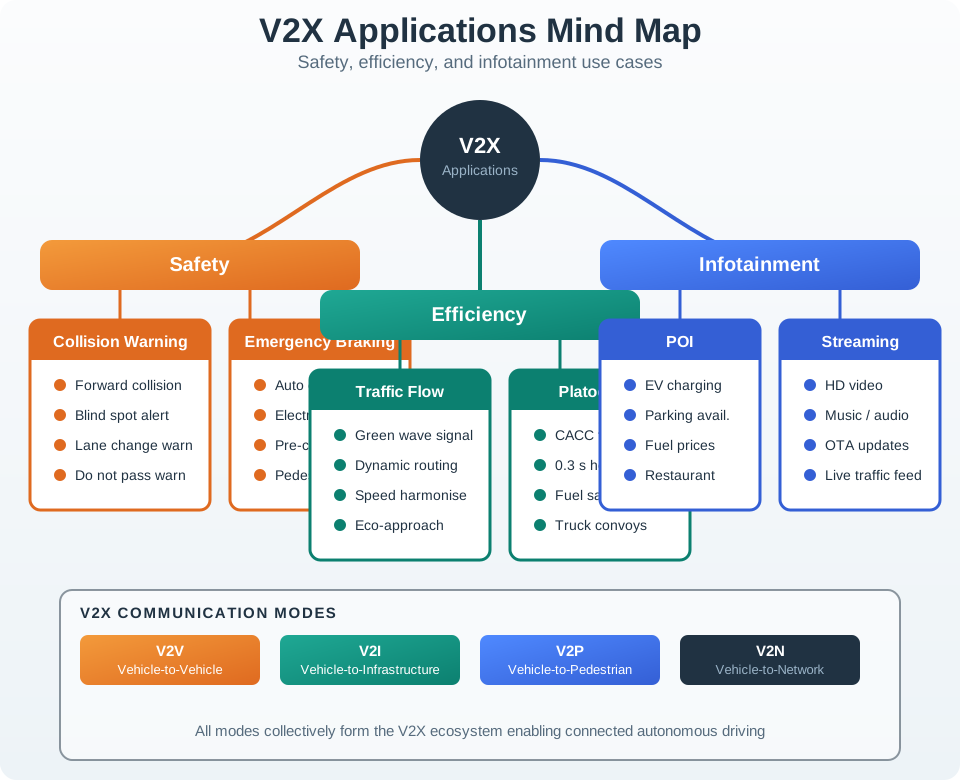
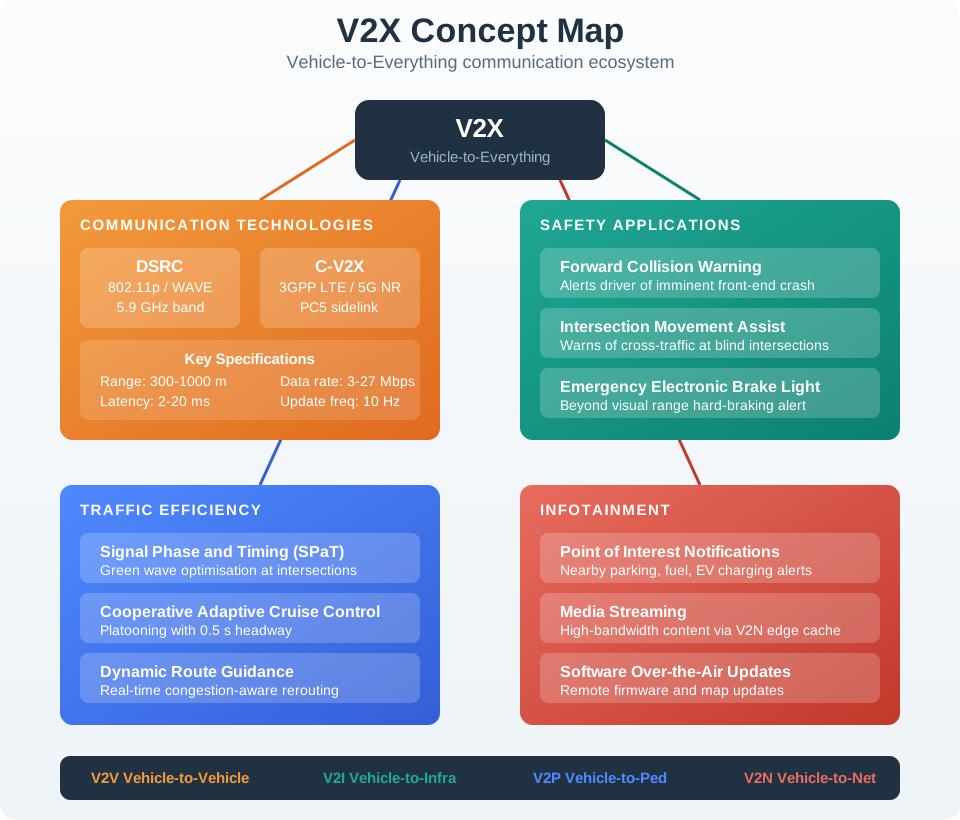
Figure 36.2: Mindmap diagram of V2X communication ecosystem showing four branches: V2V for collision avoidance…
For Beginners: Why Do Cars Need to Talk?
Think about how you drive today: you use your eyes (cameras), ears (horns, sirens), and mirrors (radar, LiDAR). But these only work when you can directly see or hear something.
V2X adds a “sixth sense” – the ability to know about dangers you cannot physically see:
A car braking hard two vehicles ahead (hidden from your view)
A child running into the road around a blind corner
A traffic light about to turn red in 8 seconds
Black ice on the road 500 meters ahead (reported by a car that just hit it)
Without V2X, a driver at 100 km/h has about 1.5 seconds of reaction time when they see a hazard. With V2X, they can receive warnings 5-10 seconds earlier – transforming panic stops into smooth, safe deceleration.
36.5 The Four V2X Communication Types
36.5.1 V2V (Vehicle-to-Vehicle): Direct Car Communication
Purpose: Enable direct communication between vehicles to prevent collisions and coordinate maneuvers.
Key Applications:
Collision Avoidance at Intersections: Vehicles broadcast position, speed, and trajectory to warn of potential T-bone collisions
Emergency Brake Warnings: Hard braking triggers immediate alerts to following vehicles beyond visual range
Platooning (Convoy Driving): Multiple vehicles travel closely together with automated following, reducing air drag and improving fuel efficiency
Lane Change Assistance: Share blind spot information with adjacent vehicles
Why Low Latency Matters: At highway speeds (120 km/h or 33 m/s), a vehicle travels 33 meters per second. A 100ms delay means the vehicle has moved 3.3 meters before receiving a warning - potentially the difference between collision avoidance and impact.
36.5.2 V2I (Vehicle-to-Infrastructure): Smart Road Communication
Purpose: Enable vehicles to communicate with roadside infrastructure for traffic optimization and hazard awareness.
Key Applications:
Traffic Light Timing Optimization: Vehicles receive Signal Phase and Timing (SPaT) data to optimize speed and reduce idling at red lights
Speed Limit Warnings: Dynamic speed limits based on weather, construction, or traffic conditions
Road Condition Alerts: Infrastructure sensors detect icy roads, standing water, or potholes and broadcast warnings
Parking Availability: Real-time parking space availability to reduce congestion from circling vehicles
Technical Specifications:
Range: Up to 1 kilometer from roadside units (RSUs)
Latency: 50-100ms (less time-critical than V2V)
Infrastructure: Roadside Units (RSUs) at intersections, highway entry/exit ramps, and hazard locations
Data Types: SPaT (signal phase and timing), MAP (intersection geometry), TIM (traveler information messages)
Real-World Impact: A connected vehicle approaching an intersection with SPaT data can calculate the optimal speed to arrive during a green light, reducing fuel consumption by 15-25% and eliminating unnecessary stops.
36.5.3 V2P (Vehicle-to-Pedestrian): Vulnerable Road User Protection
Purpose: Protect pedestrians and cyclists by enabling detection and warning systems beyond line-of-sight.
Key Applications:
Smartphone-Based Pedestrian Detection: Pedestrian smartphones broadcast presence to nearby vehicles
Crosswalk Warnings: Vehicles detect pedestrians waiting at or entering crosswalks, even in low visibility
School Zone Alerts: Children with wearable V2P devices trigger speed reduction warnings
Cyclist Awareness: Bicycles equipped with V2P transmitters alert drivers to their presence in blind spots
Technical Specifications:
Range: 50-200 meters (sufficient for stopping distance)
Latency: <50ms (time-critical for collision avoidance)
Challenges: Not all pedestrians carry V2P-enabled devices; cannot fully replace camera/radar-based detection
Privacy Considerations: V2P systems must balance safety with privacy. Broadcasts should be anonymous (no persistent identifiers), short-range (to prevent tracking), and only active when needed (e.g., when crossing street).
Range: DSRC typically reaches 300-500 m line-of-sight; C-V2X reaches 500 m-1 km with stronger non-line-of-sight performance.
Latency: DSRC delivers 3-5 ms direct communication; C-V2X is typically 10-20 ms on LTE and 1-5 ms on 5G NR-V2X.
Maturity: DSRC has field pilots dating back to the 2010s; C-V2X is newer but backed by the 3GPP roadmap.
Infrastructure: DSRC depends on dedicated roadside units; C-V2X can use direct sidelink plus existing carrier networks.
Cost profile: DSRC tends to have cheaper radios but more dedicated infrastructure cost; C-V2X shifts more cost into the vehicle modem and less into roadside build-out.
Network dependency: DSRC is purely ad-hoc; C-V2X supports both direct and network-assisted modes.
Evolution path: DSRC has a limited roadmap; C-V2X continues into 5G NR-V2X with broader ecosystem investment.
Adoption: DSRC appears in legacy US and European pilots; C-V2X has stronger current momentum, especially in China.
The Verdict: The industry is shifting toward C-V2X due to its integration with 5G, better non-line-of-sight performance, and alignment with cellular infrastructure investments. However, DSRC remains deployed in some regions and offers proven low-latency performance.
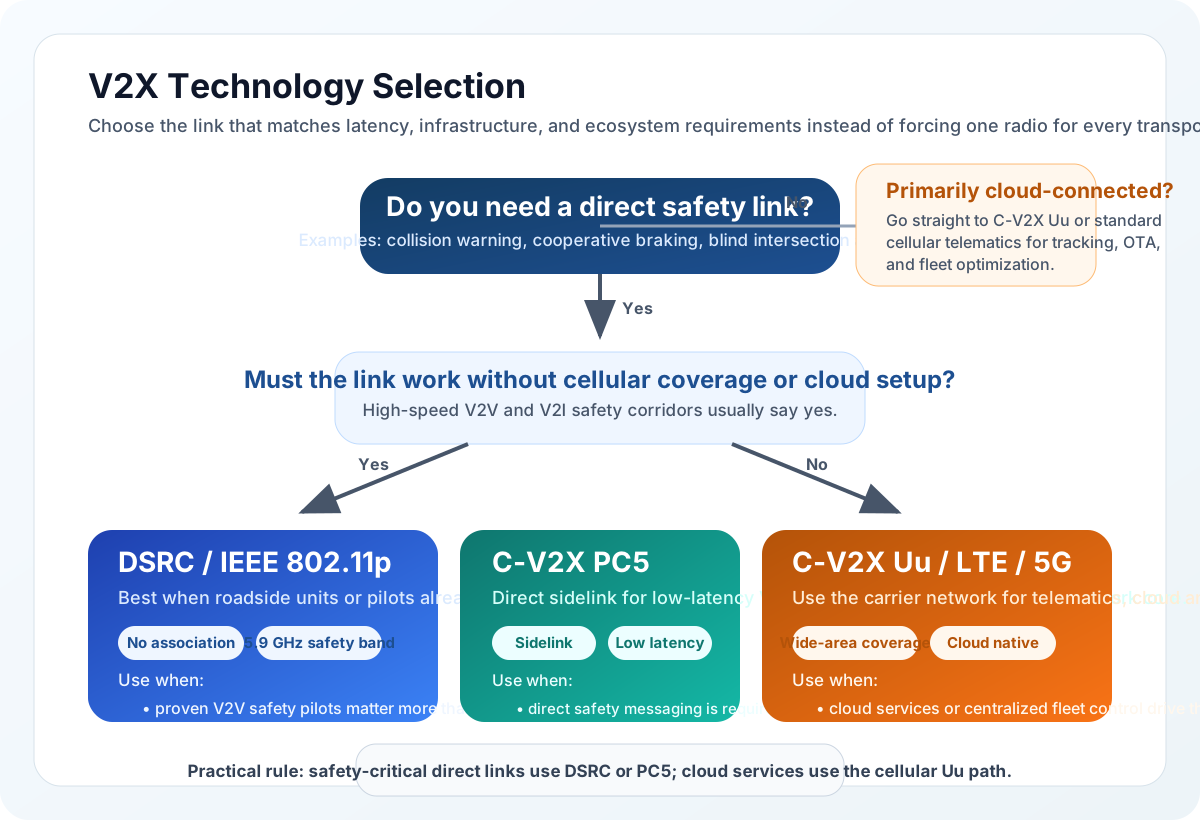
Figure 36.3: V2X technology selection decision tree showing when to use DSRC, C-V2X PC5 sidelink, or cloud-connected cellular links based on safety criticality, cloud dependence, and infrastructure availability.
36.6.1 Knowledge Check: DSRC vs C-V2X
36.7 V2X Safety Applications and Requirements
Different safety applications have varying latency and reliability requirements:
Intersection collision avoidance: V2V/V2I, under 10 ms, about 300 m range, 99.999% reliability.
Emergency brake warning: V2V, under 20 ms, about 300 m range, 99.99% reliability.
Blind spot warning: V2V, under 50 ms, about 50 m range, 99.9% reliability.
Curve speed warning: V2I, under 100 ms, about 500 m range, 99% reliability.
Pedestrian crosswalk alert: V2P, under 50 ms, about 100 m range, 99.9% reliability.
Traffic signal timing: V2I, under 100 ms, about 300 m range, 99% reliability.
Navigation updates: V2N, under 1 s, cellular backhaul, about 95% reliability.
OTA software updates: V2N, under 10 s, cellular backhaul, eventual consistency around 99%.
Takeaway: At the default 120 km/h setting, the vehicle travels 33.3 m/s, so even a 10 ms message delay consumes 0.33 m of stopping margin. The calculator makes the tradeoff concrete: direct V2V/V2I links buy back tens to hundreds of meters of warning distance compared with human-only line-of-sight detection.
Critical Insight: Safety-critical applications (collision avoidance, emergency braking) require V2V or V2I with direct communication and edge processing. Cloud-based V2N cannot meet <50ms latency requirements for life-critical decisions.
Common Pitfalls in V2X System Design
Pitfall 1: Relying on V2N for safety-critical decisions. Cloud round-trip latency (50-500ms) is far too slow for collision avoidance. Safety decisions must use V2V direct communication or on-vehicle edge processing. Design your architecture with V2N as an enhancement layer, not a safety dependency.
Pitfall 2: Assuming 100% V2X penetration. Even in optimistic scenarios, V2X-equipped vehicles will coexist with non-equipped vehicles for decades. Systems must degrade gracefully – V2X warnings supplement but never replace on-vehicle sensors (camera, radar, LiDAR).
Pitfall 3: Ignoring the privacy-safety tradeoff. Broadcasting precise position and speed 10 times per second enables tracking. Rotating pseudonymous certificates (SCMS) mitigate this, but certificate rotation creates gaps. Too-frequent rotation reduces safety message continuity; too-infrequent rotation enables tracking.
Pitfall 4: Underestimating spectrum congestion. At a busy intersection with 200+ V2X-equipped vehicles each broadcasting 10 BSMs/second, the channel carries 2,000+ messages/second. Without congestion control (DCC), message collisions increase and safety-critical warnings are lost.
Pitfall 5: Single-technology lock-in. Deploying only DSRC or only C-V2X creates regional incompatibility. Vehicles crossing borders between DSRC regions (some European countries) and C-V2X regions (China) lose V2X capability entirely.
36.8 V2X Deployment Challenges
Despite proven safety benefits, V2X faces significant deployment hurdles across technical, business, and regulatory dimensions:
Technical Challenges:
Penetration Rate Problem: V2X safety benefits require critical mass – research shows 30-50% vehicle penetration before cooperative awareness significantly reduces accidents. Below this threshold, the probability of two V2X vehicles meeting at a collision point is low
Spectrum Allocation: Debate over dedicating 5.9 GHz band vs. sharing with Wi-Fi. In 2020, the US FCC reallocated 45 MHz of the 75 MHz band to unlicensed Wi-Fi use, reducing V2X spectrum
Security at Scale: Prevent spoofing, replay attacks, and privacy leaks while maintaining sub-millisecond cryptographic verification for 2,000+ messages/second at busy intersections
Interoperability: Ensure vehicles from different manufacturers, using different chipsets and software stacks, communicate reliably across national borders
Business Challenges:
Chicken-and-Egg Problem: Vehicles need infrastructure (RSUs at $15,000-50,000 each), but infrastructure investment requires vehicle penetration to show ROI
ROI Uncertainty: Difficult to quantify safety benefits in dollars – a prevented fatality is valued at $11.6 million (US DOT VSL), but attributing it to V2X vs. other safety systems is complex
Liability: Who is responsible if a V2X safety warning fails – vehicle manufacturer, infrastructure operator, or telecom provider? Legal frameworks are still evolving
Regulatory Challenges:
Standards Fragmentation: US (DSRC legacy + C-V2X transition), Europe (C-V2X hybrid with ITS-G5), China (C-V2X mandate since 2020)
Privacy Regulations: GDPR and similar laws restrict location data sharing, creating tension with V2X’s need to broadcast position 10 times per second
Spectrum Policy: US FCC debating whether to preserve remaining 5.9 GHz spectrum for V2X or further repurpose for Wi-Fi 6E
36.9 Real-World V2X Deployments
US Department of Transportation Connected Vehicle Pilots:
Wyoming: I-80 corridor V2I for road weather warnings (500+ RSUs)
Tampa, Florida: Streetcars and buses with V2V/V2I (600+ vehicles)
New York City: Midtown Manhattan V2V/V2I for pedestrian safety (400+ vehicles)
Results: 80% reduction in intersection accidents, 40% reduction in rear-end collisions, 30% reduction in curve overspeed crashes.
General Motors OnStar: Over 12 million connected vehicles using V2N for navigation, diagnostics, and emergency services.
Volkswagen Car2X: European deployment using 802.11p DSRC for V2V emergency brake warnings and hazard alerts.
36.10 Connected Vehicle Data Architecture
Connected Vehicles Data Flow
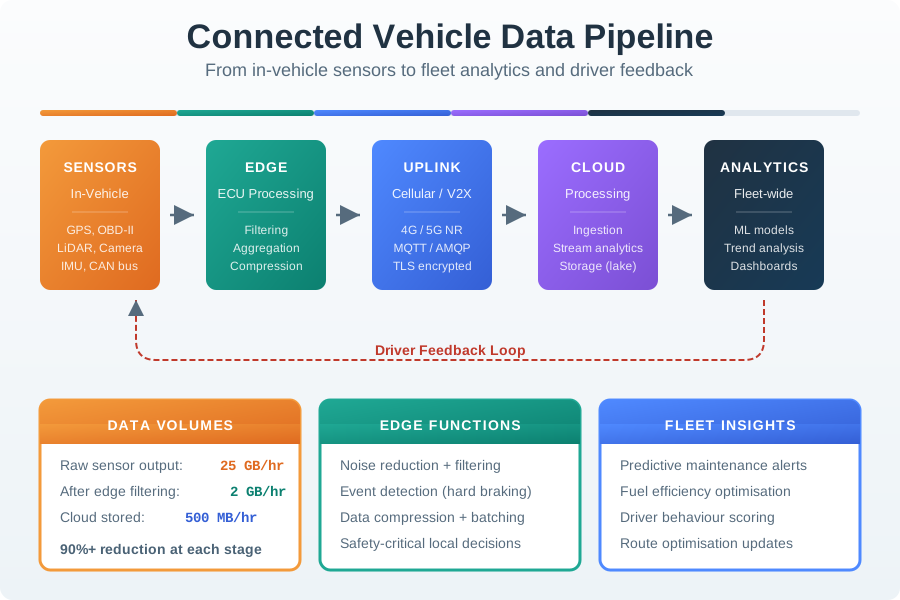
Figure 36.4: Connected vehicles stream telemetry from the assembly line through to fleet operations for analytics and automation.
Figure 36.5: Sequence diagram showing the connected vehicle data pipeline: vehicle sensors generate 25 GB per …
Vehicle Sensor Data Volumes:
Camera (forward): 20-40 MB/s for lane keeping and obstacle detection.
LiDAR: 100-300 MB/s for 3D mapping and object classification.
Radar: 0.1-15 MB/s for adaptive cruise control and blind-spot detection.
GPS/IMU: 0.1 MB/s for navigation and positioning.
CAN bus telemetry: 0.5 MB/s for engine, brakes, and steering data.
Total raw data: around 25 GB/hour before filtering.
Transmitted to cloud: around 25 MB/hour after on-vehicle aggregation and filtering.
Edge Processing Importance: 99.9% of sensor data is processed on-vehicle. Only aggregated insights, anomalies, and training data samples are transmitted to the cloud, reducing bandwidth costs and enabling real-time decision-making.
36.10.1 Worked Example: Calculating V2X Data Bandwidth Requirements
Scenario: A city deploys V2X at a busy intersection where 150 vehicles pass per minute during rush hour. Each vehicle broadcasts Basic Safety Messages (BSMs) at 10 Hz (10 messages per second). Each BSM is 300 bytes.
Step 2: Calculate peak channel load At any moment, assume 40 vehicles are within V2X range of the intersection RSU: \[\text{Channel load} = 40 \text{ vehicles} \times 3 \text{ KB/s} = 120 \text{ KB/s} = 0.96 \text{ Mbps}\]
Step 3: Assess channel capacity DSRC channels provide ~6 Mbps effective throughput. The channel utilization is: \[\text{Utilization} = \frac{0.96}{6} = 16\%\]
This is well within the recommended <50% channel busy ratio (CBR) threshold. Above 50% CBR, the Decentralized Congestion Control (DCC) mechanism reduces message rates to prevent channel saturation.
Insight: DSRC channels provide about 6 Mbps of effective throughput. Above a 50% Channel Busy Ratio (CBR), Decentralized Congestion Control (DCC) starts reducing message rates to prevent saturation. With the default values, the channel remains comfortably below that threshold.
Step 4: Monthly data for V2N cloud upload If the RSU forwards aggregated traffic data to the cloud at 1% of received V2X messages: \[\text{Cloud data} = 120 \text{ KB/s} \times 0.01 \times 3{,}600 \times 24 \times 30 = 3.1 \text{ GB/month}\]
36.11 Knowledge Check
36.11.1 Knowledge Check: Edge Processing
36.12 V2X Security Considerations
Connected vehicles face unique security challenges that differ from typical IoT systems due to the real-time safety requirements and mobile, anonymous nature of vehicle communication:
Spoofing: Fake V2V messages can trigger phantom braking or traffic disruption; mitigate with PKI certificates and message authentication.
Replay: Re-transmitted old messages can create ghost vehicles or wrong driving decisions; mitigate with timestamps, sequence numbers, and freshness checks.
Jamming: RF interference can wipe out cooperative awareness; mitigate with redundant channels and fallback to on-vehicle sensing.
Privacy leakage: Persistent identifiers enable surveillance and stalking; mitigate with rotating pseudonyms and short-lived certificates.
Injection: Malicious OTA updates can become remote vehicle-control attacks; mitigate with secure boot, code signing, and staged rollouts.
Sybil attacks: A single attacker can pretend to be many vehicles and create fake congestion; mitigate with certificate-authority validation and plausibility checks.
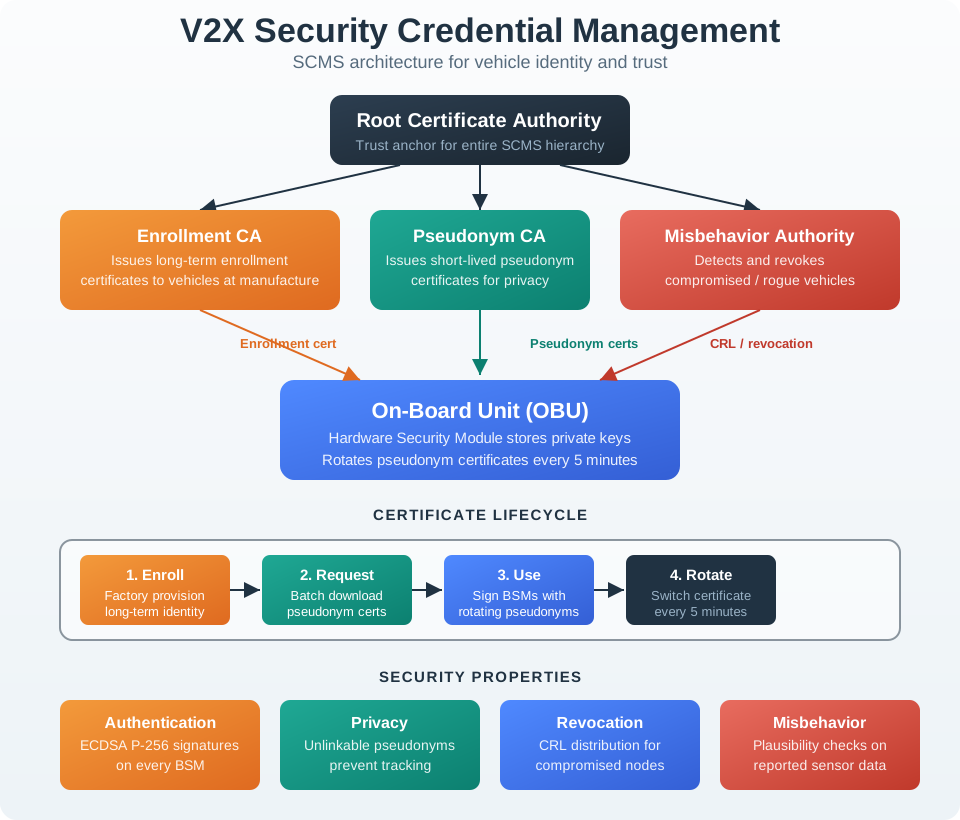
Figure 36.6: Diagram of the V2X Security Credential Management System (SCMS) architecture showing the enrollme…
Security Architecture: V2X systems use a Security Credential Management System (SCMS) with short-lived certificates (typically 5-minute validity) that are frequently rotated to prevent tracking while ensuring message authenticity. The system involves several key authorities:
Root CA: The ultimate trust anchor for the entire V2X PKI
Enrollment CA: Issues long-term enrollment certificates to vehicles during manufacturing
Pseudonym CA: Provides batches of short-lived pseudonym certificates for signing BSMs
Misbehavior Authority: Detects and revokes compromised or misbehaving vehicles
Linkage Authority: Enables anonymous revocation – a misbehaving vehicle can be blacklisted without revealing its true identity to any single entity
36.12.1 Knowledge Check: V2X Security
Worked Example: V2X Deployment Cost-Benefit for a Highway Corridor
Scenario: A state DOT evaluates deploying C-V2X infrastructure on a 50-mile Interstate corridor with 8 major intersections and 120,000 daily vehicle-miles traveled. Goal: reduce intersection collision rate by 80%.
Given:
Baseline: 18 injury crashes per year at 8 intersections (2.25 per intersection)
Average crash cost: $158,000 (NHTSA comprehensive cost including injuries, property damage, delays)
RSU cost: $28,000 per intersection (hardware + installation + backhaul)
Annual RSU maintenance: $2,400 per unit
5G backhaul: $800/month per intersection
V2X equipped vehicle penetration: 12% in Year 1, growing 8% per year
Year 5 cumulative: $4.05M savings - $608K total cost = $3.44M net benefit
10-year NPV (7% discount): $7.2M benefit at 84% penetration
Result: V2X deployment achieves payback in 18 months despite low initial penetration (12%). At Year 5, the corridor saves $1M annually in crash costs. Over 10 years, the $224K infrastructure investment generates $7.2M in net societal benefit, a 32:1 return.
Key insight: V2X benefits scale non-linearly with penetration. Early deployment (when penetration is 10-20%) appears marginally economic, but capturing the 50-80% penetration benefits requires infrastructure in place years earlier. First-mover DOTs that deploy in the 2025-2027 window will realize full benefits by 2030-2032, while late deployers miss the critical growth phase.
Putting Numbers to It: V2X Deployment Payback Calculation
Key insight: V2X benefits scale non-linearly with penetration. At the default 44% penetration setting, the calculator estimates about 6.3 prevented crashes per year and just over $1.0M in annual savings against about $96K in recurring cost.
How V2X concepts connect across IoT networking and security domains:
C-V2X vs DSRC connects to Cellular IoT: LTE-V2X and 5G NR-V2X reuse cellular spectrum and roadmap decisions.
V2X security (SCMS) connects to IoT Security Fundamentals: PKI and rotating pseudonymous certificates balance authentication with privacy.
Edge processing connects to Edge Computing Fundamentals: 99.9% of sensor data must stay on the vehicle for sub-10 ms decisions.
Latency requirements connect to MQTT vs CoAP: V2V timing budgets are too tight for cloud-round-trip application protocols.
Data architecture connects to stream processing: 25 GB/hour of raw data is reduced to about 25 MB/hour before backhaul.
36.13 See Also
Related chapters for deeper V2X technical implementation:
5G NR-V2X - Next-generation cellular V2X with <5ms latency
Network Slicing - QoS guarantees for safety-critical V2X traffic
Smart Cities - V2I integration with traffic management systems
Case Studies - Real-world connected vehicle deployments
In 60 Seconds
This chapter covers connected vehicles, explaining the core concepts, practical design decisions, and common pitfalls that IoT practitioners need to build effective, reliable connected systems.
Interactive Quiz: Match V2X Concepts
Interactive Quiz: Sequence the Steps
Label the Diagram
💻 Code Challenge
36.14 Summary
Figure 36.7: Concept map summarizing connected vehicles chapter showing V2X communication at the center connec…
Connected vehicles and V2X communication represent one of the most impactful IoT application domains, with direct implications for road safety, urban mobility, and autonomous driving:
Four V2X types: V2V handles direct sub-10 ms warnings, V2I supports infrastructure timing and alerts, V2P protects vulnerable road users, and V2N handles cloud services.
Latency hierarchy: Safety-critical applications need under 50 ms with very high reliability, which only direct V2V/V2I paths can consistently provide.
Technology transition: Industry momentum is moving toward C-V2X and 5G NR-V2X because they align with cellular evolution and cloud integration.
Real-world results: US DOT pilots reported roughly 80% fewer intersection crashes and 40% fewer rear-end collisions in equipped corridors.
Edge processing: About 25 GB/hour of raw sensor data is reduced on-vehicle to roughly 25 MB/hour before cloud upload.
Security architecture: SCMS rotates short-lived pseudonymous certificates to balance authentication, revocation, and privacy.
Deployment challenge: Full benefit depends on penetration rates around 30-50%, so hybrid sensor plus V2X operation is required during the long transition period.
Key Design Principles for V2X Systems
Never depend on the network for safety – all life-critical decisions must be made on-vehicle or via direct V2V/V2I
Design for graceful degradation – V2X supplements but never replaces on-vehicle sensors
Process at the edge – 1000x data reduction through on-vehicle filtering is essential at fleet scale