Start with a fleet producing data after the original device sale is complete. The monetization story is not simply selling data; it is deciding what insight is valuable, who may use it, how privacy and ownership are protected, and whether indirect value beats direct revenue.
39.2 Learning Objectives
By the end of this chapter, you will be able to:
Evaluate Data Monetization Opportunities: Assess opportunities and risks in selling IoT-generated insights
Design Privacy-Preserving Data Products: Implement anonymization and aggregation strategies
Distinguish Indirect Revenue Streams: Classify ecosystem monetization, advertising, and lead generation models by revenue potential and risk
Justify Privacy-Revenue Tradeoffs: Defend ethical decisions about data monetization using the four-question ethics test
Apply Data Valuation Frameworks: Estimate the monetary value of different IoT data streams
Assess Regulatory Constraints: Evaluate monetization strategies for compliance with GDPR, CCPA, and sector-specific regulations
Key Concepts
This chapter covers data monetization strategies and indirect revenue models:
Data Monetization: Aggregated insights, predictive analytics, benchmarking services, data marketplaces
Compliance: GDPR, CCPA, and other data protection regulations
Data Valuation: Methods for estimating the monetary worth of IoT data assets
Chapter Roadmap
This chapter is long, so read it as a sequence of decisions:
First decide what buyer decision an IoT insight improves, and where the privacy boundary belongs.
Then trace raw telemetry through governance, processing, packaging, and valuation.
Next compare direct data products with indirect revenue from ecosystems, referrals, ads, and retention.
After that choose privacy-preserving techniques that keep monetization inside consent and regulatory limits.
Finally test the whole plan with ethics, compliance, quizzes, and common failure modes.
Checkpoints recap the decision rules as you go. Anything that is a calculator, quiz, or deep technical detail can be revisited after the main flow is clear.
39.3 Sell Insight, Not Exposure
IoT data can create revenue when it reveals a pattern that another decision-maker can act on. The safest data products are usually aggregate benchmarks, utilization trends, risk scores, forecast signals, and operational insights. They do not require exposing raw household, patient, worker, driver, or machine-level records to buyers.
The business question is not just “who will pay for this data?” The better question is “what decision improves because this data product exists, and can we provide it without violating user trust, contracts, or law?” A traffic-flow index, building energy benchmark, fleet safety score, equipment utilization benchmark, or crop-irrigation advisory each needs a clear buyer, purpose, refresh rate, and privacy boundary.
For example, a smart-building vendor might be tempted to sell every thermostat reading to energy brokers. A more defensible product is a weekly benchmark that compares similar buildings by floor area, climate zone, occupancy schedule, and HVAC type. The buyer can still see which operating patterns waste energy, but the product does not expose one tenant’s arrival time or one facility’s exact control schedule. The same pattern applies to fleets, farms, factories, and home devices: raw telemetry is collected for operations, then transformed into a narrower answer that serves a named decision.
Revenue also has to survive trust scrutiny. If a customer bought a leak detector to prevent water damage, they may accept anonymized regional failure-rate benchmarks for insurers or plumbers; they probably do not expect household occupancy inference to be sold to advertisers. A good first screen is simple: would the user understand the value exchange if it appeared in the product UI instead of a legal appendix?
Insight product: The packaged answer, benchmark, score, forecast, or alert sold to a customer.
Privacy boundary: The aggregation, anonymization, consent, retention, and access rule that protects individuals and organizations.
Decision value: The planning, pricing, maintenance, compliance, routing, or investment choice the buyer improves with the insight.
39.4 Purposeful Data Products
A practical data monetization plan starts with purpose limitation. Decide whether the product supports benchmarking, forecasting, maintenance planning, insurance risk, public planning, logistics, energy management, or supplier performance. Then keep only the fields, time window, geographic resolution, and identifiers required for that purpose.
Privacy controls should be designed before any buyer receives data. Aggregation thresholds, k-anonymity checks, differential privacy, pseudonymization, consent state, opt-out handling, retention limits, role-based access, and contract restrictions shape what can be sold. Location traces, household energy patterns, driving behavior, health-adjacent signals, and workplace occupancy need especially careful treatment because they can identify people even after names are removed.
Work a concrete product all the way through. A cold-chain platform may want to sell “lane reliability” scores to food distributors. The useful fields might be route segment, carrier class, temperature-excursion count, dwell time, trailer type, and month. It should not need driver names, exact customer addresses, full GPS trails, or every second of temperature telemetry. A release rule could require at least 30 shipments per lane bucket, suppress rare carrier-lane combinations, round dwell time to useful intervals, and let buyers query only approved summaries through a dashboard or API.
Pricing should follow the decision the buyer can improve. A one-off PDF benchmark is worth less than an API that feeds procurement or dispatch software, but the API also needs stronger entitlement checks, usage logging, and contract language that blocks repurposing. Before launch, review a sample buyer query, the exact output fields, and the deletion path for an opted-out customer. If the insight stops working after removing unnecessary detail, the product was probably selling exposure rather than insight.
Name the buyer decision. Specify the action: adjust tariff, dispatch maintenance, choose store location, reroute vehicles, benchmark energy use, or price insurance.
Remove unnecessary detail. Reduce identifiers, precision, frequency, and retention until the insight still works with less exposure.
Set release rules. Define minimum group size, geography, time bucket, suppression rules, buyer access, contract use limits, and deletion behavior.
Measure harm and value together. Compare revenue potential against consent expectations, re-identification risk, regulatory scope, and long-term trust cost.
You have now moved from “data exists” to “a governed insight product can be described.” The next question is whether the pipeline can prove that description every time it releases data.
39.5 Data Products Need Governance
A monetized data product should have a traceable pipeline. The system needs source device ids, collection purpose, consent version, data category, transformation job, aggregation rule, model version, release table, buyer entitlement, and retention date. Without lineage, teams cannot explain what was sold, reproduce an insight, or remove data after consent or contract changes.
Implementation often combines device telemetry, stream processing, warehouses, privacy transforms, and access controls. MQTT or HTTP ingestion may feed Kafka, Kinesis, Pub/Sub, or a warehouse such as BigQuery, Snowflake, or Redshift. Analytics jobs may publish aggregate tables, dashboards, API products, data clean-room outputs, or partner reports. Access should be enforced through contracts and technical controls, not only policy text.
Re-identification risk is the hard part. A few timestamps, locations, device behaviors, or rare operating patterns can identify a person, company, farm, vehicle, or production line. Privacy reviews should test whether small cohorts, outliers, joins with public data, or repeated releases make a supposedly anonymous dataset identifiable again.
Data-product release gate: each saleable output moves from telemetry to a buyer-facing insight only after purpose, privacy, entitlement, and deletion checks pass.
Collect Device event, purpose, consent version, and retention tag.
Transform Clean, bucket, aggregate, suppress, or add privacy noise.
Release Publish only approved fields through a dashboard, API, clean room, or report.
Enforce Check buyer entitlement, log use, expire access, and honor deletion or opt-out.
In production, these gates should be automated where possible. A dbt model, Spark job, or warehouse scheduled query can stamp the transformation version. An API gateway, data clean room, or row-level-security policy can restrict buyer access. Audit logs should show which buyer saw which aggregate output, not raw secrets. When consent changes, the pipeline needs a reproducible way to rebuild or suppress affected outputs; otherwise the company can promise deletion while continuing to sell derived tables that still contain the customer’s contribution.
Controls: Use aggregation thresholds, suppression, noise, access reviews, export limits, watermarking, and contract enforcement.
Monitoring: Watch cohort size, outlier exposure, buyer usage, deletion jobs, opt-outs, and complaints as product health signals.
Checkpoint: Insight Products and Governance
You now know:
A saleable data product starts with a named buyer decision, not with a raw export.
The cold-chain lane example needs at least 30 shipments per lane bucket before release.
Governance means lineage from source device ids through consent version, transformation job, buyer entitlement, and retention date.
MVU – Minimum Viable Understanding
If you only have 5 minutes, remember these three principles:
Sell insights, not raw data. Aggregated and anonymized patterns are more valuable and legally safer than individual records.
Indirect revenue can exceed direct device margin. Ecosystem fees, service referrals, and loyalty mechanics are powerful only when the connected product creates repeatable user value.
Privacy is a business asset, not a cost. Companies that build trust through transparent data practices attract more users, more data, and better partnerships.
Making Money from IoT Data
Data monetization (the ethical way):
Approach
What You Sell
Privacy Level
Aggregated insights
“30% of homes heated at 7am”
High (anonymous)
Anonymized patterns
Traffic flow trends
Medium
Raw individual data
Avoid this!
Low (privacy risk)
The key principle: Sell insights, not personal data. Transform raw sensor readings into valuable patterns that help other businesses make decisions, while protecting individual user privacy.
Example revenue streams:
Utility companies pay for aggregated energy usage patterns
City planners pay for traffic flow data
Insurance companies pay for anonymized driving behavior statistics
Why this matters: A single smart thermostat can generate many readings per day. Multiply that by a large installed base, and the raw data becomes costly to store and difficult to interpret. That raw data is nearly worthless on its own – but the patterns extracted from it (peak usage times, seasonal trends, building efficiency scores) can become valuable to the right buyer when privacy boundaries are respected.
Sensor Squad: Data Detectives!
Hey Sensor Squad! Imagine you and your friends keep a log of when you brush your teeth. Each log alone is pretty boring. But what if you combined all the logs from every kid in your school – without using anyone’s name?
You could discover patterns like:
“Most kids brush at 7:15 AM and 8:30 PM”
“Kids brush longer on weekends”
“Strawberry toothpaste is 3x more popular than mint”
A toothpaste company would pay to know these patterns! They could make better flavors or run ads at the right time.
That is data monetization: taking lots of small, boring readings and turning them into patterns that someone else finds valuable – all without revealing who you are.
Sammy says: “My temperature sensor collects thousands of readings. Nobody cares about my reading at 2:47 PM. But if you combine readings from sensors in every room of a big building, you can figure out which rooms waste energy. That pattern is worth real money to building managers!”
39.6 Raw Data to Revenue
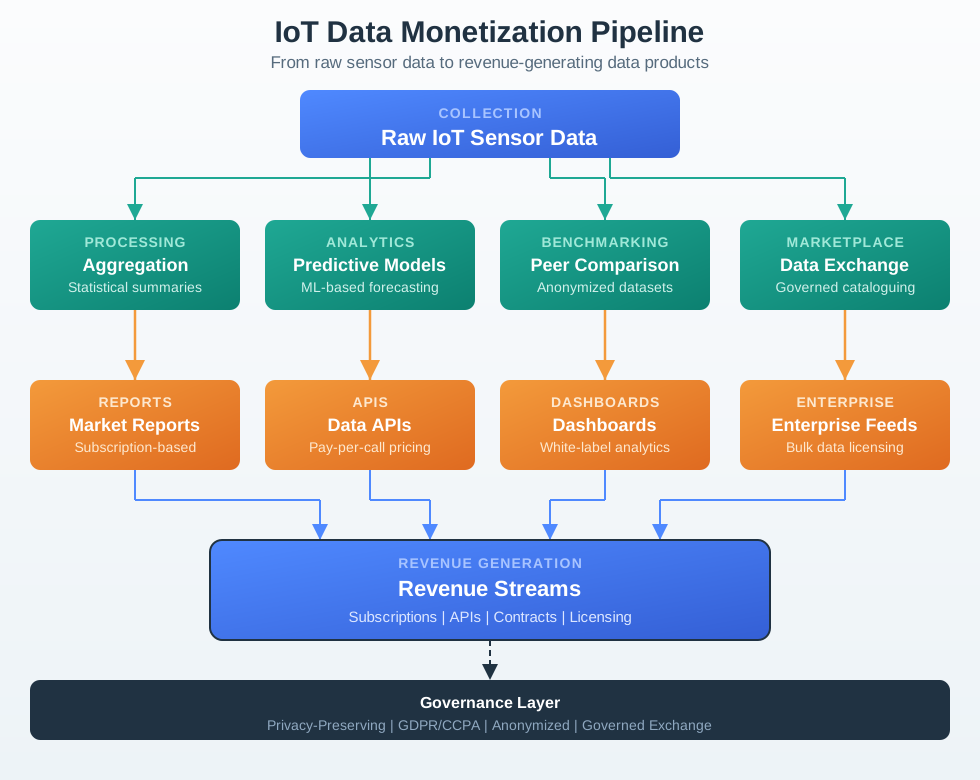
Data Monetization Value Chain
The big picture: IoT data gains value through a four-stage transformation from worthless raw readings to actionable insights that buyers will pay for.
Step-by-step breakdown:
Raw collection: A large thermostat fleet generates temperature, humidity, and HVAC-state telemetry every few minutes. Raw sensor readings are a weak product because few buyers want CSV files full of timestamps and temperatures.
Processing and anonymization: Apply k-anonymity, aggregate by region and hour, and extract features such as peak usage time, setback patterns, and efficiency scores. Data volume falls while decision value rises.
Packaging as products: Create API endpoints, weekly reports, and enterprise dashboards. Pricing should be tied to the buyer’s decision value, not to the number of raw rows exported.
Revenue generation: Sell approved insights to utilities, HVAC manufacturers, city planners, or internal account teams. Each buyer segment should receive only the slice that matches its consented purpose.
Why this matters: The value chain multiplies value at each stage: raw data becomes cleaned features, then aggregated statistics, then predictive insights. Value is created through processing and governance, not collection alone.
IoT Data Value Shift
Illustrative scenario: 10M smart thermostats, 8MB/day each = 80TB/day raw data
Interpretation: These are teaching assumptions for comparing raw-export pricing with insight-product pricing. They are not reported revenue for a specific company.
Data Value Transformation Tool
Explore how processing transforms raw IoT data value. Adjust device count, data volume, and pricing to see the value multiplier in action.
Show code
viewof deviceCount = Inputs.range([1000,50000000], {value:10000000,step:1000000,label:"Number of IoT devices:",format: d => d.toLocaleString()})viewof dataPerDay = Inputs.range([1,100], {value:8,step:1,label:"MB per device per day:",format: d =>`${d} MB`})viewof rawDataPrice = Inputs.range([0.001,0.1], {value:0.01,step:0.001,label:"Price per GB (raw data):",format: d =>`$${d.toFixed(3)}`})viewof insightPrice = Inputs.range([0.01,1.0], {value:0.10,step:0.01,label:"Price per device/month (insights):",format: d =>`$${d.toFixed(2)}`})
The first block established the product rule: sell a decision-ready insight. Now compare the economics of raw rows, processed features, and packaged predictions.
39.7 Data Monetization
⏱️ ~12 min | ⭐⭐⭐ Advanced | 📋 P03.C05.U02
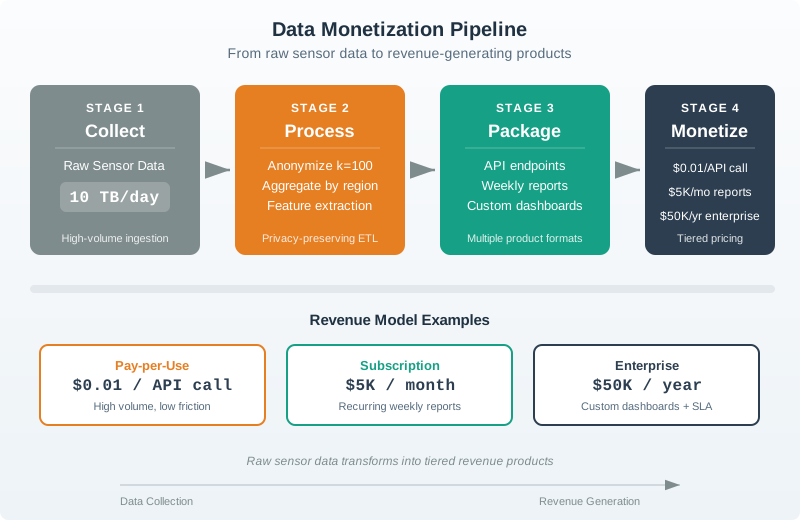
IoT data monetization pipeline from raw sensor data to revenue streams
Figure 39.1
Four-stage data monetization pipeline. Stage 1 Collect: raw sensor data. Stage 2 Process: anonymize, aggregate by region, and extract features. Stage 3 Package: API endpoints, weekly reports, and custom dashboards. Stage 4 Monetize: tiered buyer access. Stages flow left to right showing transformation from raw data to revenue.
Figure 39.2: Alternative view: Data Monetization Pipeline - This diagram shows data monetization as a four-stage pipeline. Stage 1 (Collect): raw sensor data at scale. Stage 2 (Process): anonymization, geographic aggregation, and feature extraction. Stage 3 (Package): multiple product formats including API endpoints, weekly reports, and custom dashboards. Stage 4 (Monetize): tiered buyer access. Students can trace how raw data transforms into revenue-generating products without treating raw telemetry as the saleable asset.
IoT devices generate large amounts of data that can be monetized in various ways while respecting privacy and regulatory constraints. Market forecasts vary by analyst and definition, so the durable skill is evaluating whether a proposed data product has a named buyer, a clear decision value, and a defensible privacy boundary.
39.7.1 Aggregated Insights
Sell anonymized, aggregated data to third parties for market research and trend analysis.
How it works: Raw sensor readings from thousands or millions of devices are combined into statistical summaries that reveal patterns without identifying individuals. The aggregation itself creates the value – no single device’s data is interesting, but the population-level trends are highly valuable.
Pattern examples:
Company
Data Source
Buyer
Revenue Model
Smart thermostat platform
Regional temperature, humidity, and HVAC-state patterns
Utility planning teams
Demand forecasting reports and dashboards
Fitness route platform
Aggregated cycling/running traces
City planning departments
Heat maps and corridor analysis
Connected vehicle platform
Aggregated vehicle telemetry
Insurance and mapping companies
Governed API or clean-room access
Indoor air quality platform
CO2, particulate, and ventilation trends
Real estate and HVAC teams
Building health benchmarks
Critical considerations:
Ensure proper anonymization techniques (minimum group sizes of 50-100)
Comply with GDPR, CCPA, and other data protection regulations
Maintain user trust through transparency about what data is shared
Obtain explicit consent before collecting data intended for third-party sale
Regularly audit anonymization to prevent re-identification attacks
39.7.2 Predictive Analytics
Generate revenue from actionable predictions derived from IoT data. Unlike raw data or simple aggregations, predictive analytics applies machine learning models to forecast future events, making the output significantly more valuable.
Value chain: Raw data ($0.001/record) -> Cleaned data ($0.01/record) -> Aggregated statistics ($0.10/record) -> Predictive insights ($1-10/prediction)
Implementation examples:
Fleet management: Telematics platforms can sell predictive maintenance insights that forecast component failures before roadside breakdowns.
Agriculture: Weather, soil, and equipment telemetry can become field-level irrigation, yield-risk, or input-planning recommendations.
Energy: Smart-meter analytics can identify usage patterns and appliance-level signals that utilities use for efficiency programs.
39.7.3 Benchmarking Services
Provide customers comparative performance data to help organizations understand their position relative to peers.
How it works: Your platform collects operational data from many customers, then offers each customer a view of how they compare to anonymized industry averages, top performers, and similar organizations.
Implementation examples:
Energy Star Portfolio Manager: Buildings benchmark energy efficiency against similar properties nationwide
Samsara: Fleet operators compare fuel efficiency, safety scores, and maintenance costs against industry peers
Enlighted: Office buildings compare occupancy and space utilization against regional benchmarks
Pricing models: Benchmarking is usually sold as a subscription or account add-on. Higher tiers justify price when they provide finer peer groups, stronger data quality, and actionable recommendations rather than static charts.
39.7.4 Data Marketplaces
Create platforms where data buyers and sellers connect, facilitating data exchange with proper governance. Data marketplaces act as intermediaries, handling consent management, quality assurance, pricing, and delivery.
Marketplace economics:
Platform typically takes 15-25% transaction fee
Sellers set pricing (per-record, per-query, or subscription)
Quality scoring and provenance tracking increase data value
Escrow and preview mechanisms build buyer confidence
Implementation examples:
Dawex: Enterprise data exchange platform for IoT and operational data
Datarade: Aggregates data providers including IoT sensor data streams
AWS Data Exchange: Marketplace for third-party data including IoT datasets
John Deere Operations Center: Farmers can share anonymized field data with researchers and input suppliers
Sell Insights, Not Raw Data
The mistake: Offering raw sensor CSV exports (temperature readings, GPS coordinates, accelerometer values) as the primary data product.
Why it fails: Raw telemetry has weak market value because buyers must invest heavily in cleaning, processing, and analyzing it themselves. The same data becomes more useful when processed into building efficiency benchmarks, HVAC failure predictions, and energy optimization recommendations.
The consequence: Teams can spend heavily on collection infrastructure, then discover that raw exports produce weak revenue because buyers still have to clean, join, validate, and interpret the data. The value-to-cost ratio improves only when the product becomes a decision-ready insight.
The fix: Transform raw data into three tiers of increasing value:
Tier
Product
Example
Price
Tier 1: Raw data
CSV exports, API dumps
Temperature readings every 5 min
Lowest value; highest cleanup burden
Tier 2: Processed features
Cleaned, aggregated, labeled
Daily energy consumption by zone
Higher value when it fits a workflow
Tier 3: Actionable insights
Predictions, recommendations, benchmarks
“HVAC unit will fail in 14 days”
Highest value when the decision saves cost
Illustrative outcome: Repackaging raw data as Tier 3 insights can increase revenue per data point because the buyer pays for a decision-ready signal. For example, a smart-building platform might compare a low-price raw reading export with a higher-value failure prediction subscription; the second product earns more only if the prediction reliably prevents maintenance cost or downtime.
Key principle: Data value is created through processing, not collection. Budget for analytics, governance, product packaging, and buyer integration before scaling sensors and data lakes.
39.7.5 IoT Data Valuation
Before monetizing data, you need a framework for estimating its value. Not all IoT data is equally valuable – freshness, exclusivity, accuracy, and actionability all affect pricing.
Data value multipliers:
Factor
Low Value
Medium Value
High Value
Freshness
Historical (>7 days)
Near-real-time (hours)
Real-time (<1 min)
Exclusivity
Commodity data available from many sources
Limited to a few providers
Only you can provide it
Accuracy
<95% confidence
95-99% confidence
>99% calibrated
Actionability
Context/background info
Informs decisions
Triggers automated actions
Coverage
Local/single-site
Regional
National/global
39.8 Applying Data Monetization in Practice
In real deployments, implementing data monetization is less about writing a single Python script and more about designing a pipeline:
Ingestion and Cleaning – Raw telemetry arrives from devices, is validated, deduplicated, and anonymized where needed. This stage typically filters out 10-30% of data as noise or duplicates.
Feature Engineering – You transform raw readings into higher-level features such as daily energy use, anomaly flags, or churn risk scores. This is where most of the intellectual property and competitive advantage resides.
Productization – Those features become reports, dashboards, APIs, or benchmark services that customers pay for. Each product format serves a different buyer persona and price point.
Governance and Compliance – Every step must comply with GDPR/CCPA and internal data-handling rules. Automated compliance checks should be embedded in the pipeline, not bolted on afterward.
Cross-Reference
For technical details on building these data pipelines, see:
Edge Computing Patterns in Module 5.3 – how to process data before it leaves the device
Stream Processing in Module 6.2 – real-time data transformation architectures
Data Storage in Module 6.1 – choosing the right database for your data products
The key monetization step is deciding which derived insights are valuable enough that customers will pay for them. A useful test: if the insight saves or earns the buyer at least 10x what they pay for it, you have a viable data product.
Checkpoint: Data Product Economics
You now know:
The teaching scenario compares 80TB/day of raw thermostat data with processed insight pricing.
In that scenario, raw CSV value is $292K/year, processed insights are $120M/year, and the value multiplier is 411x.
A practical buyer test is whether the insight saves or earns at least 10x what the buyer pays for it.
Data products are one route. The next route monetizes the ecosystem around the device: partners, referrals, recommendations, and reduced churn.
39.9 Indirect Revenue Models
⏱️ ~12 min | ⭐⭐ Intermediate | 📋 P03.C05.U03
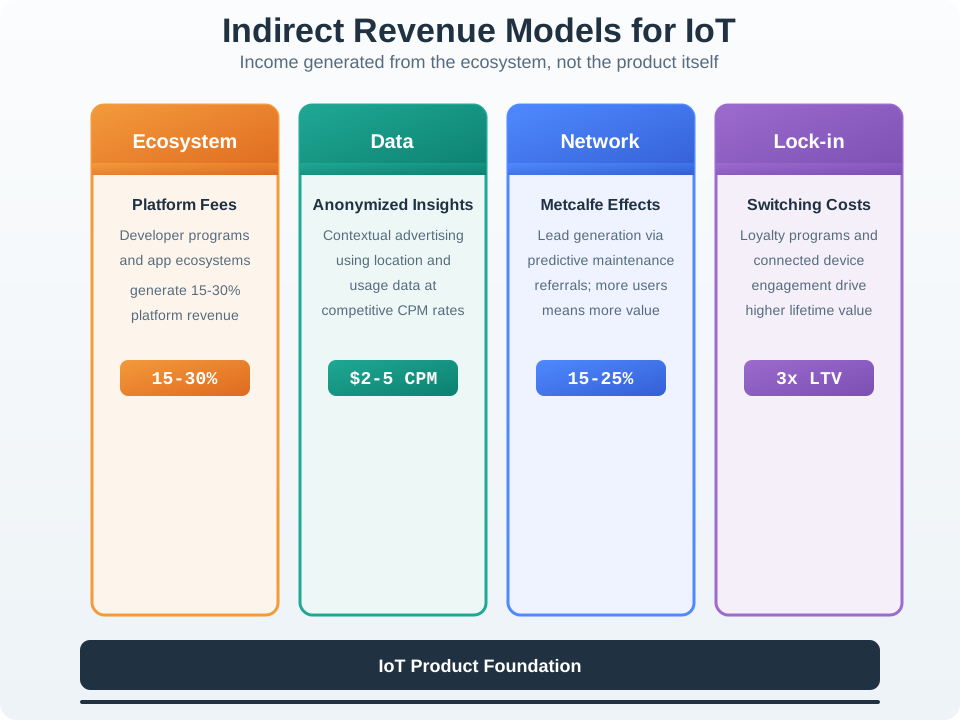
Indirect revenue models generate income not from the IoT product itself, but from the ecosystem, relationships, and behaviors it enables. For many IoT companies, indirect revenue ultimately exceeds direct product sales.
Indirect revenue models enabled by an IoT product ecosystem
Figure 39.3
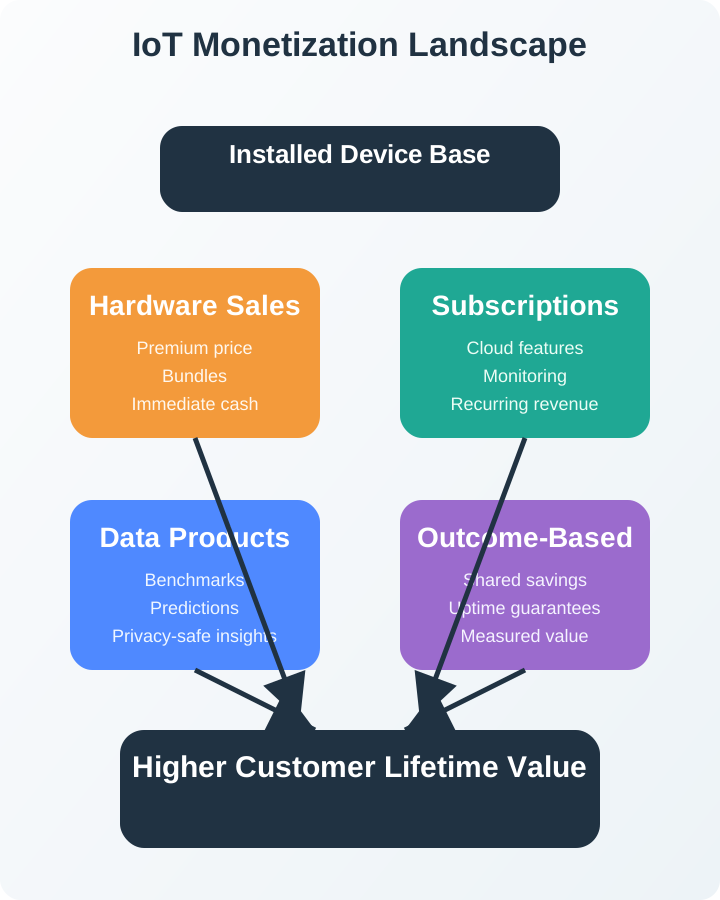
IoT monetization landscape showing hardware sales, subscriptions, data products, and outcome-based models building customer lifetime value from an installed device base.
Figure 39.4: Alternative view: Monetization Landscape - This diagram shows how indirect revenue is part of a broader IoT monetization stack. Hardware sales create the installed device base; subscriptions, data products, and outcome-based services add recurring value when the product keeps solving customer problems after deployment.
39.9.1 Ecosystem Monetization
Ecosystem monetization leverages the network of third-party developers, manufacturers, and service providers that build around your platform.
Platform Fees: Charge third-party developers or integrators API access fees, certification fees, or revenue sharing. In a smart-home ecosystem, the fee must be justified by real value: user reach, integration tooling, device certification, cloud infrastructure, support, and reduced partner acquisition cost.
Platform Mechanism
What the Partner Gets
Why It Can Be Billable
API access
Commands, device state, automations, and account linking
Lets the partner plug into an existing user workflow
Certification
Compatibility testing and a “works with” badge
Reduces buyer uncertainty and support risk
Marketplace listing
Discovery, ratings, documentation, and onboarding
Lowers customer acquisition cost
Cloud integration
Event routing, permissions, rate limits, and monitoring
Avoids every partner rebuilding the same infrastructure
Certification Programs: Generate revenue from “Works with” certification, testing, and compliance services. The defensible price depends on test depth, support burden, legal review, and the demand created by the platform.
Training and Education: Monetize ecosystem expertise through developer training programs and certification courses. Training revenue is usually secondary; the larger value is reducing support load and increasing successful integrations.
Ecosystem Revenue Modeling
Model ecosystem monetization revenue from platform fees and certification programs. Adjust partner count and fee structure to project total revenue.
Show code
viewof platformFee = Inputs.range([5,35], {value:25,step:1,label:"Platform fee percentage:",format: d =>`${d}%`})viewof thirdPartyRevenue = Inputs.range([100000,10000000], {value:2000000,step:100000,label:"Third-party annual revenue ($):",format: d =>`$${(d /1000000).toFixed(1)}M`})viewof numberOfPartners = Inputs.range([10,1000], {value:100,step:10,label:"Number of ecosystem partners:",format: d => d.toLocaleString()})viewof certificationFee = Inputs.range([1000,100000], {value:15000,step:1000,label:"Certification fee per partner ($):",format: d =>`$${(d /1000).toFixed(0)}K`})
Display relevant advertising or sponsorship based on IoT data insights, requiring careful balance to avoid user alienation. Example: a free fitness app may show relevant sports-equipment offers, while a security camera or health-adjacent product needs a much stricter standard.
Revenue potential by channel should be modeled as assumptions, then validated with actual engagement:
In-app display ads: low friction, low trust risk only when clearly separated from product controls
Sponsored content/recommendations: higher value when the recommendation helps the user’s task
Native integrations: brand partnerships that must not compromise user safety or autonomy
Best practices:
Ensure ads are genuinely relevant and valuable to the user context
Provide ad-free paid option (typically $3-10/month)
Never compromise user privacy for advertising revenue
Be transparent about data usage in clear, plain-language policies
Cap ad frequency to avoid fatigue (max 2-3 per session)
Common Pitfall: Ad-Driven Revenue in IoT
Advertising works well for consumer IoT apps with high engagement (fitness trackers, navigation apps). It works poorly for low-engagement devices (smart plugs, sensors) where users interact infrequently. If your users only open the app twice per month, ad revenue will be negligible – focus on other indirect models instead.
39.9.3 Lead Generation
Use IoT interactions to identify potential customers and connect users with relevant service providers. This model works especially well when IoT data reveals a need that a third party can fulfill.
How the lead generation funnel works:
Detection: IoT sensor identifies a condition (e.g., HVAC running inefficiently)
Notification: User is alerted about the issue with diagnostic context
Recommendation: Platform suggests a vetted service provider
Referral: User connects with the provider; platform earns a disclosed referral fee or service commission
Smart thermostat: Detects HVAC inefficiency and recommends a local contractor or energy audit.
Security system: Detects repeated alarm events and offers professional monitoring or installation support.
Connected vehicle adapter: Detects diagnostic trouble codes and connects the driver to a repair appointment.
39.9.4 Loyalty and Retention
IoT features that increase customer lifetime value and reduce churn through connected experiences. The core insight: once a customer’s device is connected and integrated into their routine, switching costs become very high.
Retention mechanics in IoT:
Mechanism
How It Works
Churn Reduction
Auto-reorder
Device detects low supplies and prompts or places a replenishment order
Convenience can reduce churn
Usage data lock-in
Historical data makes switching costly
Switching requires exporting or abandoning history
Cross-device integration
Multiple connected devices create ecosystem
More devices make the account harder to replace
Personalization
Learned preferences improve over time
Service quality improves with continued use
Pattern examples:
Connected consumable device: Detects low supply and offers replenishment at the moment of need.
Connected printer: Monitors ink or toner levels and schedules replacement before the user runs out.
Connected fitness product: Uses workout history, leaderboards, and coaching to make the subscription feel cumulative.
Checkpoint: Indirect Revenue
You now know:
Ecosystem fees can sit in the 15-30% range when APIs, users, certification, and acquisition savings create partner value.
In the worked platform example, 25% of $2M is $500K.
Advertising needs a stricter fit: the chapter’s ad guidance names $3-10/month ad-free options and a max 2-3 ads per session.
Indirect revenue only works while users still trust the product. The next section turns that trust requirement into concrete privacy controls.
39.10 Privacy-Preserving Monetization
⏱️ ~10 min | ⭐⭐⭐ Advanced | 📋 P03.C05.U04
When monetizing IoT data, implementing proper privacy protections is essential for compliance and user trust. The techniques below form a defense-in-depth strategy – use multiple approaches simultaneously for maximum protection.
39.10.1 K-Anonymity
K-anonymity ensures each record is indistinguishable from at least k-1 other records. For data monetization, this means grouping data so individual users cannot be identified.
How it works: Before releasing a dataset, you generalize quasi-identifiers (attributes that could identify someone when combined, such as ZIP code, age, and device type) until every unique combination appears at least k times.
Example: With k=5, any combination of attributes (zipcode, age group, device type) must appear in at least 5 records. Records in smaller groups are suppressed or generalized further before sale.
IoT-specific considerations:
High-frequency data: IoT sensors generate timestamps that can re-identify users through movement patterns. Always aggregate time to hourly or daily bins.
Location precision: GPS coordinates with 6+ decimal places uniquely identify locations. Reduce precision to 2-3 decimal places (city-block level) or use grid cells.
Device fingerprinting: Even without user IDs, unique device configurations (firmware version, sensor calibration) can identify devices. Remove or generalize device metadata.
Recommended k values: Consumer data (k >= 100), B2B data (k >= 20), research data (k >= 50)
39.10.2 Differential Privacy
Differential privacy adds calibrated statistical noise to query results, providing a mathematical guarantee that the presence or absence of any individual’s data does not significantly change the output.
The privacy budget (epsilon, e):
Epsilon Value
Privacy Level
Use Case
e = 0.01
Very strong
Medical/health IoT data
e = 0.1
Strong
Consumer behavior data
e = 1.0
Moderate
Aggregate trends and statistics
e = 10.0
Weak
Barely anonymized
Example: Instead of reporting “47 users in zipcode 90210 have smart thermostats,” report “approximately 47 +/- 5 users” with calibrated Laplace noise. The noise magnitude is determined by the privacy budget (e) and the query sensitivity.
Real-world adoption: Apple uses differential privacy in iOS to collect emoji usage, Safari statistics, and health data trends. Google’s RAPPOR system uses it for Chrome usage statistics. Both demonstrate that differential privacy works at scale with millions of IoT and mobile devices.
39.10.3 Aggregation Requirements
Data buyers receive only aggregated statistics, never individual records. This is the simplest and most commonly used privacy technique in IoT data monetization.
Aggregation rules for IoT data products:
Minimum group sizes: Typically 50-100 records per aggregation cell. Cells with fewer records are suppressed.
Geographic aggregation: City-level or postal-code-level, not address-level. For dense urban areas, this may mean aggregating to neighborhoods of 10,000+ residents.
Temporal aggregation: Daily or weekly summaries, not minute-by-minute traces. Hourly aggregation acceptable for non-sensitive data.
Complementary suppression: If only one user fits a rare demographic cell, suppress that cell even if the group size requirement is met.
39.10.4 Federated Learning (Advanced)
Federated learning trains machine learning models on-device, sending only model updates (gradients) to a central server rather than raw data. This enables data monetization through model improvement without ever centralizing personal data.
IoT applications:
Predictive text on smartphones: Models improve from all users’ typing patterns without collecting keystrokes
Anomaly detection in smart homes: HVAC failure models trained across thousands of homes without sharing individual usage data
Wearable health insights: Population-level health models trained without centralizing heart rate or activity data
Cross-Reference
For deeper coverage of privacy-preserving techniques, see Module 7.4 (Privacy and Compliance), particularly the chapters on GDPR compliance and privacy-by-design frameworks.
39.11 Ethical Framework for Data Monetization
Data monetization must be guided by ethical principles, not just legal compliance. Regulations set the floor, but building lasting user trust requires going beyond minimum legal requirements.
39.11.1 The Four-Question Ethics Test
Before monetizing any IoT data, answer these four questions:
Expectation: Would the user reasonably expect their data to be used this way? (If you need to bury it in a 50-page Terms of Service, the answer is probably no.)
Consent: Has the user given explicit, informed consent – not just clicked through a wall of text?
Anonymization: Can any individual be identified, directly or through re-identification attacks?
Benefit: Does the data buyer’s use case ultimately benefit or at least not harm the end users?
Anonymized Data Fallacy
Many companies believe removing names and email addresses makes data anonymous. Research consistently shows this is false:
Netflix Prize dataset (2006): Researchers de-anonymized “anonymous” movie ratings by cross-referencing with public IMDb reviews
NYC Taxi data (2014): “Anonymous” trip records were re-identified by matching drop-off locations to celebrity addresses
Fitness app data (2018): Strava’s “anonymous” heat maps revealed secret military base locations and patrol routes
Rule of thumb: If your dataset contains location data, timestamps, and any behavioral patterns, assume it can be re-identified unless you apply rigorous privacy techniques (k-anonymity with k >= 100, differential privacy, or aggregation).
39.12 IoT Data Monetization Regulation
Understanding the regulatory environment is essential before designing any data monetization strategy. Regulations vary significantly by jurisdiction, industry, and data type.
Regulation
Jurisdiction
Key Requirements for Data Monetization
GDPR
EU/EEA
Explicit consent, purpose limitation, right to erasure, Data Protection Impact Assessment required
CCPA/CPRA
California, USA
Right to opt-out of data sale, “sale” broadly defined (includes sharing for value), $7,500 per intentional violation
LGPD
Brazil
Similar to GDPR; consent or legitimate interest basis required
PIPA
South Korea
Strict consent requirements; heavy fines for non-compliance
HIPAA
USA (health)
Health data cannot be sold without explicit patient authorization; de-identification requires expert determination or safe harbor
COPPA
USA (children)
Parental consent required for children under 13; severe limits on data monetization
Practical Tip: Consent by Design
Build consent management into your IoT product from day one, not as an afterthought. A well-designed consent flow:
Explains in plain language what data is collected and how it will be used
Separates product consent from data sharing consent (users can use the device without agreeing to data monetization)
Provides granular controls (share energy data but not occupancy patterns)
Makes opt-out easy (one-tap in the app, not a support ticket)
Respects choices without degrading service (no punitive feature restrictions for users who opt out of data sharing)
Checkpoint: Privacy, Ethics, and Regulation
You now know:
Consumer data may require k >= 100, while aggregation rules often use 50-100 records per cell.
The smart-city quiz protects 50,000 connected vehicles with grid k-anonymity, 15-minute bins, and differential privacy on counts.
Ethical and regulatory risk is not abstract: the chapter includes a 73% depression-inference example and a $7,500 CCPA/CPRA intentional-violation figure.
The remaining sections connect the chapter to neighboring topics and give you practice applying the same release-gate logic under quiz conditions.
39.13 Concept Relationships
How data monetization connects to privacy, architecture, and business models:
Case Studies - Peloton and Ring’s data-driven revenue models
GDPR Compliance - Legal framework for data monetization in EU
Analytics and ML - Building predictive models that create monetizable insights
Data Storage - Architectures for managing monetizable data at scale
Interactive Quiz: Match Concepts
Interactive Quiz: Sequence the Steps
Common Pitfalls
Sell Decisions, Not Rows
Exporting raw telemetry before naming the buyer’s decision creates a low-value data dump and a high-value privacy risk. Start with the decision the buyer improves, then publish the smallest aggregate, score, benchmark, or forecast that supports that decision.
Anonymization Needs Ongoing Work
Removing names once is not enough. Location, timestamps, rare device behavior, public datasets, and repeated releases can re-identify users or organizations. Re-check cohort size, suppression rules, privacy budget, and buyer access every time the product changes.
Price Data by Decision Value
Charging by gigabyte rewards noisy collection instead of useful insight. Price by the decision value: avoided truck rolls, better route planning, energy savings, faster maintenance, safer underwriting, or improved product planning.
Label the Diagram
💻 Code Challenge
39.15 Summary
39.15.1 Key Takeaways
This chapter covered data monetization and indirect revenue strategies for IoT products:
Chapter Summary
Data Monetization Strategies:
Aggregated insights: Sell anonymized population-level patterns to third parties, such as energy usage trends, traffic flows, or equipment utilization benchmarks.
Predictive analytics: Transform raw data into actionable forecasts, risk scores, or maintenance recommendations that improve a named buyer decision.
Benchmarking services: Offer customers comparative performance data with useful peer groups, suppression rules, and actionable recommendations.
Data marketplaces: Facilitate data exchange with provenance, consent, quality checks, entitlement controls, and buyer usage logs.
Data Valuation: Assessed across four dimensions – freshness, exclusivity, accuracy, and actionability. Real-time exclusive data is more valuable only when it improves a decision enough to justify the privacy and delivery cost.
Privacy-Preserving Techniques:
K-anonymity (k >= 50-100): Groups records so individuals cannot be identified
Differential privacy (e = 0.1-1.0): Adds calibrated noise to prevent inference
Aggregation (min group 50-100): Only group-level statistics shared
Federated learning: Models trained on-device; only gradients shared centrally
Indirect Revenue Models:
Ecosystem monetization: Platform fees, certification, training, and API access for third-party developers and manufacturers.
Advertising: Contextual offers can work in high-engagement consumer apps but create higher privacy and trust risk.
Lead generation: Service referrals triggered by IoT data insights need user control, disclosure, and quality safeguards.
Loyalty/retention: Auto-reorder, data history, personalization, and cross-device integration can increase lifetime value when they reduce user effort.
In 60 Seconds
This chapter covers data and indirect monetization, explaining the core concepts, practical design decisions, and common pitfalls that IoT practitioners need to build effective, reliable connected systems.
Ethics and Compliance: Four-question ethics test (expectation, consent, anonymization, benefit). Regulatory compliance with GDPR, CCPA, HIPAA, and sector-specific rules. Privacy is a business asset, not a cost.
 Checkpoint: Insight Products and Governance