3 Privacy vs Security in IoT
More
Depth: Practitioner
Progress saves as you read. Mark sections complete as you go; your progress appears in the sidebar.
3.1 A Door Lock Is Not a Curtain
This section: A Door Lock Is Not a Curtain — Picture a shared home where a smart lock records every arrival.
Ask What the System Should Know
Picture a shared home where a smart lock records every arrival. The resident may want a warning when a door is forced, but not a permanent map of family, visitors, and care workers. Strong access checks can protect the record while the record itself still exceeds the purpose.
Write the purpose before the data path. Name each field, person affected, place, time detail, user benefit, receiver, allowed use, storage period, choice, deletion route, and owner. Include people who never opened the app but still enter the sensed space.
Test first use, a visitor, a child account, a support request, a new partner, a new use, withdrawal, export, deletion, and the end of service. Check the device, app, stored copies, reports, and partner path. A settings change is not proof if sensing or sharing continues elsewhere.
Keep urgent door safety working when sharing is off. Privacy choice should reduce collection or use without disabling the local protection a person still needs.
This opening does not decide every lawful use or social trade-off. Practitioner turns purpose, people, data, and control into a review record. Under the Hood examines inference, hidden copies, re-identification, long-term patterns, and why encryption alone cannot answer what should exist.
Use a one-room review before release. Let a resident, visitor, and support worker enter at different times. Show each person what is sensed, why it is needed, who receives it, and how long it stays. Then turn off one optional use and make another event.
Follow that event through every copy. Check the local device, app, service, report, backup, and partner route. Keep only the detail needed for the stated job. Repeat the review after a field, receiver, purpose, place, or storage time changes. If a person cannot see or challenge the new use, the review is not complete.
Close with plain questions. Would the feature still work with less detail? Could a shorter time meet the need? Does each new receiver add a clear gain for the person? Can a guest learn what is sensed before it starts? Can the owner prove that an old copy is gone or held for a stated reason?
Imagine a smart lock that uses strong encryption, rejects every fake credential, and logs every entry perfectly. It is secure. Now imagine the lock also shares every arrival time with an analytics partner and keeps that history forever. The lock did not fail as a lock, but it still exposed a life pattern. That is the privacy lesson for IoT: keeping attackers out is only one question; deciding what the system is allowed to know and remember is another.
Privacy Priya
“The safest data is the data you never collected — justify every field before it reaches storage.”
Through this chapter, Priya puts each data flow on her Data Diet: what is collected, why every field is needed, and when it expires.
3.3 Learning Objectives
This section: Learning Objectives
By the end of this chapter, you will be able to:
- Explain the difference between privacy and security in connected devices.
- Identify why always-on sensors, metadata, and data flows create privacy risk.
- Recognize common IoT privacy questions before choosing a technical control.
- Follow the privacy curriculum from fundamentals to safeguards and zero trust.
- Build a first privacy review record for a simple IoT feature.
- Choose the next chapter based on your role and learning goal.
3.4 Prerequisites
This section: Prerequisites — This is an entry chapter.
This is an entry chapter. No previous privacy chapter is required.
3.5 Why Privacy Is Different from Security
This section: Why Privacy Is Different from Security — Security controls who can access a system.
Security controls who can access a system. Privacy asks whether the system should collect, keep, infer, or share the data in the first place. A connected device can be secure and still privacy-invasive if it collects more data than needed, keeps raw data too long, uses it for a new purpose, or gives users no practical control.
Use Figure 3.1 to keep the security and privacy questions separate while seeing where they meet. Start with what each discipline controls, then look for the shared outcome.
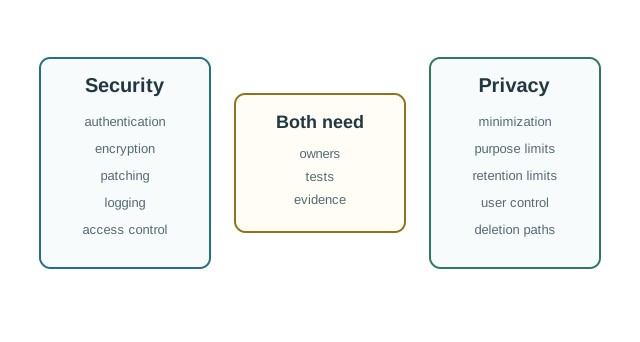
In Figure 3.1, read security as control over access and system behavior, then privacy as control over collection, purpose, inference, retention, and sharing. Their overlap is accountability: authorized access can still support an unjustified use, while a justified use still needs protection. That distinction carries forward into the IoT data path, where both questions must be asked at every boundary.
Security
3.5.1 Who can get in?
Authentication, encryption, patching, logging, and network controls reduce unauthorized access and tampering.
Privacy
3.5.2 What should exist?
Minimization, purpose limits, retention limits, notices, choices, and request paths reduce inappropriate collection and use.
Together
3.5.3 Who is accountable?
Security evidence and privacy evidence both need owners, tests, exceptions, and review triggers.
3.6 Why IoT Raises the Stakes
This section: Why IoT Raises the Stakes — IoT systems observe physical spaces.
IoT systems observe physical spaces. They collect data from devices that may be mounted in homes, worn on bodies, installed in workplaces, embedded in vehicles, or placed in shared public areas. The risk is not only one sensor reading; it is the pattern formed when readings are connected.
To see why one local measurement becomes a wider privacy claim, follow Figure 3.2 across every actor that can copy, transform, or reuse it.
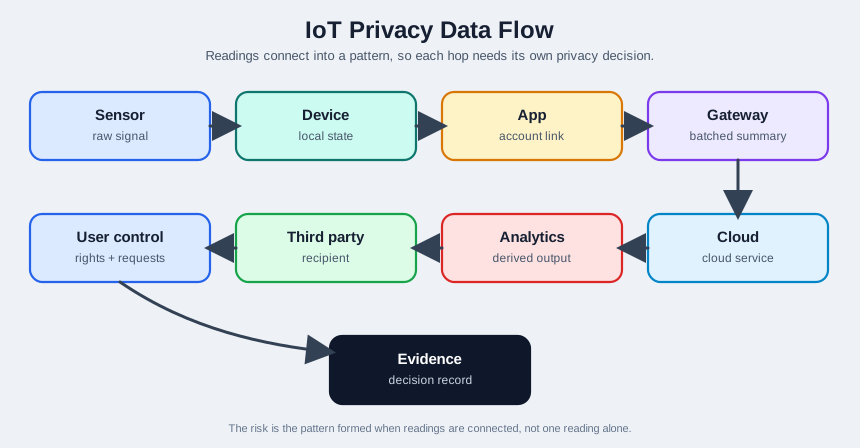
Read Figure 3.2 from sensor and device through app, gateway, cloud analytics, and any third party. At each hand-off, ask whether detail increases through correlation, whether a new actor gains access, and whether the person still has meaningful control. The final evidence record must cover the whole chain, because securing only the sensor-to-gateway hop does not justify later inference or sharing.
Always on
3.6.1 Passive collection
Sensors can collect data when a person is not actively using an app or filling out a form.
Shared space
3.6.2 Bystander data
Visitors, family members, workers, and nearby people can be captured by a device they did not configure.
Metadata
3.6.3 Pattern exposure
Time, place, frequency, device state, and routine can reveal more than a single reading.
Cloud link
3.6.4 Wider access
Apps, gateways, cloud services, support teams, and partners may all become part of the privacy review.
3.7 Privacy Across Device Tiers
This section: Privacy Across Device Tiers — Privacy risk changes with how visible the device is to the person being sensed.
Privacy risk changes with how visible the device is to the person being sensed. A phone, watch, or smart glasses frame is usually obvious, but the app and third-party flows behind it are not. A thermostat, speaker, appliance, or vehicle device is partly visible, but the service relationships may be hidden. A badge, environmental mote, tag, occupancy sensor, or building sensor may be easy to miss entirely, especially in workplaces and shared spaces.
Top tier
Middle tier
3.7.2 Hybrid visibility
Thermostats, speakers, vehicles, cameras, and appliances mix visible hardware with less visible accounts, automations, support access, and cloud services. The review should connect device indicators, app controls, local fallback, household or workplace roles, and partner sharing.
Bottom tier
The practical question is: what sign tells people that sensing or sharing is happening? A Signifiers.io-style design review asks how the connected object makes its state legible. For a top-tier phone, that may be a just-in-time permission prompt and a data-flow review panel. For a Mites.io-class environmental node, it may be a room notice, visible label, status light, public sensor map, or posted owner contact. Without a signifier, an otherwise useful sensor can feel like surveillance, even when it is secure.
This is why privacy can become the adoption barrier for ubiquitous computing. People react not only to breaches, but also to app permissions that seem excessive, workplace badges that pinpoint location, activity trackers that create resale or insurance concerns, and connected objects whose data trail is unclear. A review should record the device tier, what people can notice before collection starts, how information flows become visible later, and how a user or bystander can object, pause, or get an explanation.
3.8 Awareness, Defaults, and Product Labels
This section: Awareness, Defaults, and Product Labels — Awareness should be quick enough for a real room, not just a settings page.
Awareness should be quick enough for a real room, not just a settings page. A person entering a classroom, office, or home should be able to learn what is sensing, what it can infer, and who operates it without becoming a privacy expert. Good notification design treats audio, visual, motion, haptic, screen, and posted cues as a cost-benefit choice: too many notices become noise, but no notice turns ordinary sensing into hidden surveillance. Familiar conventions help. A light switch near a doorway works because people understand where to look, what it controls, and what state it is in.
Low-end and middle-tier devices need help from the surrounding infrastructure. A tiny sensor may not have a screen, speaker, update workflow, or usable account interface, so middleware has to carry some privacy and security work for it. That can include access control, filtering, update status, a device inventory, a list of sensors and destinations, and a simple risk statement for what the device collects. A GiOTTO-style privacy support layer uses this idea across the physical, logical, and app layers: expose higher-level abstractions such as “home” instead of raw GPS or “loud” instead of raw microphone samples, require apps to state purposes such as “location for maps” or “contacts for advertising,” and check those claims with static analysis, dynamic behavior, and crowd evidence.
Defaults are a privacy control, but only when they are useful. For a campus person-locator, “share nothing” may protect privacy while destroying the feature, while “share everything” may be too invasive to trust. Better defaults use coarse and socially meaningful levels such as on campus, in office, team only, or city-level. Relationship evidence can help set those defaults, but it must be handled carefully: contact lists, call or message history, co-location, floor plans, Wi-Fi co-presence, and co-authorship can all reveal relationships while trying to protect them. The review question is not “can we infer it?” but “does this inference create a safer default than asking every user to make every decision from scratch?”
People also need privacy and security information before purchase. Consumer-facing IoT labels can package general product facts, privacy facts, security facts, and follow-up links in a form that fits a box, store page, or comparison tool. Useful label fields include collected data, purpose, retention time, sharing party, user choices, update lifetime, encrypted communication, authentication method, internet requirement, and independent ratings. User studies of such labels reported two practical lessons for design reviews: many buyers value privacy and security information before purchase, yet many also struggle to separate privacy from security. Labels should therefore make the distinction explicit, show defaults and controls plainly, and avoid requiring the buyer to decode vendor language.
3.9 The First Privacy Questions
This section: The First Privacy Questions — Before choosing a control, ask a small set of review questions.
Before choosing a control, ask a small set of review questions. These questions keep the team focused on the purpose of the data instead of treating privacy as a final approval step.
Inspect Figure 3.3 as the first-pass interview for a feature. The diagram deliberately begins with what exists and why before moving to controls and proof.
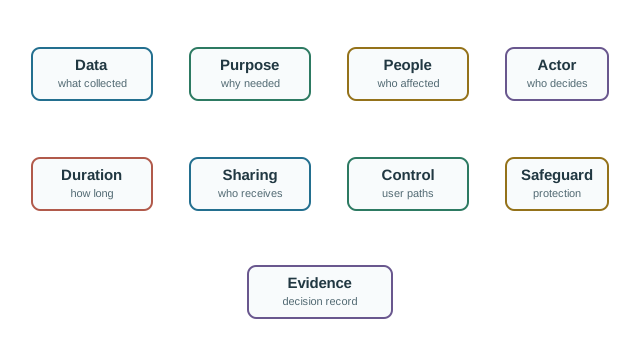
In Figure 3.3, trace data to purpose and the people affected, then identify actors, duration, and sharing boundaries. Only then inspect user control, safeguards, and evidence. This sequence prevents a strong encryption claim from answering the wrong question. The record below expands the same route into fields a reviewer can challenge and an owner can maintain.
3.10 Inference Risk
This section: Inference Risk — Many privacy failures come from inference.
Many privacy failures come from inference. The system may not store a user’s name, but a routine can still reveal when someone is home, when a space is empty, when a person sleeps, or when behavior changes. Data that looks harmless in isolation can become sensitive when combined.
The risk emerges through transformation rather than from one field alone. Use Figure 3.4 to follow how repeated readings acquire meaning and where review can reduce exposure.
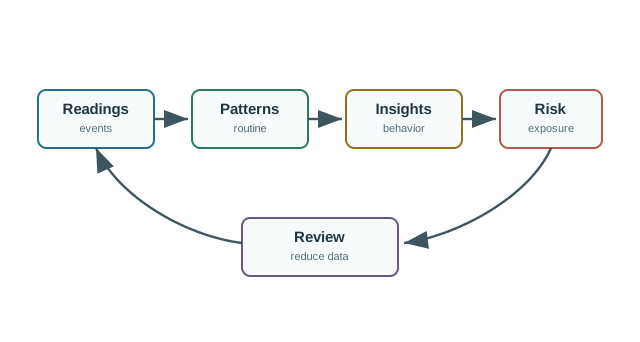
Read Figure 3.4 from individual readings into patterns, then from patterns into an insight about a person or household. The privacy risk sits in what that insight enables—such as prediction, targeting, or surveillance—not merely in whether a name was stored. The review loop then asks what detail, frequency, retention, linkage, or access can be reduced before the pattern becomes unnecessary exposure.
Removing a name is not enough when device timing, location, and behavior remain distinctive. Treat repeatable patterns as privacy-relevant data and test whether a person, household, or role could still be singled out.
3.11 Data Minimization Lever: Sampling Rate
This section: Data Minimization Lever: Sampling Rate — Because inference scales with data granularity, the most effective privacy control is often to collect less: fewer fields, lower sampling rates, coarser aggregation, and shorter retention.
Because inference scales with data granularity, the most effective privacy control is often to collect less: fewer fields, lower sampling rates, coarser aggregation, and shorter retention. Match the granularity to the purpose, not to what the hardware can capture.
3.11.1 Worked Example: Smart Meter Sampling Rate
Consider what different sampling rates reveal for the same encrypted meter.
- One sample per second: individual appliance signatures such as a kettle, refrigerator compressor cycle, or television can become distinguishable. That is roughly 2.6 million samples per meter per month of highly revealing data.
- One sample per 15 minutes: about 2,880 samples per month can support time-of-use billing while being too coarse to identify most individual appliances.
- The control: the privacy protection is the sampling rate, not the cipher. If billing only needs 15-minute or daily totals, collecting one-second data because the meter can creates privacy risk without a purpose to justify it.
Data minimization asks a design question before an encryption question: what is the coarsest data that still serves the goal? Whatever is not collected cannot be breached, subpoenaed, or inferred from later.
3.11.2 Minimization Ledger
| Lever | Fine-grained | Minimized | Purpose served |
|---|---|---|---|
| Sampling rate | 1 sample/second | 1 sample/15 minutes | Time-of-use billing |
| Aggregation | Per-appliance detail | Whole-home total | Energy usage tracking |
| Retention | Kept indefinitely | Deleted after billing cycle | Dispute window only |
Priya’s Data Diet
Read the parts as one connected control chain. First, Collect: one meter sample per 15 minutes — about 2,880 a month, not 2.6 million. Next, Justify: time-of-use billing needs interval totals, never appliance signatures. Finally, Expire: readings deleted after the billing cycle; the dispute window sets retention.
3.11.3 Practitioner Knowledge Check
3.12 Metadata and Re-Identification Limits
This section: Metadata and Re-Identification Limits — Two deeper effects show why security controls alone do not deliver privacy.
Two deeper effects show why security controls alone do not deliver privacy. The first is metadata leakage. Even when payloads are encrypted, the pattern of traffic - when a device transmits, how often, and how large the messages are - can reveal the events the payload describes. A door or motion sensor that only sends a message when it fires announces presence by the timing of its encrypted packets alone.
The second is the re-identification fallacy: removing names does not make data anonymous. Rich behavioral data is often unique to a person, so it can be re-linked to an identity through correlation with other datasets. True de-identification requires reducing uniqueness through aggregation, generalization, or added noise, not just deleting an obvious name column.
3.12.1 Why Encryption Is Not Enough
Traffic
3.12.2 Timing leaks events
Encrypted messages sent only on an event reveal the event by when they appear.
Metadata
3.12.3 Size and rate leak
Packet sizes and frequencies can fingerprint device types and activities without decryption.
Uniqueness
3.12.4 Uniqueness re-links
Behavioral traces are often unique, so a few points can re-identify a person across datasets.
Identifiers
3.12.5 Names are not the only identifiers
Deleting a name column does not anonymize data whose pattern is itself identifying.
3.12.6 Under-the-Hood Knowledge Check
3.13 The Privacy Learning Route
This section: The Privacy Learning Route — This module builds from basic vocabulary into engineering and governance practice.
This module builds from basic vocabulary into engineering and governance practice. Inspect Figure 3.5 before choosing the next chapter: start with the data flow, then move toward principles, mapping, techniques, design, safeguards, and zero-trust boundaries.
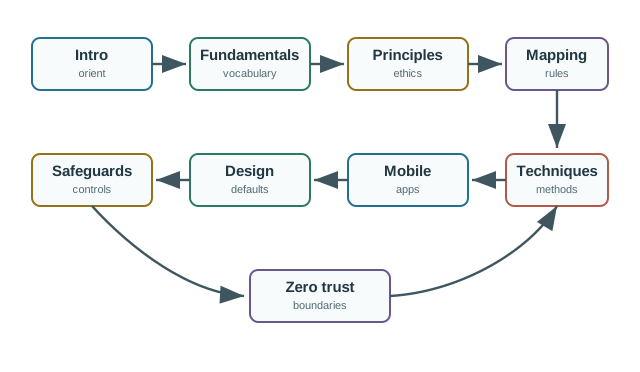
Read Figure 3.5 from introduction and fundamentals into principles and regulation mapping, then through privacy techniques and mobile exposure. Privacy by Design changes the architecture; safeguards and zero trust make boundaries enforceable and observable. The order is a learning route, not a claim that governance waits until the end: every stage adds evidence to the same privacy review record developed in this chapter.
Start
3.13.1 Fundamentals and principles
Use Privacy Fundamentals in IoT and Privacy Principles and Ethics in IoT for vocabulary, purpose limits, minimization, participation, and accountability.
Map
3.13.2 Regulation and compliance
Use Privacy Regulation Mapping for IoT and Privacy Compliance for IoT to map applicable frameworks, request paths, and evidence.
Engineer
3.13.3 Techniques and design
Use Privacy-Preserving Techniques for IoT and Privacy by Design Foundations to choose minimization, aggregation, local processing, and default settings.
Protect
3.13.4 Safeguards and trust boundaries
Use Safeguards and Protection and Zero Trust Fundamentals for access, monitoring, identity, and network boundaries.
3.14 Baseline Standards for IoT Review
This section: Baseline Standards for IoT Review — Standards and frameworks help teams avoid starting from a blank page.
Standards and frameworks help teams avoid starting from a blank page. They are useful as orientation aids, not universal checklists. Each standard emphasizes a different angle: device capabilities, consumer product expectations, common failure patterns, or governance outcomes.
NISTIR 8259A
3.14.1 Device Capability Baseline
Useful for asking whether devices support identity, configuration, data protection, interface control, update, and event visibility. Read more.
ETSI EN 303 645
3.14.2 Consumer IoT Baseline
Useful for baseline product security and data protection expectations, especially for internet-connected consumer devices. Read more.
OWASP IoT Top 10
3.14.3 Common Failure List
Useful as an awareness list for common IoT weaknesses such as weak passwords, insecure services, insecure interfaces, and weak update paths. Read more.
NIST CSF 2.0
3.14.4 Outcome Framework
Useful for organizing Govern, Identify, Protect, Detect, Respond, and Recover outcomes and evidence. Read more.
A useful standards-based review selects the right lens for the current question, maps relevant items to the actual system, tailors controls to the design, and keeps evidence of the decision and when it should be revisited.
3.15 Simple Review Example
This section: Simple Review Example — Feature: a room sensor that controls lights and creates occupancy summaries for facility planning.
Feature: a room sensor that controls lights and creates occupancy summaries for facility planning.
- Purpose: turn lights on and off, then show area-level occupancy trends.
- Data: motion state, room identifier, timestamp, local device status.
- People: employees, visitors, and cleaners in a shared workplace.
- Privacy decision: process motion locally, upload area summaries, suppress small groups, avoid user-level tracking, delete raw events quickly.
- Control: provide notice, a contact path, and a review path for new analytics.
- Evidence: record the purpose, data fields, summary logic, retention decision, owner, and trigger for review.
Priya’s Data Diet
- Collect: motion state, room identifier, timestamp, and local device status — nothing user-level.
- Justify: lights need occupancy now; facility planning needs only area-level trends.
- Expire: raw events deleted quickly; only small-group-suppressed area summaries are uploaded.
The worked decisions above need one durable artifact that another reviewer can test. Use Figure 3.6 to check whether the feature claim is connected all the way to ownership and reopening conditions.
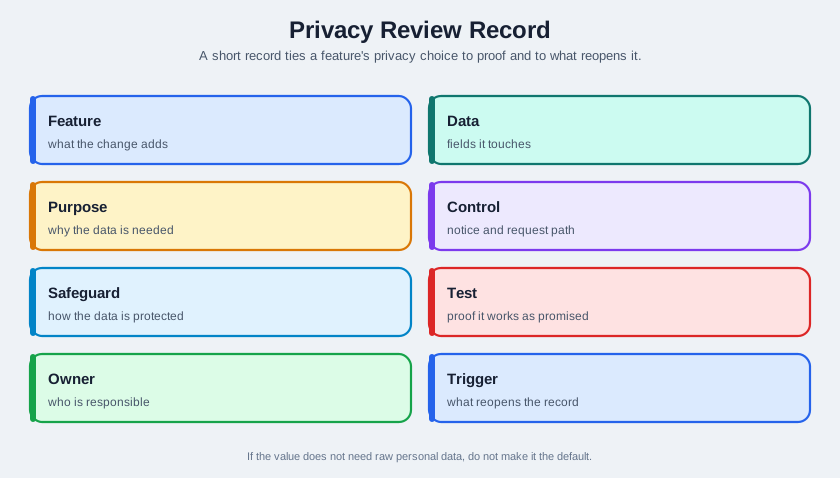
In Figure 3.6, start with the feature, data, and purpose so the necessity claim is explicit. Then follow the person’s control into the safeguard and the test that proves it operates. Finish with a named owner and a trigger for review when data, purpose, destination, or behavior changes. That final trigger keeps the simple example alive after launch instead of freezing it as release paperwork.
This section:
If the system does not need raw personal data to deliver the user value, do not make raw personal data the default.
This section:
3.15.1 Starter Review Record
For a new IoT feature, a short review record anchors the privacy and security decision without requiring a long checklist upfront:
- Feature purpose: What the feature does and why the data or command path is needed.
- Data map: Source, destination, storage, retention, access, and deletion path.
- Security review: Device identity, allowed communication, update path, access control, monitoring, response, and recovery.
- Privacy review: Minimization, purpose, notice, user control, sharing, inference, retention, and request handling.
- Evidence: Configuration proof, denied-path test, access review, retention test, monitoring sample, owner approval, and next review trigger.
3.16 Knowledge Check
This section: Knowledge Check
3.17 What to Read Next
This section: What to Read Next
Foundations
3.17.1 Build vocabulary
Read Privacy Fundamentals in IoT to learn personal data, inference, purpose, minimization, and retention.
Principles
3.17.2 Make tradeoffs
Read Privacy Principles and Ethics in IoT to connect privacy decisions to fairness, participation, accountability, and misuse review.
Techniques
3.17.3 Choose controls
Read Privacy-Preserving Techniques for IoT for minimization, identity reduction, aggregation, local processing, differential privacy, and federated learning.
Design
3.17.4 Set defaults
Read Privacy by Design Foundations when you are ready to turn the review into architecture and product defaults.
Privacy in IoT is the discipline of controlling data before, during, and after collection. Start with the purpose, map the data flow, reduce exposure, give users meaningful control, and keep evidence for every important decision.
3.18 Summary
This section: Summary — This chapter frames privacy as a design constraint for IoT systems.
This chapter frames privacy as a design constraint for IoT systems. It connects sensing, identity, location, cloud processing, user expectations, and governance.
Find help
3 reviewed answers.
Where should I start in a module?
Open the module page from the sidebar to see its chapters in order. Use the module map to return to a topic you need.
Modules and pathsReviewed
What can I try when a project does not work?
Check the symptom, then work through the diagnostic steps. Keep the error message and the smallest example that reproduces it.
When you are stuckReviewed
How do interactive examples work?
Use the interactive guide to check how examples and simulations work before changing your project.
Interactive examples guideReviewed