22 NIST Cybersecurity Framework for IoT
More
Depth: Practitioner
Progress saves as you read. Mark sections complete as you go; your progress appears in the sidebar.
22.1 Start Simple
This section: Start Simple — Imagine a care service that depends on home alert units.
Turn a Safety Framework Into Daily Work
Imagine a care service that depends on home alert units. A stolen password, missed update, or silent device could delay help. A long security checklist is useful only when each item protects a real service and has an owner.
The NIST Cybersecurity Framework is a shared way to organise security work. Start with the service and its likely harm. Identify what matters, protect it, look for trouble, respond when trouble appears, and restore safe service. These five actions form a loop, not a one-time project.
For each action, name the evidence and owner. Test a lost device, a blocked account, a false alert, and recovery from a saved copy. Record what worked, what did not, and the date for the next check.
Connect each check to a person or service. A list of devices matters because the team cannot protect an unknown unit. A warning matters because someone can decide what to do. A saved copy matters because the care service can return without losing needed history.
Review the loop after a change and after an incident. Remove controls that no longer match the system, but keep the risk visible until another control replaces them. Share the result in plain language with service owners as well as technical staff.
The framework does not choose every control or prove compliance by itself. Practitioner maps actions to systems and teams. Under the Hood examines risk, control strength, records, and assurance.
Suppose a building operator has hundreds of sensors, gateways, dashboards, vendor accounts, and update paths. Buying one security product will not answer the basic review questions: who owns the risk, what assets exist, how are they protected, how is trouble detected, who responds, and how does service recover?
The NIST Cybersecurity Framework is useful because it gives that review a shared route, from governance through recovery, without pretending every IoT deployment needs the same tools.
22.2 Overview: A Map of Outcomes, Not a Product
This section: Overview: A Map of Outcomes, Not a Product — The NIST Cybersecurity Framework is a voluntary, risk-based way to organize the work of protecting systems.
The NIST Cybersecurity Framework is a voluntary, risk-based way to organize the work of protecting systems. Its strength is that it describes outcomes to achieve rather than a fixed list of products to buy, so it fits organizations of very different sizes and a device fleet as easily as a data center. The current version groups everything into six Functions: Govern, Identify, Protect, Detect, Respond, and Recover.
NIST also publishes a companion Privacy Framework with a parallel structure for managing privacy risk. For connected products this pairing is valuable, because an IoT system has to be both secure and respectful of the people it senses, and the two frameworks give teams a shared language to say what "protected" means and to show where each outcome is actually met.
If you only need the intuition, this layer is enough: use the six Functions as a checklist of outcomes. Govern the risk, know your assets, protect them, detect problems, respond, and recover. Treat the Privacy Framework as the companion for privacy risk, and map every outcome to evidence.
Think of a pilot's checklist, organized into phases such as before-start, taxi, takeoff, cruise, and landing. The checklist does not fly the plane, but it makes sure no critical step is forgotten and gives everyone a shared structure to follow under pressure. The framework's Functions are those phases for cybersecurity: a structure that keeps a team from protecting the obvious things while forgetting to detect, respond, or recover.
For an IoT team, the Functions become a review route rather than a poster. Use Figure 22.1 to follow a smart-building operator from ownership and vendor rules into asset knowledge, protective baselines, health signals, containment, and restoration. The value is the sequence: each Function leaves evidence for the next one, so a reviewer can see how governance becomes operational proof.
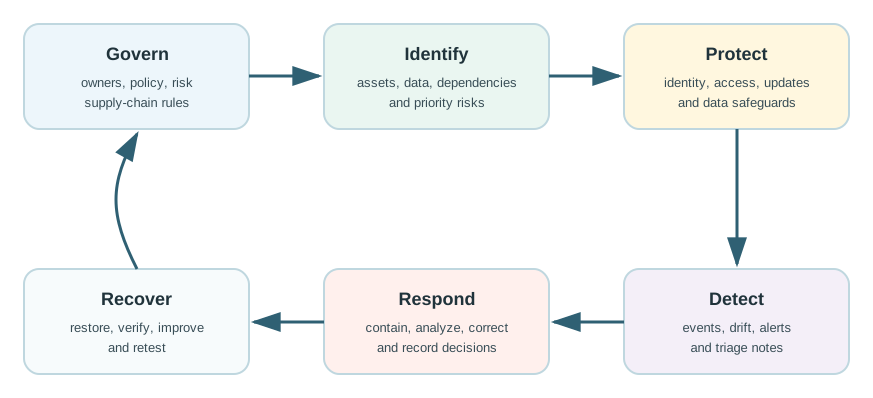
Read Figure 22.1 from Govern through Identify, Protect, Detect, Respond, and Recover. Governance assigns risk ownership; identification establishes the device, gateway, service, and dependency inventory; protection defines the baseline; detection exposes drift; response contains it; recovery restores service and feeds improvement back to governance. The route therefore connects framework language to the concrete records and tests developed throughout this safeguards chapter.
22.2.1 The One-Minute Framework View
Outcomes, not products
The framework names results to achieve, which each team maps to its own controls and context.
Six functions, full lifecycle
Govern, Identify, Protect, Detect, Respond, and Recover cover the whole arc, not just prevention.
Privacy is a companion frame
The Privacy Framework parallels the cybersecurity one, so privacy risk gets the same structured treatment.
22.2.2 Beginner Examples
Work from the simplest case toward the broader design consequence. First, listing every connected device and what data it handles is an Identify outcome; you cannot protect what you have not inventoried. Next, having a tested plan for who acts when an alert fires is a Respond outcome, not an afterthought. Finally, the framework is voluntary and risk-based, so "we use the framework" means achieving its outcomes, not citing the document.
22.2.3 Overview Knowledge Check
If you can see the framework as a map of outcomes spanning the whole lifecycle, you have the core idea. Continue to Practitioner to apply the Functions to a device fleet.
22.3 Practitioner: Apply the Functions and Profile the Gap
This section: Practitioner: Apply the Functions and Profile the Gap — Using the framework means scoping a system, enumerating the outcomes the six Functions call for, describing where you are today, and deciding where you need to be.
Using the framework means scoping a system, enumerating the outcomes the six Functions call for, describing where you are today, and deciding where you need to be. The description of outcomes you currently achieve and the ones you target is called a Profile, and the distance between the two is your prioritized work.
Start with one bounded system rather than the whole organization. For a campus sensor fleet, the scope might include wall-mounted occupancy sensors, BLE tags, PoE gateways, an MQTT broker, a cloud dashboard, the vendor support portal, and the maintenance laptop used for firmware updates. The current Profile records what is true now: some devices have serial numbers in the asset tool, gateways accept unique credentials, logs reach the SIEM, and recovery depends on a manual vendor ticket. The target Profile records what the risk justifies: every device has a lifecycle owner, update status is visible, gateways alert on unexpected management access, response playbooks name the facility and IT owners, and recovery includes a tested rollback path.
That profile gap is the work queue. A high-risk gap might be "no authenticated firmware update for hallway gateways," tied to Protect and Recover. A lower-risk gap might be "asset owner missing for a small storage-room sensor," tied to Govern and Identify. The practitioner move is to keep each gap attached to a Function, an owner, a due date, and an artifact such as an inventory export, configuration baseline, alert rule, response record, or recovery test. This keeps the framework from becoming vocabulary and makes it a steering mechanism for the next sprint, change review, supplier discussion, and audit prep.
22.3.1 The Six Functions in Brief
Govern and Identify
Set the risk strategy, roles, and policy, then inventory devices, data, and the risks they carry.
Protect and Detect
Put safeguards in place, then build the monitoring that notices when something is wrong.
Respond and Recover
Plan how to act on an incident and how to restore normal, trustworthy operation afterward.
22.3.2 Anchor Protect and Detect with a Device Baseline
Generic outcomes become concrete for IoT when you tie them to device capabilities. NIST's IoT guidance describes a core baseline of capabilities a connected device should be able to support, which gives the Protect and Detect Functions something specific to require of hardware and firmware.
22.3.3 Profiles and Tiers
A current Profile records which outcomes the system achieves now; a target Profile records what it should achieve given its risk. Implementation Tiers describe how rigorous and repeatable the risk governance is, from informal and reactive toward adaptive and well-managed. Tiers are not a grade to chase for its own sake; they help a team decide how much rigor a given risk justifies.
22.3.4 Worked Example: A Fleet of Smart Sensors
The Profile turns a vague goal of "be secure" into a short, ranked list of concrete gaps, each tied to a Function and a piece of evidence.
22.3.5 Practitioner Knowledge Check
If you can build a current and target Profile and anchor it with a device baseline, you can stop here. Continue to Under the Hood for the framework's structure and how privacy risk is treated alongside security.
22.4 Under the Hood: Structure, Privacy, and Evidence
This section: Under the Hood: Structure, Privacy, and Evidence — The deeper layer explains how the framework is built, how the Privacy Framework extends it, and why the whole thing is only as good as the evidence behind each claimed outcome.
The deeper layer explains how the framework is built, how the Privacy Framework extends it, and why the whole thing is only as good as the evidence behind each claimed outcome.
22.4.1 How the Framework Is Organized
The framework is layered. The broad Functions break down into Categories, which break down into Subcategories that state specific outcomes. Each outcome can be linked to informative references, which point to detailed controls in other standards, so the framework organizes work without reinventing every control. On top of this sit Implementation Tiers, which describe the rigor of risk governance, and Profiles, which capture current and target outcome states. Because the Subcategories are outcomes rather than fixed instructions, the same structure adapts to a constrained sensor and to a cloud backend, which is the point of the design.
22.4.2 The Privacy Framework as a Companion
The NIST Privacy Framework mirrors this structure for privacy risk, with its own Functions: Identify-P, Govern-P, Control-P, Communicate-P, and Protect-P. The most important idea it adds is that privacy risk is not only about breaches. A system can be perfectly secure, suffer no unauthorized access, and still cause privacy problems through its normal, authorized data processing, for example by collecting more than people expect or using data in surprising ways. The Privacy Framework treats those processing-driven risks as first-class, and its Protect-P outcomes overlap with cybersecurity where a breach is the privacy threat, while its Control-P and Communicate-P outcomes address processing and transparency that security alone never touches.
22.4.3 Outcomes Need Evidence
A claimed outcome with no evidence is just a hope. Saying the Detect Function is satisfied means little without showing the monitoring that produces alerts and a record that someone reviews them. The framework is a way to organize evidence as much as work: each target outcome in a Profile should map to an artifact, such as an inventory, a configuration baseline, an update log, an alert history, or a tested response plan. For IoT, device baselines and federal device guidance help translate generic outcomes into specific, testable device requirements, which is exactly where constrained hardware forces hard questions about logging, updates, and access.
22.4.4 Failure Modes and Fixes
22.4.5 Common Pitfalls
-

Wrong: Naming the framework proves the work is done. Check owners, real risks, privacy, detection, response, and recovery.
Review these failure modes in order. First, Citing the framework instead of achieving outcomes. Naming it is not the same as meeting its results. Next, Skipping governance. Without ownership and strategy, controls drift and conflict. Then, Copying a Profile. A target Profile only helps when it reflects this system's actual risk. Then, Seeing only security. Privacy risk can arise from authorized processing, which the Privacy Framework addresses. Finally, Stopping at prevention. Detect, Respond, and Recover are outcomes too, not optional extras.
22.4.6 Under-the-Hood Knowledge Check
At this depth, the NIST frameworks are a layered structure of outcomes that organize both work and evidence. Use the six cybersecurity Functions to cover the full lifecycle, pair them with the Privacy Framework so processing-driven risk is not missed, anchor device outcomes with a capability baseline, and back every claimed outcome with an artifact a reviewer can check.
22.5 Summary
This section: Summary — Use framework outcomes and profiles to identify the security and privacy work still needed.
Use framework outcomes and profiles to identify the security and privacy work still needed. First, the NIST Cybersecurity Framework is a voluntary, risk-based structure that describes security outcomes rather than fixed products, grouped into six Functions: Govern, Identify, Protect, Detect, Respond, and Recover. Next, a companion NIST Privacy Framework mirrors that structure for privacy risk, with the Functions Identify-P, Govern-P, Control-P, Communicate-P, and Protect-P. Then, profiles capture which outcomes a system achieves now and which it should achieve, turning a vague goal into a ranked list of gaps, while Implementation Tiers describe the rigor of risk governance. Then, for IoT, a core baseline of device capabilities, such as identification, secure configuration, data protection, logical access control, software update, and state awareness, makes the Protect and Detect outcomes concrete. Then, a key Privacy Framework insight is that privacy risk can arise from authorized data processing itself, not only from breaches, so a secure system can still create privacy harm. Finally, the framework organizes evidence as well as work: each target outcome should map to an artifact a reviewer can check, because a claimed outcome with no evidence is only a hope.
Treat the NIST frameworks as a map of outcomes, not a product or a certificate. Use the six cybersecurity Functions to cover the whole lifecycle, pair them with the Privacy Framework so risks from authorized processing are not overlooked, anchor IoT device outcomes with a capability baseline, build a current and target Profile to rank the gaps, and back every claimed outcome with evidence.
22.6 See Also
This section: See Also
See how the Functions translate into layered technical, organizational, and physical controls.
Security Control Implementation
Turn framework outcomes into selected, tailored, and tested security controls.
Connect the Privacy Framework outcomes to the records that demonstrate compliance.
Find help
3 reviewed answers.
Where should I start in a module?
Open the module page from the sidebar to see its chapters in order. Use the module map to return to a topic you need.
Modules and pathsReviewed
What can I try when a project does not work?
Check the symptom, then work through the diagnostic steps. Keep the error message and the smallest example that reproduces it.
When you are stuckReviewed
How do interactive examples work?
Use the interactive guide to check how examples and simulations work before changing your project.
Interactive examples guideReviewed