4 Defining and Minimizing Personal Data
More
Depth: Practitioner
Progress saves as you read. Mark sections complete as you go; your progress appears in the sidebar.
4.1 A Receipt Becomes a Diary
This section: A Receipt Becomes a Diary — Picture a motion sensor that records only on or off.
Ask What a Pattern Can Reveal
Picture a motion sensor that records only on or off. One event may say little. A month of events can show sleep, work hours, visitors, illness, or an empty home. The risk comes from the pattern and its context, not just the field name.
For each planned item, name the person it may describe, the purpose, who can see it, how long it stays, and what else it may reveal when joined with other records. Collect less when the decision does not need more. Use broad groups or local counts when exact identity is not required.
Test access, correction, export, deletion, and a lost device. Check that the service can stop a use that falls outside the stated purpose. Keep an owner and review date for every retained stream.
No list can predict every future use or inference. The deeper sections explain personal data, context, and safeguards so new links, longer history, or a changed purpose reopen the review before harm occurs.
One sensor reading can look as boring as one shopping receipt. A year of readings is different. It can describe when someone sleeps, when a home is empty, which room is used, who visits, and what habits are changing. Privacy fundamentals are the discipline of spotting that transformation before the data is collected.
4.2 The Core Idea: Whose Data, What Risk?
This section: The Core Idea: Whose Data, What Risk? — Privacy in IoT begins with two plain questions about any piece of data a device touches: whose information is this, and what could it reveal about them?
Privacy in IoT begins with two plain questions about any piece of data a device touches: whose information is this, and what could it reveal about them? Personal data is any information that relates to an identified or identifiable person. That is broader than it first sounds. A name is obviously personal, but so is anything that can be linked back to a person — a device that lives in one home, a unique identifier that never changes, a location trail, or a pattern of readings that belongs to one individual. IoT raises the stakes because connected devices sense people continuously, in homes, on bodies, and in public spaces, often capturing far more than the single value they were bought to measure.
The second idea is that sensitivity depends on context. The same reading can be harmless or revealing depending on where it is taken, when, and about whom. A motion event in a warehouse aisle is logistics; the same motion event in a bedroom at night is something else entirely. Because of this, privacy is not decided only by the data type; it is decided by the data in its context.
Treat anything that can be tied to a person as personal data, remember that context decides how sensitive it is, and lean on the most reliable safeguard there is — data you never collect cannot leak, be misused, or be demanded later.
Think of the difference between a shopping receipt and a diary. A single receipt seems trivial, but a year of receipts begins to describe a life: routines, health, habits, and relationships. IoT data behaves the same way. Each reading looks minor, yet a stream of minor readings can become a detailed portrait of a person who never agreed to be portrayed.
4.2.1 The One-Minute View
4.2.1.1 Personal data is broader than names
Identifiers, device IDs, locations, and patterns that can be linked to a person are all personal data, not just names and addresses.
4.2.1.2 Context decides sensitivity
The same reading can be ordinary or revealing depending on the place, the time, and the person it describes.
4.2.1.3 Less data, less risk
The safest data is the data you chose not to collect. It cannot leak, be repurposed, or be requested in a dispute.
4.2.2 Beginner Examples
- A motion sensor’s simple on/off log looks harmless, yet over weeks it can reveal when someone is home, asleep, or away.
- A device identifier that never changes can act like a name, quietly linking all of one person’s activity together.
- Smart-meter energy readings are just numbers, but their shape over a day can suggest when a household wakes, cooks, and sleeps.
The examples become reviewable only when each concern is recorded with its context and response. Inspect Figure 4.1 to turn one apparently harmless reading into a complete beginner privacy record.
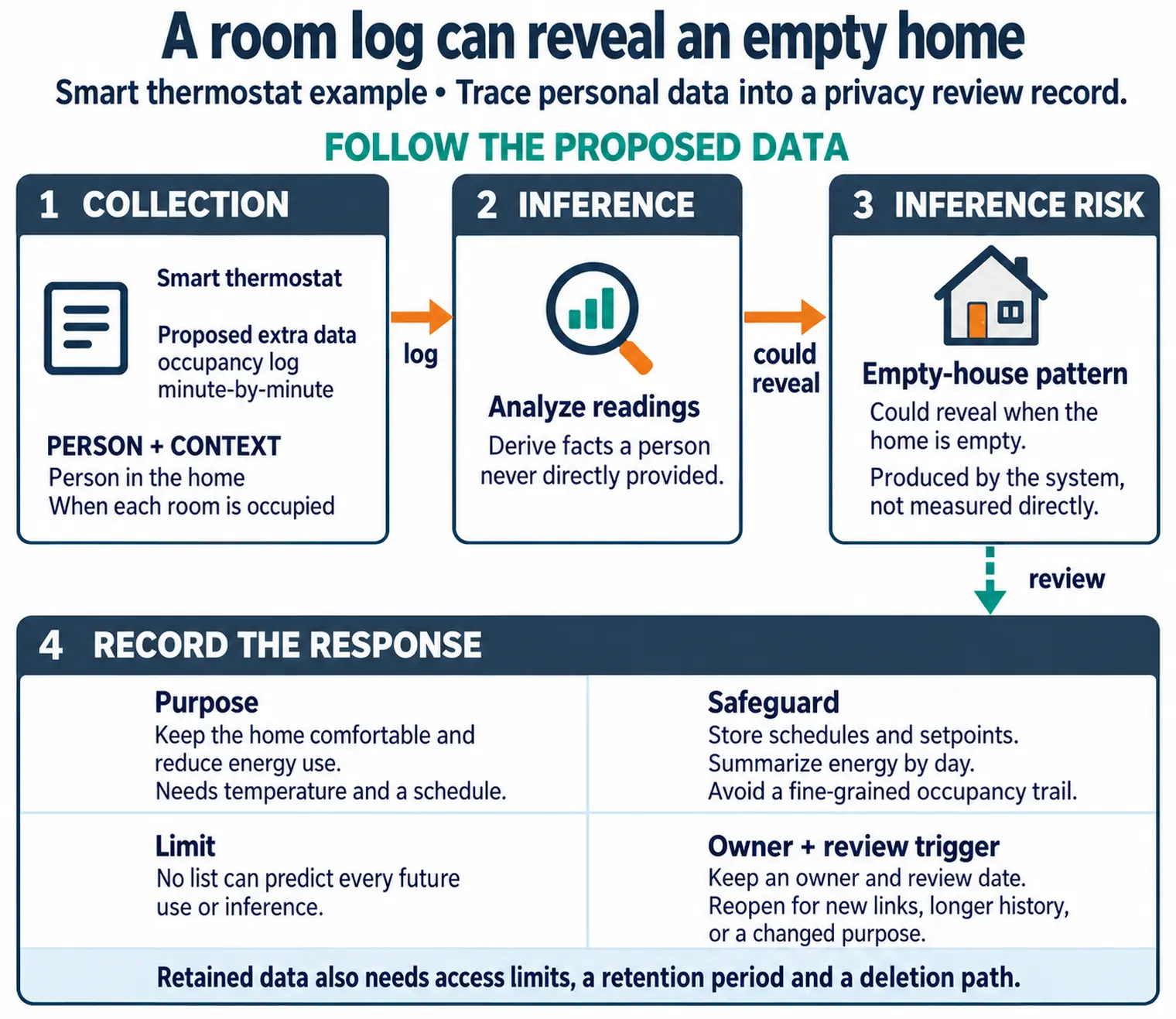
Read Figure 4.1 from the data item to the person and context it can expose, then test the stated purpose against the inference risk. Only after that should you name a safeguard, its limit, an owner, and the change that reopens review. The sequence keeps privacy tied to people and use rather than treating a field name as proof that data is harmless.
4.2.3 Overview Knowledge Check
If you can recognize personal data, see why context shapes sensitivity, and accept that the least data is the safest, you have the core idea. Continue to Practitioner for the data lifecycle and the first defenses.
4.3 Practitioner: Lifecycle Defenses
This section: Practitioner: Lifecycle Defenses — The most practical way to reason about privacy is to follow the data through its life, because risk appears at every stage, not only at collection.
The most practical way to reason about privacy is to follow the data through its life, because risk appears at every stage, not only at collection. The lifecycle has six stages, and a privacy review asks a question at each one rather than assuming the data is fine once it has arrived.
4.3.1 Purpose and Minimization
Two ideas do most of the protective work, and they come before any encryption or access control. Purpose means deciding the specific reason for the data before collecting it, so collection is a deliberate choice rather than a default. Minimization means collecting the least data that serves that purpose, at the lowest detail that still works, and keeping it for the shortest time that the purpose needs. Together they shrink the amount of personal data in the system, which shrinks everything that can go wrong with it later. A useful test: for each field, ask “what breaks if we do not collect this?” If nothing breaks, do not collect it.
4.3.2 Inference in Harmless Data
The subtle part of IoT privacy is inference: combining or analyzing seemingly harmless readings to derive facts a person never directly provided. Energy-use patterns can suggest daily routines; motion timing can suggest sleep and wake cycles; a step counter combined with location can suggest health conditions. The important consequence is that data can be more sensitive than it looks, because the sensitive fact is produced by the system rather than measured directly. A good practitioner asks not only “what does this field contain?” but “what could be inferred from it, alone or combined with the rest?”
4.3.3 Worked Reasoning: A Smart Thermostat
4.3.3.1 Purpose
Keep the home comfortable and reduce energy use. That purpose needs temperature and a schedule, not a continuous record of exactly when each room is occupied.
4.3.3.2 Minimization
Store schedules and setpoints, summarize energy by day, and avoid keeping a fine-grained occupancy trail that would reveal when the home is empty.
4.3.3.3 Inference check
A minute-by-minute occupancy log could reveal an empty-house pattern. Coarsening and short retention reduce that inference risk but do not make it impossible.
4.3.4 Practitioner Knowledge Check
If you can walk the lifecycle, apply purpose and minimization, and check for inference, you can stop here. Continue to Under the Hood for re-identification, the security boundary, and the privacy review record.
4.4 Under the Hood: Re-ID and Records
This section: Under the Hood: Re-ID and Records — The deeper layer explains why “we removed the names” is rarely the end of the privacy story, how security and privacy relate without being the same thing, and what a small, reviewable privacy record contains.
The deeper layer explains why “we removed the names” is rarely the end of the privacy story, how security and privacy relate without being the same thing, and what a small, reviewable privacy record contains. These are the foundations the Fair Information Practice Principles are built on, which is why understanding them makes the later principles concrete rather than abstract.
4.4.1 Why “Anonymized” Can Re-link
Removing direct identifiers such as names is necessary but often not sufficient. Many records still contain quasi-identifiers — attributes that are not unique on their own but, in combination, can single out one person. A coarse location, an approximate age, a routine, and a device type together can narrow a dataset to a single individual, especially when the data can be linked against another source that the holder did not control. This is the difference between two ideas that are easy to confuse: pseudonymization replaces identifiers with a key or token but keeps a path back to the person if the extra information is available, while anonymization aims to make re-identification infeasible even with effort. Treating pseudonymized data as if it were fully anonymous is one of the most common privacy mistakes, because the link back to the person still exists.
Some IoT architectures use a related pattern sometimes called identity shadowing: the device or service acts through a virtual identity or pseudonymous token so it can prove authority without revealing the owner’s civil identity at every hop. Shadowing can reduce unnecessary exposure in discovery, routing, or service calls, but it does not erase the person behind the device. The controller that can link the virtual identity back to the owner still holds personal data, and the design still needs purpose limits, access controls, retention rules, and a re-identification review.
4.4.2 Security Is Only One Boundary
Privacy and security are related but distinct. Security protects data with the familiar triad of confidentiality (only authorized parties can read it), integrity (it is not altered without detection), and availability (it is there when legitimately needed). Confidentiality is the part most people picture as “privacy,” and it is essential — weak access control or unprotected storage turns a privacy plan into a wish. But strong security on over-collected data is still a privacy problem: perfectly encrypting data you should never have gathered does not make collecting it appropriate. Security keeps unauthorized people out; privacy also asks whether the data should exist, for what purpose, and for how long. You need both, and security is the boundary that makes the privacy decisions enforceable.
4.4.3 Retention Turns Data Risky
Data kept past the purpose that justified it is one of the quietest privacy liabilities. It no longer serves the reason it was collected, yet it can still leak, be repurposed, or be demanded in a dispute. Setting a retention period tied to the purpose, and proving that deletion actually happens (including in backups and logs), converts a growing liability into a bounded one. “We keep everything forever” is not a neutral default; it is an accumulating risk that someone eventually inherits.
4.4.4 A Small, Reviewable Privacy Record
The fundamentals come together in a short record that another person can inspect. For each kind of personal data, it names the data and where it is sensed, the specific purpose, the storage location and who can access it, the retention period and deletion path, and the change that would require a fresh review. The record is what turns good intentions into something checkable later, after the people who made the original decisions have moved on.
4.4.5 Common Pitfalls
- Treating only names as personal data. Stable identifiers, locations, and patterns are personal data too.
- Ignoring inference. Harmless-looking readings can combine into sensitive conclusions.
- Confusing pseudonymization with anonymization. A reversible token still links back to a person.
- Equating security with privacy. Well-secured over-collection is still a privacy problem.
- Keeping data forever. Retention without a limit is an accumulating, inheritable risk.
4.4.6 Under-the-Hood Knowledge Check
At this depth, privacy fundamentals are about reducing how much a system knows about people and proving it. Recognize personal data broadly, watch for inference and re-identification, use security to enforce privacy decisions without mistaking one for the other, bound retention to purpose, and keep a small record that another reviewer can check. These foundations are exactly what the privacy principles build upon.
4.5 Summary
This section: Summary — Decide what counts as personal data before choosing how much the IoT system collects.
Decide what counts as personal data before choosing how much the IoT system collects. First, personal data is any information that can be linked to an identifiable person, which in IoT includes stable identifiers, locations, and patterns of readings, not only names. Next, sensitivity depends on context: the same reading can be ordinary or revealing depending on the place, time, and person it describes. Then, the most reliable safeguard is to collect less, because data you never gather cannot leak, be repurposed, or be demanded later. Then, reasoning along the data lifecycle, from collection through use, storage, sharing, retention, and deletion, surfaces risk at every stage rather than only at collection. Then, purpose and minimization are the first defenses: decide the specific reason before collecting, then keep the least data at the lowest detail for the shortest time. Then, inference makes harmless-looking data more sensitive than it appears, because the system can derive facts a person never directly provided. Then, removing names is not anonymization: quasi-identifiers and reversible tokens can re-identify people, so pseudonymization must not be mistaken for anonymization. Finally, security enforces privacy through confidentiality, integrity, and availability, but well-secured over-collection is still a privacy problem, and retention without a limit is an accumulating risk.
Privacy fundamentals come down to knowing less about people and being able to prove it. Treat anything linkable to a person as personal data, let context decide sensitivity, collect for a clear purpose, minimize what you gather and keep, watch for inference and re-identification, use security to enforce your privacy decisions, and record each choice with a retention limit and a review trigger so it can be checked later.
4.6 See Also
This section: See Also
4.6.1 Privacy Principles and Ethics
Build on these fundamentals with the durable principles the law encodes, plus ethics beyond compliance.
4.6.2 Privacy Techniques for IoT
Learn the techniques that turn minimization and abstraction into working mechanisms.
4.6.3 Privacy by Design
See how these fundamentals become design-time defaults and embedded controls.
4.6.4 Privacy Regulation Mapping
See how these foundations are encoded, with local wording, into real data protection law.
Find help
3 reviewed answers.
Where should I start in a module?
Open the module page from the sidebar to see its chapters in order. Use the module map to return to a topic you need.
Modules and pathsReviewed
What can I try when a project does not work?
Check the symptom, then work through the diagnostic steps. Keep the error message and the smallest example that reproduces it.
When you are stuckReviewed
How do interactive examples work?
Use the interactive guide to check how examples and simulations work before changing your project.
Interactive examples guideReviewed