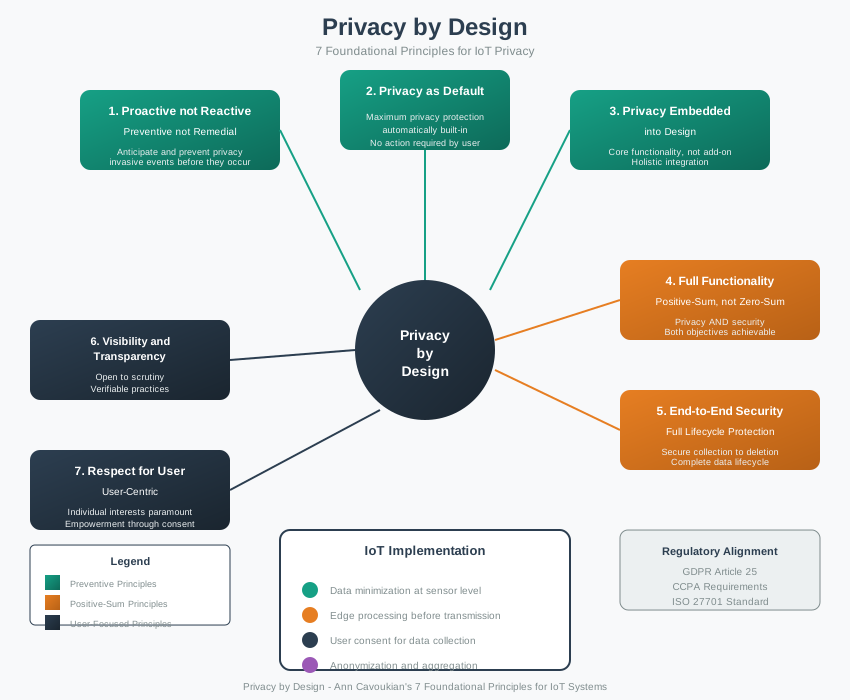
8  Privacy by Design Principles

8.1 Learning Objectives

By the end of this chapter, you should be able to:

  • Define Privacy by Design and explain its origins
  • Apply the 7 foundational principles of Privacy by Design
  • Distinguish between proactive and reactive privacy approaches
  • Configure privacy-by-default settings for IoT devices
  • Design privacy-embedded system architectures
  • Implement positive-sum (privacy AND functionality) solutions
  • Apply end-to-end security throughout the data lifecycle
In 60 Seconds

Privacy by Design’s seven foundational principles (proactive not reactive, privacy as the default, privacy embedded in design, full functionality, end-to-end security, visibility and transparency, respect for user privacy) transform privacy from a compliance obligation into a design philosophy. All seven principles must be present simultaneously — implementing only some provides incomplete privacy protection.

Key Concepts

  • Privacy by Design (PbD): Framework developed by Ann Cavoukian requiring privacy to be proactively embedded into system design rather than added as an afterthought; now referenced in GDPR Article 25.
  • Seven Foundational Principles: The PbD framework’s core principles — proactive not reactive; privacy as default; privacy embedded in design; full functionality; end-to-end security; visibility and transparency; respect for user privacy.
  • Privacy as Default: PbD principle requiring that the most privacy-protective setting is the system default, not something users must actively enable.
  • Proactive Privacy: PbD approach preventing privacy violations before they occur through architectural design rather than responding to violations after the fact.
  • Full Functionality (Positive-Sum): PbD principle rejecting the privacy vs. functionality trade-off, seeking designs that achieve both privacy and full feature set simultaneously.
  • Privacy Embedded in Architecture: Treating privacy as a structural system property (like scalability or security) rather than an add-on feature or compliance module.
  • GDPR Article 25: EU regulation requirement for “data protection by design and by default,” giving legal force to Privacy by Design principles for EU-deployed systems.

What is Privacy by Design? Privacy by Design means building privacy protections into systems from the very beginning - not adding them later as an afterthought. It’s like designing a house with locks already installed versus buying padlocks after you move in. Privacy becomes embedded in the architecture, default settings protect users automatically, and privacy controls are proactive (preventing problems) not reactive (apologizing after breaches).

Why does it matter? Amazon Ring doorbells uploaded video to the cloud by default and shared footage with police without warrants - privacy was retrofitted after scandal, not designed in. Apple HomePod processes “Hey Siri” on-device instead of sending all audio to the cloud - privacy was architecturally embedded from day one. Privacy by Design prevents violations before they happen, builds user trust, and avoids expensive retrofits after launch.

Key terms:

Term Definition
Privacy by Default Most protective settings enabled automatically without user configuration (opt-in not opt-out)
Proactive Anticipating privacy risks during design phase through threat modeling and assessments
Privacy Embedded Building privacy controls into system architecture (not bolt-on features added later)
Positive-Sum Achieving both privacy AND functionality - not forcing users to choose between them
Data Minimization Design principle of not collecting data in the first place (better than encrypting everything)

“There are seven principles of Privacy by Design,” Max the Microcontroller announced. “Number one: be PROACTIVE, not reactive. Do not wait for a privacy breach to start thinking about privacy. Plan for it from the very first day of design!”

Sammy the Sensor explained another key principle. “Privacy by DEFAULT means the most protective settings are turned on automatically. Users should not have to dig through menus to protect themselves. If a smart camera has a privacy mode, it should be ON by default, not hidden in settings where most people will never find it.”

“Data minimization is my favorite principle,” Lila the LED said. “The best way to protect data is to never collect it in the first place! If a smart thermostat only needs to know the temperature, it should not also be recording conversations. Collect the minimum data needed for the service to work, and nothing more.”

“Think of it as positive-sum design,” Bella the Battery concluded. “You should not have to choose between privacy and functionality. Apple’s Face ID stores your face data only on your device, never in the cloud. Amazon Ring originally uploaded all doorbell video to the cloud. Both provide home security features, but one was designed with privacy embedded in the architecture from day one!”

Key Takeaway

In one sentence: Privacy by Design means building privacy protections into systems from the start - not adding them after a breach or scandal.

Remember this rule: The best privacy protection is not collecting data at all; when collection is necessary, minimize scope, enable privacy by default, and embed controls into architecture rather than bolting them on later.

8.2 Prerequisites

Before diving into this chapter, you should be familiar with:

  • Introduction to Privacy: Understanding of fundamental privacy concepts, personal data definitions, and regulatory frameworks like GDPR provides essential context for Privacy by Design principles
  • Security and Privacy Overview: Knowledge of the CIA triad (Confidentiality, Integrity, Availability) and basic security concepts helps understand how privacy-by-design integrates with broader security architecture
  • Threat Modelling and Mitigation: Familiarity with identifying and mitigating threats enables proactive privacy protection, a core Privacy by Design principle

8.3 What is Privacy by Design?

Privacy by Design (PbD) is a framework that embeds privacy into the design and architecture of IT systems and business practices.

Core Concept

Build privacy in from the start, not bolt it on later.

Privacy by Design makes privacy the default setting, ensuring data protection is embedded into the system architecture and business operations.

Origin: Developed by Dr. Ann Cavoukian (Information and Privacy Commissioner of Ontario) in the 1990s.

Adoption:

  • Incorporated into GDPR (Article 25)
  • Recognized by ISO/IEC standards
  • Adopted by major tech companies

8.3.1 Real-World Privacy by Design: Good vs Bad

8.3.1.1 GOOD: Apple HomePod (Voice Processing On-Device)

What they did:

  • Voice command processing happens on-device (not sent to cloud)
  • Siri only activates after hearing “Hey Siri” (local detection)
  • If cloud query needed (like weather), only the transcribed text is sent (not voice recording)
  • Random identifier used (not linked to Apple ID)
  • Designed with privacy from the start

Privacy by Design principles used:

  • Proactive: Anticipated privacy concerns with always-listening device
  • Privacy Embedded: On-device processing built into chip architecture
  • Default: Most protective mode is default behavior
  • Full Functionality: Works great without sending voice to cloud

8.3.1.2 BAD: Amazon Ring Doorbell (Privacy as Afterthought)

What they did:

  • Video uploaded to cloud by default (no local-only option at launch)
  • Shared video with police without warrants or user consent (via “Neighbors” program)
  • Privacy concerns emerged AFTER millions of doorbells were sold
  • Eventually added privacy controls (after backlash and lawsuits)

Privacy by Design failures:

  • Reactive: Added privacy controls AFTER scandal, not proactive
  • Not Default: Cloud upload enabled by default, no local storage option
  • Not User-Centric: Shared user data with police without explicit consent
  • Not Transparent: Users didn’t know about police partnerships

Lesson: Privacy retrofitted after launch = privacy theater. Privacy by Design = trust from day one.

8.4 The 7 Foundational Principles

Seven Pillars of Privacy by Design
Principle Simple Explanation Good Example Bad Example
1. Proactive (Not Reactive) Anticipate privacy problems BEFORE they happen Privacy Impact Assessment during design phase Apologizing for privacy breach after it happens
2. Privacy as Default Most protective settings ON by default Smart doorbell doesn’t upload video to cloud unless you explicitly enable it Cloud upload enabled by default, buried opt-out in settings
3. Privacy Embedded Built into the system architecture (not bolt-on) Smart speaker processes voice commands ON-DEVICE (doesn’t send to cloud) Smart speaker sends ALL audio to cloud, privacy policy as afterthought
4. Full Functionality Privacy AND features (not either/or) Fitness tracker works fully offline, cloud sync is optional extra App says “Location required” even for features that don’t need it
5. End-to-End Security Protect data through entire lifecycle (collection to deletion) Smart lock encrypts data at rest, in transit, and has secure deletion Smart lock encrypts during transmission but stores plaintext keys in database
6. Visibility & Transparency Users can see what data is collected and how Dashboard shows exactly what your smart home hub knows about you “We collect data to improve services” (vague)
7. User-Centric Respect user privacy rights (control, consent, access) One-click “delete all my data” button that actually works “Submit request via mail, wait 90 days, prove your identity with notarized forms”

8.4.1 Principle 1: Proactive not Reactive; Preventative not Remedial

Principle: Anticipate and prevent privacy invasive events before they happen

Flowchart showing proactive privacy process from threat modeling through risk assessment to design mitigation before product launch
Figure 8.1: Proactive Privacy: Threat Modeling to Design Mitigation Before Launch

Implementation Example:

Privacy Threat Risk Level Proactive Mitigation Reactive Response
Unauthorized PII Access HIGH Encrypt at source (AES-256) Apologize after breach
Third-party Data Exposure MEDIUM Share only aggregated data Add deletion button later
Location Tracking HIGH Don’t collect precise location Add privacy policy disclaimer
Persistent Identifiers MEDIUM Use rotating pseudonyms Let users opt-out

LINDDUN Privacy Threat Model:

Threat Category Description IoT Example Mitigation
Linkability Link multiple actions to same user Correlate sensor readings by timing Rotating device IDs
Identifiability Identify specific user De-anonymize location data K-anonymity (k>=5)
Non-repudiation User cannot deny action Smart lock logs prove entry Anonymous credentials
Detectability Detect someone’s involvement Detect device in network scan MAC address randomization
Disclosure Unauthorized information reveal Cloud breach exposes sensor data End-to-end encryption
Unawareness User unaware of data collection Hidden analytics tracking Transparency dashboard
Non-compliance Violate privacy regulations GDPR violation for lack of consent Privacy Impact Assessment

8.4.2 Principle 2: Privacy as the Default Setting

Principle: No action required by user to protect privacy - it’s automatic

Privacy-by-Default Configuration (ESP32/IoT Device Example):

Setting Default Value Rationale User Can Enable
Encryption ENABLED (AES-256) Always protect data Cannot disable
Location Collection OFF Not essential for core functionality Yes (opt-in)
Usage Analytics OFF Benefits vendor, not user Yes (opt-in)
Data Retention 7 days Shortest period for functionality Yes (extend)
Third-party Sharing OFF User data stays with vendor Yes (explicit consent)
Processing Mode LOCAL Minimize data transmission Yes (enable cloud)

Comparison: Privacy by Default vs. Privacy by Negotiation

Side-by-side comparison of privacy by default with opt-in model versus privacy by negotiation with opt-out model, showing how default settings affect user data protection
Figure 8.2: Privacy by Default (Opt-In) vs Privacy by Negotiation (Opt-Out) Comparison

8.4.3 Principle 3: Privacy Embedded into Design

Principle: Privacy is integral to system design, not an add-on

Layered system architecture diagram showing privacy-first design from IoT sensor data minimization through local processing to encrypted cloud storage with consent management
Figure 8.3: Privacy-First System Architecture: Data Minimization to Encrypted Cloud Storage

Example: Smart Thermostat - Privacy Embedded vs. Privacy Bolted-On

Architecture Component Privacy Bolted-On Privacy Embedded
Data Collection Collect everything, filter later Collect only temperature + timestamp (no user ID, location)
Processing Send all to cloud, process there Process locally first, send only if necessary
Storage Store raw data indefinitely Store aggregated hourly averages, 30-day retention
Sharing Share by default, add opt-out later Check consent before EVERY share, log all sharing
Anonymization “We anonymize data” (vague promise) Built-in anonymizer removes PII before transmission
Encryption Added TLS after beta testing Encryption engine integrated from day 1

8.4.4 Principle 4: Full Functionality - Positive-Sum, not Zero-Sum

Principle: Privacy AND functionality, not privacy OR functionality

Real-World Examples: Achieving Both Privacy and Functionality

Use Case Zero-Sum Approach Positive-Sum Solution How It Works
Personalized Recommendations Upload all behavior to cloud Federated learning on-device ML model trains locally, only model updates shared (not user data)
Energy Optimization Minute-by-minute tracking Hourly aggregates Aggregate before storage: 22.1, 22.3, 22.2 -> Avg: 22.2 (equally effective)
Voice Assistant Record all conversations On-device wake word detection Process locally until “Hey Siri” detected, then send only query
Security Camera 24/7 cloud recording Event-triggered local storage Store locally, upload only motion-detected clips (encrypted)
Smart Lock Upload all entries to cloud Local logging, cloud sync optional Keep entry log on device, user chooses cloud backup

Privacy vs. Functionality: The False Dichotomy

Comparison diagram contrasting zero-sum design where privacy and functionality trade off against positive-sum design where both coexist through techniques like on-device processing and federated learning
Figure 8.4: Zero-Sum vs Positive-Sum Design: Energy Optimization Privacy Trade-offs

Case Study: Federated Learning (Google Gboard Keyboard)

Aspect Traditional Cloud ML Federated Learning (Privacy by Design)
Data Collection All keystrokes uploaded to Google servers Keystrokes stay on device
Model Training Train on aggregated user data in cloud Train local model on your device
Model Updates Download model trained on everyone’s data Upload only model improvements (differential privacy)
Privacy Google sees all your typing Google sees no individual typing data
Functionality Personalized predictions Personalized predictions (identical UX)
Result Zero-sum (functionality requires privacy loss) Positive-sum (both privacy AND functionality)

Case Study: Security Without Surveillance (Smart City)

Traditional urban security relies on pervasive video surveillance with centralized recording - creating massive privacy concerns. Edge AI enables a Security without Surveillance approach that achieves security goals without mass data collection:

Split diagram comparing traditional centralized video surveillance with edge AI approach where cameras process video locally and transmit only anonymous metadata like counts and flow statistics
Figure 8.5: Traditional surveillance vs Security without Surveillance using edge AI
Aspect Traditional Surveillance Security without Surveillance
Data Collected Full video, faces, license plates Anonymous counts, flow statistics
Storage Weeks to months of footage Zero raw video retained
Processing Cloud-based, centralized Edge AI, on-pole
Privacy Risk High (mass surveillance) Minimal (no PII collected)
Security Capability Full forensics, face ID Anomaly detection, traffic optimization
Regulatory Compliance Requires extensive justification GDPR-friendly by design

How Edge AI Enables This:

  1. Local processing: Neural network runs on camera hardware (e.g., NVIDIA Jetson, Intel Movidius)
  2. Immediate inference: Vehicle/pedestrian detection happens in <100ms
  3. Metadata extraction: Only anonymous statistics transmitted (counts, speeds, anomalies)
  4. No raw storage: Video frames deleted after processing - no footage to breach

Real-World Example: Street light-mounted cameras detect wrong-way drivers and send instant alerts to traffic control - without ever recording or transmitting identifiable video.

8.4.5 Principle 5: End-to-End Security - Full Lifecycle Protection

Principle: Protect data from collection to deletion

Six-stage pipeline diagram showing data lifecycle protection from collection with encryption at source through storage, processing, sharing, retention, to secure deletion with specific controls at each stage
Figure 8.6: End-to-End Security: Six-Stage Data Lifecycle Protection Framework

End-to-End Protection Through Data Lifecycle:

Lifecycle Stage Privacy Risk Protection Mechanism Implementation Example
1. Collection Plaintext sensor data Encrypt at source AES-256 encryption before transmission
2. Storage Database breach Encrypted at rest Database-level encryption (TDE)
3. Processing Cloud provider access Secure computation Homomorphic encryption or secure enclaves
4. Sharing Interception in transit Encrypted transmission TLS 1.3, re-encrypt for recipient’s public key
5. Retention Indefinite storage Automatic deletion 30-day retention policy, automated cleanup
6. Deletion Recovery from backups Secure erasure Delete from DB + backups + destroy encryption keys

True End-to-End Protection Checklist:

  • Encrypted during collection (sensor to gateway)
  • Encrypted at rest (database, files)
  • Encrypted during processing (homomorphic or secure enclave)
  • Encrypted in transit (TLS 1.3, certificate pinning)
  • Automatic retention enforcement (delete after N days)
  • Secure deletion (DB + backups + keys)
  • Deletion verification (audit log confirms erasure)
  • User-initiated deletion (right to be forgotten)

8.4.6 Principle 6: Visibility and Transparency

Principle: Keep operations open and visible to users and stakeholders

Transparency Dashboard Example (Smart Thermostat):

Data Type Collection Frequency Purpose Retention Shared With
Temperature readings Every 10 minutes HVAC control 30 days None
Device status Every 10 minutes System health monitoring 90 days Cloud provider (encrypted only)
Firmware version Once per week Update checks Until device reset Update server

Privacy Notice - Plain Language Example:

What We Collect

  • Temperature and humidity (every 10 minutes)
  • Device on/off status
  • We DO NOT collect: Voice, location, personal identifiers

Why We Collect It

  • Temperature: To control your heating/cooling
  • Device status: To detect malfunctions

How Long We Keep It

  • Sensor data: 30 days, then automatically deleted
  • Device status: 90 days

Who We Share With

  • Cloud Provider (AWS): Encrypted storage only - they cannot see your data
  • Nobody else. We never sell your data.

Your Rights

  • Download your data anytime (Settings -> Export)
  • Delete your account and all data (Settings -> Delete)
  • Analytics already OFF by default

Questions? privacy@company.com

8.4.7 Principle 7: Respect for User Privacy

Principle: Keep user interests first, make privacy user-centric

Granular User Privacy Controls:

Data Collection Setting Default User Can Disable? Purpose User Benefit
Temperature ON No (required for core function) HVAC control Device works
Location OFF Yes Weather-based optimization More accurate by ~2°F
Usage Analytics OFF Yes Product improvement Better features over time

User-Centric Design Principles:

  • Granular control: Separate controls for each data type (not all-or-nothing)
  • Clear trade-offs: Explain what user gains/loses with each setting
  • Easy access: Privacy controls in main settings (not buried in legal pages)
  • Reversible choices: User can change mind (enable/disable at any time)
  • Informed consent: Explain purpose, benefit, and duration before collecting
  • No dark patterns: Equally prominent “Accept” and “Reject” buttons
  • Respect preferences: Honor user choices without nagging to reconsider
Knowledge Check

Test your understanding of Privacy by Design principles.

8.5 Worked Example: Privacy by Design Audit of a Smart Thermostat Product

Scenario: A startup is launching a smart thermostat that learns user schedules. Before release, audit the design against all 7 Privacy by Design principles and calculate the engineering cost of compliance.

Current Design (Pre-Audit):

  • Thermostat sends temperature + occupancy data to cloud every 60 seconds
  • Cloud ML model learns schedule and adjusts temperature
  • Data stored indefinitely for “product improvement”
  • Account creation requires name, email, home address, household size
  • Third-party energy analytics company receives anonymized data
  • Privacy policy: 14-page legal document
  • All features require cloud connectivity

Principle-by-Principle Audit:

Principle Current State Gap Fix Engineering Cost
1. Proactive No PIA conducted No threat model LINDDUN analysis + PIA $8,000 (40 hrs consulting)
2. Default Cloud upload ON, analytics ON, sharing ON Everything opt-out Flip all to OFF, opt-in $3,000 (2 sprint days)
3. Embedded Privacy = policy document Not architectural On-device ML, local-first $45,000 (TFLite port)
4. Full Functionality Cloud required for all features No offline mode Local schedule learning $25,000 (embedded ML)
5. End-to-End Indefinite retention, no deletion No lifecycle mgmt 90-day auto-delete, secure wipe $6,000 (3 sprint days)
6. Visibility 14-page legal policy Not user-readable In-app dashboard showing data flow $12,000 (UI development)
7. User-Centric No data export, no deletion No user controls GDPR export + delete buttons $8,000 (API + UI)
Total $107,000

Quantified Privacy Improvement:

Data collection reduction:
  Before: 1,440 cloud uploads/day x 128 bytes = 180 KB/day/device
  After (local-first): 1 cloud sync/day x 256 bytes = 256 bytes/day
  Reduction: 99.86% less data leaving the home

Personal data fields:
  Before: name + email + address + household size + schedule + temperature
  After: email only (for account recovery), all other data on-device
  PII reduction: 6 fields -> 1 field

Third-party data sharing:
  Before: "anonymized" data to analytics partner (re-identification risk)
  After: Aggregated, differentially-private statistics only (epsilon=1.0)
  Or: No sharing by default (user opts in for energy comparison features)

Data retention:
  Before: Indefinite (growing liability)
  After: 90 days on-device, 30 days cloud (if user opts into cloud sync)
  Legal exposure reduction: Eliminates years of accumulated personal data

Business Case:

Cost of Privacy by Design: $107,000
Cost of NOT implementing (GDPR fine risk):
  Violation: Art. 25 (data protection by design) + Art. 5(1)(c) (minimization)
  Art. 25 falls under Art. 83(4): Up to 2% of annual revenue or 10M EUR
  For startup with 2M EUR revenue: Up to 40,000 EUR
  Probability of enforcement: ~5% per year (based on DPA activity)
  Expected annual fine cost: $2,000/year

  But also: Customer trust differential
  Privacy-first smart home products command 15-25% price premium
  (Source: Cisco 2024 Consumer Privacy Survey)
  At $199 thermostat price, 20% premium = $40/unit
  Break-even: 2,675 units (achievable in first year for funded startup)

Result: The $107,000 Privacy by Design investment pays for itself at 2,675 unit sales through price premium, while reducing GDPR fine risk and cutting cloud infrastructure costs by 99.86% (less data to store and process). The largest single investment – porting ML to on-device ($45,000) – simultaneously delivers the biggest privacy improvement (local-first processing) and the strongest marketing differentiator.

Key lesson: Privacy by Design is not a cost center. On-device processing reduces cloud bills, minimal data collection reduces breach liability, and privacy-first positioning commands premium pricing. The audit found that 5 of 7 principles could be addressed for under $10,000 each – the expensive item (embedded ML) was also the biggest competitive advantage.

Concept Relationships
Concept Builds On Enables Contrasts With
Proactive Privacy Threat modeling, risk assessment Prevention before incidents occur Reactive compliance (proactive anticipates risks)
Privacy by Default Automatic protection, opt-in design Maximum protection without user action Privacy by negotiation (default requires no choices)
Privacy Embedded Architectural integration, technical controls Privacy as core functionality Bolt-on security (embedded is foundational)
Positive-Sum Federated learning, edge processing Privacy AND functionality together Zero-sum tradeoffs (positive-sum rejects forced choices)

Key Insight: The seven Privacy by Design principles work together as a system—proactive measures are embedded architecturally, privacy becomes the default, and users get full functionality without sacrificing protection, creating end-to-end transparency and user-centric control.

8.5.1 Interactive: Privacy Investment ROI Calculator

Use this calculator to explore how Privacy by Design investment costs compare against potential breach costs and GDPR fines for an IoT product.

Return on Investment (ROI) for privacy measures compares cost savings from avoided breaches and fines against implementation costs.

\[ROI = \frac{(E[Fine] + E[Breach\_Cost]) - Implementation\_Cost}{Implementation\_Cost} \times 100\%\]

where \(E[Fine]\) is the expected GDPR fine (probability × magnitude) and \(E[Breach\_Cost]\) includes notification, remediation, and reputation damage.

Working through an example: Given: IoT thermostat startup with 50,000 devices, €5M annual revenue. Compare Privacy by Design investment vs. reactive compliance.

Privacy by Design Implementation Costs: | Component | Cost | |———–|——| | On-device ML (local processing) | €45,000 | | Data minimization audit | €15,000 | | Privacy-by-default configuration | €8,000 | | Consent management system | €12,000 | | Encryption (TLS 1.3) | €6,000 | | Documentation (PIA, policies) | €10,000 | | Total | €96,000 |

Expected Cost WITHOUT Privacy by Design:

Step 1: Calculate breach probability - Industry average: 25% probability over 3 years for IoT startups - With 50K devices × €5M revenue scale: 30% probability

Step 2: Calculate GDPR fine exposure - Article 25 violation (no privacy by design): up to 2% of global revenue - Fine = €5M × 2% = €100,000 - Expected fine: €100,000 × 0.30 = €30,000

Step 3: Calculate breach costs - Customer notification: €2 per customer × 50,000 = €100,000 - PR crisis management: €50,000 - Legal fees: €30,000 - Customer churn: 15% × 50,000 devices × €199 = €1,492,500 lost future revenue - Total breach cost: €1,672,500 - Expected breach cost: €1,672,500 × 0.30 = €501,750

Step 4: Calculate ROI \[ROI = \frac{(€30,000 + €501,750) - €96,000}{€96,000} \times 100\% = 454\%\]

Data Minimization Cloud Cost Savings:

Without minimization (readings every 5 minutes): - 50,000 devices × 288 readings/day × 30 days = 432M data points/month - Storage: 432M × 16 bytes = 6.9 GB/month → €150/month - Bandwidth: 432M × 16 bytes = 6.9 GB/month → €200/month - Processing: 432M API calls → €500/month - Total: €850/month = €10,200/year

With on-device aggregation (hourly averages): - 50,000 devices × 24 readings/day × 30 days = 36M data points/month - Storage: 36M × 16 bytes = 576 MB/month → €15/month - Bandwidth: 576 MB → €20/month - Processing: 36M API calls → €50/month - Total: €85/month = €1,020/year

Cloud cost savings: €10,200 - €1,020 = €9,180/year

5-Year Total Savings:

  • Avoided breach costs: €501,750 (one-time expected)
  • Cloud savings: €9,180 × 5 = €45,900
  • Avoided fines: €30,000 (one-time expected)
  • Total savings: €577,650

Net ROI over 5 years: \[ROI_5 = \frac{€577,650 - €96,000}{€96,000} \times 100\% = 502\%\]

Result: €96K Privacy by Design investment yields 502% ROI over 5 years through avoided breach costs (€501K), regulatory fines (€30K), and ongoing cloud savings (€46K). The largest investment—on-device ML—provides dual benefits: privacy compliance AND €9K/year cloud cost reduction.

In practice: Privacy by Design is often perceived as a cost center. This calculation proves it’s a profit center: data minimization reduces cloud bills by 90%, breach avoidance prevents massive customer churn, and GDPR compliance eliminates fine risk. For IoT startups, investing 2% of annual revenue (€96K/€5M) in privacy architecture provides 5× returns through quantifiable cost avoidance.

8.6 See Also

Chapter Summary

Privacy by Design establishes seven foundational principles for embedding privacy into system architecture:

  1. Proactive not Reactive: Anticipate and prevent privacy invasions before they occur through threat modeling
  2. Privacy as Default: Maximum data protection is automatic without user action
  3. Privacy Embedded: Integrate privacy controls architecturally rather than bolting-on compliance
  4. Full Functionality: Pursue positive-sum outcomes - strong privacy enhances rather than diminishes user experience
  5. End-to-End Security: Protect data throughout entire lifecycle from collection through deletion
  6. Visibility and Transparency: Provide complete awareness through clear policies and transparency dashboards
  7. Respect for User Privacy: Maintain user-centricity through informed consent and granular controls

These principles originated with Dr. Ann Cavoukian in the 1990s and are now incorporated into GDPR Article 25, making them both best practice and legal requirement.

Common Pitfalls

Privacy by Design’s seven principles work together as a framework. Implementing “end-to-end security” while ignoring “privacy as default” leaves users with strong encryption but insecure default settings. Apply all seven principles; each provides distinct protection that others don’t cover.

Privacy by Design is about system architecture, not documentation. A detailed privacy policy doesn’t constitute Privacy by Design if the underlying system collects more data than necessary, defaults to maximum data sharing, or requires user action to enable privacy protections.

Building “privacy settings” as a feature page separate from core system design is not Privacy by Design. Privacy must be embedded in data collection, processing, storage, and sharing infrastructure — not offered as optional settings that most users never access.

“We can’t implement data minimization without reducing functionality” is the most common objection to Privacy by Design. PbD explicitly addresses this with the “full functionality” principle — seek design solutions that achieve both. Often data minimization improves performance and reduces storage costs alongside privacy benefits.

8.7 What’s Next

Continue to Privacy Design Patterns and Data Tiers where you’ll learn:

  • Data minimization and aggregation techniques
  • Local processing vs cloud processing decisions
  • Anonymization and pseudonymization methods
  • The Three-Tier Privacy Model for IoT data classification
  • Implementation guidance for tier-aware systems
← Privacy by Design Schemes Privacy Patterns and Data Tiers →