5 Applying Privacy Principles and Ethics
More
Depth: Practitioner
Progress saves as you read. Mark sections complete as you go; your progress appears in the sidebar.
5.1 Rules Only Matter When They Change the Design
This section: Rules Only Matter When They Change the Design — A team has not applied a privacy principle just because the word appears in a slide or policy.
A team has not applied a privacy principle just because the word appears in a slide or policy. The principle has to change a feature: collect less, explain more clearly, offer a real choice, keep evidence, or reject a secondary use. This chapter treats principles as design questions, not slogans.
5.2 The Core Idea: Shared Rules
This section: The Core Idea: Shared Rules — Privacy principles are durable statements of how personal data should be handled, independent of any single company or country.
Privacy principles are durable statements of how personal data should be handled, independent of any single company or country. They were distilled over decades into the Fair Information Practice Principles and echoed in the OECD privacy guidelines, and the same ideas reappear in modern data protection law. The principles are not the law itself; they are the shared understanding that the law encodes, which is why they translate across products and borders.
Ethics goes one step further than the principles. The principles ask whether data handling is responsible; ethics asks whether it is right, even when it would be permitted. For IoT, where devices sense people continuously in homes, bodies, and public spaces, that extra question matters: a use can be technically allowed and still feel like a betrayal of the person being sensed.
Collect for a clear purpose, collect as little as possible, be honest about it, give people a say, stay accountable, and treat people fairly. Principles are only useful when they change a design decision.
Think of the rules of the road. They exist above any one country’s traffic code: drive predictably, signal your intent, yield where you should, and do not endanger others. The local code writes them down differently, but the shared expectations keep everyone safe. Privacy principles are the rules of the road for personal data, and ethics is the courtesy that goes beyond the minimum the code demands.
5.2.1 The Core Principles
5.2.2 Purpose and minimization
Decide the specific purpose first, then collect only what that purpose needs and keep it only as long as the purpose lasts.
5.2.3 Transparency and participation
Be honest about what happens, and give people real ways to see, correct, export, and delete their data.
5.2.4 Accountability and fairness
Be able to show you meet your obligations, and make sure the data is not used in ways that harm or mislead people.
The principles become useful when they are applied in a sequence rather than recited as labels. Inspect Figure 5.1 from purpose and minimization through accountability and fairness.
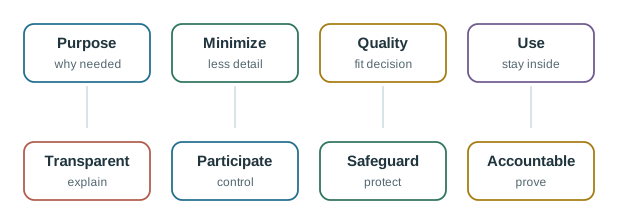
Read Figure 5.1 by first asking why the data is needed and how little will serve that purpose. Then check quality, use boundaries, transparency, participation, and safeguards. Finish with accountability and fairness, which require the team to show that the earlier choices work and do not create unjustified harm. The beginner examples now apply that same route to familiar connected products.
5.2.5 Beginner Examples
Work from the simplest case toward the broader design consequence. First, a scale that records weight to show a trend has a clear purpose; recording the household’s voices alongside it would breach purpose limitation. Next, an app that lets a person export and delete their history is honoring participation, not just describing it. Finally, reciting the principles in a slide while the product still over-collects is not honoring them; nothing changed.
5.2.6 Overview Knowledge Check
If you can explain why principles sit above any single law and why ethics adds a further question, you have the core idea. Continue to Practitioner to turn principles into feature decisions.
5.3 Practitioner: Principles to Choices
This section: Practitioner: Principles to Choices — Principles become useful when each one is run as a question against a specific feature, and the answer is written down.
Principles become useful when each one is run as a question against a specific feature, and the answer is written down. The aim is a deliberate decision about data, recorded so it can be reviewed, rather than a default that no one chose.
5.3.1 The Principles as Working Questions
5.3.2 Misuse and Secondary-Use Review
The strongest practitioner habit is to ask not only what you intend to do with the data, but what the data could be used for. A continuous location history collected to improve a route feature could also reveal a home address, a workplace, a place of worship, or a health clinic. The misuse review asks whether each such secondary use would be acceptable to the person, and designs to prevent the unacceptable ones, often by minimizing or abstracting the data so the harmful use is simply not possible.
This is not a hypothetical risk. Internet-connected CPAP breathing machines, prescribed for the sleep interruptions of sleep apnoea, have been reported to track how often and how effectively they are used and to share that information with the providing company and, where the machine was supplied as part of a health plan, with the person’s insurer. Users in the reported case only learned of the sharing when they received the kind of encouragement email usually associated with activity trackers, and said the way the data was collected and shared had not been clearly communicated to them. The underlying collection, usage logging for a breathing-support device, was easy to justify; the secondary use, routine sharing with an insurer, was the part that needed its own decision and its own disclosure.
5.3.3 Worked Reasoning: Three Features
5.3.4 Activity trends
Purpose: weekly trend. Decision: summarize on the device, keep no raw stream, and offer export and delete. Minimization and participation honored together.
5.3.5 Route assistant
Purpose: better routes. Misuse review: precise history reveals sensitive places. Decision: coarsen location and shorten retention to reduce that risk; avoid storing precise history if it is not needed.
5.3.6 Usage analytics
Purpose: product insight. Decision: aggregate and de-identify, disclose it plainly, and record the purpose so accountability is real, not assumed.
5.3.7 Practitioner Knowledge Check
If you can run the principles as questions and add a misuse review, you can stop here. Continue to Under the Hood for where the principles come from, how they tension, and where they fail.
5.4 Under the Hood: Roots and Tensions
This section: Under the Hood: Roots and Tensions — The deeper layer explains where the principles came from, why ethics extends past compliance, and why principles sometimes pull against each other.
The deeper layer explains where the principles came from, why ethics extends past compliance, and why principles sometimes pull against each other. Knowing the tensions is what separates thoughtful design from box-ticking.
5.4.1 Where the Principles Come From
The modern privacy principles trace back to the Fair Information Practice Principles, refined internationally in the OECD privacy guidelines, and they reappear, with local wording, in contemporary data protection law. In European data protection law, for example, the same ideas appear as principles such as lawfulness, fairness and transparency, purpose limitation, data minimisation, accuracy, storage limitation, integrity and confidentiality, and accountability. Because the principles are shared, a design that honors them tends to satisfy many regimes at once, which is why principle-led design travels better than law-by-law patching.
A parallel effort aimed specifically at autonomous and intelligent systems is IEEE’s Ethically Aligned Design initiative, which sets out eight general principles for autonomous and intelligent systems: human rights, well-being, data agency, effectiveness, transparency, accountability, awareness of misuse, and competence. For IoT products that increasingly turn sensed data into an automated decision, these principles echo the demands above from a different angle: keep the system’s operation traceable, weigh well-being alongside commercial metrics, and make sure someone is accountable when a decision causes harm.
5.4.2 Ethics Beyond Compliance
Compliance asks whether a use is permitted; ethics asks whether it is right. The two usually agree, but not always. A use can be lawful and still be manipulative, exclusionary, or simply not something a reasonable person would expect from the product they bought. The fairness principle is the bridge: it tells designers to weigh the effect on the people sensed, not only the letter of the rule. In IoT this is sharp, because the people affected often did not choose the device, such as a guest in a monitored home or a passer-by near a sensor.
Facebook’s 2006 launch of its News Feed is a well-known illustration of the gap between technical privacy and felt privacy. Nothing changed about who could see a given piece of information: friends had always been able to see each other’s posts, relationship changes, and group activity by visiting a profile page. What changed was that News Feed aggregated all of it and surfaced it on the first page after login, and thousands of users protested even though no new access had been granted. As the researcher danah boyd observed of the episode, the tendency in technology is to treat “private” as a single bit that is either on or off, but for the people affected, making existing data easier to notice was itself a privacy harm, independent of whether it was technically accessible before. A design can be lawful and leave every access control unchanged, and still betray a reasonable expectation simply by changing how easily the same information is surfaced.
5.4.3 Ethical Design and Build Lifecycle
Ethics has to follow the product from problem framing to retirement. A review performed only after the enclosure, model, data path, and suppliers are fixed can document harm but has little leverage to remove it.
| Lifecycle gate | Questions to ask | Evidence that can change approval |
|---|---|---|
| Frame the problem | Who benefits, who is sensed, and who bears error or surveillance without choosing the product? | stakeholder map, non-device alternative, distribution of benefits and harms |
| Co-design | Are affected users diverse in ability, age, language, income, culture, role, and technical power? | paid participation, accessible prototypes, dissent log, changes made from feedback |
| Define autonomy | Which decisions may the system make, with what evidence and consequence? | operating envelope, uncertainty threshold, prohibited actions, human authority, appeal path |
| Source and build | Which materials, suppliers, and labour conditions make the device possible? | bill of materials, origin/due-diligence records, supplier corrective actions, worker health/safety and pay evidence |
| Validate and release | Does performance remain fair and safe outside the convenient test population? | subgroup and edge-case results, hazard tests, privacy misuse tests, rollback and incident owners |
| Operate and retire | Can people repair, update, contest, return, reuse, and recycle the product? | support period, spares and repair route, take-back path, data deletion, material recovery evidence |
Participatory design is a decision process, not a usability session. Invite people while the problem and alternatives are still negotiable. Include those who will be indirectly sensed—visitors, neighbours, workers, children, support staff—not only the purchaser. Make participation accessible and compensate it. Record minority objections and product changes; a diverse room that cannot change the design is consultation theatre.
Autonomous decisions need an explicit envelope. For each decision, write the sensed inputs, confidence or validity conditions, maximum consequence, reversibility, and escalation path. A simple policy form is
The threshold does not make the decision ethical by itself. The team must justify whose errors set it, test disparate effects, preserve a safe state, and make consequential decisions reviewable and contestable. Some decisions—such as denying essential access or taking an irreversible safety action—may remain outside machine authority regardless of confidence.
Build ethics widens “cost” beyond the purchase order. A cheaper part can depend on unsafe extraction, conflict-affected sourcing, excessive hours, inadequate worker protection, or a short unsupported life that multiplies waste. Procurement should trace high-risk minerals and manufacturing stages, investigate rather than assume supplier claims, define corrective action, and retain a route to disengage responsibly when severe harm cannot be prevented or mitigated. Product design then reduces demand through fewer material types, modular repair, replaceable wear components, firmware support, standard fasteners, separable batteries, and documented recycling.
Compare alternatives over delivered service rather than unit price alone:
where the numerator includes environmental and human impacts that the decision record can meaningfully quantify or classify, and is supported service life. The equation is not a licence to turn dignity or safety into a convenient monetary offset. Keep non-negotiable labour, human-rights, accessibility, and safety constraints as hard gates; use lifecycle cost only among options that pass them.
The output is one ethical lifecycle record: affected people and unresolved dissent, autonomous authority, data and material provenance, worker and supplier evidence, production/operation impacts, supported lifetime, repair plan, recyclability, retirement responsibility, and the owner/date for re-review. Ethics becomes real when that record changes a requirement, supplier, enclosure, algorithm, or release decision.
5.4.4 Principles in Tension
5.4.5 Accountability Means Evidence
Accountability is the principle that turns the others from intentions into something checkable. It asks an organization to be able to demonstrate that it meets its obligations, with records of the purpose for each collection, the decisions made, and the controls in place. Without that evidence, the other principles rest on trust alone, and trust cannot be audited or relied upon after the people who made the decisions have moved on.
5.4.6 Common Pitfalls
- Principle as slogan. Naming the principles while the product still over-collects and over-retains.
- Consent theater. Treating a buried agreement as if it honored transparency and participation.
- Purpose creep. Reusing data for a new purpose without re-deciding whether that purpose is acceptable.
- Fairness ignored. Checking what is permitted while skipping whether the use harms or excludes anyone.
- No evidence. Claiming accountability with nothing recorded to demonstrate it.
5.4.7 Under-the-Hood Knowledge Check
At this depth, privacy principles are a shared, durable standard that designs should meet and ethics should exceed. Bind data to a purpose, minimize it, be honest, give people a real say, stay accountable with evidence, and weigh fairness for everyone affected, including those who never chose the device. A trustworthy review asks not whether the principles are named, but where each one changed the design and what record proves it.
5.5 Autonomous-System Ethics Exercise
This section: Autonomous-System Ethics Exercise — A Moral Machine-style dilemma can expose values hidden inside an autonomous IoT decision, but a preference poll is not a safety requirement.
A Moral Machine-style dilemma can expose values hidden inside an autonomous IoT decision, but a preference poll is not a safety requirement. The exercise below creates a review record before anyone votes on an outcome. Use a real operational boundary—such as a delivery robot choosing between stopping in a doorway, entering an uncertain roadway, or requesting remote assistance—and keep “the system cannot safely tell” as a valid state.
Now have groups argue the strongest case for each affected person, including someone who did not buy or operate the system. Record disagreement rather than averaging it away. A defensible approval then traces law and standards, hazards and severity, accessibility and distributional effects, privacy, system limits, human authority, fallback behavior, audit evidence, and a route to challenge the decision. Majority preference may be an input to deliberation; it cannot override a legal duty or turn an untested behavior into a safe one.
5.6 Summary
This section: Summary — Use privacy rules to test a planned use of data.
Use privacy rules to test a planned use of data. First, privacy principles are durable, source-independent statements of how personal data should be handled; they were distilled into the Fair Information Practice Principles and the OECD privacy guidelines and reappear in modern data protection law. Next, ethics extends past compliance: the principles ask whether a use is responsible, while ethics and the fairness principle ask whether it is right, even when it is permitted. Then, the core principles are purpose limitation, data minimization, transparency, participation, accountability, and fairness, each best used as a working question against a specific feature. Then, a misuse and secondary-use review asks not only what you intend to do with data but what it could be used for, and designs to make the harmful uses impossible. Then, principles can pull against each other, such as transparency versus security or minimization versus accuracy, and good design resolves the tension deliberately rather than ignoring one side. Finally, accountability turns the principles from intentions into something checkable by requiring records of purpose, decisions, and controls; without evidence, the rest rests on trust alone.
Privacy principles are the shared rules behind the rules, and ethics is the courtesy that goes beyond them. Bind data to a clear purpose, collect the least you need, be honest, give people a real say, weigh fairness for everyone affected, and keep records that demonstrate it. The test of a principle is not whether it is named, but where it changed the design and what evidence proves it.
5.7 See Also
This section: See Also
5.7.1 Privacy by Design
See how these principles become design-time defaults and embedded controls.
5.7.2 Privacy Regulation Mapping
See how the principles are encoded, with local wording, into real data protection law.
5.7.3 Privacy Techniques for IoT
Learn the techniques that turn minimization and abstraction into working mechanisms.
Find help
3 reviewed answers.
Where should I start in a module?
Open the module page from the sidebar to see its chapters in order. Use the module map to return to a topic you need.
Modules and pathsReviewed
What can I try when a project does not work?
Check the symptom, then work through the diagnostic steps. Keep the error message and the smallest example that reproduces it.
When you are stuckReviewed
How do interactive examples work?
Use the interactive guide to check how examples and simulations work before changing your project.
Interactive examples guideReviewed