10 Runtime Privacy Enforcement
More
Depth: Practitioner
Progress saves as you read. Mark sections complete as you go; your progress appears in the sidebar.
Start With the Switch That Must Change the Device
A gateway is the device or service that carries local data toward another network. Imagine setting up a voice assistant, an activity wearable, and a shared-space occupancy sensor. Each one can show a privacy switch, but the learner's real question is simpler: what changes in the device, gateway, cloud service, or support console when that switch moves? If nothing changes in the data path, the product has a privacy message rather than a privacy control.
Privacy by Design is the idea that privacy is built into a system from the start, not bolted on after a complaint. Implementation is where that idea stops being a principle list and becomes system behavior. The single most useful test of whether it is real is whether the setting changes what the system actually does in the path where data is collected, sent, stored, viewed, exported, or kept.
Two ideas anchor the chapter. Privacy by default means the protective state is the starting state: optional collection, external sharing, and long retention are off until someone chooses otherwise. Evidence means you can show where each control is enforced and prove, with a test, that it still works. Regulators frame this duty as data protection by design and by default; in the EU it appears in the General Data Protection Regulation as Article 25.
If you only need the intuition, this layer is enough: trace a feature from purpose to data path to control to evidence. Default to the protective state, enforce the setting in the runtime path rather than only in the interface, and keep a test that fails if a later change quietly turns collection or sharing back on.
Inspect Figure 10.1 to verify that a disabled analytics setting changes the running data path at a device-side gate and remains protected by regression evidence.
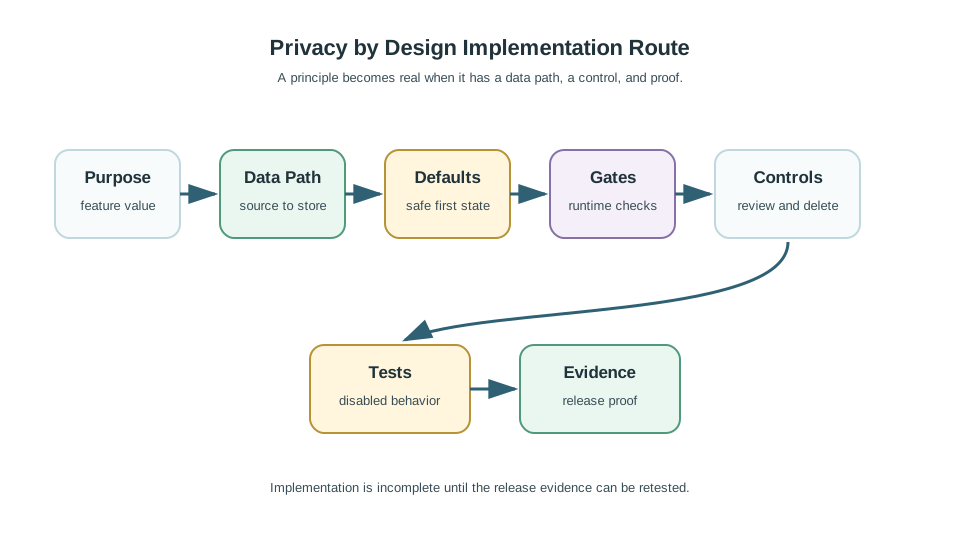
Read Figure 10.1 from the stated purpose and off-by-default setting into the device-side gate. The blocked path shows that optional analytics must stop before the gateway, cloud, or support console receives it. Continue through implementation evidence to the regression loop, where any later change that restarts collection makes the test fail. This order turns a user-facing switch into an enforceable runtime contract: the setting controls behaviour, the trace proves the blocked route, and the retained test protects the promise across future releases.
Start Simple: Trace One Feature
Begin with one feature, one data path, and one promise. For example: "with analytics off, no optional analytics event leaves the device." That sentence tells you where to place the gate, what the default should be, and what evidence has to fail if a later release breaks the promise.
Settings must change behavior
A toggle that updates the screen but not the data path is a failed control. Enforce it where data actually flows.
Default to protective
Optional collection, external sharing, and long retention start off. The user opts in, not out.
Prove it with evidence
If you cannot show where a control is enforced and how it was retested, the implementation is not finished.
Beginner Examples
Work from the simplest case toward the broader design consequence. First, an app's "turn off analytics" switch must stop the device from sending analytics, not just hide the chart. Next, A new device should ship with command history and product-improvement sampling off, so the safe state is the one users get by default. Finally, "We added a privacy setting" is not evidence. The evidence is a test that confirms the setting actually stops the data.
To work the analytics example, leave the setting off, trigger the same event, and inspect the outgoing path. The test passes only if no optional analytics event leaves the device; hiding its chart does not meet the promise.
Check the Runtime Gate
If you can explain why a setting must change behavior and why default-protective matters, you have the core idea. Continue to Practitioner for the workflow that builds these controls feature by feature.
Put the Privacy Gate in the Data Path
Once the promise is clear, build the control where the data actually moves. A device alert, cloud backup, app dashboard, export, or support tool all use the same workflow: intake the purpose and the people affected; inventory the data path (raw fields, derived labels, stores, logs, destinations, support views, retention); set protective defaults; place runtime gates; expose controls; and retest with evidence.
Where to Place Runtime Gates
A gate is a check that blocks an action unless the current setting and purpose allow it, and it logs the decision. Put gates at the four points where data changes hands.
Written settings matter only where they can stop runtime behavior. Use Figure 10.2 to follow one feature request through the decisions that must occur before data is collected, moved, accessed, or retained.
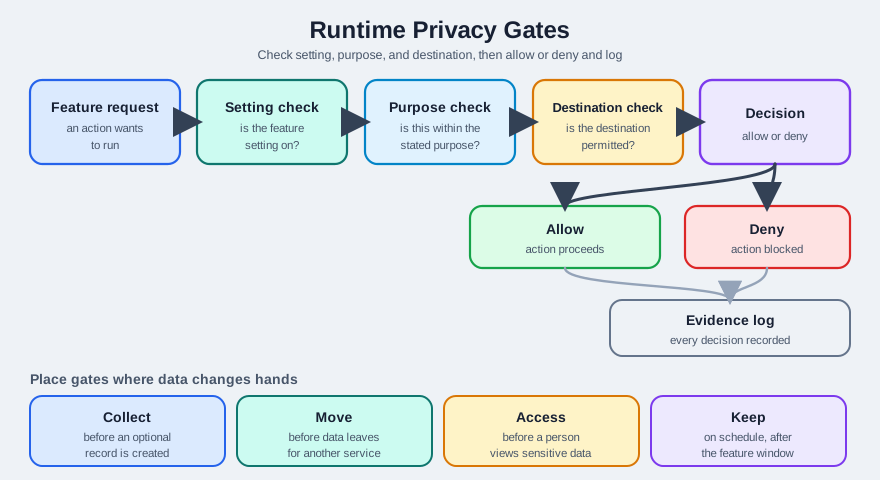
Read Figure 10.2 from the request through current setting, allowed purpose, and permitted destination. A failed check must deny the action; either result should leave a decision record. Then place the same logic at collection, movement, access, and retention boundaries, because blocking only a user-interface path leaves background and support paths untouched. The ledger below assigns those gates to concrete enforcement points and evidence.
-

Priya records the purpose and the people affected.
-

She traces every store, log, and destination.
-

Protective defaults stop optional data at first.
-

The live gate checks setting, purpose, and destination.
-

The gate allows or denies and logs the choice.
-

Priya retests the real path, including background routes.
Minimize Early, Default Protective
The strongest gate is the data you never create. A minimization pipeline derives the needed output as early as practical and drops the raw input: do not create optional records, lower detail before data leaves the device area, derive a score or state locally, separate identity from events, drop raw input once the derived output is checked, and retest so a future change does not start sending raw fields again. Pair this with a default matrix: optional data off at setup, local processing first, retention short by default, and external sharing off until a feature reason is recorded.
Worked Reasoning: Three Features, One Pattern
Voice command device
Responding to commands needs intent and device state, not stored history. Default history off, gate the storage path to check the setting before writing, and retest that no command record appears with history off.
Activity wearable
Trends need summaries, not continuous raw motion. Derive steps and activity minutes on device, drop raw samples after the summary is checked, and inspect the sync payload to confirm it carries summaries only.
Shared-space occupancy
Comfort automation needs room load, not named badges. Convert events to zone-level states at the gateway, keep badge access data in a separate system, and confirm no identity field reaches the comfort store or logs.
Control Surfaces and Release Evidence
User and operator controls must connect to the gates, not just display text. Offer review (what is collected, derived, sent, stored, kept), pause (stop optional collection and destinations, not just notifications), delete (remove records from the stores named in the evidence), export (user-relevant records, with operational exclusions explained), and change setting (applied to future collection immediately), each ending in a clear success, failure, or pending result. Then capture the minimum release evidence: a default-state test, a disabled-state test, a destination test, a retention test, a deletion test, and an access test.
Check the Data Path Default
If you can run the workflow and place gates where data changes hands, you can stop here. Continue to Under the Hood for enforcement detail, pseudonymization boundaries, and how evidence drifts.
Keep the Boundary Enforced After Launch
The deeper layer explains what makes each artifact genuinely protective rather than nominal. The recurring failure is a control that looks present but is not enforced, separated, or tested, especially after new jobs, exports, destinations, or support tools are added.
What Makes a Gate Real
An enforced gate sits in the execution path, reads the live setting and purpose at the moment of the action, and has a default-deny branch with a logged decision. The contrast is a gate that is evaluated only in the interface, or evaluated once at startup and cached while the user later changes the setting. Two consequences follow. First, the check must run on every path that can perform the action, including background jobs, retries, exports, and support tools, because a single unguarded path defeats the control. Second, the denial should be observable: a logged "blocked send to destination X because setting off" is what lets a test prove the gate works.
Pseudonymization as a Boundary, Not a Label
Pseudonymization replaces direct identity with a token so normal workflows do not handle identifying fields, but it is only a boundary if the information that reconnects identity is genuinely separated and rarely used. That means the identity store sits apart from the event store, pseudonyms are scoped per purpose so records cannot be trivially joined across contexts, and rejoin is allowed only for defined workflows with approval and logging. If the token-to-identity mapping lives in the same database that every product service can read, the separation is cosmetic: any service can rejoin identity at will. Remember that pseudonymous data is still personal data, so the boundary reduces exposure rather than removing obligations.
Pseudonymization reduces routine identity exposure only when the rejoin capability is structurally separate. Inspect Figure 10.3 to locate that boundary and its exceptional path.
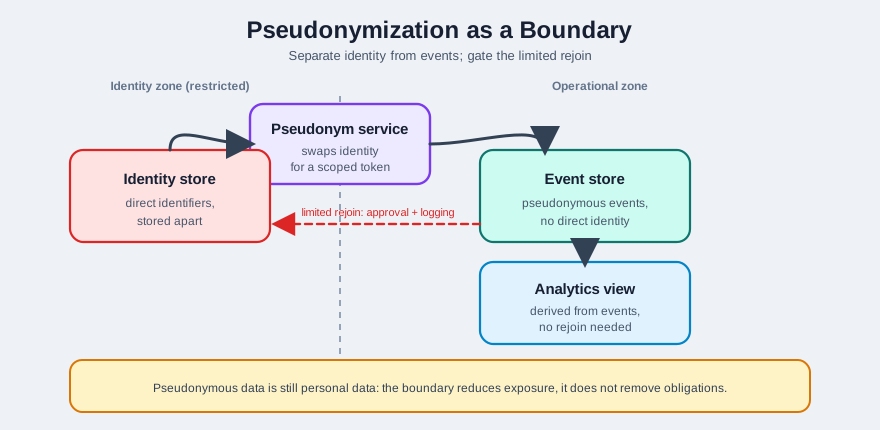
Read Figure 10.3 from the identity zone through the pseudonym service into events and analytics. Normal operations receive a purpose-scoped token, not direct identity; the reverse path is narrow, approved, and logged. Because the mapping still exists, the operational data remains personal data and needs safeguards. The tests below must therefore prove both routine separation and denial of unauthorized rejoin attempts.
Tests That Can Actually Fail
Release evidence is only meaningful if each test can fail when a future change breaks the behavior. Six tests cover the common drift paths: the default-state test (optional collection and sharing are off before any user action), the disabled-state test (turning a setting off stops collection, movement, storage, and export where promised), the destination test (records do not appear at unexpected endpoints, logs, dashboards, or support views), the retention test (records leave stores after the feature window), the deletion test (a request removes the records listed in the evidence), and the access test (roles and case reasons are enforced in the runtime path). Testing only the happy path is the classic gap, because privacy defects hide in disabled states, denied destinations, and expiry.
Privacy Drift
Evidence ages. A new sensor, an added destination, a changed retention rule, an expanded support workflow, or a new integration can quietly reintroduce collection, sharing, retention, or access that the original review excluded. Treat these events as explicit retest triggers, recorded next to the owner and date, so the evidence stays current instead of describing a system that no longer exists.
Mechanisms and Failure Modes
Common Pitfalls
Review these failure modes in order. First, Settings without gates. A settings page is not enforcement; put the check in the runtime path on every route. Next, Storing raw data for future ideas. Build the current feature with the smallest data path; review future features on their own. Then, Testing only the happy path. Cover disabled states, denied destinations, deletion, retention expiry, export content, and support access. Then, A nominal pseudonymization boundary. If the rejoin key is broadly readable, identity is one query away. Finally, Letting evidence drift. Retest when a sensor, destination, retention rule, support flow, or integration changes.
Check the Boundary Enforcement
At this depth, Privacy by Design implementation is a chain of enforced artifacts: gates that run on every path and fail closed, pipelines that drop raw data early, pseudonymization that truly separates identity, defaults that start protective, and tests that fail on drift. The start-simple punchline still holds: choose one promise, find the data path, put the gate where behavior changes, and keep a test that proves it still works.
10.1 Enforce a Door-Sensor Purpose at Runtime
This section: Enforce a Door-Sensor Purpose at Runtime — A gateway is the device or service that carries local data toward another network, while a payload is the set of fields carried in one message.
A gateway is the device or service that carries local data toward another network, while a payload is the set of fields carried in one message. In this privacy example, a door sensor in supported housing changes from CLOSED to OPEN at 02:14. The event can trigger a safety alert, but the same event stream can also reveal sleep, visitors, and daily routines. Runtime privacy enforcement must keep the safety purpose attached while data crosses the gateway, message service, staff view, and archive.
Read Figure 10.1 from the physical door event toward each recipient. At the first privacy route, minimise the payload to sensor identity, state, event time, and a purpose tag. At the privacy service route, policy decides whether the on-call team may receive an alert. Door-sensor enforcement at the storage route decides when the detailed event expires. Figure 10.1 presents the same privacy path as a sequence of enforceable choices rather than a policy page beside the system.
The gates in Figure 10.2 answer different questions. A collection gate asks whether this door field is needed. A use gate compares the requested action with the safety purpose. A disclosure gate checks the recipient and fields, while a retention gate removes detail when its allowed window ends. The pseudo-flow in Figure 10.3 makes those checks executable: missing purpose, disallowed recipient, or expired data should produce a denial, not a hopeful log entry.
Consider how runtime policy handles an OPEN event meant for a response team. The privacy gateway accepts door_state=OPEN and drops an unused battery-history array. The runtime policy service permits the on-call role to view the flat number for 30 minutes. It sends a coarser building-only alert to a maintenance queue and refuses an advertising export. After the response window, the detailed event is deleted while a non-identifying count remains for service planning. Each change follows the door purpose instead of copying the richest record everywhere.
Runtime enforcement also needs a failure position. If the purpose tag is missing, forwarding the event “just in case” silently defeats the privacy design. If the policy service is unavailable, a narrowly defined emergency rule may allow the on-call alert, but that hardware and service behaviour must be tested in the deployed system. The chapter cannot promise how a vendor gateway caches or retries a denied message without that test evidence.
10.1.1 Predict the Runtime Privacy Gate
For the door alert, compare two payloads. The first contains flat=12, state=OPEN, time=02:14, and purpose=safety-response. The second adds resident name, full battery history, and the last week of door events. Only the first payload fits the immediate alert. The extra fields create more privacy exposure without helping the on-call worker answer the door event.
Privacy enforcement should also expose a reason code when it blocks a field. A denial such as purpose-mismatch helps the service distinguish a policy result from a broken door sensor or network timeout.
Now test a purpose change. A maintenance engineer may need battery voltage and device fault code, but does not need the resident’s night-time door pattern. Runtime enforcement can form a maintenance payload from those device fields and omit the household event trail. This is not one global “allow” switch. It is a field and recipient decision for each purpose.
The user-facing control must reach the same runtime policy. If optional analytics is off, the device or earliest trusted service should block the analytics fields before they enter a shared log or retry queue. Removing them only from the final dashboard leaves copies elsewhere. A regression test should inspect the outgoing message and the stored record after a software update.
Emergency access also needs a narrow end. A break-glass rule can record who used it, why, which flat was opened, and when access will close. It should not turn into permanent support access after the event. The running privacy system must return to its normal role and retention limits.
- Predict: A support worker requests last night’s detailed door events during an active safety call. The role, purpose, and time window match. What should happen? Check: The runtime policy can permit the minimum detailed view needed for that call and record the decision.
- Predict: A product analyst requests the same flat-level door trail to improve engagement. Does the safety consent automatically cover that use? Check: No. The new purpose needs its own lawful basis, field limit, and user-facing choice.
- Predict: The retention job fails and detailed events remain after their deadline. Is a written 30-day rule enough? Check: No. Runtime privacy requires evidence that expiry actually removed or de-identified the stored events.
10.2 Summary
This section: Summary — Picture a shared-office app that shows which desks are free.
Build Privacy Into the First Sketch
Picture a shared-office app that shows which desks are free. The team needs a room count. It may not need a named trail of where each worker sat all day. Waiting until launch to ask this question makes needless copies hard to remove.
The product owner should start with the useful decision. List the smallest facts it needs, who may use them, and how long they remain useful. Give people a clear choice when the use is optional. Make the safe setting the normal one.
Follow every copy from collection to deletion. Test a support request, an account closure, a lost device, and a change of purpose. Record who can approve a new use and how the person will be told.
Less data does not remove every risk. Joined records can reveal a person again. Practitioner turns these choices into design checks. Under the Hood examines threat paths, legal duties, identity, and proof of deletion.
Check whether each privacy setting changes the running data path and its default state. First, privacy by Design implementation turns principles into system behavior; regulators frame the duty as data protection by design and by default (in the EU, GDPR Article 25). Next, a privacy setting is a real control only when it changes the runtime data path, not just the interface. Then, default to the protective state: optional collection, external sharing, and long retention start off, so users opt in rather than out. Then, run a per-feature workflow: intake purpose, inventory the data path, set defaults, place gates, expose controls, and retest. Then, place runtime gates at collect, move, access, and keep; each should fail closed and log its decision on every path, including background jobs and exports. Then, minimize early with a pipeline that derives the needed output and drops raw input, so summaries flow instead of raw streams. Then, pseudonymization is a boundary only when the identity store is separated, tokens are scoped per purpose, and rejoin is gated and logged; pseudonymous data is still personal data. Finally, release evidence must include tests that fail on drift (default-state, disabled-state, destination, retention, deletion, access), kept current through explicit retest triggers.
Implementation is finished only when you can point to where each privacy control is enforced and show a test that fails if a change breaks it. Start with one feature promise, build settings that change behavior, default to protective, minimize before you store, make pseudonymization a true boundary, and keep evidence alive with retest triggers. “We added a privacy setting” is a claim; an enforced gate with a failing test is proof.
10.3 See Also
This section: See Also
Privacy by Design Foundations
Review the principles and the privacy-by-default stance behind these implementation choices.
Privacy by Design Assessment
Find weak evidence and anti-patterns before and after implementation.
Privacy by Design Patterns
Reuse minimization, separation, and control-surface patterns across features.
Privacy-Preserving Techniques
Go deeper on the minimization, pseudonymization, and local-processing techniques these gates enforce.
Find help
3 reviewed answers.
Where should I start in a module?
Open the module page from the sidebar to see its chapters in order. Use the module map to return to a topic you need.
Modules and pathsReviewed
What can I try when a project does not work?
Check the symptom, then work through the diagnostic steps. Keep the error message and the smallest example that reproduces it.
When you are stuckReviewed
How do interactive examples work?
Use the interactive guide to check how examples and simulations work before changing your project.
Interactive examples guideReviewed