8 Privacy Patterns and Data Tiers
More
Depth: Practitioner
Progress saves as you read. Mark sections complete as you go; your progress appears in the sidebar.
A meeting-room sensor counts entries locally and sends an hourly total. The service does not need a face image or a person’s name to adjust ventilation. A privacy pattern should therefore change what leaves the room, not merely rename the raw records.
Start With the Data You Really Need
Imagine a smart building team trying to measure whether rooms are busy. One path records every person, every movement, and every timestamp because the sensors can. The safer path asks the smaller question first: does the system only need an hourly count, a room state, or a trend? That first question decides whether the design creates a privacy problem or avoids one.
Two ideas make privacy work repeatable instead of ad hoc. The first is the privacy pattern: a small set of reusable moves, such as collecting less, summarizing, processing on the device, and separating identity, that solve the same privacy problems again and again. The second is the data tier: a way to sort the information a system handles by how sensitive it is, so the strength of a safeguard matches the risk of the data.
For IoT, patterns and tiers fit together naturally. A single product may handle operational telemetry, behavioral patterns, and directly identifying details all at once. Patterns give you the moves; tiers tell you how hard to apply them. The catalogue of privacy design strategies described in the academic literature, often associated with Jaap-Henk Hoepman, organizes these moves into data-oriented strategies (minimize, separate, abstract or aggregate, hide) and process-oriented strategies (inform, control, enforce, demonstrate).
These strategies sit at one rung of a larger ladder that runs from the very abstract to the very concrete. Privacy principles sit at the top, naming a value without prescribing a mechanism. Design strategies come next, naming a specific goal, such as minimize or hide, still without dictating an implementation. Guidelines break each strategy into lower-level, concrete instructions an engineer can actually follow; one published guideline set breaks the eight strategies into roughly thirty such instructions, for example reduce data acquisition and shorten the retention period under minimize, encrypt data in storage and in transit under hide, and apply geography- or time-period-based summaries under aggregate. Patterns, the subject of this chapter, are reusable and closer to implementation still, and tactics are the smallest building blocks a pattern is assembled from. Each rung solves the one above it in a more concrete way, and each new tactic can fix one weakness while introducing another, which is why review keeps checking conditions rather than trusting a label from any single rung.
If you only need the intuition, this layer is enough: not all data is equally sensitive, and a few repeatable patterns cover most cases. Sort the data by sensitivity, then apply minimization, aggregation, local processing, and separation in proportion to the tier.
Pattern choice should be visible in the data path, not only in design vocabulary. Use Figure 8.1 to compare what remains local with the smaller representation allowed to cross into cloud analytics.
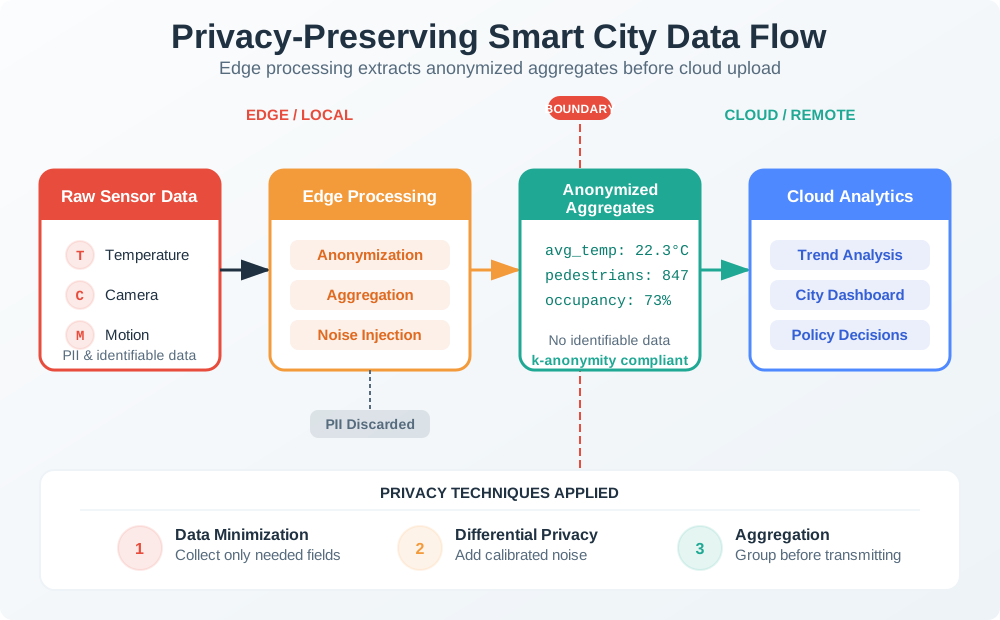
In Figure 8.1, start with raw sensing inside the edge boundary, then follow local filtering, aggregation, and identity reduction. In this example, the edge discards user_id and combines four people into a 15-minute occupancy bucket; only room, occupancy, and the grouped timestamp cross to the cloud. The point is not that edge processing automatically guarantees privacy; it is that the selected patterns change what data exists at each boundary.
An analogy: a building does not protect every room with the same lock. A storage closet, an office, and a vault get protection sized to what is inside. Treating every piece of data identically either over-protects the harmless or under-protects the sensitive. Tiers let you spend protection where it counts.
Three Moves That Repeat
Minimize
Collect and keep the least data the feature needs. The cheapest data to protect is the data you never hold.
Aggregate and localize
Report group summaries instead of individual records, and process on the device when you can, so raw detail never leaves.
Separate, then tier
Keep identity apart from behavior, and size every safeguard to the data's sensitivity tier.
What This Looks Like
- A people counter that reports "twelve visitors this hour" uses aggregation; storing a record per person would not.
- A doorbell that decides "motion or no motion" on the device uses local processing, so raw frames need never be uploaded.
- A maintenance log of error codes is a low tier; a record linking a named user to their daily routine is a high tier and needs stronger protection.
Check the Aggregation Pattern
If you can ask for the smallest useful data and see why sensitivity differs, you have the core idea. Continue to the next layer to assign tiers and choose patterns deliberately.
Match Protection to Sensitivity
Now turn the idea into a product decision. Take each data item the feature wants, name its sensitivity, then choose the pattern that gets the job done with the least exposure. A room count, a wearable trend, and a driver route should not all travel through the same privacy pipeline.
The workflow is two linked decisions. First, classify each piece of data into a sensitivity tier. Second, choose patterns that reduce exposure, and size the remaining safeguards to the tier. Doing them in this order stops you from over-engineering low-risk telemetry and from under-protecting behavioral or identifying data.
A Simple Tier Scheme
Pattern Selection
Worked Reasoning: Match Pattern to Tier
Energy dashboard
Goal: show neighborhood usage trends. Tier: aggregate to a tier low enough that no household is singled out. Pattern: aggregation plus minimization.
Wearable heart data
Goal: weekly trends. Tier: sensitive (health). Pattern: local processing and short retention, sync summaries, strong access control on any stored detail.
Fleet telematics
Goal: route efficiency. Tier: personal (driver location). Pattern: separate identity from trips, pseudonymize, and keep the rejoin key apart and gated.
Check the Tier Choice
If you can assign a tier and pick patterns that fit it, you can stop here. Continue to the deeper layer for why aggregation and pseudonymization can fail, and how tiers drift.
Check Whether the Pattern Actually Holds
The hard part is not naming a privacy pattern; it is proving the pattern still works after filters, logs, backups, joins, and analytics are added. A design can say "aggregated" or "pseudonymous" while still leaving one person easy to single out.
The deeper layer is about the gap between a pattern's name and its effect. Aggregation, pseudonymization, and tiering all reduce risk only under conditions that are easy to miss. The recurring failure is a pattern applied in name while the underlying data is still re-identifiable or mis-tiered.
Three Ways Re-Identification Happens
Privacy researchers commonly describe three re-identification risks that survive naive de-identification. Singling out is isolating one person's records even without a name, often because a rare combination of attributes is unique. Linkability is connecting records about the same person across data sets. Inference is deducing a sensitive attribute from other values. A pattern that removes the name but leaves a unique attribute combination has stopped none of these.
Aggregation Needs Large Enough Groups
Aggregation protects only when each reported group is large enough that no individual stands out. An hourly count can still expose a person when the group is small; a count of "visitors to this aisle, in this five-minute window, over the age of seventy" can describe one person. The intuition behind k-anonymity captures this: a record should be indistinguishable from at least several others on its quasi-identifiers. Small cells, rare categories, and overlapping reports can each re-expose an individual that the aggregate was meant to hide.
Pseudonymization Is Not Anonymization
Pseudonymization replaces direct identifiers with tokens, but a reconnect key still exists, so the data remains personal data. It is a boundary only when the identity store is genuinely separated, tokens are scoped per purpose so records cannot be trivially joined across contexts, and rejoin is gated and logged. If the token-to-identity mapping lives where every service can read it, the separation is cosmetic. Quasi-identifiers complicate this further: even without the key, distinctive patterns of location, timing, or behavior can re-link a pseudonymous record to a person.
Tiers Drift, and Derived Data Can Outrank Its Inputs
A tier assignment is not permanent. Combining low-tier feeds can produce a higher-tier result: harmless-looking motion and timing data can reveal sleep patterns or absences. Inference means the output of processing can be more sensitive than any single input, so the derived data deserves its own tier rather than inheriting the lowest one. New sensors, new joins, and new analytics are all triggers to re-tier, because the sensitivity of what the system can now produce has changed.
Mechanisms and Failure Modes
Common Pitfalls
Review these failure modes in order. First, Naming a pattern without meeting its conditions. Aggregation with tiny groups, or pseudonymization with a readable key, protects little. Next, Treating pseudonymous as anonymous. A reconnect key means the data is still personal data. Then, Ignoring quasi-identifiers. Distinctive location, timing, or behavior can re-identify without a name. Then, Static tiers. New joins and analytics can raise sensitivity; re-tier when the system can produce more. Finally, Under-tiering derived data. The output of inference can outrank every input.
Check the Re-Identification Risk
At this depth, privacy patterns are conditional guarantees, not labels. Aggregation needs large groups, pseudonymization needs a truly separated key, local processing needs the raw data to actually stay local, and tiers need to move when the system can produce more sensitive results. A trustworthy review asks not which pattern was named, but whether its conditions are met and whether the tier still fits.
8.1 Lifecycle Sustainability and Material Provenance Pattern
This section: Lifecycle Sustainability and Material Provenance Pattern — Privacy by design asks what information a product creates; responsible hardware design asks what material and labour trail the product requires.
Privacy by design asks what information a product creates; responsible hardware design asks what material and labour trail the product requires. Both use the same discipline: minimize what is not needed, separate risks that need different controls, retain provenance, and plan the end state before deployment.
The hands-only disassembly scene in Figure 8.2 illustrates the end-of-life work that a recoverable product must enable: housings, batteries, boards, and reusable parts have to be separated without turning data-bearing devices or hazardous materials into an uncontrolled waste stream.

Photo: Victor Grigas, CC BY-SA 3.0
In Figure 8.2, recoverability depends on access to separable assemblies and an identifiable downstream process. The photograph does not certify the facility by itself; the lifecycle record below still needs take-back, data-erasure, worker-safety, and recovery-route evidence.
A smartphone is a useful warning because a small object can depend on a large slice of the periodic table. The European Chemical Society’s scarcity-awareness table identifies about 30 elements commonly used in smartphones and notes that more than half may give cause for concern as scarcity increases. That is an educational screening statement, not a bill of materials for every phone and not a claim that all 30 have the same risk. Supply criticality changes with technology, geography, demand, recycling, and policy; conflict linkage, toxicity, and geological scarcity are separate axes.
Use a material-provenance record rather than a single “green” label:
| Record field | Question it answers |
|---|---|
| Part and material declaration | Which substances and approximate masses are in the released configuration? |
| Functional necessity | Which requirement needs this material, and can design or substitution reduce it? |
| Supplier and transformation chain | Who supplied the part, and which smelter/refiner or processor evidence is available for high-risk minerals? |
| Origin and risk context | Is extraction or processing linked to conflict-affected/high-risk areas, forced labour, unsafe work, corruption, or severe environmental harm? |
| Supply risk | Is supply concentrated, import-dependent, rapidly growing in demand, or difficult to substitute? |
| Circularity | What recycled content is credible, how can the part be separated, and which recovery route exists at end of life? |
| Lifecycle | How long will hardware, security updates, consumables, batteries, spares, and repair instructions be supported? |
The responsible-sourcing loop follows the OECD five-step structure used for mineral supply-chain due diligence: establish management systems; identify and assess risk; design and implement a response; support appropriate independent audit; and report. Electronics teams should map high-risk supply chains toward smelters/refiners rather than treating a first-tier supplier declaration as proof. In the EU, the Conflict Minerals Regulation specifically addresses tin, tantalum, tungsten, and gold (3TG); that legal scope is not the boundary of ethical review, because other materials and labour stages can carry serious risks too.
Apply the pattern step by step:
- Inventory before optimizing. Bind the product BOM, firmware-supported configuration, material declarations, supplier, and provenance evidence to one versioned release record.
- Separate the risk axes. Score supply disruption, conflict/human-rights risk, worker health/safety, toxicity, carbon/water burden, and recoverability independently. A scarce element is not automatically toxic; a plentiful material is not automatically responsibly sourced.
- Avoid and reduce. Remove decorative or redundant material, reduce part diversity, and substitute only after checking whether the substitute moves harm elsewhere or reduces reliability.
- Extend service life. Make wear components and batteries replaceable where safe, keep spares and security updates available, expose diagnostics, use reversible assembly, and avoid software locks that turn repairable hardware into waste.
- Design recovery. Mark materials, make hazardous and valuable parts separable, define take-back and certified downstream routes, and erase device data before reuse or recycling.
- Re-evaluate. Trigger review on supplier/origin change, adverse-impact report, material criticality update, redesign, support-policy change, or failure of the planned recovery route.
Two calculations make short replacement cycles visible. If product mass is , supported life is , and recovered mass at end of life is , then
Doubling supported life approximately halves virgin material demand per service-year when repair and use impacts remain comparable. A high collection rate is not the same as high recovery yield: record what was actually reused or recovered, not merely what entered a take-back box.
This pattern ends where privacy lifecycle rules end: with accountable retirement. Remove account bindings and credentials, provide verifiable data deletion, decide whether a returned device is repaired, harvested, or recycled, and retain downstream evidence. Current repair policy increasingly reinforces this direction; for example, the EU repair-of-goods framework was adopted in 2024 and required Member States to apply its national rules from 31 July 2026 for covered products. The ethical requirement is broader: do not make a connected product disposable by design when a maintainable, supported, recoverable design can deliver the same service.
8.3 Summary
This section: Summary — Picture a city travel study that does not need names.
Picture a city travel study that does not need names. The team should not collect names just in case they become useful. It should keep only the least data needed for the stated job.
A privacy pattern is a repeatable way to reduce harm. A data tier groups records by how much harm their use or loss may cause. Start with the purpose. List the data the purpose truly needs. Keep work near the device when raw detail does not need to leave it. Join records into groups only when the group is large enough. Separate any reconnect key from the records it can unlock.
Ask these plain questions:
- Why is this data needed?
- Can one field be left out?
- Can raw detail stay local?
- Is the group large enough?
- Can two feeds identify a person?
- Who can use a reconnect key?
- Is that use logged?
- Can new analysis raise the tier?
- When must the tier be checked again?
Removing a name does not always make data anonymous. Joined facts can still point to one person. Practitioner applies patterns and tiers to a real flow. Under the Hood covers linkability, inference, group limits, and proof. Those details may raise the safeguards. They never make an unmet pattern condition disappear.
Classify the data first, then choose privacy patterns suited to its sensitivity. First, privacy work becomes repeatable through two ideas: reusable privacy patterns and data sensitivity tiers that size each safeguard to the risk. Next, the data-oriented patterns to reach for are minimization, aggregation, local processing, pseudonymization, and separation; the academic privacy design strategies (often associated with Hoepman) organize these moves. Then, classify data first (operational, pseudonymous, personal, sensitive), then choose patterns and size the remaining safeguards to the tier. Then, aggregation protects only when groups are large enough; small or overlapping cells can single out an individual. Then, pseudonymization is not anonymization: a reconnect key means the data stays personal, so the key must be separated, scoped, and its use gated and logged. Then, re-identification can happen through singling out, linkability, and inference, and quasi-identifiers can re-link records even without a name. Finally, tiers drift: combining low-tier feeds or running new analytics can produce higher-tier results, so derived data deserves its own tier and re-tier triggers.
Patterns and tiers turn privacy from improvisation into a method, but a pattern is a conditional guarantee, not a label. Sort data by sensitivity, apply minimization, aggregation, local processing, and separation in proportion, and remember that aggregation needs large groups, pseudonymization needs a separated key, and derived data can outrank its inputs. The review question is whether each pattern’s conditions are actually met.
8.4 See Also
This section: See Also
Privacy by Design Foundations
Review the principles and the privacy-by-default stance these patterns put into practice.
Privacy by Design Implementation
Enforce the chosen patterns with runtime gates, minimization pipelines, and release evidence.
Privacy-Preserving Techniques for IoT
Go deeper on minimization, pseudonymization, aggregation, and related techniques.
Privacy by Design Schemes
See how patterns combine into larger privacy schemes and architectures.
Find help
3 reviewed answers.
Where should I start in a module?
Open the module page from the sidebar to see its chapters in order. Use the module map to return to a topic you need.
Modules and pathsReviewed
What can I try when a project does not work?
Check the symptom, then work through the diagnostic steps. Keep the error message and the smallest example that reproduces it.
When you are stuckReviewed
How do interactive examples work?
Use the interactive guide to check how examples and simulations work before changing your project.
Interactive examples guideReviewed